
Sedgwick County weighs new voting machines in 2017
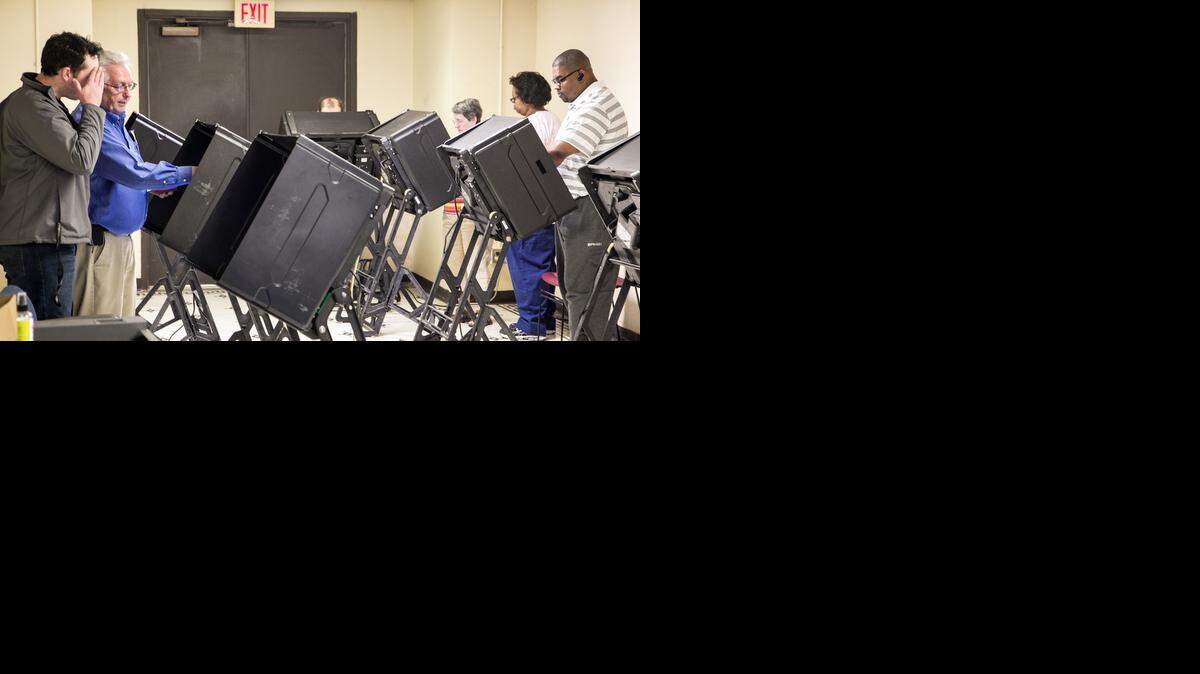
Voting machines in Sedgwick County and across the country are starting to wear out, prompting conversations about how they will be replaced.
The county’s 617 iVotronic touch-screen voting machines were purchased in 2006 for about $2.2 million. Some of the cost was covered by the Help America Vote Act, a law passed after the Bush-Gore election that funded new election equipment across America.
But in Kansas and elsewhere, the voting machines are aging.
The Presidential Commission on Election Administration warned of a voting-machine crisis in a report it issued nearly a year ago.
“This impending crisis arises from the widespread wearing out of voting machines purchased a decade ago,” it wrote. “Jurisdictions do not have the money to purchase new machines, and legal and market constraints prevent the development of machines they would want even if they had the funds.”
The county has budgeted more than $7 million for new machines in its capital improvement plan. But County Manager William Buchanan says the county needs to look at all its options for running elections efficiently.
Buchanan is not sold on the idea that the county must use electronic machines.
“We have paper ballots and have paper scanners that can go pretty fast also. I’ve urged staff to do an examination of the various (options). The Secretary of State’s Office allows paper ballots, optical scanning, hand-counted and electronic machines. Optical readers have worked in the past, and that whole process is way less expensive,” he said.
A county memo prepared by finance staff said 76 counties in Kansas use a system that depends on an optical scanner to read marked paper ballots and tally results. Sedgwick County is one of 22 counties that use a direct-recording electronic system in which voting data and ballots are stored electronically. A computer program processes the data.
Electronic machines have pros and cons, Buchanan said. Part of the equation is the public’s expectations for results on election nights.
“Is it worth a couple million dollars if you get the results at 8:30 rather than 9:30?” he asked.
‘Technology is old’
The current machines do still work, Sedgwick County Election Commissioner Tabitha Lehman said.
“We’re just seeing parts failing,” she said. “There’s more wear on the touch screens. We’re having more issues keeping them calibrated correctly.”
The county gets the machines serviced before every election, she said. It has repaired touch screens, video cards and motherboards.
“But the technology is old,” she said. “We need to make sure we’re staying up to date with technology for elections.”
During the November election, “there were several issues with the voting equipment” and 17 of the touch-screen machines had problems that must be fixed before the next election, according to a county staff memo.
“It is unknown if those issues are the result of aging equipment,” the memo said. “Additionally, there were numerous issues with some ballot scanning machines, but it is thought that those issues were the result of not being handled properly by movers.”
Carole Neal, co-president of the League of Women Voters in Wichita, said that group has concerns about the machines.
“Our machines are very outdated and break down,” she said.
Neal said she took a voter who is blind to the polls, and workers never could get the machine to work properly so he could cast his vote electronically.
“He never has been able to vote the way he’s supposed to,” she said.
Neal would like Kansans to be able to vote online, but she doesn’t see that happening anytime soon.
Election offices in Johnson, Riley, Shawnee and Wyandotte counties reported having problems with aging equipment during the most recent election, Sedgwick County’s finance staff memo said. Johnson County reported problems with touch-screen machines, and Riley County had to recalibrate its machines more often.
Any type of machine used in elections must be certified by the federal government and the state, she said.
“The touch screens we have tabulate votes in them,” Lehman said.
Next-generation touch-screen machines, she said,will mark and print out a ballot that then will be run through a tabulator.
“We’ve looked at multiple vendors, and they’re all going in that direction,” Lehman said.
The county lets people vote electronically or by paper ballot.
Voters prefer to use the touch-screen machines, Lehman said. In the last general election, 64,749, or 85 percent, of voters used an electronic machine, and 11,367, or 15 percent, filled out a paper ballot, Lehman said.
That trend has remained steady.
Paper ballot concerns
Lehman has concerns about relying too much on paper ballots.
“If we went to all paper, it would significantly increase the number of paper ballots we need to pre-print and send out to the polling locations. They would not fit in the vehicles of the supervising judges who are picking up the supplies,” she said.
Lehman said her office put a lot of thought into the timing of replacing machines. The county selected 2017, when it has only school board and city elections, instead of 2016, when there is a presidential election, or 2018, when Kansas has a gubernatorial election.
“While we strongly believe it is time to replace our equipment due to its age and advances in technology, we are also confident that our current fleet will see us through the next few election cycles,” Lehman said.
“Replacing equipment going into a major election is not a good idea,” she said.
Reach Deb Gruver at 316-268-6400 or dgruver@wichitaeagle.com. Follow her on Twitter: @SGCountyDeb.
This story was originally published January 5, 2015 at 4:39 PM.