
Commissioners will decide fate of Sedgwick County Zoo’s elephants
Should they stay, or should they go?
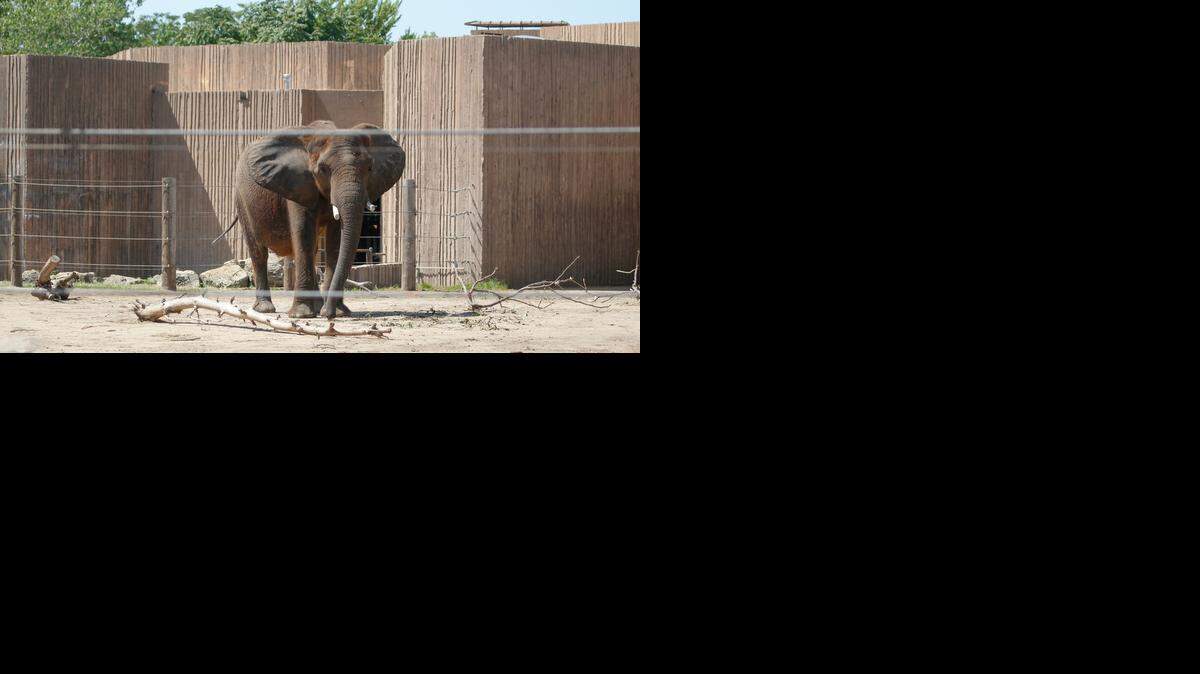
The future of the Sedgwick County Zoo’s two elephants, Stephanie and Cinda, will be decided this week by five elected officials when they vote whether to spend $5.3 million of taxpayers’ money to support an expanded exhibit for the biggest land animals roaming the Earth.
If a majority of the Sedgwick County commissioners approves the spending, the South African elephants will stay and be joined by others. If a majority votes no, Stephanie and Cinda eventually will leave Wichita, where they’ve spent 42 years.
“This is driven by the need to keep Stephanie and Cinda here,” Gayle Malone, a board member of the Sedgwick County Zoological Society, said of the proposed $10.5 million, five-acre exhibit that would allow the zoo to potentially have a breeding herd of elephants.
The decision is one faced by other communities with zoos accredited by the Association of Zoos and Aquariums. The association is requiring that its zoos that feature elephants have at least three females, two males or three elephants of mixed gender by September 2016.
The Denver Zoo responded by building the $55 million Toyota Elephant Passage, which opened in 2012 and the zoo calls its crown jewel.
The Woodland Park Zoo in Seattle, where an African elephant recently died, hopes to build a new exhibit. It faces opposition from a group called Friends of Woodland Park Zoo Elephants that is pressuring the city to send the zoo’s remaining two elephants to a preserve.
The Smithsonian’s National Zoo expanded its elephant exhibit and recently added three elephants from Calgary.
The Oregon Zoo is spending $57 million on its Elephant Lands exhibit that will house a breeding herd of eight elephants; it will be finished next year. That project is part of an overall $125 million bond project to improve the Portland zoo.
About 70 AZA-accredited zoos care for roughly 300 elephants. Just fewer than 30 of those zoos have breeding programs for elephants.
“Many of AZA’s accredited members who have elephants in their care are currently evaluating their facilities and making decisions on the future of their elephant programs,” Rob Vernon, senior vice president of external affairs at the AZA, said in an e-mail Friday to The Eagle.
“This includes the whole spectrum from whether or not to continue to have elephants to expansions of current facilities, like at Sedgwick County Zoo. We’ll be watching what happens with the county commissioners closely.”
Confinement controversy
Based on commissioners’ recent discussions, it appears a majority — Tim Norton, Jim Skelton and Dave Unruh — supports spending down part of the county’s reserves to pay for a 18,500-square-foot elephant barn, a move Sedgwick County Manager William Buchanan supports.
Commissioners Karl Peterjohn and Richard Ranzau have questioned the expense.
“$5.3 million for an elephant barn?” Ranzau asked publicly.
If the commission gives the zoo the money to move forward, the zoo wants to bring in four more elephants and hopes to eventually have a breeding herd. The new barn as currently designed could hold up to nine elephants.
Although elephants are popular at zoos, there also has been backlash against confining such large animals.
In 2012, the Seattle Times published stories that concluded that efforts to breed and preserve elephants were largely failing. The newspaper analyzed the deaths of 390 elephants at accredited American zoos in the past 50 years and found that for every elephant born in a zoo, another two die on average.
“At that rate, the 288 elephants inside 78 U.S. zoos could be ‘demographically extinct’ within the next 50 years because there’ll be too few fertile females left to breed, according to zoo-industry research,” the newspaper reported.
The AZA “vehemently” disagreed with the stories, Vernon said.
AZA records show that 48 elephants have been born at accredited zoos from 2003 to 2013.
People for the Ethical Treatment of Animals opposes keeping Stephanie and Cinda in Wichita.
In a recent letter to the editor, a staff writer for the animal rights group’s foundation said “it’s baffling that the Sedgwick County Zoo wants to squander millions to build a new cage that will be measured in square feet. Wild elephants roam up to 30 miles every day; a zoo cage can never come close to providing elephants a fulfilling life.”
African elephants are dying at the rate of 96 a day in the wild because of poaching and loss of habitat.
Exhibits built to grow
Ranzau pressed the society to come up with less expensive alternatives.
In a Sept. 11 letter shared with The Eagle, the society responded to Ranzau’s and Peterjohn’s questions.
Ranzau had asked about the possibility of the zoo withdrawing from the AZA. Doing so would allow the zoo to skirt standards on elephants.
Scott Ochs, president of the zoological society, said the zoo would lose some of its animals if it lost accreditation by the AZA. Zoos accredited by the group share animals managed under Species Survival Plans.
Ochs also said it wouldn’t look good for the state’s largest city to have a zoo that was not accredited. The zoo is Kansas’ No. 1 tourist attraction for families, and elephants are among the three top favorite animals of visitors, the zoo says.
Ranzau asked if the barn could be smaller or if an additional elephant could be housed in the rhino exhibit. He suggested getting just one more elephant; he noted the AZA was not requiring the zoo to get a breeding herd but only one more elephant.
A smaller barn for three to four elephants, including a bull, or male, elephant, would save about $500,000 to $600,000, Ochs said in his letter to commissioners.
The proposed new barn is a big expense because it must hold a bull, which would weigh about what Stephanie and Cinda weigh together.
“If you put a bull elephant in our (current) barn, he would knock it down in a couple hours,” Ochs told The Eagle.
The zoo builds exhibits to grow, he said.
“One of the reasons this partnership has been so successful is that the board has never planned for the short term but instead looked to the most efficient and responsible answer for the long-term question of how the Sedgwick County Zoo benefits the community,” Ochs said in the letter.
The zoo started with 14 penguins when it planned the Cessna Penguin Cove, he said.
“When we opened the Downing Gorilla Forest, we had two gorillas but have had up to nine,” he noted. “When we started the Slawson Family Tiger Exhibit, we had four tigers but welcomed two new cubs last year and can hold up to six to eight.”
The zoo is committed to a breeding herd, he said “because we know how important it is to make sure our children and grandchildren can see elephants.”
Conservation is important, but the truth is, baby animals also sell tickets.
“We know that baby animals at the zoo create a great deal of excitement and pleasure even beyond knowing we’re doing our part to prevent extinction in many cases,” Ochs wrote.
Malone noted that elephants, while large, are not as expensive to feed as other animals.
“Penguins eat fish,” she said with a laugh. “These people eat hay.”
Reach Deb Gruver at 316-268-6400 or dgruver@wichitaeagle.com. Follow her on Twitter: @SGCountyDeb.
This story was originally published September 13, 2014 at 4:56 PM with the headline "Commissioners will decide fate of Sedgwick County Zoo’s elephants."