
Kobach on Sedgwick County election lawsuit: Time is past, votes are sealed
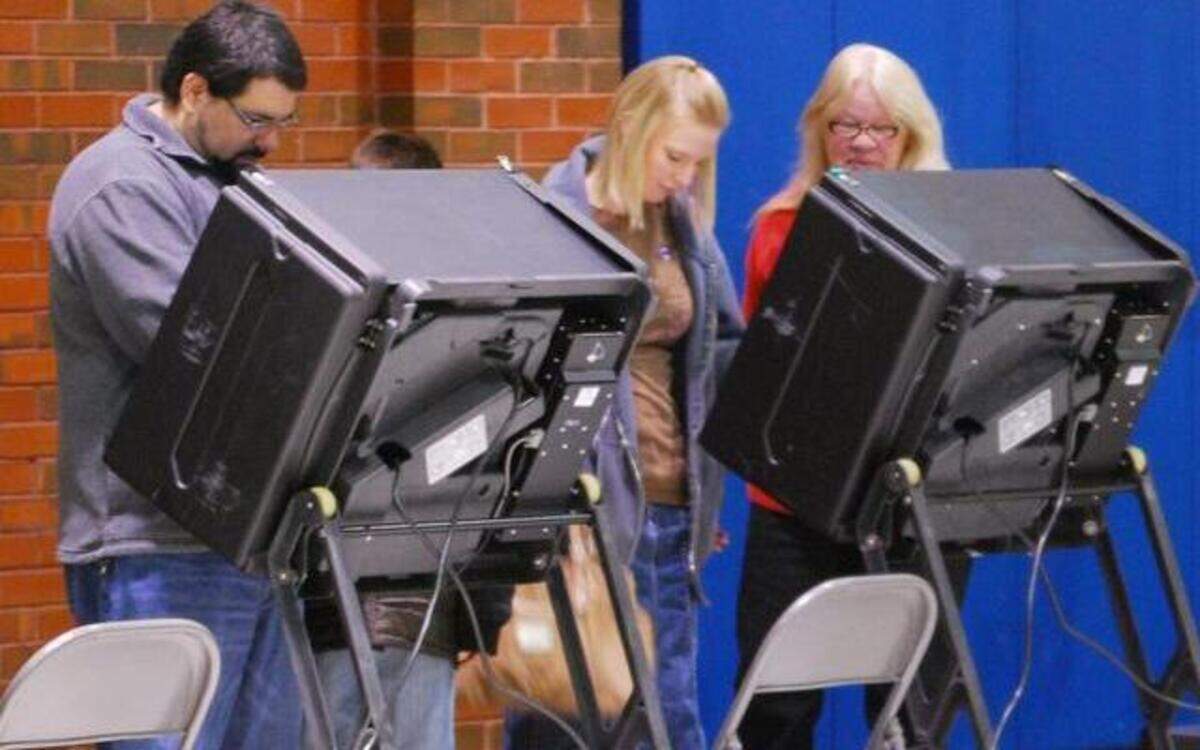
Secretary of State Kris Kobach said a researcher wanting to check the accuracy of voting machines from the November election missed her opportunity to do so before the votes were sealed.
For the first time, Kobach commented Friday on a lawsuit, in which he is a defendant, involving election results in Sedgwick County.
Kobach was added as a defendant Wednesday to a lawsuit brought in the Sedgwick County District Court by Beth Clarkson, the chief statistician for the National Institute for Aviation Research, who is seeking to study the accuracy of reported vote tallies in Sedgwick County. She emphasized that this activity is independent from her duties at the institute.
Clarkson, who is representing herself, wants to study the paper records from Sedgwick County’s electronic voting machines. She is suing Kobach and Sedgwick County Election Commissioner Tabitha Lehman for access to those records.
“When you vote in Sedgwick County, there’s a paper record that records every button you push. … I want to look at those and see are those matching up to the totals being reported,” Clarkson said Friday.
Kobach said he has yet to receive a copy of Clarkson’s complaint and so he could not comment on the specific claims in the suit. He did, however, offer a more general response about Clarkson’s desire to analyze voting results.
“She actually had a perfect opportunity to do some of the analysis she wanted to do during the contest period. Any registered voter in the relevant district in Kansas can bring a contest to challenge election results, so she has had multiple opportunities to do that,” Kobach said. “But Kansas law is very clear (that) after the contest period expires … the ballots are sealed after the contest period.”
The State Board of Canvassers certified the election results on Nov. 26. Kobach said the records were sealed five days later in accordance with the law.
Clarkson said she filed a request for a recount after the 2014 election but was rebuffed by the Sedgwick County Election Office. Clarkson said she was told that only candidates could file for a recount of their own races.
“Further, I kept asking them what’s going to be the cost of sitting down and going through these voting machine tapes, and I was told that’s not part of a recount, you can’t do that,” she said.
The Sedgwick County Election Office refused to comment about the pending lawsuit and about Clarkson’s claims.
Sedgwick County District Court records show that Clarkson brought a similar lawsuit against the election office in 2013, which was unsuccessful. In that case, the court found that the paper records Clarkson was seeking were not subject to the Kansas Open Records Act and that releasing them “would invade the province of the Election Commissioner in certifying election results.”
Clarkson said an audit of the paper records would give more confidence in the election results or potentially uncover problems if something went wrong.
“I’m a certified quality engineer. I know how to do audits. … I can pull a random sample and I can look at it and I check the error rate of the machines versus the paper tapes that they provide,” she said.
“This is about gaining confidence in the results as reported. You’ve got to have a post-election audit to know the error rate and to have confidence in the final results. And we don’t have this in this county,” Clarkson said. “They’ve never looked at those paper tapes and compared them to the tabulated results that the software provides.”
Kobach said he had a high degree of confidence in Kansas voting machines. He cited a recount in Wyandotte County that occurred after the March primary for an at-large seat in the Unified Government of Kansas City. The hand recount yielded the same result as the original count.
However, he said he is sympathetic to the public’s concern that voting machines could fail and that he wants any county using electronic voting machines to use machines that leave a paper trail, as Sedgwick County does.
“My hope is that by the end of my second term, every county in Kansas will have a paper trail,” he said.
This story was originally published April 5, 2015 at 8:54 PM with the headline "Kobach on Sedgwick County election lawsuit: Time is past, votes are sealed."