
Bill ties Kansas school funding formula to post-graduate success
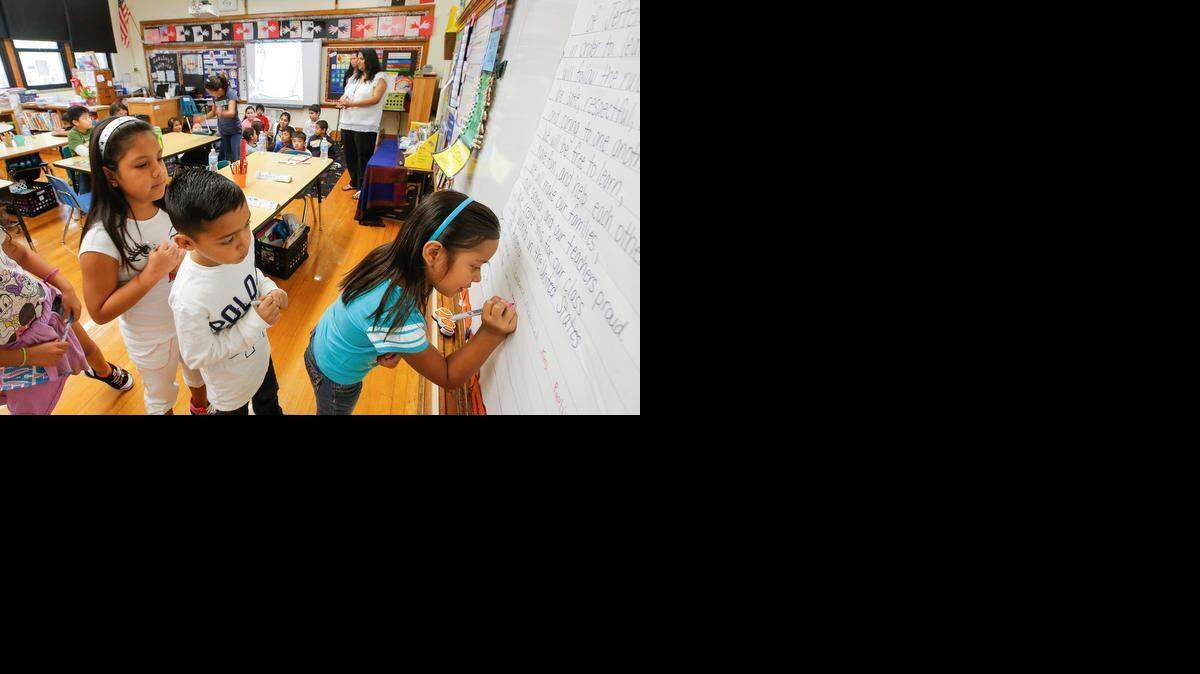
A proposal for a new school finance formula would link school funding to the success of students after graduation.
SB 294, introduced by Sen. Steve Abrams, R-Arkansas City, would tie part of districts’ funding to the number of graduates enrolled in college or working in jobs where they earn above a certain threshold.
The bill is set for a hearing Tuesday before the Senate Education Committee.
Abrams’ bill would break state education aid up into six main categories: enrollment, poverty, sparsity, equalization, pensions and success.
Districts would receive success ratings based on the number of graduates who had earned an industry certification, completed basic military training, enrolled in a third consecutive semester at a college or worked at a job earning an income of at least 250 percent of the poverty level. That would be $29,425 now.
Abrams, who chairs the Senate Education Committee and previously served on the State Board of Education, said this would link educational funding to real world outcomes.
“What does it mean to be an educated person in the state of Kansas?” Abrams said. “I’d like my kids to be on the path to be in the middle class.”
He said that statistically a person is more likely to be in the middle class if he or she has earned a degree or technical certification or has a military service background. “Therefore, how do we get one of those things to accomplish that? That becomes the point of education.”
Abrams said superintendents he consulted while drafting the bill agreed it was appropriate to hold them accountable for placing students on that path.
State assessment tests, which now are used to measure educational success, are not as effective a measurement as real world outcomes, he said. “Well, when’s the last time you guys applied for a job and the employer said, ‘What’d you do on the state assessment?’ ” he asked.
Districts’ success ratings would be factored against their poverty rate and enrollment.
That means that the Kansas City district, which has one of the highest poverty rates in the state, could receive $32 million in success aid compared with $14 million for the Blue Valley School District, which has a higher success rate but one of the lowest poverty rates in the state. Those numbers are based on an analysis by the Kansas Association of School Boards.
Formula’s complexity
The Legislature recently passed a repeal of the state’s current school finance formula, which Gov. Sam Brownback is expected to sign. It would be replaced with block grants for the next two years while lawmakers craft a new formula.
Republican lawmakers have repeatedly said the current formula is overly complex.
“I cannot answer if this is supposed to be less complicated. It is not less complicated, in my opinion. It is simply different,” said Mark Tallman, the school board association’s associate executive director.
Tallman said that Abrams’ bill is arguably more complex.
“Any formula that uses the term ‘cubed root’ is not a simple formula,” he joked during a webinar for school district officials from across the state.
Abram contended his bill is simpler and more straightforward than the current formula.
“I wanted a formula where anybody with a decent math background could be able to take this and be able to derive how the numbers work,” he said.
Abrams’ bill, if passed, would apply only to the state’s six “innovation” school districts next year: Kansas City, Blue Valley, Hugoton, Concordia, Marysville and McPherson. The following year it could be expanded to up to 100 districts; it would apply to all districts in fiscal year 2018.
The districts would not see a significant change in dollars per student next year compared with the block grant bill.
How it works
Here’s how other parts of the formula would work:
▪ Enrollment aid: Districts would receive $3,820 for each student enrolled. Total student counts would be based on December of the previous school year rather than the current school year, as they are now.
▪ Poverty aid: Districts would receive aid based on the poverty rate for ages 5 through 17 as determined by the U.S. Census. Tallman noted that the use of census data meant the amount a district received for poor students might be affected by the number of private school attendees in the district.
Currently schools receive funding for at-risk students, which is based on the number of students receiving federal free or reduced-price lunches.
Shelly Martin, superintendent of the Parsons district, raised concerns about the use of census data.
“Basing our funding on Census data rather than actual students is problematic for many reasons. In my district, 6 to 10 percent of the student population is in the foster care system and look very different from the ‘average’ resident,” she wrote during the webinar. “I don’t see how this new formula would take those high-needs, high-risk students into account.”
▪ Sparsity aid: This would be calculated by dividing the square miles of a district by the total school-aged population, based on the previous year’s census data.
▪ Equalization aid: The bill changes how this aid, meant to address gaps between rich and poor districts, is calculated. The current system relies on assessed property value in a district, which Abrams said provides an incomplete measurement. Lawmakers have said some school districts in Johnson County that are primarily residential are considered poorer than districts like Burlington, where industrial property inflates the assessed value.
Abrams’ bill would factor in the mean federal gross income in each district and average appraised value for a single-family home to determine which districts should be eligible for equalization aid.
The bill would require rich districts that raise local property taxes to contribute money to the state to go into the equalization fund. Abrams said this policy was in response to recent court rulings that have called for equitable funding.
Tallman compared this to the luxury tax Major League Baseball teams pay for going over the salary cap.
Reach Bryan Lowry at 785-296-3006 or blowry@wichitaeagle.com. Follow him on Twitter: @BryanLowry3.
This story was originally published March 23, 2015 at 7:32 PM with the headline "Bill ties Kansas school funding formula to post-graduate success."