
Court reopens lawsuit as Kansas House narrowly passes school finance overhaul
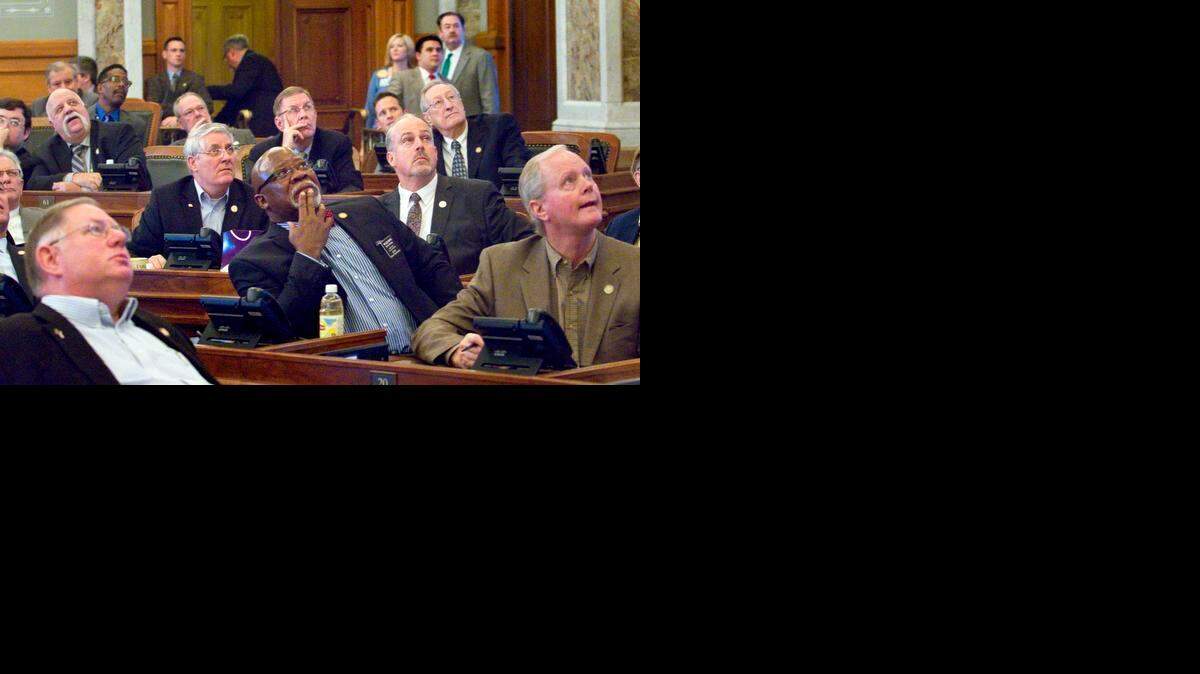
A major overhaul of the state’s school finance system passed in close vote in the Kansas House on Friday, but a district court hinted that it might eventually block it.
The bill eliminates the state’s current school finance formula, the subject of an ongoing lawsuit brought by school districts that argue the state is not funding schools adequately or equitably as required by the Constitution.
The current formula uses weighting for districts’ specific needs to determine funding levels. The bill that passed Friday uses flexible block grants. It includes an increase in pension funding, but reduces aid in the current school year and keeps money for daily operations mostly flat for the next two years.
SB 7 passed 64-57. Sixty-three votes were needed to pass the bill.
The initial vote fell one short of the minimum for a constitutional majority. Lawmakers had to wait two hours for missing Reps. Rob Bruchman and James Todd, both Republicans from Overland Park, to arrive before the vote became final.
Later in the day, a three-judge panel issued an order to reopen the equity portion of the school funding lawsuit, which had been settled last year after lawmakers allocated more money to equalize funding between districts.
The court indicated that it could move to block any policy changes by the Legislature “to protect the status quo and to assure the availability of relief.”
It also said that in order to enforce future rulings it was adding several state officials, including the state’s treasurer and revisor of statutes, as defendants. The treasurer is responsible for making state payments to schools. The revisor is responsible for the publication of laws.
Attorney General Derek Schmidt called the order “unexpected and unusual to say the least” in a short statement.
“We had thought and hoped this dispute was headed for a swift and final resolution,” Schmidt said. “But today’s order from the panel introduces further delays and injects a host of additional constitutional and legal issues. The path to resolution is now less clear than ever before.”
Senate Minority Leader Anthony Hensley, D-Topeka, said the order showed the court “has their eye on us” as lawmakers debate the block grant funding bill, which moves to a vote in the Senate on Monday.
House Majority Leader Jene Vickrey, R-Louisburg, said any time the Legislature reworks finances it’s a tough vote and some school districts “are very nervous” about the change. However, he said, it was important for lawmakers to forge a new path on how to pay for schools.
“This formula has gotten distorted. It’s become a political formula,” Vickrey said, contending it is disconnected from classroom needs. “It has survived through political meandering. And we need a formula based on fact – based on what the costs are and what the outcomes, what the goals, are.”
Changing to block grants
The shift to block grants was offered by Gov. Sam Brownback in his State of the State address. His office has signaled that he is ready to sign that bill if it comes to his desk.
Supporters say the block grants will free up money for the classroom by giving districts more flexibility on how to spend state funds.
Diane Gjerstad, lobbyist for the Wichita school district, said the current finance formula, which was adopted in 1992, has served Kansas students and taxpayers well.
“The governor campaigned all during the (election) season on how well Kansas schools are doing,” Gjerstad said. “And we’re doing well because the system, the funding system, supports that kind of outcome. Right now we’re just sort of standing at the edge of a cliff not knowing what’s about to come.”
The Wichita school district has vocally opposed the bill, which would reduce the district’s funding by about $4.8 million compared to current law and eliminate a weighting for at-risk students.
The money the Wichita district would lose represents about a fifth of the money cut from all schools statewide.
The bill restores a $28 million automatic cut by the governor that went into effect this month and affected all school districts. But it cuts $51 million in equalization aid – meant to close funding gaps between rich and poor districts – that has largely benefited urban districts like Wichita and Kansas City.
Gjerstad said the governor’s cut was fair “because everybody had skin in the game,” but this bill affects some school districts more than others.
The Wichita district will receive $7.7 million less than it had expected at the start of the school year. Excluding the increase in pension funds, which are not flexible, it will receive between $5 million and $7 million less the next two years for operational costs, according to analysis done by the district.
The district will receive $13 million more in pension funds in the 2016-2017 school year compared to the current year. Statewide the pension increase is about $122 million over two years, which supporters note would have been a cost otherwise passed onto schools.
Wichita supporters of bill
Every Republican in the Wichita delegation voted in favor of the legislation. Democrats universally opposed the bill.
Rep. Mark Hutton, R-Wichita, said he voted for the bill because “the old formula had to go.”
He said this step was needed to enable lawmakers to begin a viable discussion on how to craft a new formula – after the block grants end in 2017 – that works for all school districts and is fair to taxpayers.
He also pushed back on the notion that school districts are losing money with this bill.
“I think it’s disingenuous for the schools to say they’re taking the cut,” Hutton said, noting that districts will still receive more this year than last year.
Lawmakers passed a bill last session that increased school funding after the Kansas Supreme Court ordered them to make school funding more equitable. But the bill cost about $60 million more than initially estimated, and many lawmakers have looked to scale back.
Rep. John Carmichael, D-Wichita, said the block grant bill benefits the wealthiest districts in the state at the expense of poorer ones, including Wichita.
Rep. Jim Ward, D-Wichita, said it was “frustrating and disappointing that these folks continue to vote against public schools.”
“How can you stand up in Wichita and say we just cut your schools $7.7 million, we’re going to cut them $7 million next year after that and $5 million the year after that, and say I believe in public schools?” he said.
Other districts in south-central Kansas – Andover, Maize and Hutchinson – have also raised concerns that the bill will force them to make cuts to programs.
Two Johnson County districts, Blue Valley and Shawnee Mission, have offered support for the plan as the best option to give schools stability in the face of the state’s budget problems.
Republican opponents of bill
More than 30 Republicans voted against the bill.
Several GOP lawmakers suggested the bill was being pushed as a way to preserve controversial income tax cuts the Legislature passed in 2012.
“The almighty dollar appears to more important than quality education,” said Rep. Larry Hibbard, R-Toronto. “The winners on the bill are the ultraconservative think tanks. … The losers are the boys and girls of Kansas.”
Rep Ron Ryckman, R-Olathe, one of the authors of the bill, responded to this claim after the vote.
“The winners are the school kids definitely. This will allow more money to make it to the classrooms. It removes the red tape, removes the silos. The current formula restricts money and puts it in silos,” Ryckman said.
Reach Bryan Lowry at 785-296-3006 or blowry@wichitaeagle.com. Follow him on Twitter: @BryanLowry3.
How they voted
Here’s how south-central Kansas lawmakers voted on SB 7, to change how the state funds schools. The bill passed 64-57.
Republicans voting yes: Steve Anthimides, Steve Brunk, Mario Goico, Daniel Hawkins, Dennis Hedke, Mark Hutton, Mark Kahrs, Les Osterman, Joseph Scapa, Gene Suellentrop, John Whitmer, Wichita; Steven Becker, Buhler; Blake Carpenter, Derby; Will Carpenter, El Dorado; Pete DeGraaf, Mulvane; Kyle Hoffman, Coldwater; Steve Huebert, Valley Center; Kasha Kelley, Arkansas City; Les Mason, McPherson; Jan Pauls, Hutchinson; Virgil Peck, Tyro; Marc Rhoades, Newton; Joe Seiwert, Pretty Prairie; Jack Thimesch, Cunningham; Kristey Williams, Augusta
Democrats voting no: John Carmichael, Gail Finney, Roderick Houston, Tom Sawyer, Ponka-We Victors, Jim Ward, Brandon Whipple, Wichita; Ed Trimmer, Winfield.
Republicans voting no: Don Schroeder, Hesston
Democrats absent: Carolyn Bridges, Wichita
Republicans absent: Virgil Peck, Tyro
This story was originally published March 13, 2015 at 10:48 AM with the headline "Court reopens lawsuit as Kansas House narrowly passes school finance overhaul."