
Republicans unveil ‘block grant’ school funding plan
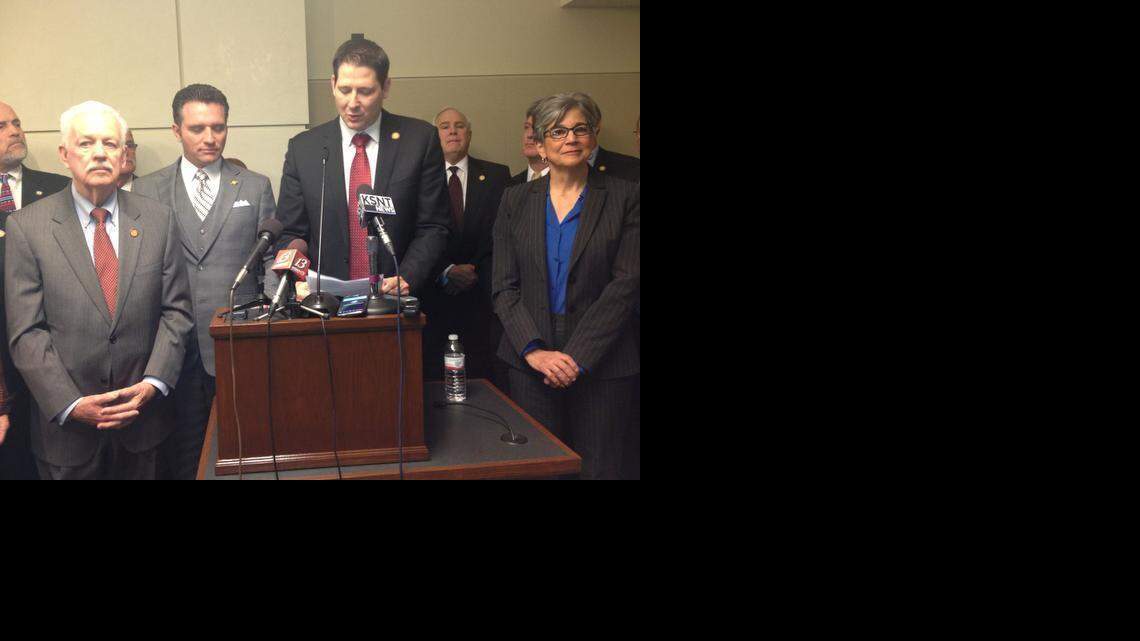
Republican lawmakers unveiled a plan to temporarily transition K-12 education funding to a block grant system Thursday morning in Topeka.
The impact on individual districts at this point is unclear. Estimates will be available Friday morning on the Department of Education’s website.
One of the biggest changes, according to Republican leaders, is flexibility. Instead of schools receiving money for specific purposes, such as capital improvements for buildings and equipment, school districts are free to spend most of the money in the block grant for any purpose.
“It is flexible, so at the local level they can decide whether they buy a Suburban or hire a new teacher,” said Sen. Ty Masterson, R-Andover, Senate Ways and Means chair.
Gov. Sam Brownback first proposed shifting to a block grant system in his State of the State address.
He would then like lawmakers to work on a new funding formula.
Republicans argue the current funding formula is overly complex and lacks transparency. The current funding system requires schools to spend dollars for the specific purposes they are allocated.
The proposed legislation would redefine general state aid to also include supplemental state aid, capital outlay aid, virtual school aid, various tax levies and employer contributions to the pension fund.
The pension dollars will still have to go to the pension fund despite their inclusion in the block grant, Masterson said.
The bill would give districts greater authority over how money is spent.
Rep. Ron Ryckman Jr., R-Olathe, said that lawmakers – and newspaper editorial boards – did not know the best way to educate children. He argued that more local control would result in better outcomes for students.
“Traditionally, we have not listened to our school districts. That has stopped,” Ryckman said.
Mark Tallman, spokesman for the Kansas Association of School Boards, said his organization would welcome increased trust in local school boards to make decisions.
The bill would restore the $28 million in cuts that the governor announced last month, which are set to begin at the end of this week. Masterson argued the bill would create stability in school funding that would enable lawmakers to begin work on a new formula.
“This is not the new formula. But it does create an environment of stability, predictability, certainty for our schools,” Masterson said. “An environment without fear that dominates our debate in the public eye currently.”
Some lawmakers have expressed hesitance about scuttling the current formula in favor of a long-term plan that would be drafted in the future.
Rep. Don Hineman, R-Dighton, said this was too big a gamble for his taste.
“It’s a big gamble to throw away the formula we have now and trade it for a blank slate that someone’s going to fill in … I can’t get comfortable with that,” he said.
The bill includes the creation of an “extraordinary need fund” to provide additional aid to districts that experience unforeseen hardships from the transition to block grants. That would include increases in enrollment, according to Ryckman, the chair of the House Appropriations Committee. His committee will begin hearings on the bill next week.
Masterson said no school should have to cut a planned expense under the proposal, arguing the bill gives districts the flexibility to cover their expenses.
Masterson said the bill would put an additional $300 million toward schools over three years but said that more than half of that number would be pension costs. Unlike the governor’s proposed budget, this bill would fund scheduled increases in pension funding.
Diane Gjerstad, lobbyist for the Wichita school district, said funding the pension increases – the governor’s budget passed this expense on to school districts – was a positive sign but would not help schools with their daily expenses.
Masterson argued that money spent on teachers’ retirements is a classroom expense in his opinion.
The two identical bills, SB 273 in the Senate and HB 2403 in the House, were officially introduced at 4:30 p.m. Thursday.
The bill funds districts for next school year and thereafter based on the amounts allocated for the 2014-2015 school year.
But Gjerstad flagged the fact that, according to the text of the bill, the funding would be “prorated.” She read that to mean it would not include all of the supplemental aid included in last year’s school bill.
“It depends on where they set the base from. And it appears they’re going to be setting the base at $8 million less than where we thought we were going to be at,” she said about the impact to Wichita.
In recent months many Republicans have complained that last year’s school finance bill ended up costing $60 million more than originally expected. Masterson said during the news conference that the bill funds school districts at the level intended by lawmakers.
Democrats accused Republicans of being intentionally vague about the impact of the block grant to individual districts.
“While the Republican block grant proposal continues to be shrouded in mystery, one thing is clear. They want to fund our public schools with accounting gimmicks and fake money,” Senate Minority Leader Anthony Hensley, D-Topeka, said in a statement.
Hensley argued that the proposal would not put more money into the classroom and that it would prompt further legal challenges by increasing the funding gaps between districts.
Deena Horst, a member of the State Board of Education, expressed confusion Thursday morning over the details. She also pondered the impact of the bill on the state’s pending school finance lawsuit over whether schools are adequately funded.
“Until I see the details I don’t know if I have a reaction other than to wonder how the court will react,” Horst said. “I would have preferred to have the details.”
Thursday morning, about the same time lawmakers held their news conference, the Kansas Supreme Court issued an order remanding the case to the district court to resolve some post-trial motions. A three-judge panel ruled in December that Kansas schools were unconstitutionally underfunded.
Once the lawsuit gets back to the higher court, Brownback’s recent appointee to the court, Justice Caleb Stegall, said he will recuse himself from the case. Stegall was involved in the case previously as the governor’s lawyer.
Reach Bryan Lowry at 785-296-3006 or blowry@wichitaeagle.com. Follow him on Twitter: @BryanLowry3.
This story was originally published March 5, 2015 at 11:08 AM with the headline "Republicans unveil ‘block grant’ school funding plan."