
Obama seeks 50,000 body cameras for local police
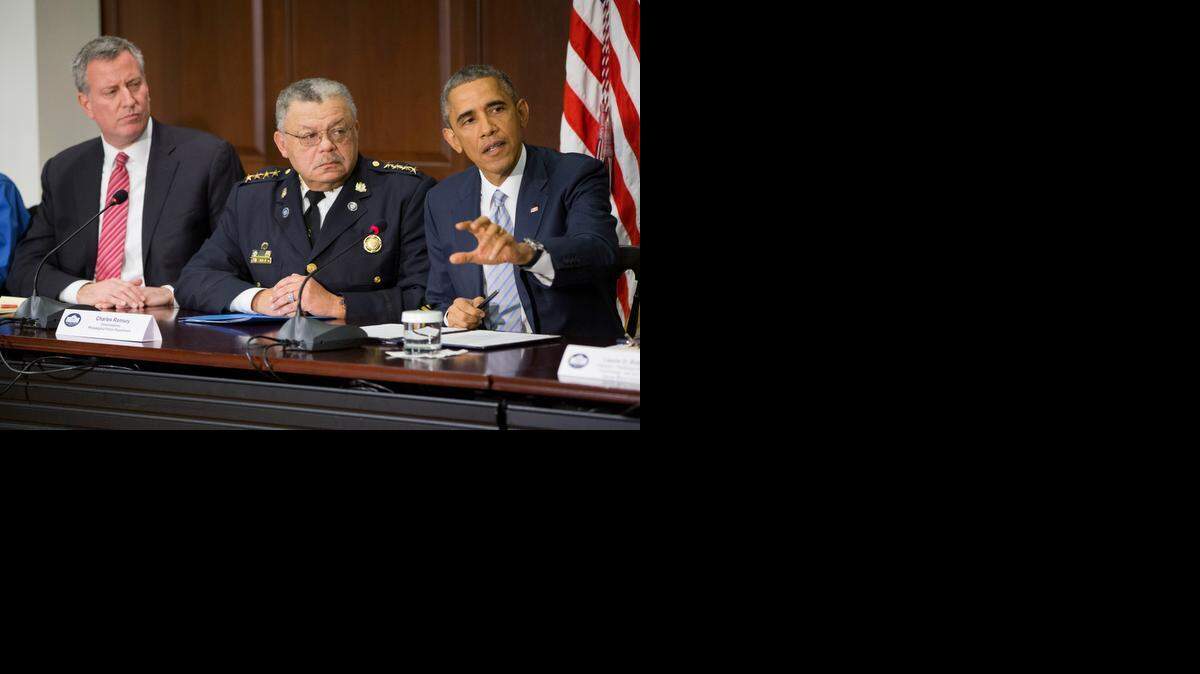
President Obama is asking Congress for $75 million to buy 50,000 more body-worn cameras for local law enforcement after the national uproar over the shooting of an unarmed teenager by a police officer in Ferguson, Mo.
Obama also said Monday that he will not significantly change a federal program that provides military equipment to local police, despite complaints after police with riot gear and assault-style weapons responded to protesters in Ferguson.
“I think Ferguson laid bare a problem that is not unique to St. Louis or that area and is not unique to our times,” Obama said. “And that is a simmering distrust that exists between too many police departments and too many communities of color.” The Ferguson officer is white; the teen was black.
Obama spent much of Monday in meetings on the continued unrest a week after a St. Louis County grand jury decided not to indict Officer Darren Wilson in the August death of Michael Brown.
In addition to protests in Ferguson, protesters across the country walked off the job or away from class in support of the Ferguson protesters. Walkouts took place in New York, Washington, Chicago, San Francisco and elsewhere.
At the University of Missouri-St. Louis, three dozen students rallied outside the library and walked out of class, some with their hands up in the air, a gesture that has become a symbol of the movement.
Obama, meanwhile, met separately with his Cabinet, young civil rights leaders, a group of elected and law enforcement officials and civil rights and religious leaders from around the country. No members of Congress were invited, though they would have to approve the money for Obama’s plan.
The proposals also include a task force aimed at building trust between police and minority communities.
“The president and his administration are very focused on the underlying issues that have been uncovered in a pretty raw way in Ferguson,” said White House press secretary Josh Earnest. “These kinds of issues – the nature of the relationship between law enforcement agencies and the communities they’re sworn to serve and protect – is something that a lot of communities across the country are dealing with.”
Obama will ask Congress to spend $263 million over three years to increase use of the cameras, expand training for law enforcement and increase the number of cities where the Department of Justice works with local police. The $75 million camera program calls for state and local funding matches.
Individual cameras can cost $800 to $1,200. Thirty-nine percent of agencies responding to a Justice Department-funded study of police cameras by the Police Executive Research Forum identified price as a primary reason for not ordering the cameras.
City officials in Wichita say they plan to spend $1.5 million to outfit every Wichita police officer with a body camera by December 2015.
Analysts said the benefits of cameras include better documentation of evidence, increased police accountability and a reduction in the use of force.
“If widely implemented, that single change would not only establish real transparency when force is used during a police incident, it would also substantiate the fact that the vast majority of police officers carry out their duties with bravery and integrity,” said Rep. William Lacy Clay, D-Mo.
Obama has said the nation has work to do to resolve the tension between law enforcement and minority communities. In recent years, Obama started a program called My Brother’s Keeper to empower young black men.
Obama said he knows that people are often wary of more task forces but that he plans to take action after the studies are complete.
“In the two years I have remaining as president,” he said, “I’m going to make sure we follow through.”
In August, after the shooting in Ferguson, Obama ordered a review of federal programs that provide military equipment to local police. Among other things, the review was supposed to examine “whether these programs are appropriate.”
But a senior administration official with knowledge of the review but who was not authorized to speak publicly as matter of policy said Monday that the review did not examine whether the equipment should be used.
“Our assumption is Congress has an intent here to support local law enforcement with the use of this kind of equipment,” the official said. “Our focus is on what kind of protections are in place to make sure it’s used properly and safely.”
Earnest said later that the program serves its purpose, citing the successful use of military equipment by police after the Boston Marathon bombing in April 2013.
“What is needed, however, is much greater consistency in oversight of these programs,” he said. “Primarily in how these programs are structured, how they’re implemented and then how the programs themselves are audited.”
“Our local police officers and law enforcement deserve the best tools and training available to protect and serve our communities,” said Rep. Emanuel Cleaver, D-Mo. “But we should not turn our cities into war zones. Today’s announcement is a positive first step.”
Obama’s Task Force on 21st Century Policing – chaired by Philadelphia Police Commissioner Charles Ramsey and former Assistant Attorney General Laurie Robinson – will look at reducing crime while increasing public trust. It will prepare a report within 90 days.
Contributing: Associated Press
This story was originally published December 1, 2014 at 9:15 PM with the headline "Obama seeks 50,000 body cameras for local police."