
Wichita schools’ demographics shifting toward greater racial, ethnic diversity
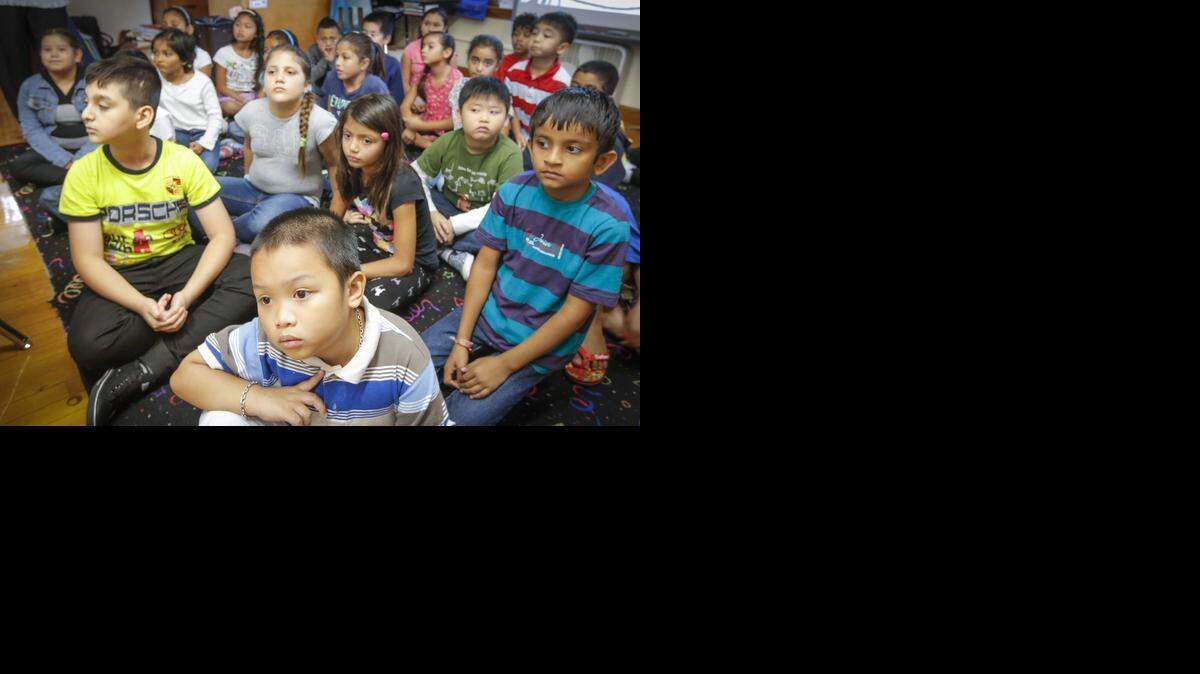
Sarah Hensley’s classroom is a snapshot of the world:
There’s Thang from Vietnam. Aliannis from Cuba. Fatima from Mexico. Zakariye from Ethiopia.
Ashley from Peru. Syahidah from Malaysia. Hongbin from China. Abdullah from Iraq.
Hensley’s 28 students came from 13 countries. In their homes, they speak nine languages.
At Jefferson Elementary School, near Kellogg and Oliver in southeast Wichita, they learn to speak, read and write English. They sing about pennies, nickels, dimes and quarters. They eat pizza in the cafeteria and play soccer on the playground.
The students are enrolled in the Wichita school district’s Newcomers program for recent immigrants and refugees. They also are part of the changing face of schools in the Wichita area and nationwide.
This fall, for the first time, the overall number of Hispanic, black and Asian students in public school classrooms in the United States is expected to surpass the number of non-Hispanic whites.
The new majority of minority schoolchildren – projected by the National Center for Education Statistics to reach 50.3 percent this school year – is driven largely by dramatic growth in the Hispanic population, a decline in the white population and a steady rise in the number of Asian-Americans.
Kansas students will be counted Monday as part of an official head count conducted each year and reported to the State Department of Education. The number is used to determine each district’s per-student state funding, as well as additional funding for students in at-risk programs and those who receive special-education or bilingual services.
If current trends continue – and officials think they will – Wichita’s enrollment will rise again by at least 300 students, and Hispanic families will continue to drive that growth. This year or next, the number of Hispanic students could exceed the number of non-Hispanic white students and become the largest ethnic group in the district.
Over the past decade, the percentage of Hispanic students in Wichita schools has more than doubled – from 15 percent in the 2000-01 school year to more than 33 percent today.
“We are diverse already and just becoming more diverse,” said Dalia Hale, director of the district’s Multilingual Education Service Center. “Hispanics are a part of that, but only a part.”
For nearly a decade, Wichita schools have provided Spanish and Vietnamese interpreters for parent-teacher conferences and other events. A staff of translators regularly records Spanish and Vietnamese versions of school newsletters, e-mails and phone messages about weather cancellations.
This year, because of the growing variety of languages spoken in Wichita homes, the district began contracting with Propio Language Services, an over-the-phone interpreting service, which lets teachers connect by phone with parents in any language in just minutes.
“I’ve had so many people call and say they appreciate that new service,” Hale said of Propio, which means “proper” in Spanish.
“It’s now our time to really incorporate these other languages into our school repertoire so we can come together with parents and really connect.”
More refugee children
The need for intensive English instruction, interpreters and other language services continues to rise, but not only for native Spanish speakers.
Ten years ago, fewer than 4,300 Wichita students required ESOL – English for Speakers of Other Languages – services to help them speak, read and write English. Last year, 9,080 qualified for services, and a growing percentage of those speak languages other than Spanish. In fact, fewer than half of Wichita students who identify as Hispanic qualify for ESOL services.
Local groups that rescue foreigners from war and oppression are helping resettle more refugee families in Wichita, and children from those families are enrolling at Jefferson Elementary and other area schools in record numbers.
They come from all over the world, Hensley said, including Asia, Africa, Central America and the Middle East. At her busiest point last school year, Hensley had 24 students in her Newcomers class. This fall she began with 27, and new students continue to arrive.
Sharon Schultheis, Hensley’s co-teacher, says she loves the job because she knows how the children and their families feel. Schultheis’ son didn’t know English when her family moved back to the United States from Germany and he started kindergarten.
“I know what it’s like to feel stupid or to be a parent dealing with kids who feel that,” Schultheis said.
“People have negative ideas about things, like, ‘Why are we letting these people in?’ or ‘Why are we letting these kids in?’ or whatever. But you know, they’re here.”
“My standpoint is, if the kids are here then we want for them to be productive members of society and to be educated,” Hensley added.
“And they are thrilled. I think our class is one of the most eager classes to learn, just because they want to learn English so they can play and talk to other kids,” she said. “Most of the time they are very hard-working.”
Hensley’s Newcomers class includes children from second through fifth grades. Kindergartners and first-graders, even those who can’t speak English, are placed into regular classrooms – the idea being that children in those classes will learn to read and write together.
Jefferson is one of 11 schools in the Wichita district with a Newcomer program.
One day last week, Hensley read a picture book titled “We The Kids” to the class, pointed out objects in the illustrations, and explained phrases from the Constitution such as “justice,” “tranquility,” “general welfare” and “blessings of liberty.”
The concepts may be complex, but they’re relevant to these children, Schultheis said. A girl from Cuba was not allowed to practice her religion in her home country, she said. An Iraqi girl was allowed to attend school only part-time, so she started at Jefferson significantly behind her younger brother academically.
“Sometimes they get it and sometimes they don’t, but that’s OK,” Hensley said. “They have a lot to learn, but they also teach other children about the world.”
Growing diversity
Non-Hispanic white students make up about two-thirds of public school classrooms in Kansas, a number that is down from nearly 80 percent in 2000.
Hispanic enrollment statewide doubled during that time, from 9 percent in the 2000-01 school year to more than 18 percent last year. The number of black students statewide has decreased, from 8 percent in 2000 to about 6 percent last year.
Also worth noting: Kansas schools did not add the “multiethnic” category to enrollment forms until 2003. That year, 1,264 Wichita students identified themselves as multiethnic; last year, the number was 4,224.
“When we talk about families fitting into a role, we have to remember that many of them see themselves as multiracial,” Hale said. “They don’t identify as one over the other.”
Suburban schools are seeing demographic shifts as well, though not to the same extent as Wichita and other urban districts. Most report increases in Hispanic students and those who identify as multiethnic.
In Maize, just west of Wichita, total enrollment increased by 33 percent from 2000 to 2014, while the number of Hispanic students nearly tripled. State data for Derby, Goddard, Andover and Haysville show similar trends.
“When I first started in this position we had just hired our first (ESOL) teacher, and she had eight students,” said Marsha Beard, associate superintendent for the Maize district. “Most of those were from families where they knew some English.”
Today, about 100 Maize students receive ESOL services; another 65 qualified but parents or guardians waived services.
“In the last five years, we have seen a lot of students who come in, and no one in the family speaks English,” Beard said.
They’re mainstreamed into regular classrooms, she said, but may be pulled out for intensive instruction or get help from a paraprofessional.
Maize recently started using interpreters – district employees who speak Spanish and Vietnamese – to serve as translators at parent-teacher conferences, Beard added. It is in the third year of an at-risk preschool program in which an ESOL teacher works an hour a day with youngsters to help them learn English.
“I think anytime our students can work with others that come from a different culture is a great opportunity for them,” Beard said. “Particularly out here, where we have not as much diversity – the more we can get, the better for our students.”
Reach Suzanne Perez Tobias at 316-268-6567 or stobias@wichitaeagle.com. Follow her on Twitter: @suzannetobias.
This story was originally published September 20, 2014 at 6:16 PM with the headline "Wichita schools’ demographics shifting toward greater racial, ethnic diversity."