
Dennis Rader cooperating on book about his 10 BTK murders
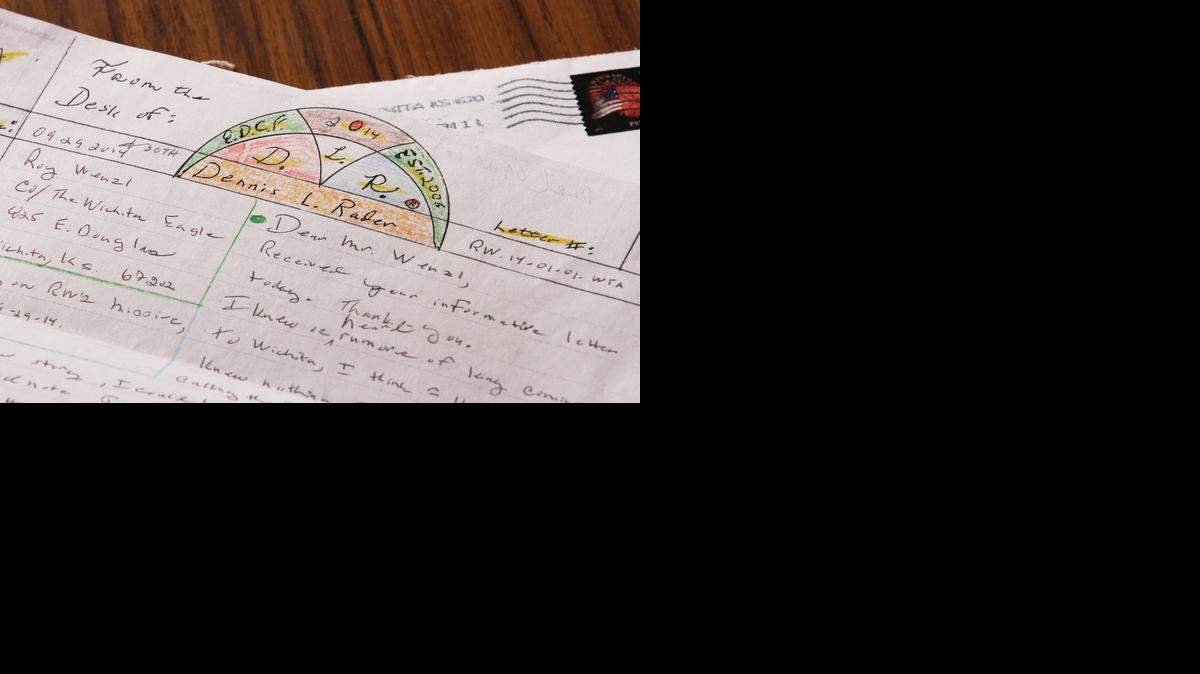
The BTK serial killer is cooperating with a book being written about his 10 murders, he wrote in a letter from prison this past week.
He’s doing it, he said, to help the families monetarily.
“I can never replace their love ones, my deeds too ‘dark’ to understand, the book or movies, etc. is the only way to help them,” Dennis Rader wrote.
He said he is sorry that the police lieutenant who caught him has died.
He gets a kick out of police recently taking “pot shots” at him.
He’s apparently read “A Good Marriage,” a novella by Stephen King inspired by BTK. He knows King is coming to Wichita in November to promote a separate book.
He loves his family very much, he wrote.
And no, he said: His wife, Paula Rader, did not know anything about his 10 murders until he got caught, 31 years after he started committing them.
“The family knew nothing about my ‘Dark Deeds.’ I carried that secret until the day I was arrested,” Rader wrote.
In a four-page hand-written letter labeled “From the Desk of: Dennis L. Rader,” the former Park City code compliance officer explained the reason he’s not talked much. The letter, written in pen and pencil, contained the typos, odd spacing and missing letters characteristic of past messages he sent to the news media and police when he was operating as BTK (Bind, Torture, Kill). His letter contains his first public comments on his crimes and the aftermath since he was sent to prison nine years ago.
He is barred from profiting from his crimes by a court settlement, he explained. He signed over his media rights to the families of his victims after he was sent to the state prison in El Dorado in 2005.
Because of that, he can’t talk much, he wrote. “But you and ‘The Wichita Eagle’ might be able to help the (Victims Family Trust), for I know the long work on a book is close to a deal, that media helps sales and interest.”
Several of the families sued him for wrongful death after his arrest.
As part of a settlement, he signed his media rights to those families, said James Thompson, a Wichita lawyer and one of the attorneys representing most of BTK victim families.
The settlement means Rader can’t profit from from any product he produces about his crimes, Thompson said.
“We could prohibit him from trying to do things like what (Serial killer Charles) Manson was doing,” Thompson said. “We can’t control the facts of the case, so much of all that went into the public domain. But we can stop him from doing some things. Making any kind of a profit, for example.”
The settlement doesn’t bar him from cooperating on a book project involving the families, Thompson said.
A percentage of any profits will go to the families, Thompson said.
The author is Katherine Ramsland, professor of forensic psychology and program director of the masters program in criminal justice at DeSales University in Pennsylvania.
She’s a nonfiction author of 54 books, most of them academic, she said. She helps train prosecutors and police and says the book she’s working on about Rader will be academic and nonsensational – an attempt to help investigators and criminologists understand killers like Rader. She has little regard for some of the lurid books written soon after Rader was arrested.
“I’m trying to make this a serious effort that will have some benefit for people who study this kind of crime,” she said.
She has corresponded with Rader to do that work, she said.
Rader, in his letter, explained why he is cooperating.
“The main reason for the book idea, is to help the VF’s (Victims Fund) monetarily wise; something I had hoped for years, to help them and in a way to pay my debt to them,” Rader wrote.
He said he hoped to someday speak more fully.
He turned down many media attempts to talk with him in the past nine years, he wrote, to stay true to the court agreement with the victim families.
“I mean to burn no bridges,” Rader wrote, “and hope some day to open up. People like me, need to be under stood, so the criminal professional field, can better under stand, the criminal mind. That would be my way helping debt to society.”
Rader wrote his letter last week to answer questions posed to him after his daughter, Kerri Rader Rawson, broke his family’s nine-year public silence about his crimes.
She said in her interview on Sept. 25 that she thought Stephen King was “exploiting” her family. King’s novella about a wife who discovers that her husband is a serial killer was made into a movie released Friday.
Rawson said she was also fed up with speculation “among people who don’t know” that her mother must have known about her husband’s crimes while they were occurring.
That question put to Rader – whether Paula, his wife, knew – prompted an immediate response from Rader.
“I’m sorry that my daughter is upset,” he wrote. “I would be, too.”
He’s apparently read the Stephen King story that prompted his daughter’s ire, although his hand-written reaction to it is punctuated oddly.
“Mr. King, in his book ‘Full Dark, No Stars;’ the last chapter ‘Good Marriage,’ the character (Fiction), also kept his secret, until his wife found his main ‘hidey hole,’” Rader wrote. “I’m sure other people have ‘dark secrets,’ that love ones don’t know about, and live normal Family lives.”
“I figure with Mr. King coming to Wichita, once more ‘BTK’ will be in the spotlight.”
Rader said little about his family.
Paula divorced him soon after his arrest, and Kerri, his daughter, said she has never visited him in the nine years he’s served in prison. Only recently, she said, did she resume writing to him occasionally.
“It’s just so weird,” she said last week. She was in her mid-20s and living in Michigan when her dad was arrested.
“On the night before he was arrested he called me and asked ‘Hey, how you doing? How are things? Are you checking the oil on your car?’
“He still asks that sometimes, when he writes,” she said. “Whether we’ve checked the oil. He still acts like he cares about us. But sometimes all that does is make you wonder: If you cared about us so much, what about the previous 31 years?”
Rader, in his letter, said he appreciated knowing that his daughter had spoken out.
“Thank you for your positive comments on Kerri,” he wrote. “Hope this helps, and hopefully you helped Kerri; she is a good daughter, and I love her deeply, but I respect her and Paula’s and Brian’s privacy.” Brian Rader, a U.S. Navy veteran, is Rader’s son.
Rader poked fun at a newspaper story, published on Sept. 21 in The Eagle, that related how in 2004, while still operating as BTK, he coaxed several police officers, including Wichita police officer Randy Stone, into coaching him about how not to get caught if he communicated with police by e-mail.
Stone, a cybercrimes cop, related in that story how he unknowingly explained to Rader that day at the Park City administration building that tracing e-mail identities, even from anonymous senders, was reasonably easy.
BTK never sent an e-mail. Stone became the officer who in February 2005 discovered Dennis Rader’s name on a message BTK had sent police on a floppy disk. It was the break that brought the 31-year murder case to an end.
“Your newspaper story in 9-21: I got a humorous kick out of the police taking ‘pot shots’ at me,” Rader said. “I guess if you catch a ‘Big Fish,’ every time you tell the story it grows ‘bigger and bigger,’ be gone the real facts or truth.”
“But that’s okay,” Rader added. “I would blow my own ‘horn’ as well.”
“I was sorry to hear about Landwehr,” he wrote.
Ken Landwehr, the longtime homicide unit commander for the Wichita Police Department, was the leader of the BTK task force that in 2004 and 2005 hunted down and tricked BTK into revealing himself in that floppy disk message Stone deciphered with software. Landwehr died in January of kidney cancer.
“He (Landwehr) was respected and I’m sure, a good family man, just doing his job,” Rader wrote.
“I hold no bad feelings with the Wichita Police Department.”
Reach Roy Wenzl at 316-268-6219 or rwenzl@wichitaeagle.com. Follow him on Twitter: @roywenzl.
This story was originally published October 4, 2014 at 7:15 PM with the headline "Dennis Rader cooperating on book about his 10 BTK murders."