
Sedgwick County gay couples refused marriage licenses after Supreme Court order
Cristel and Darla Heffron, who were married in a civil union in Hawaii in 2013, were excited by Monday’s Supreme Court ruling that appeared to make gay marriage legal in 11 more states, including Kansas.
“We’ve been waiting for it to be legal in Kansas,” said Cristel Heffron, 32, of Peck. “That way we have the same benefits and the same legal rights as anyone else.”
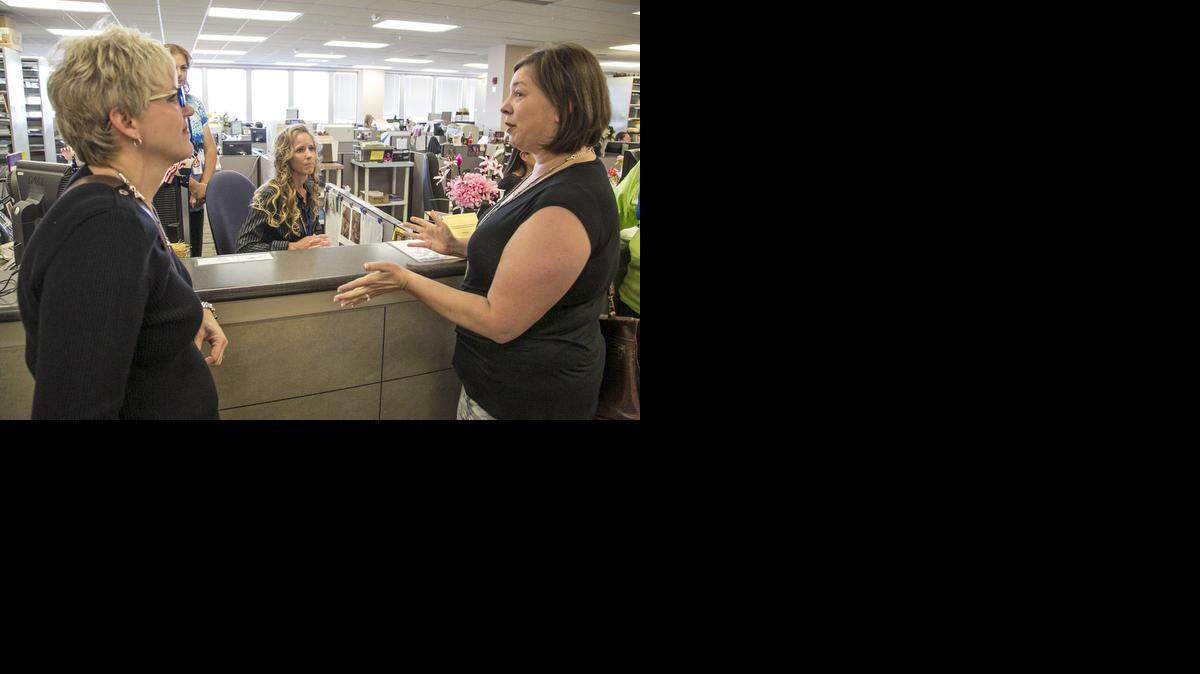
But when they went to the Sedgwick County Courthouse on Monday afternoon for a marriage license, they were turned away on orders from a district court judge. Several other same-sex couples were denied licenses by the county, as well.
“I guess I kind of knew there was a likely chance of being denied,” Heffron said, “but when it actually happened, I did start to tear up and become emotional. It is upsetting. We waited a long time, and now we’re still waiting.”
The Supreme Court cleared the way for an immediate expansion of same-sex marriage by unexpectedly and tersely turning away appeals from five states seeking to prohibit gay and lesbian unions.
Without comment, the justices brought to an end delays in same-sex marriages in five states – Indiana, Oklahoma, Utah, Virginia and Wisconsin.
Couples in six other states – Colorado, Kansas, North Carolina, South Carolina, West Virginia and Wyoming – should be able to get married in short order. That’s because those states are under the jurisdiction of the same three federal appeals courts involved in Monday’s ruling.
But the decision also has raised uncertainties and some anger. Kansas Attorney Gen. Derek Schmidt called the ruling “unexpected and disappointing” and said it avoided the issue, “ensuring that an already uncertain legal situation for Kansas and many other states will become even more so.”
The ruling is sure to generate more litigation and more uncertainty both for defenders of traditional marriage and for same-sex couples, Schmidt said in a written statement.
“To date, no Court has squarely decided whether the Kansas Constitution’s prohibition on same-sex marriage – adopted by voters less than a decade ago – is invalid,” Schmidt’s statement said.
And Gov. Sam Brownback issued this statement: “I swore an oath to support the Constitution of the State of Kansas. An overwhelming majority of Kansas voters amended the Constitution to include a definition of marriage as one man and one woman. Activist judges should not overrule the people of Kansas.”
The Kansas Supreme Court has given district court clerks no guidance on what they should do with requests from gay couples for marriage licenses. The court “does not decide questions of law until they are brought before the court,” spokeswoman Lisa Taylor said.
But Thomas Witt, executive director of the Kansas Equality Coalition, was optimistic.
“I think we’re looking at a matter of days, or weeks, before marriage equality comes to Kansas,” he said.
Witt said his organization is working with the American Civil Liberties Union of Kansas and Western Missouri to file a lawsuit on behalf of those couples who were denied marriage licenses in Sedgwick County. Doug Bonney, the ACLU’s chief counsel and legal director, said he plans to seek plaintiffs for a lawsuit in federal court and will likely ask for a preliminary injunction blocking the Kansas ban on same-sex marriage, Bonney said.
Kansas is under the jurisdiction of the 10th Circuit Court. So is Utah. In June, the 10th Circuit Court ruled in Utah’s case that banning gay marriage is unconstitutional under federal law. That ruling is binding here as well.
The ruling affected a 2005 state constitutional amendment in Kansas stating that “marriage shall be constituted by one man and one woman only” and all other marriages are void. The Kansas Legislature passed the amendment and voters approved it by a 70-30 margin.
The 10th Circuit Court had issued a stay on its June ruling, but lifted it Monday morning after the Supreme Court decision.
Okla., Colo. issue licenses
The county court clerk in Oklahoma City said his office began issuing marriage licenses to same-sex couples after the Supreme Court declined to hear an appeal in the case. Oklahoma County Court Clerk Tim Rhodes said his marriage license department was bustling with activity and that couples were waiting in the hallway to receive licenses.
Pueblo County, Colo., also began issuing marriage licenses to same-sex couples Monday.
But gay couples who showed up Monday afternoon at the Sedgwick County Courthouse were denied marriage licenses on orders from Chief Judge James Fleetwood. Fleetwood said he needed something official showing him that 10th Circuit Court of Appeals had lifted its stay.
“I’m still not in position where I have legal authority to issue any marriage license under the present circumstances with the law such as it is until I have something in hand other than a story in the newspaper that, in fact, the stay has been lifted and there’s no further proceedings on the matter,” he said.
He said he is obligated to follow the law as it is written until he has something in hand telling him otherwise. That could come within hours, or weeks, he said.
Kerry Wilks and her partner, Donna DiTrani, also were turned away at the courthouse.
Wilks said she was angry about it.
“This affects us not only on a personal level, it affects us on a financial level, and I am tired of morality being dictated by people who don’t even understand what they’re saying,” she said.
Same-sex couples said the Supreme Court’s ruling would finally grant them legal and financial privileges that civil unions don’t, such as hospital vistations, and tax and death benefits.
Wilks and DiTrani were married in Wichita two years ago, but it wasn’t legal.
“The fact is I will not accept something hollow,” Wilks said. “I should not have to be content to be less than what is afforded to any other person. It is not right.”
They decided not to go to another state where marriage is legal, she said.
“It made me angry to think that I would have to go to another state to practice a basic civil liberty,” Wilks said. “It made me angry to think I would come back and the marriage would not be recognized. I wanted to stay and fight for marriage equality.”
Reactions to court’s order
The board of the Kansas Family Policy Council, which opposes gay marriage, blamed activist judges. The council said in a written statement: “Marriage has always been – and will always be – between a man and a woman. No court can change that fundamental truth. KFPC will continue to address the importance of one-man, one-woman marriage to families, society and especially for children who have a right to both a mother and a father.”
Pointing to constitutional bans approved by voters in Kansas and other states, the family policy council statement said: “Activist judges across the nation have attempted to erase those votes. This demonstrates in a stunning manner that it matters who is elected to public office because those who are elected appoint and approve of these judges.”
Schmidt said in his written statement that his office is consulting with Brownback’s office and with other states affected by the Supreme Court’s decision, and will deal with pending or future litigation directly affecting the Kansas constitutional provision.
No other state cases were currently pending with the high court, but the justices stopped short of resolving for now the question of same-sex marriage nationwide.
Evan Wolfson, president of Freedom to Marry, called on the high court to “finish the job.” Wolfson said the court’s “delay in affirming the freedom to marry nationwide prolongs the patchwork of state-to-state discrimination and the harms and indignity that the denial of marriage still inflicts on too many couples in too many places.”
Ed Whelan of the Ethics and Public Policy Center, an opponent of same-sex marriage, also chastised the court for its “irresponsible denial of review in the cases.” Whelan said it is hard to see how the court could eventually rule in favor of same-sex marriage bans after having allowed so many court decisions striking down those bans to remain in effect.
Experts and advocates on both sides of the issue had expected the justices to step in and decide gay marriage cases this term.
The justices have an obligation to settle an issue of such national importance, not abdicate that responsibility to lower court judges, the advocates said. Opting out of hearing the cases leaves those lower court rulings in place.
Two other appeals courts, in Cincinnati and San Francisco, could issue decisions any time in same-sex marriage cases. Judges in the Cincinnati-based 6th Circuit who are weighing pro-gay marriage rulings in Kentucky, Michigan, Ohio and Tennessee, appeared more likely to rule in favor of state bans than did the 9th Circuit judges in San Francisco, who are considering Idaho and Nevada restrictions on marriage.
It takes just four of the nine Supreme Court justices to vote to hear a case, but it takes a majority of at least five for an eventual ruling. Monday’s opaque order did not indicate how the justices voted on whether to hear the appeals.
Contributing: Associated Press
This story was originally published October 6, 2014 at 10:01 AM with the headline "Sedgwick County gay couples refused marriage licenses after Supreme Court order."