
Wichita’s food charities find explosion of need
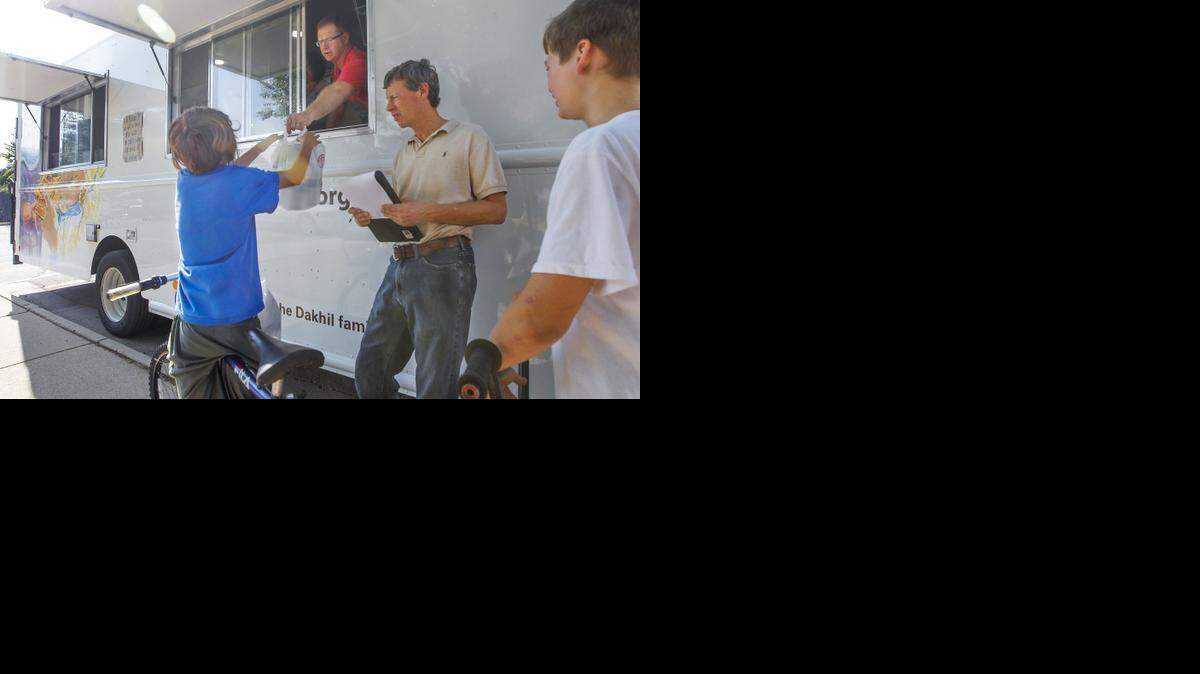
The girl in pink pants rolled up to the line standing outside the Lord’s Diner truck on a small bike with a pink-and-black frame.
She came alone, still wearing her Mayberry Middle Magnet School ID on a lanyard around her neck. She is 11, she said.
Ahead and behind her were 60 people, most of them white, all poor, some younger than her.
She’s one of the children Jan Haberly worries about these days.
A group of Catholic nuns, who have a convent in the area, urged Haberly to send food to the Hilltop neighborhood in south Wichita earlier this year. Haberly is director of the Lord’s Diner, a charity that feeds thousands of Wichita’s poor every night.
She began sending a truck loaded with boxed meals to the Hilltop Community Center in Friendship Park, near Harry and Oliver. Each box holds small amounts of meat, vegetables and fruit.
Staff members were disturbed by what they found.
“We thought we were doing an expansion,” Haberly said. “We found an explosion.”
As the Sisters of St. Joseph predicted, poor people came running, asking for meals. The diner people handed out 500 the first night.
That went to 700 in July. On July 31: 900. The number reached 1,200 meals a night last week.
Concerned, Haberly asked her staff to start asking questions of everybody coming to the truck. How many people in your household? How many children?
“We always wonder whether we are being taken advantage of,” said Paul Cater, the diner’s special projects manager, who helped hand out food from the truck at Hilltop last week. “We don’t think we’re being taken advantage of here.”
All across Wichita, food charities that serve the hungry and the poor say their numbers have risen significantly in the last year. About 14 percent of the people in Sedgwick County live in poverty, according to census data, which defines poverty as a family of four making less than $23,624.
Educators in Wichita schools by last May had found 2,700 children in the district who met the U.S. Department of Education’s criteria for being homeless. Wichita schools have tracked a steady, rapid rise in this number every school year: in 2011, they found 1,739; in 2012, 2,184.
Cynthia Martinez, the district’s official who tracks and tries to help homeless children, said it would have been unthinkable a few years ago to say that the district might eventually find 3,000 homeless children. But that number is within range now, she said.
The Bread of Life food pantry passes out boxes of food once a week in south Wichita. The pantry’s numbers jumped from 800 families seeking food per week last year to 1,000 each week now.
Rapid rise
What has Haberly concerned, she said, is that her surveyors say 60 percent of the people getting the meals are children. Many of the people who now stand in line are children like the girl in pink pants – unaccompanied.
The girl, who did want to give her name, said she was there to ask for food for herself, her mother and her two siblings. She said her mother has a job at a landscape company.
Sister Ann Catherine, a nun from the Sisters of St. Joseph, standing near her, said that the Sisters have helped the girl’s family pay utility bills several times in recent years. The girl smiled and nodded.
Many of these people, including the children, are asking for 10 or 12 or 14 meals apiece, Haberly said. They have told the diner truck staff that they are gathering them for households where two or more families are doubling up because of homelessness.
The diner is a nonprofit run by Catholic Charities. Haberly has worked for the diner for years and is accustomed to navigating political debates about the poor, she said.
“We always debate among ourselves about what we are encountering,” she said. “We ask questions, we try to be diligent and not let people take advantage. We try to work out whether we are enabling people.
“But when a lot of the individual people coming up to our truck in Hilltop are children, and sometimes without shoes, that pretty much answers that question, at least about that household, doesn’t it?
“We have found that an unaccompanied child coming up to the truck usually means not only that they need food in that house, but that the parents are working.”
Folks in need
It’s not about jobs; it’s about what kind of jobs people can get, food pantry leaders say.
Bread of Life surveys every family that comes in its door, and director Donna Pinaire said last week that “the majority” of people coming there – in addition to the elderly and children – are working people.
“They just don’t make enough to get by,” she said.
Brian Walker directs the Kansas Food Bank, which supplies much of the food that the Lord’s Diner and pantries like Bread of Life hand out.
“Life is hard enough for people who have what they need, but really hard for folks who don’t have what they need,” Walker said.
He said several factors created the current poverty. Overall, he said, employment looks OK, with only 5.7 percent unemployment in Wichita.
“But unemployment numbers don’t count the number of people who have given up looking for jobs,” he said.
There are many of those, he said. In addition, federal and state governments have cut back money spent on food for the poor or have tightened requirements.
That didn’t make the poor go away, he said. It has apparently increased the number of people asking for food from charities.
“I don’t think it is laziness,” Walker said. “It is part of our society that you are going to have folks in need. They may have made bad choices, but that doesn’t mean they should go hungry.”
The Lord’s Diner has never seen anything like the Hilltop situation before, Haberly said.
In 2013, the diner – which feeds hundreds of people a night at fixed locations downtown and in Planeview – began sending a truck loaded with takeout meals to the neighborhood around 25th Street and North Arkansas. That truck’s nightly delivery of meals leveled off quickly at about 550 a night, not even close to the 1,200 a night it hands out now at Hilltop.
“We’re trying to understand what we’re encountering now at Hilltop,” she said.
Walker said the explanation is probably simple: The Hilltop neighborhood never had the diner show up with a mobile unit before, so it’s no surprise the poor came out by the hundreds. The need was always there, he said.
The reason the food charities are keeping up with the demand so far, Cater said, is that people in Wichita are generous. Some people criticize the poor, he said. Many others give.
QuikTrip alone gives the Food Bank 1,000 meals a week, Haberly said.
“They keep careful track of how long their food has been out, and they pull it early, and give it to us,” she said.
Going without
Sister Ann Catherine, the nun who knew the Mayberry student, said the food will be a huge boost to a neighborhood where people are so poor that many can’t pay rent or utilities, or afford medicine.
The sister, 93, has been delivering food to shut-ins and other people in the community for 13 years; she has visited inside many of the homes of the people standing in line beside her on Monday night.
“Many of these people have jobs – they are not lazy,” she said. “But the jobs are minimum-wage.
“A lot of people here grew up this way. They don’t know any other way of living; it’s how they grew up. So they don’t get the education they need to get out of this life.”
Ahead of her, toward the front of the line, a young mother was waiting, holding the hand of her small son. Like everyone else in line on this night, she declined to give her name.
Both she and her husband work jobs at a Wichita manufacturing company, she said. Both earn $9.50 an hour, she said. That pay, plus food stamps, gives her family enough to live on, she said.
“But I am here now because we are out of money, and I don’t get paid until Friday,” she said.
It’s the low cost of the housing that draws the poor to live in the Hilltop neighborhood, Sister Ann Catherine said. But many of them are so poor that they stop paying rent—and find yet another apartment after they get evicted.
Many of them go for days without showers, for weeks without utilities, for summers without air conditioning. Many go without cars, she said. Most are not starving, she said, because adequate food is the one basic need they prioritize.
What the diner food will do, she said, is save them money that they will likely use to buy more food, perhaps bringing more variety into their diet – more vegetables, more fruit.
In all directions
Sister Ann Catherine, standing to the side of the long line near the diner truck, pointed with her cane to various people she knew, telling their stories in brief. Mothers, children, the grandmother in a wheelchair off to the side.
Most people in line are white; there are a few people of Asian or African-American ancestry. Many are elderly. It was hot on this Monday, in the mid-80s, and people were sweating.
“I know some people say these people have it easy,” Sister Ann Catherine said. “But why would anybody come out and stand in the hot sun day after day, and in the rain, for a little food?”
At the head of the line, the girl in the pink pants, from Mayberry Middle Magnet School, told the diner people at the truck that she needed four meals: one for her mom, three for the kids.
Around her, for a half-mile in any direction, on all the streets radiating out from the Lord’s Diner truck, were dozens of people who had stood in line ahead of her. They walked home, carrying bags loaded with food, some of them carrying one meal, some carrying six, eight, or 10 or 14 meals in bags held in each hand.
The girl in the pink pants carried the four meals in two plastic bags, and draped one bag apiece over the handle bars of her pink-and-black bicycle.
She had to be careful not to tip over, or spill the bags. Getting the bike going was a tricky move.
But once she got going, she rode away.
Reach Roy Wenzl at 316-268-6219 or rwenzl@wichitaeagle.com. Follow him on Twitter: @roywenzl.
This story was originally published October 4, 2014 at 8:45 PM with the headline "Wichita’s food charities find explosion of need."