
Proposed sales tax would target fixing the worst of Wichita’s streets
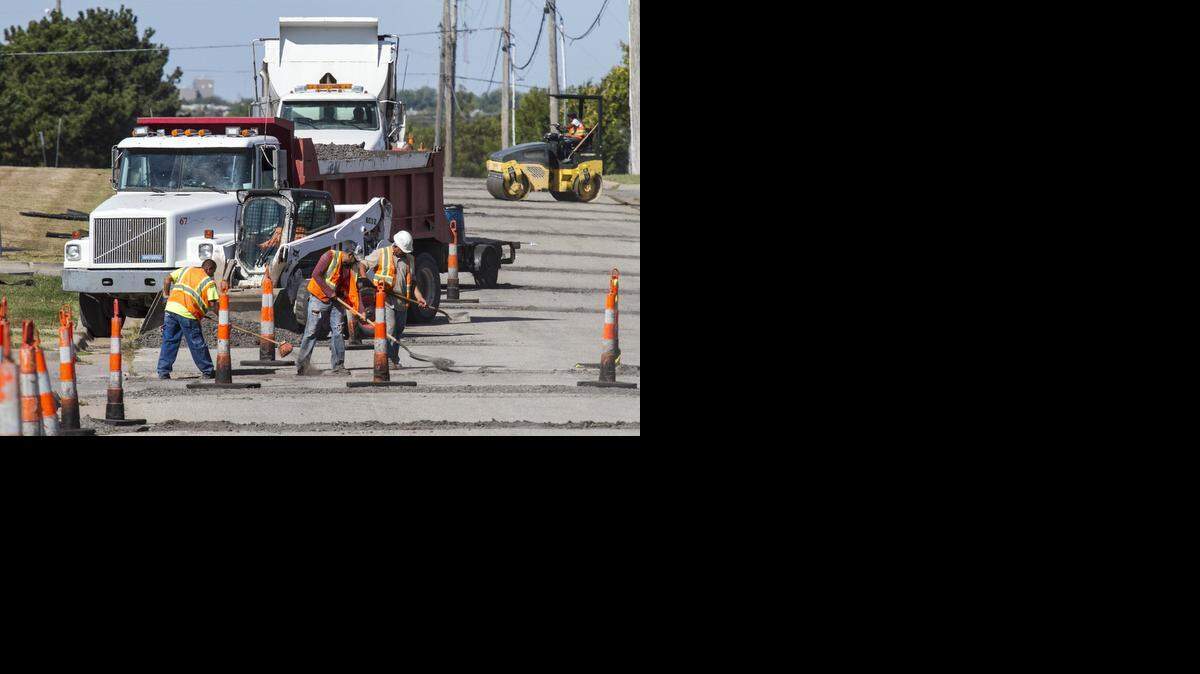
Almost a fifth of Wichita’s streets need to have a load of temporary repairs made every year just so folks can drive on them.
That’s patching on top of patching. Those streets have more than their share of the city’s annual outbreak of 50,000 potholes.
Of the city’s nearly 5,000 lane miles of paved streets, 927 fall in the decrepit category: still usable, but rough to drive over and not fun to use.
A street 5 miles long with two lanes would have 10 lane miles; a 5-mile street with four lanes would have 20 lane miles.
The city’s streets have woes beyond those 927 lane miles. Many are long past simple resealing – at a fraction of the cost of more expensive repairs – to keep them functioning like new.
Making all streets brand new would be cost prohibitive. But city officials know they need to do better with what they have.
“No one wants to drive a clunker or on a street that’s a clunker,” said Alan King, director of public works and utilities.
How did we get in such shape? Two main reasons.
City officials had a poor understanding of how much money was needed to maintain streets long term. And by long term, we’re talking decades.
On top of that, officials often shifted money from street repairs to other areas to balance the city’s budget.
That’s called deferred maintenance, which has become a national trend. This country has $3.6 trillion in deferred maintenance for all types of infrastructure, according to the American Society of Civil Engineers.
“Deferred maintenance shouldn’t be a surprise when the public is sending a very strong message that we don’t like taxes and don’t like taxes raised,” said Nancy McCarthy Snyder, director of Wichita State University’s Hugo Wall School of Public Affairs. “That’s the reality of the situation.
“And we shouldn’t be surprised for a city like Wichita, which takes pride in not raising its mill levy for more than 20 years.”
The loudest political voices have called for keeping it that way, she noted. At the same time, public input over the last year indicates that, among other things, residents want better streets.
In an attempt to catch up at least a little on the worst of the bad streets, the City Council decided to include street repairs and maintenance when it placed a proposed 1-cent sales tax on the Nov. 4 ballot.
The tax is projected to raise more than $400 million over the next five years before it expires after 2019. A new water supply, job development and public transit also would share in the revenue.
Street maintenance would get the smallest amount – $27.8 million.
That $27.8 million would be used to either rehabilitate or replace 111 lane miles that are included in the 927.
Most of the 927 lane miles and all of the 111 targeted for fixing by the sales tax money are neighborhood streets.
Arterial streets have received the best care because everyone drives on them, King said, “but we’ve pretty much neglected neighborhood streets.”
Fixing the 111 lane miles – scattered across older areas of the city – is about customer satisfaction after years of neglect.
Budgeting inconsistencies
Such routine maintenance work as filling potholes and patching is done out of an in-house budget that stays around $5.5 million yearly.
Bigger projects – repairing thermal cracks, overlays, rehabilitation and reconstruction – are funded from a separate budget and contracted out.
There hasn’t been anything consistent about that budget.
For many years, King said, a figure was put in the budget without any real idea what the amount would do for the streets. Just since 2009, the budgeted total has ranged from $6.6 million to $9 million.
“They knew that was a lot of money and did some work on the streets,” said King, who took over as head of public works and utilities in 2012. “But there wasn’t a model that showed the streets degrading and the rate of degradation.
“They just knew that was what the budget could accommodate.”
The inconsistency resulted in a poor long-term plan for keeping the streets in good condition.
More recently, a second factor cut into helping streets.
In wake of the economic recession, city officials pulled money out of the contracted maintenance budget to keep the city’s budget balanced.
For example, $7.7 million was budgeted for contracted maintenance in 2009 but only $4.6 million was spent. In 2012, $8 million was budgeted but $5.6 million was spent.
City officials and residents couldn’t see the effect of both factors in the short term.
“If you do that year after year,” King said, “it does have an effect as you accumulate deferred maintenance.”
New approach
The old way has been to build a street, then grind it down and replace it after it begins to show some wear – usually halfway through its average 40-year life cycle.
“That’s very expensive,” King said.
Grinding a street and overlaying it with asphalt costs $12 per square yard. Asphalt reconstruction costs $35 per square yard.
King and his staff changed that approach this year.
Based on past maintenance costs, street conditions and projections, they established a model to measure the effect of spending and best approaches.
That includes keeping new streets new, King said.
Many of the city’s streets are still new enough that resealing can be done to keep them new. Resealing costs $1 to $3 per square yard.
“It’s like the siding on your house,” King said. “If you keep it painted when it needs it, it’ll last forever. If you don’t, eventually you’ll have to replace all the siding on your house.”
Of course, many streets have gone way past being helped by resealing. Those 927 miles that need significant yearly repair are among them, but others fall somewhere in between that and are still relatively new.
Thermal cracks – those gaps of 1 or 2 inches that run from curb to curb and are caused by temperature changes – can be fixed for $2.10 per square yard, King said.
The high-maintenance 927 miles, including the 111, can only be fixed long term by reconstruction or rehabbing, King said.
The model also suggests that $8 million for the yearly contracted maintenance budget is “not an unreasonable baseline,” King said.
City Budget Director Mark Manning cautioned that a variety of factors could lower that amount. At the same time, he noted that City Manager Robert Layton has said his goal is to bump the amount up to $10 million.
The model also uses a formula that establishes the value of the city’s streets, giving officials an idea of whether they’re putting enough money into maintenance each year, King said.
If all the streets were brand new, they would be worth $1.6 billion. If the old ways of maintaining streets were to continue, the value would plunge to $80 million in 40 years, the model shows.
Following the new approach, including annual spending of $8 million for contracted maintenance, the value would be $458 million in 40 years.
And if the sales tax passes, adding the $27.8 million over five years to fix up the 111 most woeful lane miles, the value would be $520 million in 40 years.
That same process would give city officials an idea how many lane miles they would need to reconstruct annually.
If past methods continued, that would jump from 927 lane miles to 4,113 in 40 years – or almost all of the city’s streets.
The new approach would mean 2,729 lane miles would need annual work after 40 years. Using the $27.8 million would reduce that to 2,384.
Old cars, old streets
There’s value in having good assets, King noted. For starters, customer satisfaction.
“I would hazard to say it’s probably cheaper to keep putting money into a street – pothole after pothole – than buy a new one,” King said. “But, boy, people are going to be unhappy with the performance of that street.
“You’re always out there doing repairs. It would be kind of like your car always breaking down, having to get a ride to work, waiting to get it out of the shop.”
Like the streets, it’s probably less expensive to keep fixing up the old car than buy a new one. “But it’s inconvenient,” King said.
Drivers don’t like their streets to be inconvenient – filled with cracks and potholes – or constantly waiting for repairs, he added.
With the 927 lane miles that need constant repair, he said, “You are meeting a minimum service level. People are unhappy with the performance of that street.”
As part of the city’s plan over the next five years, the $8 million in annual contracted maintenance would go to fix 1,853 lane miles spread over the city. That figure bumps up to 1,964 lane miles if the sales tax passes and the $27.8 million can be used to reconstruct or rehab the 111 lane miles that now need yearly work.
The rate to fix up one lane mile out of the 111 would be more than $250,000 – way, way over the nearly $21,600 it would take per lane mile on the other 1,853.
“Rebuilding roads is very expensive,” King said.
The number of lane miles being fixed varies widely from one council district to another. That’s because the new approach is aimed at “keeping the newer streets newer,” King said.
There are fewer new roads in District 3 – in the city’s south end – so that area is scheduled to have 179 lane miles fixed over the next five years.
Growth in the last 15 years has come on the west and east sides, where the newer roads are. So District 2 in the east is scheduled to have 444 lane miles repaired; Districts 4 and 5 toward the west are set for 432 and 392 miles, respectively.
It generally costs more to do the work on the older streets, which is why $15.3 million is allotted for 255 lane miles for District 1 in the northeast.
Many of the newer streets can be treated with resealing, King noted.
The district figures would be adjusted to take out the 111 lane miles if the sales tax doesn’t pass. Unpaved streets wouldn’t be addressed with sales tax money, King said.
Even with all that, there is plenty of catching up to do. If the sales tax passes in November, city officials have the option of asking voters to extend the tax after five years, though it’s too early to say whether that would happen.
“To get a better outcome, you need more money – whether it’s another sales tax or more than the $8 million (for contracted maintenance),” King said. “It’s about what kind of minimal level you want for the streets.”
But he said those are policy decisions to be made by the city manager and City Council.
“We’ll let the sales tax turn out however it turns out,” King said. “The staff will be working on whether the $8 million is the right number. We’ll give the council some choices and let them decide.”
Reach Rick Plumlee at 316-268-6660 or rplumlee@wichitaeagle.com. Follow him on Twitter: @rickplumlee.
Proposed contract maintenance by district
If the sales tax passes, the city plans to spend $67.8 million over five years from 2015-19 on contracted maintenance. Without the sales tax, the city expects to spend $40 million over those same five years and repair a total of 111 fewer lane miles.
Lane miles | Spent over 5 years | |
District 1 | 255 | $15.3 million |
District 2 | 444 | $8.8 million |
District 3 | 179 | $9.7 million |
District 4 | 432 | $14.5 million |
District 5 | 392 | $8.9 million |
District 6 | 262 | $10.6 million |
Total | 1,964 | $67.8 million |
Source: City of Wichita
Contracted street maintenance
Year | Adopted budget | Amount spent |
2009 | $7.7 million | $4.6 million |
2010 | $9.0 million | $5.2 million |
2011 | $6.6 million | $6.3 million |
2012 | $8.0 million | $5.6 million |
2013 | $6.7 million | $6.0 million |
2014 | $8.0 million | *$8.0 million |
*Budgeted amount still available and will be spent.
Source: City of Wichita
To learn more
Here are options to find out more about the sales tax proposal or to get involved in a campaign.
City of Wichita
For information provided by the city about the sales tax proposal, go to www.wichita.gov/salestax.
Coalition for a Better Wichita
This group opposes the sales tax. To volunteer, get a sign, donate or ask questions, contact it at:
Phone: 316-253-2452
E‐mail: Jennifer@abetterwichita.com
Website: http://abetterwichita.com/
Yes Wichita
This group supports the sales tax. To volunteer, get a sign, donate or ask questions, contact it at:
Phone: 316-990-4212
E‐mail: YesOnNov4@VoteYesWichita.com
Website: www.VoteYesWichita.com
Send us your sales tax questions
What would you like to know about the proposed 1-cent sales tax?
The proposed tax, which would collect 1 cent per dollar on purchases in the city, is expected to generate about $400 million over five years to pay for a water source, street maintenance, transit and job development in Wichita.
The Wichita Eagle will work to answer your questions about the tax, which will be on the November ballot.
Send your questions to reporter Kelsey Ryan at kryan@wichitaeagle.com or call 316-269-6752.
This story was originally published September 27, 2014 at 3:43 PM with the headline "Proposed sales tax would target fixing the worst of Wichita’s streets."