
Growing demand for rail service bolsters growth of train-related facilities in Kansas
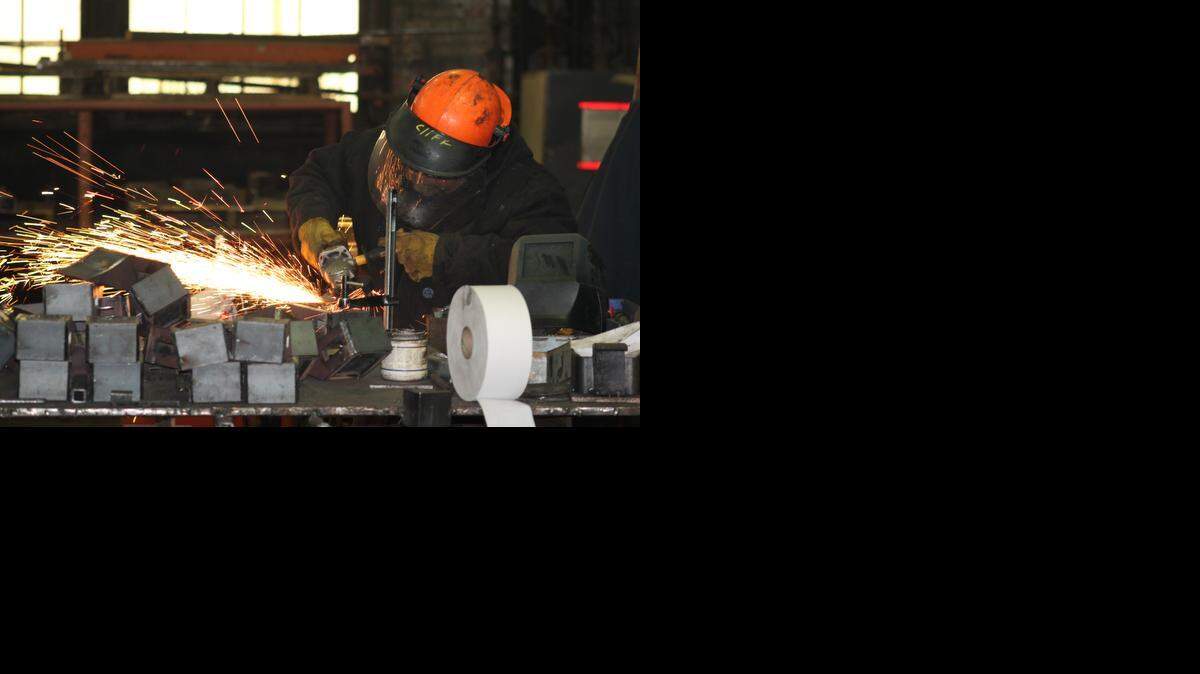
Terry Peterson sees opportunity within the walls of a nearly century-old repair shop in Parsons to serve the former Missouri, Kansas & Texas Railroad, also known as the “Katy.”
Peterson, the president of an Omaha-based railroad services company, partnered with Mike Williams of Williams Group in Missouri to re-establish a railcar repair facility and open a manufacturing operation there called TM Track Machines.
The company launched in January with 20 employees. Today, TM Track has 47 employees.
The 240,000-square-foot building was previously home to the Kanza Group Rail Repair Shop, which the Kansas Department of Revenue closed in August 2013 because of unpaid state sales and withholding taxes totaling $1.15 million.
“Everything we do is related to the railroads,” said Peterson, president of Omaha Track, a 31-year-old company. “We like the business. It’s a vibrant industry right now.”
Vibrance in the railroad business is why most of the laid-off employees of Kanza Group have a job today. It’s also driving an Illinois-based company to establish a similar but larger operation in Hutchinson. And it’s why Pittsburg-based Watco – owner of the Kansas & Oklahoma Railroad in Wichita – this summer forged a joint venture to establish a national network of railcar repair shops.
Peterson calls the present-day railroad business the “rebirth” of a golden age in railroads.
His assertion has some merit.
“The nation’s freight railroads are moving more traffic since before the last recession,” said Ed Greenberg, spokesman for the Association of American Railroads, a Washington, D.C.-based trade group for the largest railroads in the U.S., Canada and Mexico. “Rail is playing a more critical role in getting goods to the market.”
Greenberg said in the first 10 months of 2014, U.S. railroads moved about 24.3 million carloads and intermodal units (which are cars specially designed to carry shipping containters and truck trailers), up 4.5 percent from a year ago. That figure is also the highest year to date total since 2007, he said.
Union Pacific, one of the country’s largest railroads operating in Kansas, reported last month “all-time quarterly highs” in operating revenue of $6.2 billion and operating income of $2.3 billion.
“We are optimistic about the remainder of the year,” Union Pacific CEO Jack Koraleski said in an Oct. 23 news release. “Assuming the economy and weather cooperate, we are well positioned to finish up the year with record results.”
Likewise, BNSF Railway said its revenue in the third quarter of 2014 was up 4 percent from a year ago to $5.9 billion and net income was up nearly 5 percent to $1.04 billion. BNSF is the another major U.S. railroad with significant operations in Kansas.
Strong business for major railroads means good business for companies that support them, Peterson said.
He said that he leveraged Omaha Track’s relationship with UP (also based in Omaha) to the benefit of TM Track, which repairs railcars that UP uses to maintain tracks, also known as maintenance of way railcars. UP has a major train yard in Parsons.
“They have a fairly large fleet” of maintenance of way railcars, Peterson said.
Because business is good for the railroads, they are investing in their rail lines and equipment, he said.
That’s where the other part of TM Track’s business, comes in. The company also manufactures and refurbishes tampers. Tampers are large pieces of equipment that travel on tracks and pack down the ballast underneath railroad tracks. Peterson said buyers of tampers are railroads as well as companies that contract such services for railroads, and leasing companies.
Between strong business for railroads large and small, and major capital investment in their rail lines, he’s betting on strong demand for tampers as well.
“That’s why we think it’s a good business,” Peterson said. “We think the opportunities down there are tremendous. I would be surprised if we didn’t have 100 employees down there in the next couple of years.”
That’s an important number because TM Track received a $400,000 incentive package from the city of Parsons in February, including a $300,000 loan that will be forgivable if the company creates 80 jobs in 3 1/2 years.
Carolyn Kennett, Parsons’ economic development director, likes the sound of 100 people being employed in her southeast Kansas city of 11,514 residents.
“Especially with them creating a lot more jobs than what was lost (when Kanza closed last year),” she said. “It will have a great impact on the economy here.”
Kennett said it was a difficult time when Kanza closed.
“Anytime you lose an industry or business, it’s devastating to a community, especially when a community is based on the rail history,” she said. “Katy railroad, that’s really what created the community. They (the Kanza jobs) were good paying jobs. To have that loss, it was devastating.”
Kennett said Peterson wasn’t the only one expressing an interest in the Kanza property following the company’s closing.
“We had quite a bit of interest from several different companies,” she said.
TM Track is just one piece of railcar repair revitalization underway in Kansas.
Tank car demand
Mervis Industries of Danville, Ill., announced plans in October to build a $35 million railcar refurbishing facility that will be capable of receiving and servicing a 100-unit train.
The facility will comprise four buildings – two that will be about 100,000 square feet and two that will be about 25,000 square feet – and six miles of new track, said Larry Culligan, director of railcar operations for Mervis Railcar. Culligan will oversee Mervis Railcar in Hutchinson.
The company expects to hire up to 150 employees over three years.
He hopes that construction will begin in February, with the facility fully operational in March 2016.
Culligan said the company scouted a number of locations in Kansas and Missouri for Mervis Railcar. He said it chose Hutchinson based on a number of considerations, including rail service provided by both UP and BNSF and “a very nice flat site … you won’t want hills with a rail yard.”
He said repair and retrofitting tank cars will be Mervis Railcar’s primary focus. That includes tank cars that haul crude oil, regulation of which is expected to get more stringent.
The federal Department of Transportation has proposed a set of new rules for tank cars that includes retrofitting tank cars that carry flammable materials such as fuel and crude oil.
Companies such as Mervis are expecting the new tank car rules to mean an increase in tank car repairs and modifications.
Those pending changes are partly behind Watco’s joint venture with Greenbrier Cos. of Lake Oswego, Ore., in July.
The joint venture, called GBW Railcar Services, comprises 38 facilities across North America. Separately, Watco operates 15 repair facilities and Greenbrier operates 23. In Kansas, there are GBW Railcar facilities in Atchison, Coffeyville, Junction City, Neodesha, Osawatomie, Pittsburg and Topeka.
Greenbrier and Watco said in a news release announcing the joint venture that the new federal rules are expected to result in increased business for repair facilities.
It’s not clear how much effect the recent tumble in oil prices will have on the repair and replacement of tank cars.
Sterne Agee analyst Sal Vitale said in a note to investors that Greenbrier’s stock price volatility this week is thought to be the result of investors’ concerns that a continued decline in the price of crude will reduce U.S. shale oil production and future demand for tank cars.
But Vitale said in the note that he thinks “tank car replacement will still occur even in a lower oil price environment.”
“Even in a sub-$70 price environment, we believe GBX will still benefit from an imminent tank car replacement cycle,” Vitale said in the note. “We expect the U.S. government to issue a final rule in 1Q.”
Watco and Greenbrier officials noted in announcing the joint venture that while 14 of its 38 facilities would specialize in tank car retrofitting and repair, “all 38 locations can perform the type of general freight car repair and maintenance services that are consistently in demand.”
Reach Jerry Siebenmark at 316-268-6576 or jsiebenmark@wichitaeagle.com. Follow him on Twitter: @jsiebenmark.
This story was originally published December 3, 2014 at 5:32 PM with the headline "Growing demand for rail service bolsters growth of train-related facilities in Kansas."