
Speakers at Wichita Area Economic Outlook Conference advise: Embrace business landscape’s ‘new reality’
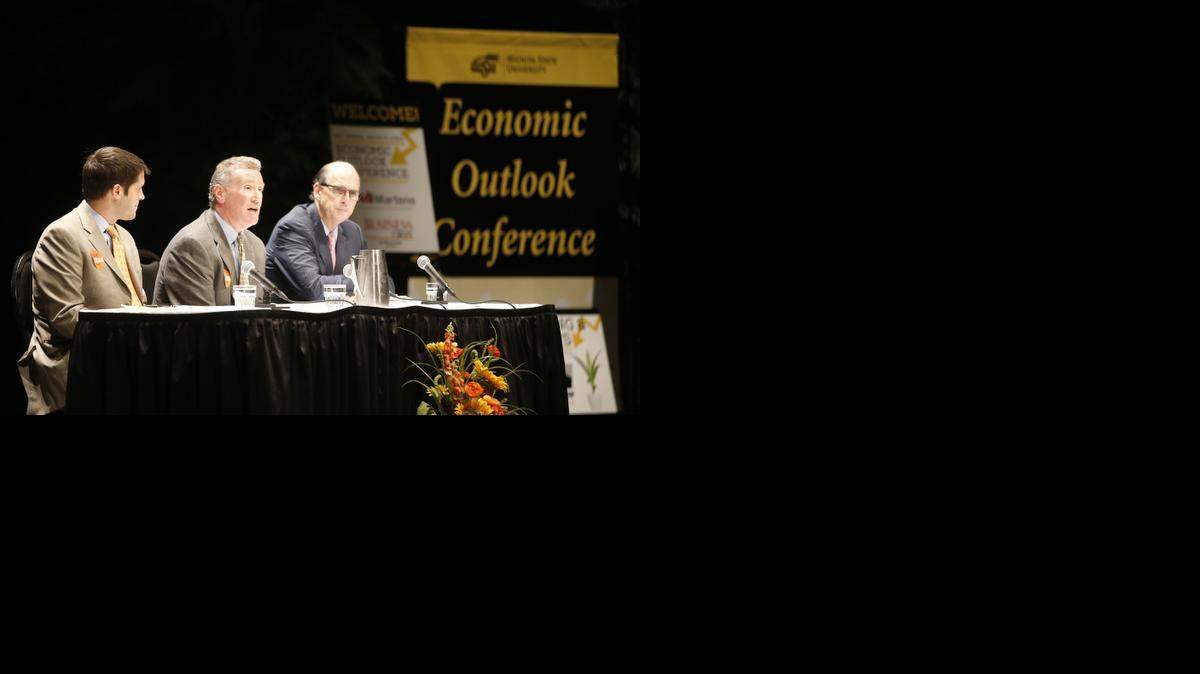
The big theme at Thursday’s Wichita Area Economic Outlook Conference: It’s different now – and not always for the better.
By that, speakers on topics as varied as the airline industry, the retail industry, the local economy, restaurants, retailers and aircraft makers mean that the recession has changed some the fundamentals of their business.
Waiting out the recession wasn’t enough; they have to adjust to a myriad of factors, including new customer expectations and behaviors.
William Swelbar, an expert on the airline industry, said that the economics of airlines have changed dramatically since the spike in oil prices in 2008 and recession in 2009. The industry has finally learned discipline: It has consolidated, cut seats and raised prices to remain consistently profitable for the first time ever.
But that also has meant the loss of flights to many smaller cities.
Wichita, on the other hand, has seen growth of about 9 percent in seats since 2012, pulled by Southwest Airlines increasing its route structure.
“Wichita is kind of the exception instead of the rule in that, over the last few years, Wichita has realized some real growth in seats and departures,” he said. “This is a really nice trend.”
But what appears to be a more or less permanent increase in the price of jet fuel and higher maintenance costs means that planes with fewer than 100 seats are becoming uneconomical. Swelbar also sees a looming pilot shortage, which will have a tremendous effect on smaller airlines that fly turboprops and commuter jets to small airports, he said.
The implications for Kansas are huge, he said, because 81 percent of the capacity that serves Kansas, including Wichita, is in planes with 50 or fewer seats.
The potential for losing routes or losing service altogether at smaller airports is growing.
“So there’s a lot at risk here and a lot of things to understand will have some impact on the communities around the state,” he said.
The theme of how business is different now came through loud and clear during a panel discussion that included of Jerry Jones, vice president with Slawson Cos.; Jon Rolph, president of restaurant company Sasnak Management; and Jack Kleinhenz, economist with the National Retail Federation.
Kleinhenz first spread the goodish news of a predicted 4.1 percent increase in holiday sales for retailers nationally.
He also said that the federation is expecting steadier economic growth, income growth and job growth nationally in the coming year.
And he noted that on the retail front, some types of businesses will see growth limited by the rapid expansion of e-commerce, which is now about 6.5 percent of all retail sales.
“I’m often asked if e-commerce will take over retail,” he said. “I don’t think so. I think brick and mortar will remain a key part of retail.”
Wichita is seeing some benefit from the same rises in jobs and income, said Jones. The tenants at his company’s shopping centers, such as NewMarket Square, are optimistic about the coming season and year.
“With nationally improving fundamentals, prospects for restaurants and retail should get a boost,” Jones said.
Rolph, who’s restaurants include Carlos O’Kelly’s, said the casual dining segment has been hurt by the fact that there are 2.8 million members of the middle class who lost their jobs in the recession.
Consumers tend to still be very value-conscious, he said. The fast casual category is seeing a lot of growth as economically stressed consumers look to stretch their dollars.
“One of the questions customers are asking is whether a server is worth a 15 percent up-spend,” he said.
Justin Salmans, vice president for supply chain management at Textron Aviation, said during a panel discussion about the local economy that his company is figuring out how to navigate in a new market – one that doesn’t seem to desire small business jets as much.
The jet market has split into two, between large and small jets, he said. The buyers of large jets have tended to use cash. That market has remained robust.
But those who bought jets with a range below 3,000 miles tended to finance the purchase with credit, which largely dried up during the credit crunch and hasn’t fully recovered.
“The old measures we looked at, cash on hand, corporate profits, are not as sticky as they used to be,” he said. “We’ve had to be more flexible in the things we look at than we used to be.”
Jeremy Hill, director of the Center for the Economic Development and Business Research at Wichita State University, forecast that the Wichita area will gain about 4,500 jobs in 2015, and that some sectors will see solid growth.
But he, too, cautioned that things have changed. The aircraft industry isn’t just suddenly going to rebound next year, hire 10,000 people, and cause the city economy to snap back. Wichita is locked into slower growth until it can figure out how to engage its thousands of skilled, but unemployed and underemployed production workers.
“This is the new reality,” he said. “We are going to have to deal with it.”
Reach Dan Voorhis at 316-268-6577 or dvoorhis@wichitaeagle.com. Follow him on Twitter: @danvoorhis.