
Why more change is coming to high school state track qualifying in Kansas
Qualifying for the Kansas state high school track and field meet already featured a new twist this season, but more changes (and more qualifying spots) are expected to be announced later this summer.
The expected changes stem from Wichita State’s ambitions to turn the remodeled University Stadium, formerly Cessna Stadium, into a premier collegiate track and field facility, which will include install a 9-lane track — widened from the current eight lanes — this summer.
The extra lane on the track means a potential extra spot in each preliminary race at the state track meet, a vacancy that the Kansas State High School Activities Association told The Eagle that it plans on filling.
“We’ve talked about it some internally and I’ve had some informal conversations with coaches around the state and we do anticipate filling all of the lanes,” said Kyle Doperalski, KSHSAA’s track and field administrator. “But nothing has been decided for sure.”
WSU’s facility upgrade makes it a formality that there will be an increase in state qualifiers, from 16 up to 18, in all 18 events for next year’s state meet. That’s the easy part.
The hard part is determining how the 18 state qualifiers are decided, a contentious debate among track and field coaches from around the state with seemingly no majority close with this year’s state meet slated to begin at University Stadium on Friday.
“It’s a complicated issue and I’m sure no matter what system we end up going with, there are going to be issues that arise,” Cheney coach Rich Simmons said. “And it’s hard to get everybody on board for the same system, to get enough push behind one idea. There’s so many different ways to approach advocating for change and it seems like we’re all on different pages right now.”

Proposals to change Kansas high school state track qualifying
Three proposals are currently being voted on by Kansas high school coaches and considered for implementation by the KSHSAA executive board.
- The first model would be a continuation of this year’s changes in qualifying, which would maintain the 4-regional format with the top-3 in each event automatically qualifying. The remaining six entries to state would go to the best performance, regardless of regional.
- The second model would revert to the old style in qualifying, which would also maintain the 4-regional format but would automatically qualify the top-4 in each event. The remaining two entries to state would go to the best performance, regardless of regional.
- The third model would be the most drastic change and follow the NCAA model of creating two “super” regionals in each classification with 18 teams competing in each regional with the top-9 finishers in each event qualifying for state.
According to Doperalski, the earliest a proposal can be approved is at the June 11 meeting for the KSHSAA executive board.
But the more likely scenario is for officials to take the summer, if not the fall, before making a decision on how state qualifying will change for the 2026 state meet.
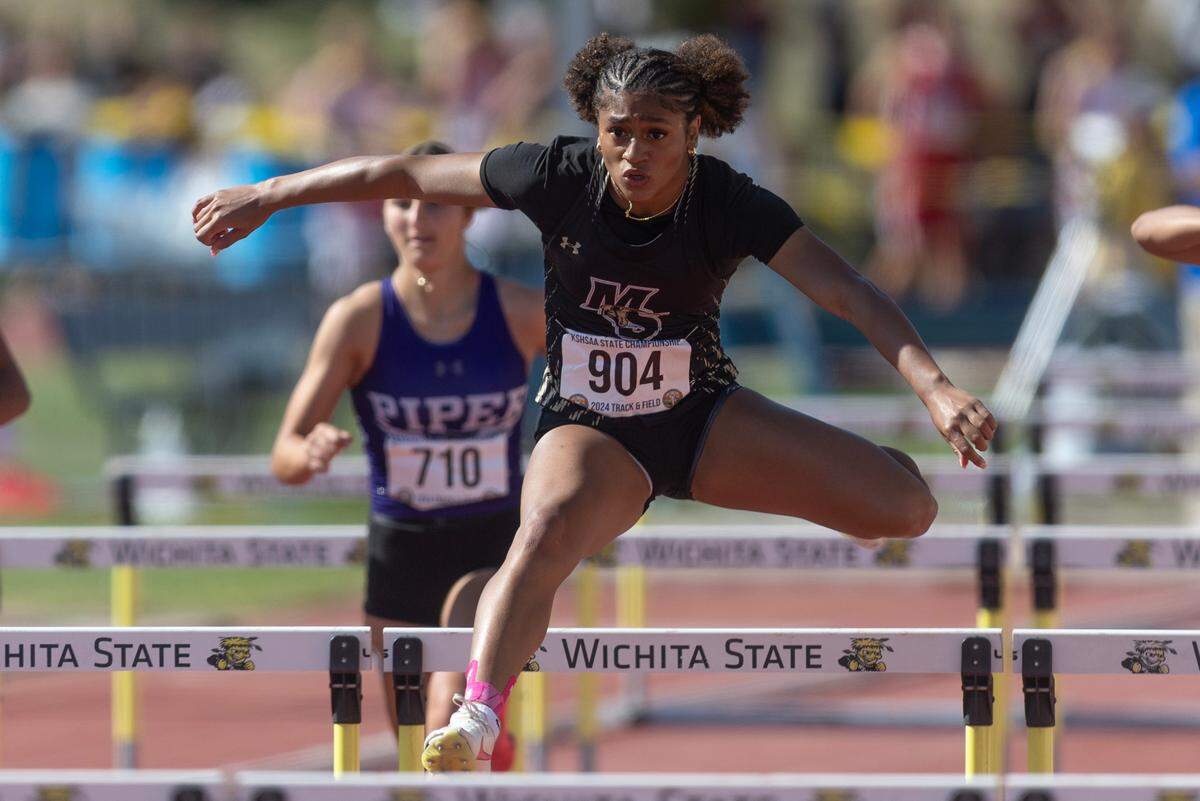
Debate on state qualifying rages on with Kansas track coaches
Qualifying for the state meet took a twist this season, as the KSHSAA scrapped the previous model where the top-4 finishers in each event at four regionals automatically qualified. Only the top-3 spots in each event were guaranteed to go to state in each regional, as the final four qualifying spots went to the four best performances, regardless of regional.
In theory, the new format ensures the best competitors, regardless of regional, advance to the state meet.
But after the new style was implemented for the first time last week, several coaches took issue with how the changes played out in practice.
“It’s just hard to do that with the shorter races and the jumps,” Cheney coach Rich Simmons said. “If you’re looking at long jump and there’s a regional with a cross-wind and then there’s another regional with a tail wind, that can make a 6-inch difference. So it ends up not being about the caliber of athlete, it’s about the conditions of the site and that’s not great.”
“You could be at a regional in Liberal and there’s a 40-mph tail wind or you could be at one in Olathe with 8-mph wind because you’re in the city,” Bishop Carroll coach Cory Swords said. “So I don’t really like my kids competing against kids at a regional that is 130 miles away with different officials on a different track with different weather conditions. I want to be able to coach my kids against who it is that they have to beat in order to make it to state.”
Proponents who are in favor of opening up the state field to six “at large” spots argue that there are too many instances in the past system where potential state medalists don’t qualify for the state meet when they are stuck in a loaded regional.
It was not unusual under the past rules for there to be an event or two in every regional that featured five or six of the best competitors in the classification in the same regional with only four available spots. Expanding the “at large” berths would expand opportunities for several athletes in a loaded regional to still qualify for state.
That’s why some coaches, particularly the Class 6A and 5A coaches in the Kansas City area, are pushing hard for the change to a super regional format. Each classification would be split into two 18-team regionals, either East/West or North/South, with the top-9 in each event advancing to the state meet.
Of course, that would create the challenge of finding enough 9-lane tracks, which are limited, to host the regional meets.

Consequences to field events for increasing state qualifying
There’s no question adding two more qualifiers to each event will expand opportunities for more athletes to experience the unique atmosphere for the Kansas state high school track and field meet.
But the increase in state qualifiers will almost assuredly force the KSHSAA to adjust its state meet schedule, at least for field events.
Adding two competitors to each event may not sound significant, but it is for a state meet that includes all six classifications for both genders. The extra slots will likely introduce hundreds of new athletes to the state meet.
The new 9-lane track should keep the meet on schedule for the track, but the additional two competitors in every field event means an extra six attempts in preliminaries. And that means the current schedule — no field event begins earlier than 8 a.m. or later than 6:30 p.m. — likely won’t be possible.
“We may have to adjust our schedule a little bit because our field events are tight as they are,” KSHSAA executive director Bill Faflick said. “You add a few more kids to every field event and over the course of a day, we may run out of daylight. So we may have to modify the schedule a little bit.”
Will that impact the decision to include field events in the increase in state qualifying for next year?
“It’s all part of the conversation,” Doperalski said. “It’s a great question and one that we’re still working on and wrestling with and talking about. Nothing has been decided yet.”
This story was originally published May 29, 2025 at 7:02 AM.
.jpg)