
This Maize High grad has become a crucial voice for Black softball players everywhere
From growing up in Arkansas City to finishing high school at Maize to her collegiate career at Florida to playing for Team USA, Kelsey Stewart is used to being one of the only Black players on her softball team.
Throughout her life in the softball world, Stewart, 25, has experienced overt racism, such as being subjected to racial slurs. And she has experienced covert racism — “backhanded” racism, as she calls it.
Like the assumption that because she is Black, she is fast and would play in the outfield (she became an All-American infielder at Florida), or the expectation that Black players should wear their hair in a certain style (straightened).
“I noticed pretty early on that there weren’t a lot of girls that looked like me playing softball,” Stewart said.
Until two weeks ago, Stewart felt like she had neither the voice nor the platform to spark change. That switched when Connie May, the general manager of Stewart’s professional softball team, Scrap Yard, posted a since-deleted tweet on the team’s official account of the players standing during the national anthem.
May tagged President Donald Trump’s Twitter handle with a message that ended with “Everyone respecting the FLAG!”
After a botched apology by May following the squad’s June 22 game, all 18 Scrap Yard players and their coaches quit the team. They have since formed a new team — This Is Us — with Stewart becoming one of the faces of change for her sport.
As one of only two Black players on the 2021 U.S. Olympic team, Stewart has both the voice and the platform now ... and the Ark City native is ready to use them.
“As Black players, we have been told our whole lives to just keep our heads down and don’t say anything, just ignore it,” Stewart told The Eagle. “We can’t let those things slide any longer. I really do believe this is one of my callings in life: to help change the sport of softball and make sure it is more inclusive for future generations.”
In the last two weeks, Stewart has conducted several interviews with national publications, bringing to light the challenges of being a Black player operating in a mostly white sport (according to an NCAA report, only 8% of Division I players in 2019 were Black). She has used her social media accounts as a megaphone, with posts that have gone viral. She talked about being used as a “political pawn” by May in her tweet about the national anthem.
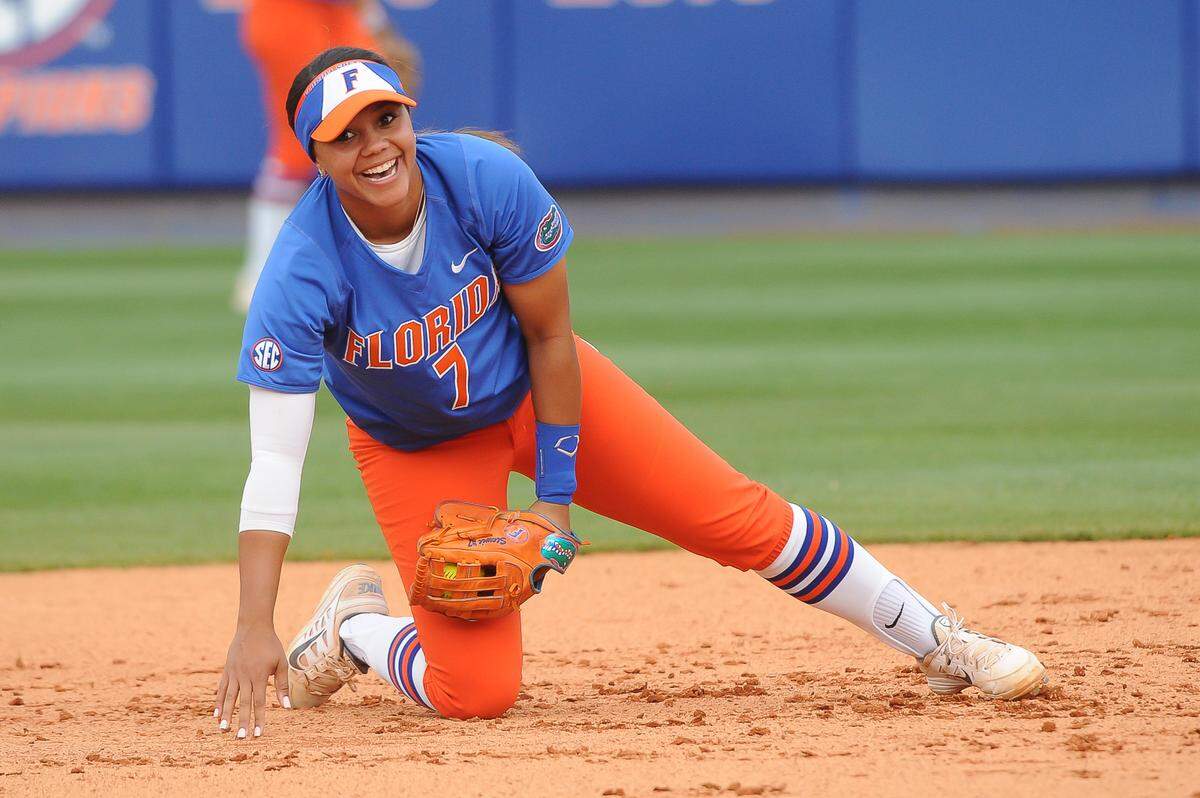
But quitting Scrap Yard wasn’t a decision she made lightly. For as morally obligated as Stewart felt, it is also true that opportunities to play professional softball, and more importantly, earn a paycheck while doing it, are rare in the U.S.
Before making her decision, Stewart reached out to her idol, Natasha Watley, the trailblazer for Black women in softball. Watley, the first Black softball player to represent the U.S. in the Olympics, encouraged Stewart to do something that she herself never did as a player.
“One of the things that I regretted during my time being on the national team was not using my voice enough,” Watley told The Undefeated. “I thought me visually being an African-American woman was enough. Now, given the climate of where we are … I wish that I used my voice more.”
That conversation emboldened Stewart, who was one of just two Black players on the Scrap Yard roster. She was the first to quit the team and was inspired by the swift and unified decision from the rest of her teammates to also walk out. Along the way, she has had tough conversations with her white teammates and coaches, in some cases opening up their eyes to the “backhanded” racism that Black players have had to try to ignore for so long.
Those subtle acts are things that Stewart is pushing to try to stamp out of the sport. With change, she is hopeful that the more inclusive environment will attract more Black players to pick up the game.
The fact that Stewart has risen to the occasion to become an important voice in the sport doesn’t surprise her former high school coach, Maize’s Jenny Meirowski.
“Kelsey has always been just an phenomenal softball player, but she’s an even better kid,” Meirowski said. “She has always had great character and good morals. She stands up for things that are right, so it doesn’t surprise me at all. She’s always been a leader and she knows right from wrong. I’m just really proud of everything she’s accomplished in her playing career and now (recently) taking it to another level.”
When she was young, Stewart grew up wanting to be the next Natasha Watley. She’s come close to fulfilling that dream, winning two national championships at Florida, playing for seven years on Team USA and being selected for her first Olympic team next summer.
Like Watley, Stewart’s career has ascended to something bigger than softball. Thanks to her willingness to speak out, now an entire generation of softball players can aspire to be the next Kelsey Stewart.
“I think it’s our job to make sure that softball changes by changing it at the pro level, then hopefully it’s going to trickle down,” Stewart said. “I hope someone can be like, ‘Wow, someone that looks like me can play at that level.’ Maybe that will inspire someone to pick up a bat. This is about the bigger picture and I’m super passionate about this right now, more than ever.
“I truly hope there is a little girl out there in Ark City or Wichita who is just like me, better than me when I was their age, and I can inspire them. That’s the way I want to give back and the way I want to change the game.”
This story was originally published July 7, 2020 at 10:50 AM.
.jpg)