
Kansas produces D-I wrestlers at a rapid rate with nowhere to send them in state
When Matt Reed was at Wichita Heights, he had a moment of realization.
Reed was a two-time state wrestling champion with the Falcons, and in 2011, he helped Heights to its first team title since 1976. He was one of the best pound-for-pound wrestlers in the state, but he couldn’t stay home.
He was too good.
There are 17 college wrestling programs in Kansas: eight at the community college level, seven in NAIA, two in Division II. Unless Reed wanted to take a step down in competition and go to Fort Hays State or Newman, which was in Division III at the time, he was leaving Kansas to wrestle. And Reed wasn’t the only one.
“It’s important to take care of our kids,” Reed said. “I’d like to see a Kansas program that prioritizes Kansas kids first, so we don’t see those guys leave. That would be great for the state.”
There are 30 Kansans on Division-I wrestling rosters across the country, but none compete in their home state.
Kansas’ top high school wrestlers are left with no where to go but out after earning Division I scholarship offers because there isn’t a Division I program in the state anymore. In fact, there hasn’t been since the 1970s.
When Reed graduated from Heights, he went to the University of Oklahoma along with teammate and four-time state champion Sean Deshazer.
This year alone, Maize’s Duwayne Villalpando and Blue Valley Southwest’s Seth Nitzel are going to Missouri. Goddard’s Trevor Dopps is going to Oklahoma State. St. James Academy’s Cade Lautt is heading to North Carolina, a path his brother, Clay, had to take as well.
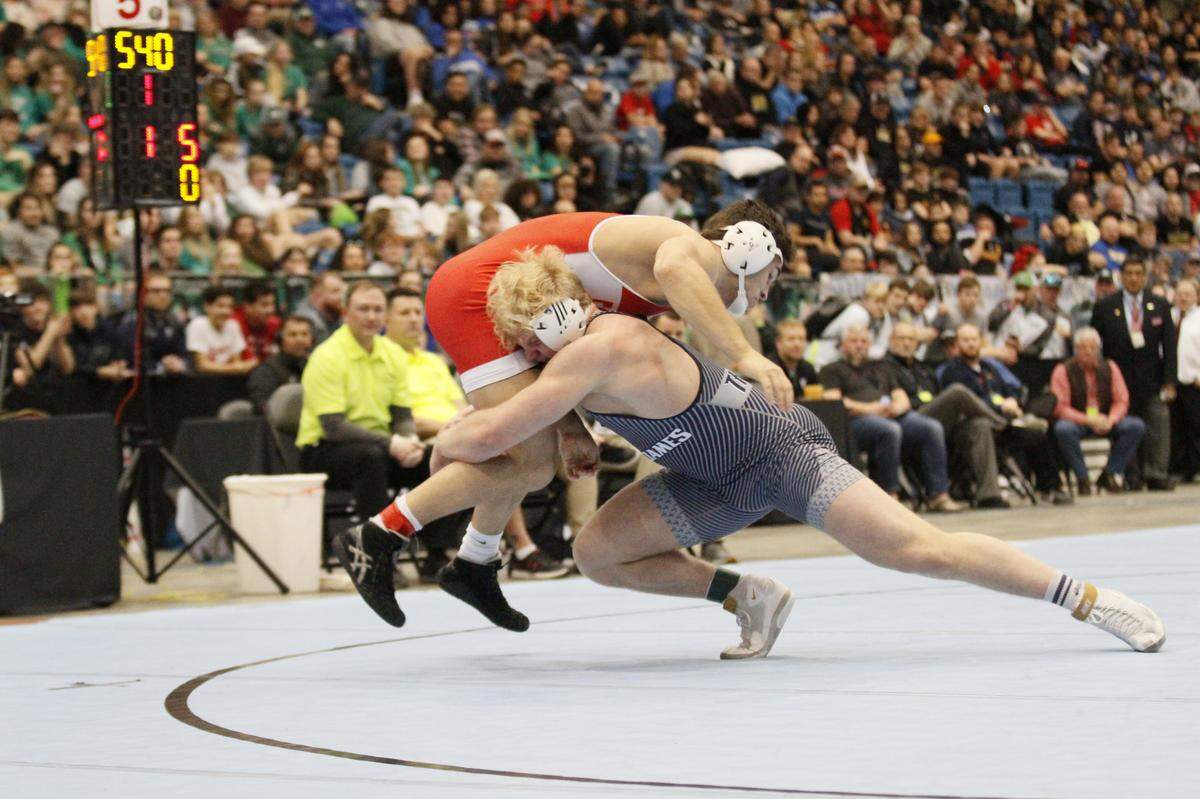
In next year’s graduating class, Maize’s Kyle Haas is the top heavyweight prospect in the country.
There are others, but the fact remains that some of Kansas’ top athletes across all sports are getting away to other states without a real chance to stay even if they wanted to.
There are stories like Haas’ and stories like his brother’s, former Goddard wrestler Tyler Caldwell. He and his teammate Boaz Beard became the 22nd and 23rd wrestlers in Kansas history to win four individual state championships from 2006-09, and Caldwell’s only Division-I offer out of high school was from California Polytechnic State University.
The coach at Cal Poly, Sammie Henson, was hired at Oklahoma, and Caldwell came along. Caldwell said without any other D-I programs taking a deep look at him, Henson took a chance.
Caldwell said he would have stayed in state if Kansas, Kansas State or Wichita State had a wrestling program and gave him a scholarship. Now he is arguably the most well-known Division-I recruiter in the state, and he works as the Oklahoma State recruiting director.
Just last year, Caldwell was a key figure in identifying Triston Wills and Cade Lindsey from Derby. Caldwell said with his Wichita area roots, he grew up watching the Panther pair wrestle. He watched them mature and wanted them at Oklahoma State.
Wills and Lindsey grew up as Oklahoma State fans. Caldwell said he did, too, but if there had been an in-state D-I program interested in him, he would’ve been interested right back.
He used to want to stay in Kansas. Now his job is to pull kids out.
“Most of these kids grow up fans of these out-of-state teams, like OSU,” Caldwell said. “They don’t have a hometown team to wrap their arms around. I was the same way.
“In Kansas, you kind of get overlooked. I’m not even going to say, ‘kind of.’ You definitely get overlooked.”
Does Kansas deserve a Division-I wrestling program?
When Erik Hinckley moved from Minnesota to Kansas, in 2000, he brought his love of wrestling with him.
Hinckley has wrestled his whole life and still does at the senior level. His two sons were state finalists, and one even won a title. But he felt like Kansas could take another step.
Hinckley saw the K-State club wrestling team one day in the early 2000s. He, a wrestling purist, was shocked at the quality. He said some of wrestlers didn’t belong at the club level. They deserved better, he said.
Hinckley started a grassroots campaign to bring Division-I wrestling back to K-State. He met with other Division-I coaches and athletic directors across the country. He said about 40 people jumped on board by late 2007, but just before he presented his 34-page proposal to the K-State Board of Directors, he said the administration at the time didn’t feel like it was the right timing.
“There is a common wisdom that says, ‘If you want something you got to kick in the door,’ ” Hinckley said. “I don’t think that’s the case. All we wanted to do was put our best foot forward, as far forward as it would go.
“If I go into somebody’s house, I want to be invited.”
There are 17 states without a college that has a Division-I wrestling option.
Pennsylvania has 11 D-I universities with wrestling teams. North Carolina and New York have seven, and Virginia has five. Kansas has none.
Of the states without D-I wrestling universities, only three have more wrestlers at that level scattered across the country in the 2019-20 season than Kansas: Georgia (49), Florida (46) and Texas (41).
But that is already a skewed statistic. Georgia, Florida and Texas average more than seven times the population of Kansas but not even twice as many Division-I wrestlers.
When dividing each state’s 2020 population, according to the World Population Review, by its number of current Division-I wrestlers, Kansas is 13th in the nation. That is higher than 11 states with one D-I program and higher than eight states that offer at least two.
Only one state without a Division-I program produces a wrestler of that caliber more often than Kansas, and it has fewer than half the population — Alaska.
In Kansas, as of the 2019-20 season, there is one Division-I wrestler per 97,012 people. In Georgia, that rate is less than half. In Florida, it one-fourth as much. And in Texas, it is less than one-seventh the rate.
Although those states have more Division-I wrestlers, Kansas has far more per capita. Montana is the only other state without a D-I wrestling program that comes close, and Montana has almost one-third of Kansas’ population.
But putting Kansas’ population and accompanying efficiency aside, Kansas has more D-I wrestlers than Arkansas (5), Nebraska (14), South Carolina (15) and nine other states with D-I programs.
Oklahoma has finished ahead of Kansas at each of the most recent Junior National tournaments in Fargo, North Dakota. But Oklahoma has only six more D-I wrestlers than Kansas this season and two universities that offer it.
“I talk to a lot of people in Kansas who ask why Oklahoma is so much better top-to-bottom,” Caldwell said. “I think it just trickles down from having a Division-I program. These kids are around. They go to the matches. They have regional training centers. They have youth clubs. From Division I to high school to middle school to youth wrestling, it’s a big reason Oklahoma has become so well known in the wrestling world.”
Pennsylvania is No. 1 in the country with 334 wrestlers on D-I rosters, but it is also No. 1 in the number of schools that offer D-I wrestling scholarships.
Pennsylvania’s 11 D-I wrestling universities are four more than what the next best state has to offer, but does the state have 11 programs because it produces so much D-I talent or does it produce so much D-I talent because it has 11 programs?
There are 14 full members of Division-I athletics in Pennsylvania across all sports. Four of its D-I wrestling universities compete in Division II in almost all other sports, and Franklin & Marshall College is a D-III school with a D-I wrestling team.
A rising tide lifts all boats.
“If there was a D-I school in Kansas that wanted a wrestling team and they could recruit only from Kansas, they would build a team that was extremely competitive at the Division-I level,” Hinckley said.
Why isn’t there a D-I wrestling program in Kansas?
In 2012, Wichita State won a college wrestling national championship.
Competing in the National Collegiate Wrestling Association (NCWA), the Shockers won the Division-II team title. It was their first year of existence. They were the only D-II team to earn an invitation to the NCWA National Duals, and they had two All-Americans.
All of this came at the club level.
The team was created in the fall of 2011 after several failed attempts at finding longevity. WSU tried in 2009, but few wrestlers could make it to 6 a.m. practices, and without any kind of scholarship coming their way, numbers dwindled.
And since 2012, those numbers have fallen off again.
There are 15 active club teams at WSU, according to the university’s campus recreation site. There are five more listed beneath titled, “Inactive sport clubs.” Wrestling is among them.
K-State had a club team from 1999-2012. The Wildcats had two national champions and 28 All-Americans in that time.
That is the closest Manhattan has come to seeing Division-I wrestling since the 1970s when K-State’s team was cut along with men’s swimming, men’s gymnastics and men’s tennis to make way for women’s programs.
At Kansas, the Jayhawks had a Division-I team that sprouted in 1962. It was cut five years later.
KU athletic director Jeff Long and K-State AD Gene Taylor did not respond to the Eagle’s attempts to reach them. But WSU athletic director Darron Boatright did.
“Wrestling is a fantastic sport and one that is popular in our state,” Boatright said. “In the time I have been at Wichita State, it has not been considered as a varsity sport. Adding sports can be complex as there are several factors to be considered.”
Perhaps the most glaring factor is Title IX implications. Title IX states, “No person in the U.S. shall on the basis of sex, be excluded from participation in, be denied the benefits of, or be subjected to discrimination under any education program or activity receiving federal financial assistance.”
Title IX enforces that there must be equitable opportunities between men and women. It requires male and female athletes to receive athletic scholarships proportional to their participation. And all collegiate athletes at a school must reap the same quality of equipment and facilities among other items.
.JPG "_MG_6193 (2).JPG")
On Jan. 25, Divisions II and III voted to approve women’s wrestling as an “Emerging Sport,” during the NCAA Convention. Division I did not vote but is scheduled to later this year, according to a USA Wrestling release.
On Feb. 27, Kansas put on the first official high school girls wrestling state championship. Girls wrestling was voted into existence at the Kansas State High School Activities Association (KSHSAA) Board of Directors meeting April 26.
Since that vote, participation has doubled with almost 1,000 girls wrestling across Kansas in its first full season. And since 2017, numbers have improved almost 20-fold.
At the state tournament, girls like Washburn Rural’s junior Dajia Anderson in their first year of wrestling brought home state championships. She finished her season 29-1. But along with rising talent, Kansas is filled with some of the best girls wrestlers in the country, too.
Kansas is home to six nationally-ranked female wrestlers, according to USA Wrestling’s preseason release:
- Amanda Newcomb - Osawatomie, senior, 100 pounds, No. 8
- Nichole Moore - Nickerson, senior, 112 pounds, No. 2
- Elise Rose - Marysville, junior, 122 pounds, No. 15
- Morgan Mayginnes - Onaga, senior, 152 pounds, No. 8
- Elise Robinson - Junction City, senior, 180 pounds, No. 1
- Maranda Bell - Shawnee Heights, sophomore, 200 pounds, No. 20
Hinckley still has his proposal ready to present. He said many of those 40 people who joined him in his effort would be quick to pick up where they left off.
“When I was creating the proposal, there weren’t any colleges looking to add women’s teams,” Hinckley said. “It’s amazing how fast it has grown. That’s the spot to invest.”
It is likely until women’s wrestling takes off, some of Kansas’ top wrestlers will continue to leave the state for Division-I scholarships even if they don’t want to. And those who are on the cusp of a D-I offer will continue to file into Kansas Division-II programs and junior colleges, where 94 Kansans presently sit on the roster with a combined 41 state championships.
A Division-I program at K-State, KU or WSU would provide some of those wrestlers an in-state opportunity to compete at the highest collegiate level. Reed, the champion from Heights, said those kinds of kids are currently fighting to scrap onto the “back end” of D-I rosters out-of-state after schools like Missouri swipe up those in their own state.
Hinckley said he is confident Kansas will have Division-I wrestling again. He said he didn’t know when that might happen but guessed, “Soon.”
“We are not opposed to wrestling, nor other sports,” said Boatright, the WSU athletic director. “Currently it just does not fit into our plans.”