
Photos and stories behind a couple of biggest known whitetail killed in Kansas in 2024
A couple of Kansas bowhunters shot their 250-plus inch target bucks, putting those deer in a class that most hunters only dream to see and making them a couple of the biggest known deer killed in the state this season.
Kansas is known for its legendary whitetail, but a 250-inch gross-score rack is still something special and taking it with a bow makes it all the more rare.
Besides the 2019 buck Brian Butcher of Andover shot in 2019, which scored over 321 inches, the last Kansas archery bucks killed around the caliber of 32-year-old Dallas Birk’s and 22-year-old Chad Chambers’ were in 2004, 1994 and 1988.
Butcher’s buck is the second-biggest non-typical buck killed in the U.S.
Birk’s and Chambers’ deer, once verified and entered in Kansas records, will be within the Top 20 and Top 25 nontypical bucks killed in Kansas with any weapon and around No. 9 and around No. 13 with a bow.
Antlers are scored as either typical or nontypical. Typical antlers follow a standard pattern for the species and are scored on size and symmetry, while non-typical racks are scored on sheer size.
Both Birk and Chambers had their target buck vanish from trail cams for weeks at a time before their fateful encounters. The hunters have both shot big bucks before but experienced extreme buck fever when their opportunity came.
The stories behind the hunts
Dallas Birk had shot a bigger and bigger buck each year over the past several years.
The Burlington, Kansas, man credits the improvement to a better understanding of deer habitat and proper nutrition — mainly adding a mineral to help sustain and grow the deer.
Last year, Birk shot a 183-inch deer.
He had his sights set this year on a deer he referenced as a linebacker, because of his sheer size.
The deer first showed up in 2021 on the private land he had been hunting for about seven years in Coffey County.
Birk credits the antler growth to a homemade mineral he makes and sells called Koated Mineral Attractant.
Birk’s sister, Cassidy Birk, first had a shot at the deer in 2021 at 100 yards during rifle, but she was new to hunting and didn’t feel comfortable shooting that far away.
“I thank her every single day that she didn’t take that shot,” he said.
Birk had the deer on camera and figured the deer was around 160 inches and around 2 to 3 years old.
The buck daylighted on one of his cameras again the next season, on Oct. 17, 2022.
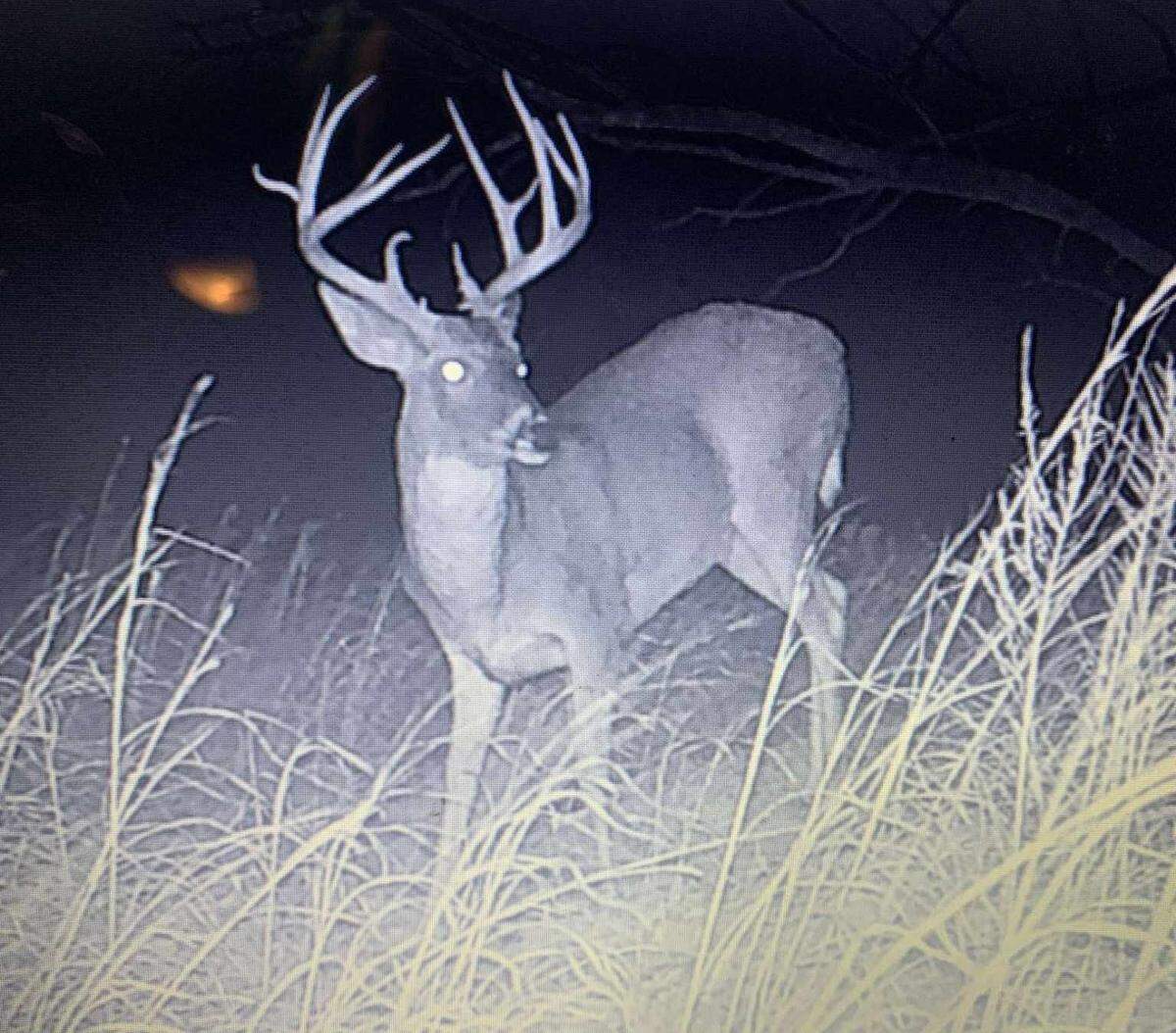
Birk was working in Nebraska at the time and preparing for his shift when he got the notice of the deer on camera around 6:45 p.m.
“And I just said, holy ----,” he said.
Birk’s sister got a picture of the buck on the other side of the property in November. He didn’t get another picture of the deer on his side of the property that year.
The buck daylighted on his cameras again the next season, in 2023, and again on Oct. 17. Then again in late November.
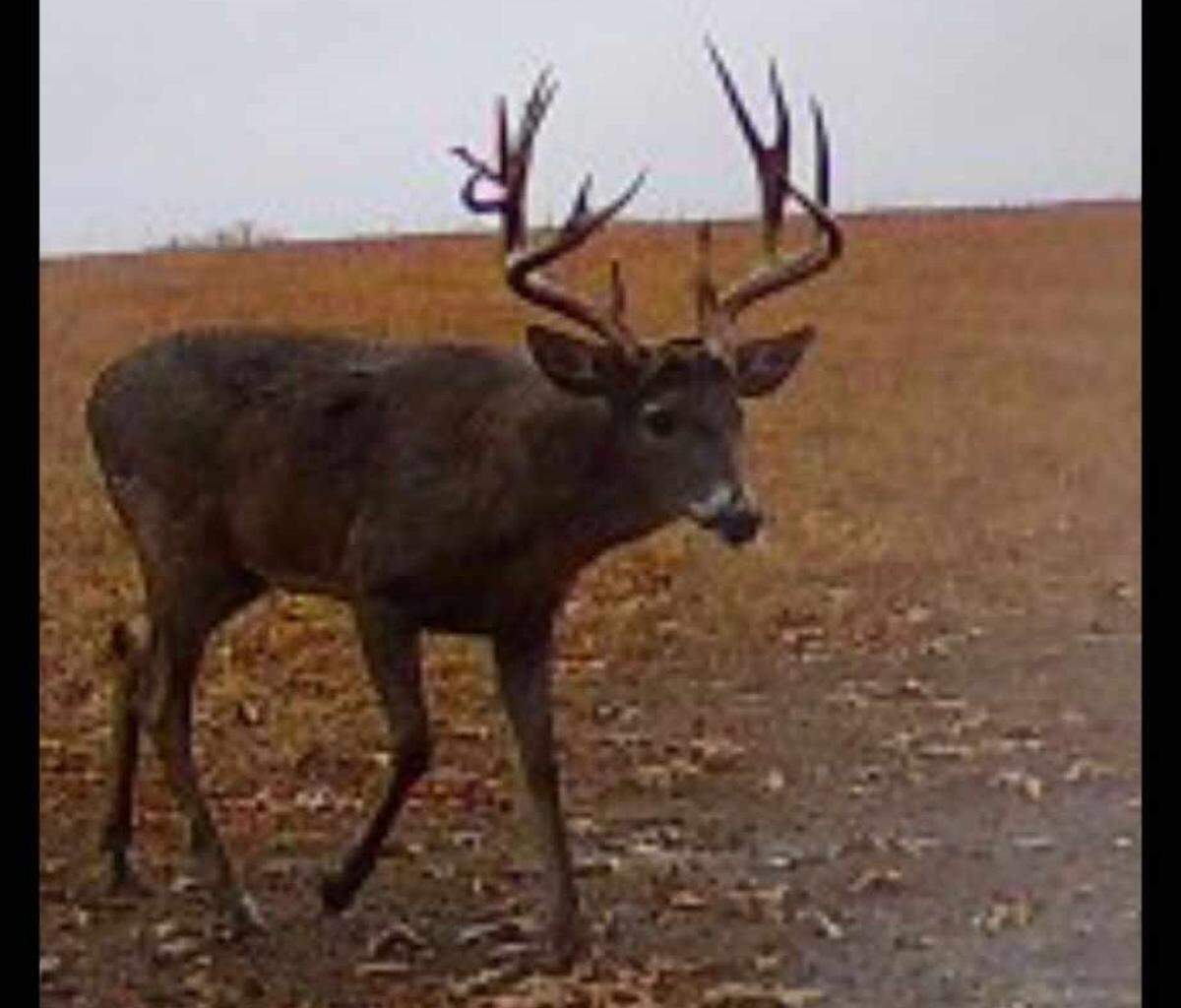
The first thing I said was, “Oh my God, I have a 200-inch buck on camera,” he said.
A neighbor found the deer’s sheds, which measured around 209 inches, in early 2024.
Birk saw the deer in person in July, while there was still velvet on the antlers. He saw it again in person while scouting in August.
He was seeing him in an area that he believed was his summer bed.
He said the deer got spooked when the landowner went in that area with a four-wheeler to retrieve loose cattle, but reappeared in that area on Sept. 29.
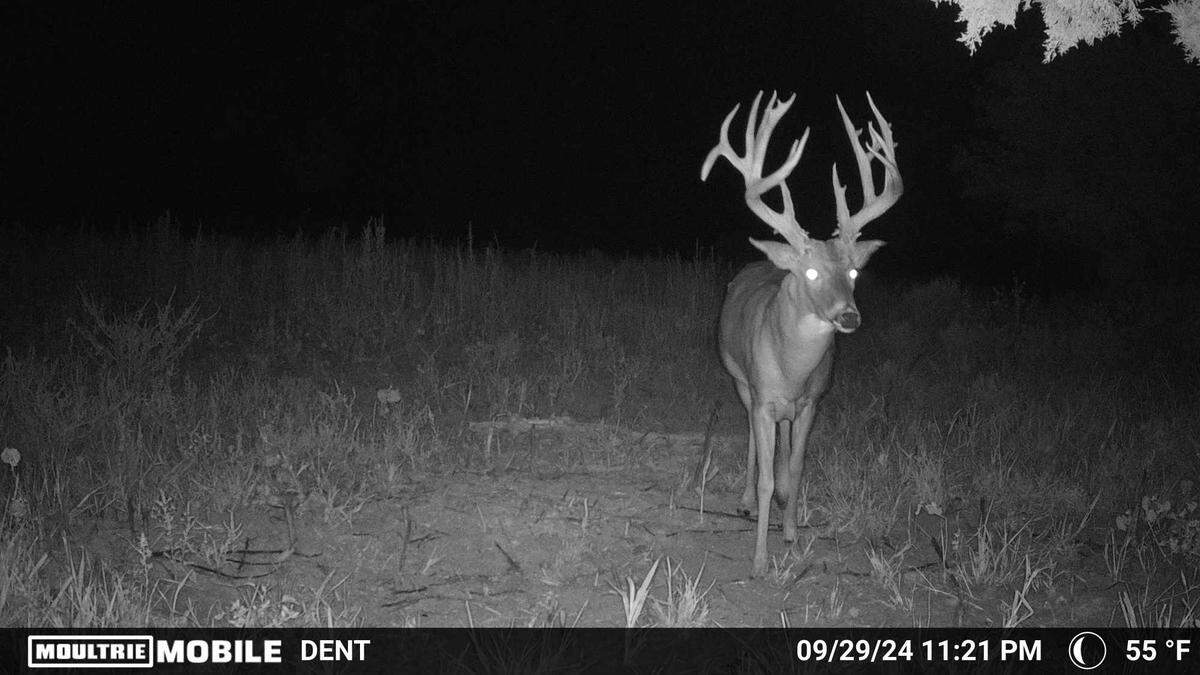
The deer came on camera again on Oct. 2, 3 and 7. It was around 6:30 a.m. that last time.
That afternoon, Birk went and set up a ground blind.
There wasn’t much area for cover between the CRP the buck was bedding in and the soybean field he would graze in.
Birk put the blind up against a cedar where he had cut limbs off and woven them into a pallet he cut in half and stuck around the blind.
He hunted that morning and the next evening, but didn’t see the deer.
He decided not to hunt it again but to come back on Oct. 17 — the day he came on camera the last two years.
He couldn’t hunt that morning, but went in the afternoon. He didn’t see anything.
He went back the next morning and about 5 minutes before legal shooting light the buck appeared about 25 yards away in some small trees in a hedgerow.
“It was like he transported,” he said. “Instant rush of buck fever almost. Like, holy smokes, this is actually going to happen.”
Birk was shaking.
He tried to look toward the ground and not at the antlers, trying to control his breathing
The deer was coming from the northeast to the southwest, where Birk was in his blind. The wind was blowing south at between zero to 8 mph.
The buck went directly downwind from Birk, and stopped for 30 seconds, but didn’t spook.
Then the deer continued around a small cedar tree. Birk drew.
But the buck came straight to him, toward the food and mineral Birk had out, and he didn’t have a good shot. The buck ate and then picked his head up and chewed and looked toward Birk.
The wind blew enough that Birk was able to let off.
“My shoulder was just on fire,” he said. “Just sheer pain. Just on fire.”
Birk caught his breath for 30 to 45 seconds. He could tell the deer was getting ready to walk off and he would get another shot.
“I was like, “OK. I look down again. I was like, ‘you already went full draw once. You can do this,’ ” he said.
The buck was 17 yards. Birk drew.
He waited for him to take a step to extend his body and expose his vitals. Birk knew his pattern. He would feed and then go to his mock scrape.
“I guess I must have closed my eyes a little bit and I shot,” he said. “I opened my eyes enough just to see my arrow come out the other side of him.”
Birk said he is diligent in practicing his shooting, but, when asked why he closed his eyes, he said: “Buck fever.”
The whole encounter lasted about 10 minutes.
He saw the buck run 100 yards through CRP ground and over a hill before starting to slow down.
Birk called his roommate, Braden Harvey, who told him to breathe. Birk found his arrow and had some concerns. His arrow looked like a mix of fat and bright blood with bubbles, indicating lung.
Looking at where he shot, he found some blood and a chunk of liver and a piece of intestine.
“I got extremely nervous there that I had center punched this buck,” he said.
He found a pile of guts about 20 yards further. He was sure it was a dead deer, but worried about how far he could go and last. He backed out for four or five hours and went back with a friend, Dylan Lamon.
He figured the buck went toward the CRP where he bedded but the signs showed he headed to this watershed area that was thick with trees, and with coyotes.
“There’s a colony of freakin’ coyotes down there,” he said.
Lamon found the first sign that confirmed Birk’s fears. The blood kept getting worse and worse, looking like it sprayed out a tree at one point. It also looked like it was coming out both sides, but they later discovered that the buck was likely chased back up the same trail it ran down originally by coyotes who smelled blood.
But they couldn’t find the deer and backed out again. He called trackers this time.
The dogs were able to find the deer, which was in the thicket and about 15 feet from where Birk had been at one point during the search — about 250 yards from where first shot.
It was dark out at that point. Birk had gone to grid search in another area but screamed as loud as he could when he got the call from the trackers.
“To say I didn’t cry would be a lie,” he said. “Tears of joy.”
The buck’s body had been picked clean by coyotes and had fur in its antlers. He went down fighting.
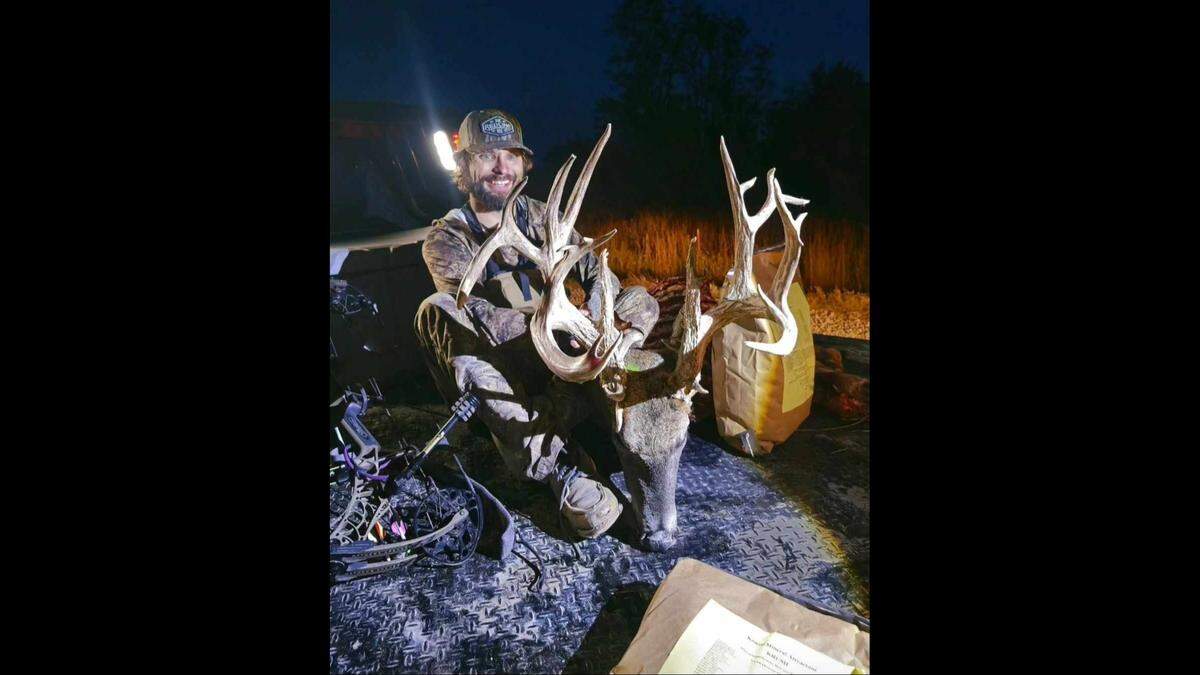
“Hooked on the sport”
Chad Chambers’ best advice for killing a monster buck that you had long been chasing: Don’t look at the rack when the time comes to shoot.
The 22-year-old, who is an apprentice for Evergy, first took up bow hunting at around age 10 after his older brother, Todd Chambers, and father, Bruce Chambers, got him hooked on the sport.
“They both have shot big deer,” Chambers said. “This thing is in a league of its own. It just doesn’t happen. For a deer to get to that size, it takes something pretty special.”
Chambers said he hunted deer around 200 or maybe even over, but the biggest deer he had killed before Oct. 27 was 158 inches, which happened in 2023.
Chad Chambers’ father had once owned the private land he shot his deer on in Wabaunsee County. But the new landowner still lets him hunt there.
“I’m very grateful for that,” Chambers said.
Chambers first saw the deer in 2022 when the it was about two and half years old and around 130 inches. The deer walked right under his stand, but Chambers passed up a shot.
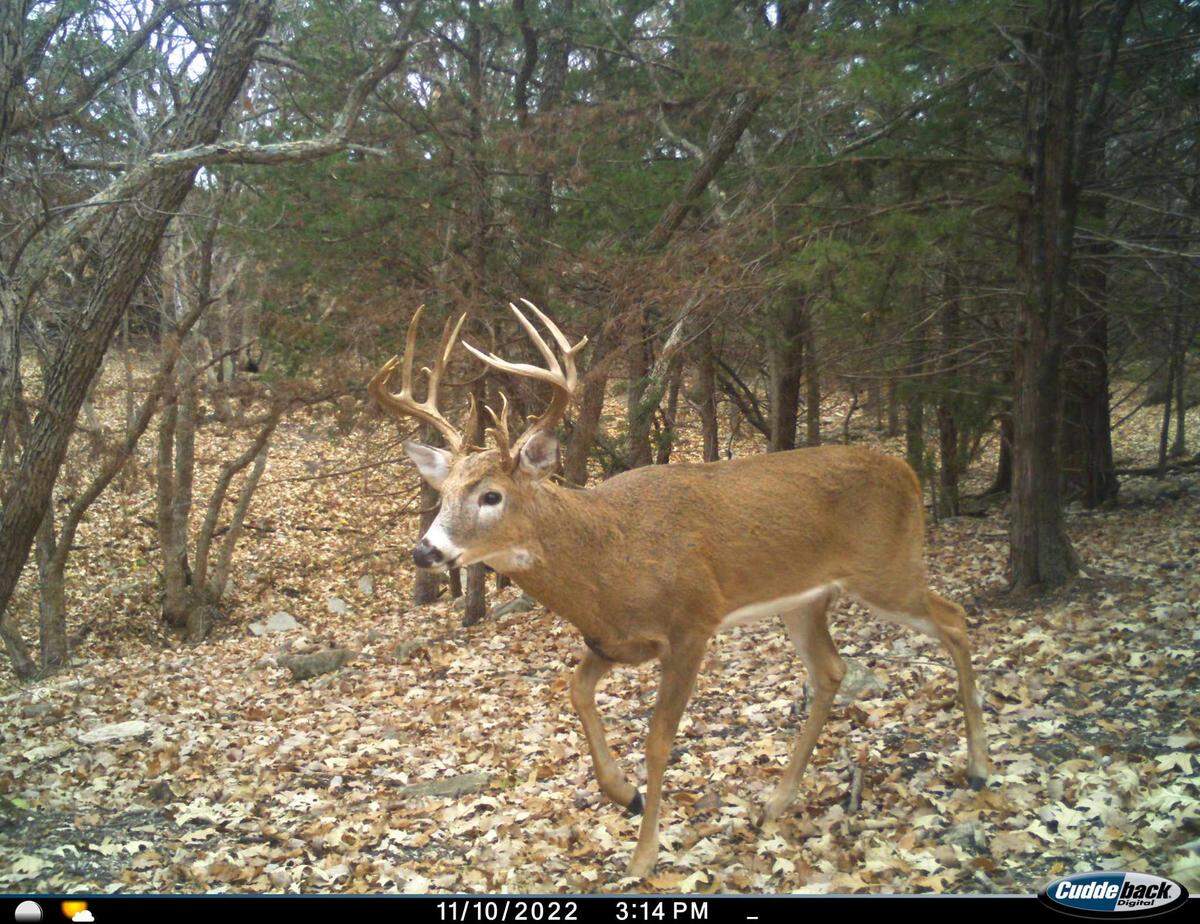
A Texas man who hunts on the property also passed him up, Chambers said. They both agreed to pass him up in 2023, to let him grow for one more year.
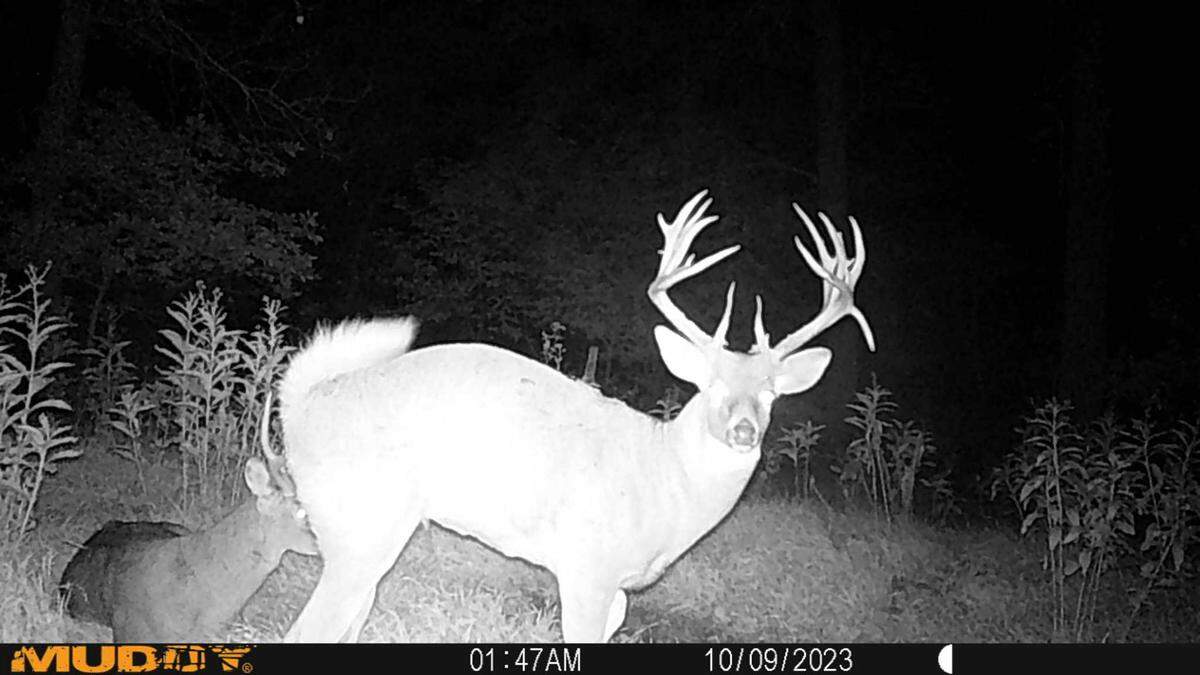
Chambers only saw him on his camera the next season, in September 2023, before he disappeared. Then Chambers saw him again on camera in August 2024.
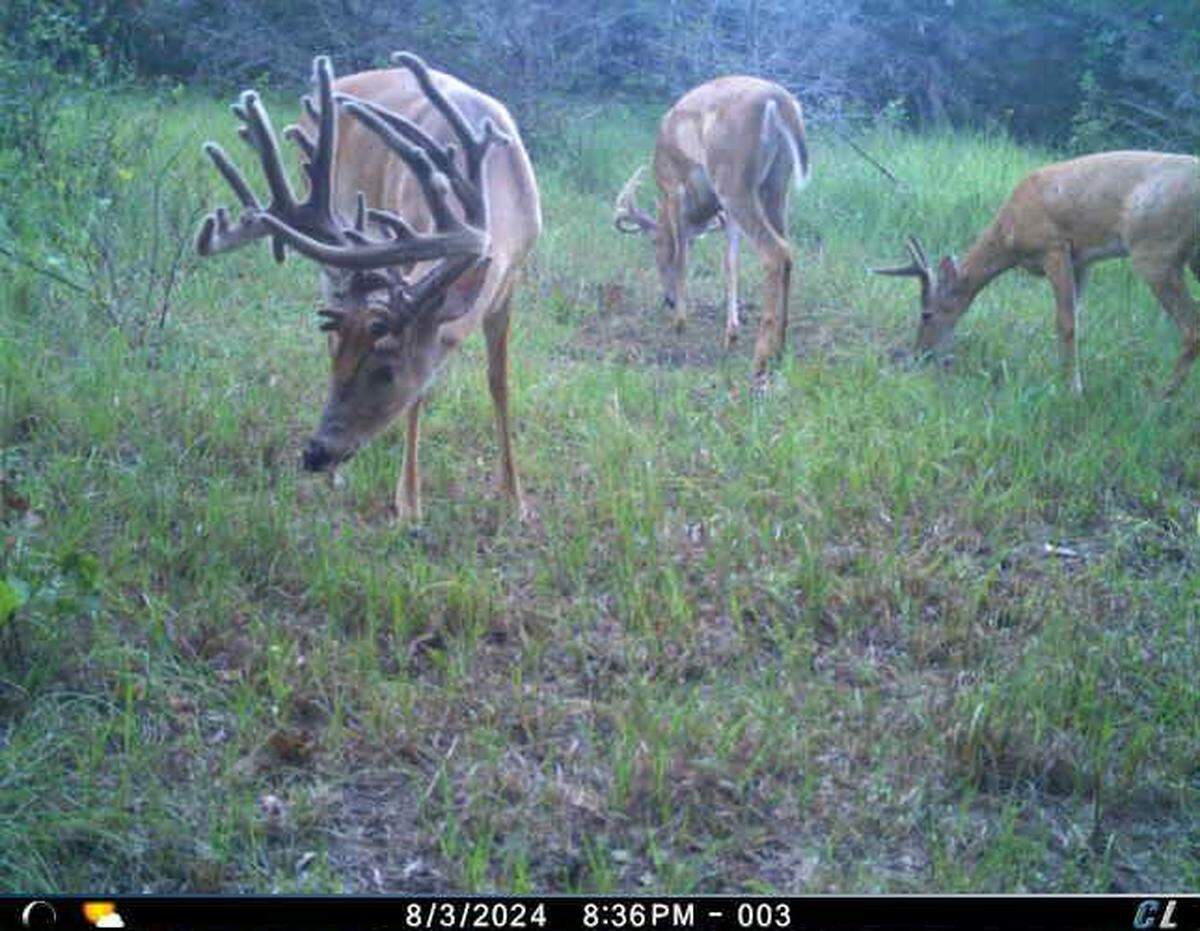
The size he put on was “just ridiculous,” Chambers said.
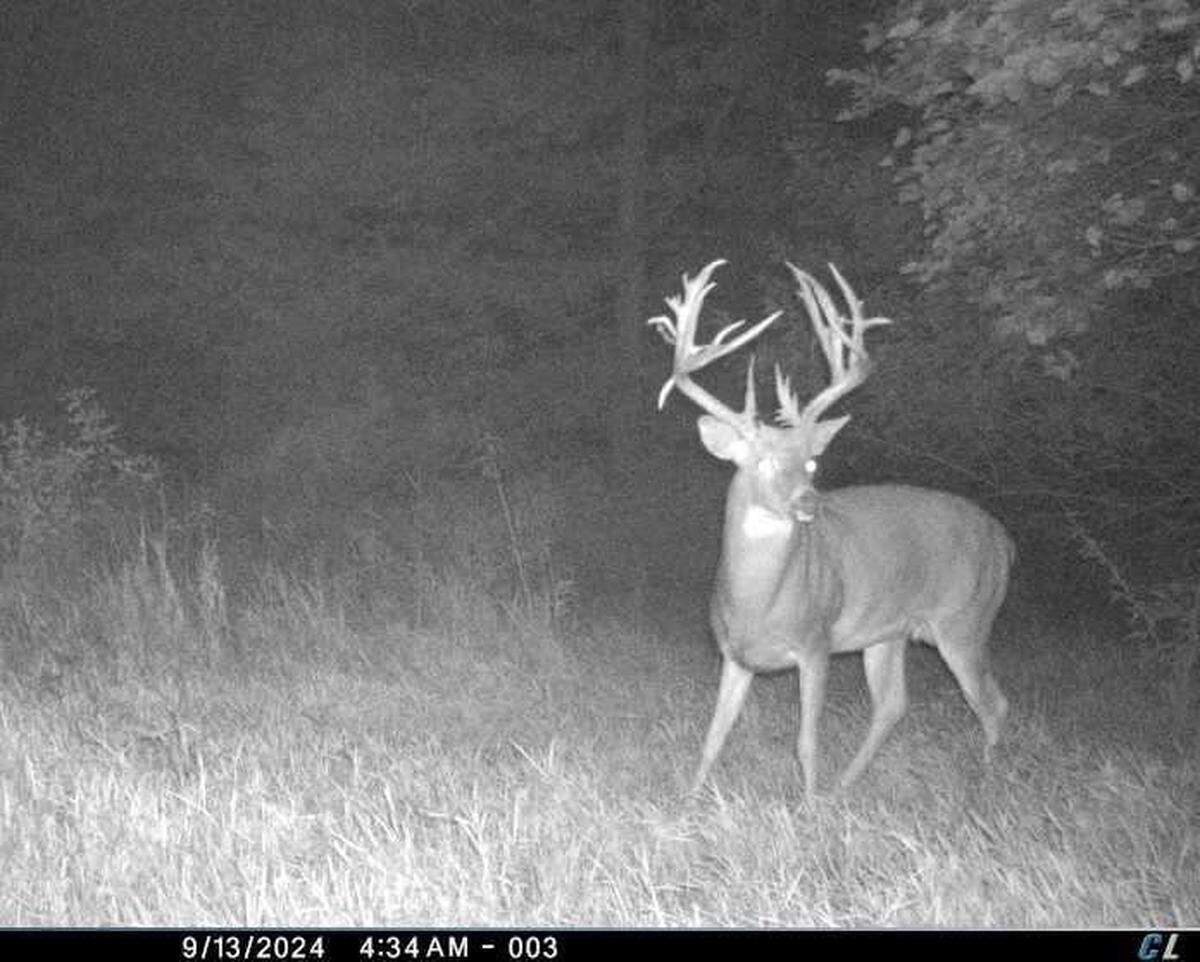
“I went out and bought a bunch more cameras, and started throwing cameras all over trying to pinpoint him,” Chambers said. “I actually saw him once in a waterway, between corn fields, with my girlfriend one night, just for a split second. I locked up the brakes. By the time I got the binoculars up, he was out of the field. … I continued to get pictures of him about every four or five days, and then he disappeared for a month.”
The deer, whom Chambers named Titus, vanished in the middle of September. Chambers gave him the name in reference to statues of Greek gods and Roman emperors.
“You look at the sculptures of those people and those Roman emperors and everything Greek mythology, they have the perfect body, you know, like the six pack, abstract perfect human,” he said. “So with this deer, he kind of turned into the perfect deer. He’s like a Greek god or a Roman emperor … Just kind of standing out against everyone else in a crowd.”
But his trophy buck was gone, until a local hunter, Carson Reves, a teen whom Chambers had helped mentor in hunting, got Chambers back on the deer.
Reves hunted in the mornings before going to school. He told Chambers he saw the buck coming out of a draw in the morning. Chambers hadn’t hunted there before.
He went and scouted that area based on the new information and found a big bedding area at the top of a hill with a cliff behind him that dropped into a creek. Chambers looked over from there to see where he had been hunting.
“This deer had been watching me every single time I went to hunt him, come out of the barn, come across the field, go up the hill and go hunting,” Chambers said. “He knew exactly where I was.”
On Oct. 26, about a week after getting the new information, Chambers went to scout and found the buck running around with a three and half year old 10-pointer.
He planned to hunt the next morning in a draw that was about 100 yards long by 40 yards wide. He took a long route around that morning so as to not disturb Titus.
The wind was the wrong direction but light enough that morning that Chambers thought it would work. Chambers also hoped, and confirmed by blowing his breath in his saddle stand, that thermals would carry his scent back up the hill behind him.
“So it was perfect,” he said.
Around 7:30 a.m., he heard two bucks fighting to his east. He rattled, grunted and did a snortwheeze at the deer. But nothing happened.
“This was a, ‘I’m going to see this deer and I’m going to shoot him, or I’m not going to see anything at all’ kind of spot,”’ he said. “You can’t see anything because it’s pinched down in these hills in this draw, you can’t see anything out of it, other than the hill in front of you.”
Around 8:10 a.m., he heard more deer fighting to the northwest and was certain Titus was involved. The wind was out of the southeast.
Chambers did the same sequence, but this time “cracked the horns together” as loud as he could.
Reves texted him, asking if he saw anything. He told him no.
As he puts his phone down, about 5 to 10 minutes after rattling, here came Titus.
“He was jogging over top of the hill, about 150 yards from me, paralleling me,” he said.
Then the massive buck stopped and let out a “huge roar,” Chambers said, adding it was a loud grunt. Titus was looking for where the noises were coming from.
Chambers put the grunt tube over his left shoulder, back behind him, and let out one soft grunt. Titus then knew exactly where to go. Chambers could see him, but there was a lot of cover between them.
Titus stopped for 30 seconds, Chambers said, then kept walking parallel to the area, trying to pick up a smell.
Titus had been out in the open, but now he moved into the trees that connected with the draw where Chambers sat.
“I can’t see him anymore,” Chambers said, recounting the events. “He’s covered up by brush and trees. I just sat completely silent, picked up my bow, kind of prepared myself, and then I’d say three or four minutes went by, and I could just hear choo, choo, choo. And, out of the bottom, here he comes right up my draw, on the opposite side from me.”
Chambers was on the east side. Titus on the west, just 20 yards away, behind brush.
“He stands there for 15 minutes,” Chambers said. “Doesn’t move. Perfectly broadside with no shot. He looked up at me three or four times, and I just shrunk as tight as I could and looked down and was like, ‘Oh God, please don’t let this deer bust me.”’
Titus was smelling the ground where Chambers had walked that morning. He also may have smelled him in the tree. Titus froze but didn’t look spooked.
Chambers said he kept repeating to himself that this was just another deer, hoping it would keep his adrenaline down.
“There was a point in time where I did start to look over his rack, and I could feel the tension building in my body and I was like ‘nope, never mind, uh-uh,’” he said. “And I went back to zeroing in where I wanted to place that arrow.”
Titus started to walk back off into the finger of trees. Chambers panicked, knowing he had to try and get an arrow off. The deer was about 28 yards away and stopped. Chambers said he thought he may have made a noise. Titus stayed there a couple minutes.
Then Titus turned back around, stopped for a few seconds to look around and then crossed the drainage right where Chambers expected.
Chambers said he expected a 5-yard shot, but instead Titus walked straight to the tree and started sniffing and licking Chamber’s climbing sticks.
“So I have this 255-inch deer standing directly below me, sniffing and licking my climbing stick, and I can’t do anything about it. I can’t shoot him.”
Titus walked around the tree, directly beneath Chambers. Titus looked around for a minute, according to Chambers, and Chambers was staring down between his legs looking at the deer.
Titus kept going to the east to follow a cattle trail around the hill. Titus cleared the last tree out into the open. Chambers pulled back on the bow, planning for Titus to follow the path and present a perfect shot. Instead, Titus stopped.
“So I was contemplating, in a matter of a split second, either spining him or shooting him through the butt and trying to get to his heart,” he said. “I decided, alright, I’m going to spine him.”
Chambers was ready to release the arrow when Titus started to jog off.
Titus got to 20 yards. Chambers did a grunt with his mouth.
“It was like out of a movie,” Chambers said. “He just two-stepped sideways, perfectly broadside, looked up at me. I settled my pin. I let it go and I watched that thing just zip right through him.”
He aimed a touch high since his pin was set at 5 yards.
Chambers hit the top of the lungs and clipped the aorta.
Titus took off to the north into the timber below. Chambers could see blood spraying out of him every step.
“I knew it was over,” Chambers said. “I completely lost it. I wasn’t calm, but I was pretty composed the entire time … but after the shot, I couldn’t breath. It was like a hyperventilating type of deal.”
Chambers said he would have heard the crash but he couldn’t breathe. He said he called his girlfriend, Makayla Howard, who wondered why he was breathing like that.
She started to head out to see the monster. Reves headed that way too.
Titus made it 70 yards and crashed on a sprint, Chambers said
Chambers waited until they got there before putting his hands on the deer. It was a special moment for Chambers and he wanted to share it with others.
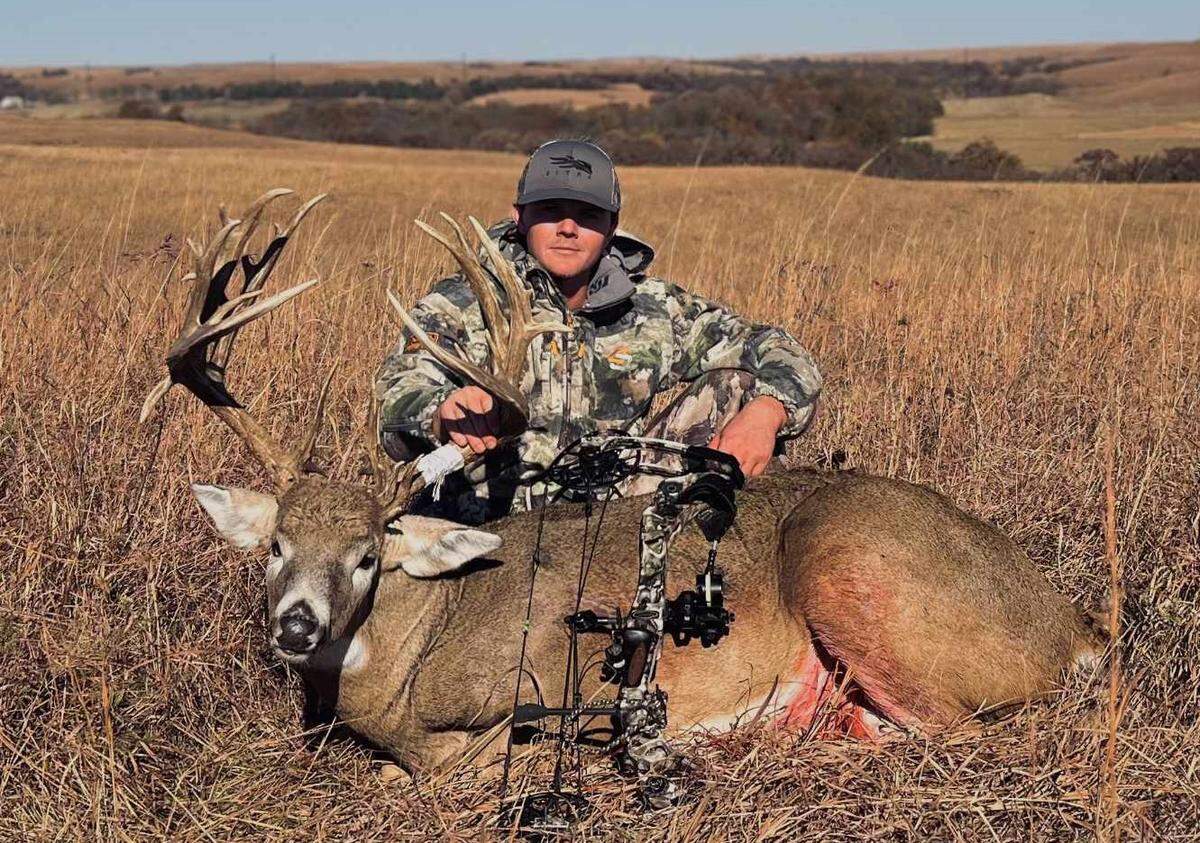
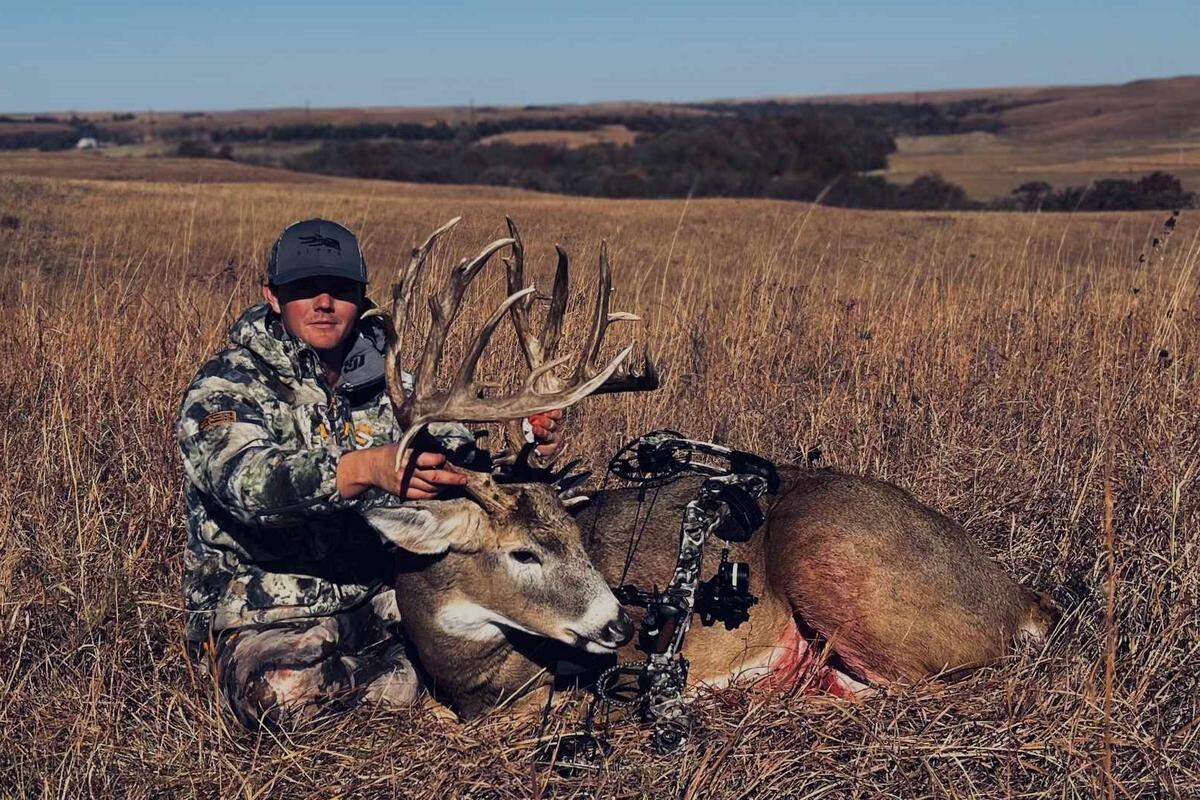
“We got to him, and it was just kind of a shell-shocking moment,” he said. “I knew he was big, but never in my wildest imagination did I think 255.”
Scoring the deer
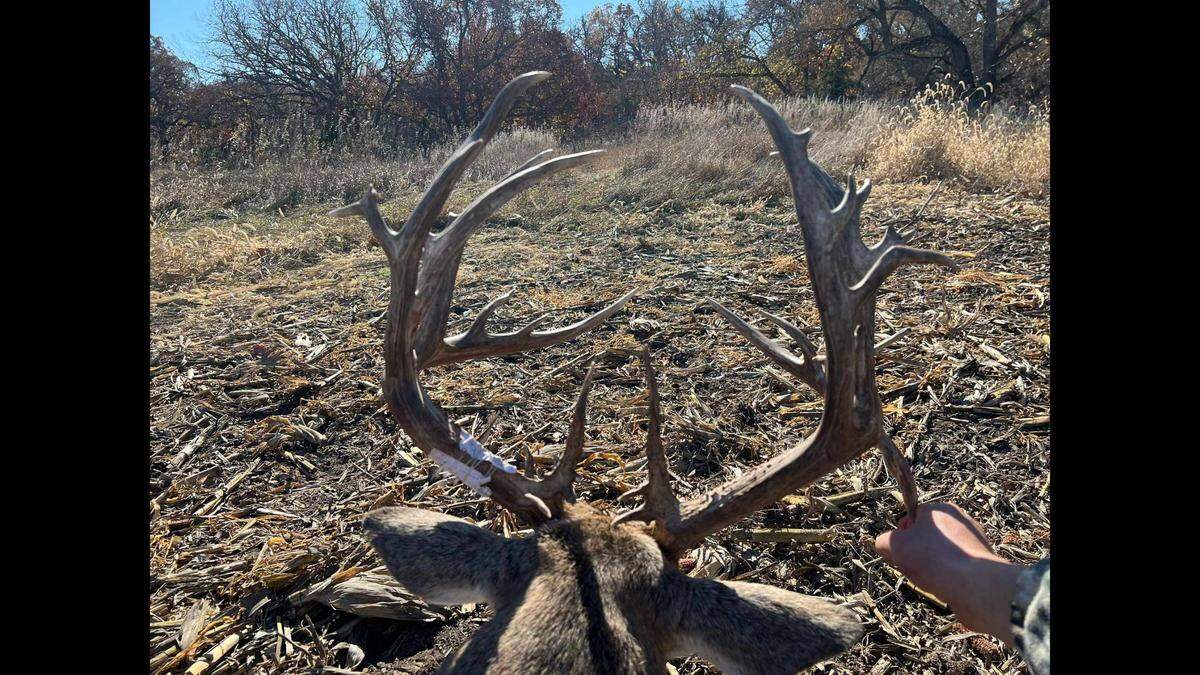
Birk’s buck had a Boone and Crockett Club gross score of 252 inches. Birk got his net score, which is the score that will go down in the Kansas record books, on Dec. 19 at Cabela’s in Kansas City, Kansas, by Cameron Coble, a Boone and Crockett Club scorer and writer for North American Whitetail.
It got a net score of 245 inches.
Chambers also brought his rack for the process. It was the first time he and Birk had met in person.
Chambers’ buck got a B&C gross score of 252 and 1/8 inches. Chambers’ buck got its net score of 241 3/8 inches measured on Dec. 30.
Coble posted a video on social media while holding the two racks and noting it was over 500 gross inches of antlers killed just 10 days apart in Kansas.
“Incredible bucks,” he said. “An eighth-inch separates them on the gross score. This won’t happen again. Unbelievable animals.”