
‘We need to go out and hunt’: How a Kansas girl ended up with record for biggest buck
(Editor’s note: Stories about some of the biggest whitetail bucks killed in Kansas are being published now as the annual mating season hits full gear and hunters take vacation (or sick days) and weekends and evenings to take part in the action.)
After three unsuccessful and uneventful hunts over a hot first couple days of the 2020 youth whitetail season, 14-year-old Paslie Werth and her father went back to her grandparents’ for lunch.
Paslie worked on her homework while her father, Kurt, took a nap. It was Sept. 6. The temperature was creeping up past 100 degrees and the winds stayed in the 25-30 mph range, Kurth Werth remembered.
But his daughter soon got the itch to go out again.
She wanted to take advantage of every day she had before her sister could hunt during the regular season.
“There is a little competition,” she said. “But that’s sisters.”
The Cimarron family had been watching a buck grow for three years and they knew others were closing in — a neighbor boy told them he got so worked up at seeing the monster buck that he missed altogether and never found his arrow.
Paslie Werth, with some luck of not spooking the buck off, didn’t miss.
She holds the record for the largest whitetail buck killed by a female hunter in the U.S., according to the Boone and Crockett Club. The record previously was held by a Marion, Kansas, mother of two who was pregnant with her third when she shot her buck in 1997, according to a previous Eagle story.
The non-typical is also fifth among bucks killed and found by a hunter in Kansas and around the mid-20s nationwide, according to the Kansas Department of Wildlife and Parks and the 2023 Boone and Crockett Club edition.
Buck racks, or antlers, can be considered either typical or non-typical. There are records for each category. Typical antlers are mostly symmetric on both sides with tines growing upward off the main beam. Non-typical racks, which are less common, often have points that come off the main vertical beams in all directions and have more antler points. Genetics and injuries factor into antler growth and types.
Werth is now 18 and a freshman at Garden City Community College studying agriculture education. She plans to be a high school agriculture teacher and work with Future Farmers of America.
Her persistence led to her getting the record buck.
Werth and her father sat for a hunt the opening day of youth season that morning and that night. They saw one doe all day.
The next morning, they went to a different hunting spot in a blind on a conservation reserve program (CRP) field that had one tree on the property — a cedar 25 yards from the blind.
Trail cam photos caught the deer at both locations overnight. And, two days before, a camera on the CRP field caught the buck around 8:05-8:10 p.m.
The Werths believed the buck was bedding on the CRP on her grandparents’ property.
Her sister, Jaeden Werth, was told to pass on the buck when he was 4 years old on opening day of rifle season. She had him at 50 yards.
Her father passed on him when he was 5 with a gun and then on the last day of archery season, partly because his antlers were broken up but also because he knew the deer would reach its peak the next year.
This was the year.
The buck became legendary
People around town were talking about the deer.
Paslie Werth felt more urgency to take advantage of the youth season, both to make sure she, instead of her sister, got the deer but also that a Werth was the one to tag the buck.
The morning hunt on Day 2 of the youth season was uneventful. They went in for lunch.
Werth did homework while her father took a nap.
“All the sudden, I got this feeling, I was like, ‘We need to go out and hunt,’” she said.
She woke up her father, who said, ‘It’s 102 out, let’s wait … ‘do you really want to go sweat in the blind for hours?’” She remembered him saying. “And I was like, ‘yea, let’s go.’”
She wanted to hunt the same blind they had been in that morning. They got there earlier than the afternoon hunt the day before.
As they got to the blind, the wind ripped the door out of her hands, sending it smacking against the blind.
“My dad goes, ‘There goes every deer in the county,”’ she recalled him saying.
They went through multiple water bottles the next few hours.
She asked her father the time.
It was 7:30 p.m. There was about an hour left in legal shooting time.
“There was something just telling me, ‘You have to stay the whole time tonight,”’ she said. “I took off my sling. This is CRP forever. You can see, it’s flat land, and we could see nothing was coming in.”
She added: “He just looks at me like I was funny. Like, you’re taking off your sling. And I was like, yeah, just in case he comes, my sling won’t hit the window or something and make a noise.”
They sat a little longer. It was about 8 p.m.
Kurth Werth didn’t think it was happening. He started packing up and dropped his grunt call, causing it to make a hollow noise when it hit the floor of the blind.
The buck popped up from under the cedar 25 yards away. He had been there the whole time, tucked under the cedar and the tall CRP.
The breezy and favorable wind kept him from busting when the blind door slammed hours earlier. The noise from the dropped grunt call was slight enough to get him up.
Paslie Werth saw him right away. Her father was picking up the grunt, empty water bottles and their other belongings.
“And I freeze like no other,” she said. “And I look at my dad and go ‘Shush,’” she remembers saying. “And, of course, him being my dad, he just looks at me and goes, ‘Don’t shush me.’”
“He said that so loud and I am over here dead still and I’m pointing out the window. And he looks and his breathing just stops.”
The buck looked right at them, then looked away. He told her to shoot.
She was already in motion.
Paslie, an accomplished 4-H shooter who made the national team after placing in the Top 4 at state for archery and different guns with her father as one of her coaches, had her scope set up for 100 yards.
“When I put my scope on him, it was just straight fur,” she said. “I found a leg and I just moved up.”
She shot.
The deer fell at first and then got back up. He ran west toward the sun, making it hard for them to see. Werth’s father told her to shoot again.
She opened the blind door. She was sure she saw him go down.
They went to look, wading through CRP taller than them, and eventually she saw the white belly.
“I said, ‘Dad, you come with me because if he stands up I am gonna freeze,”’ she remembered saying.
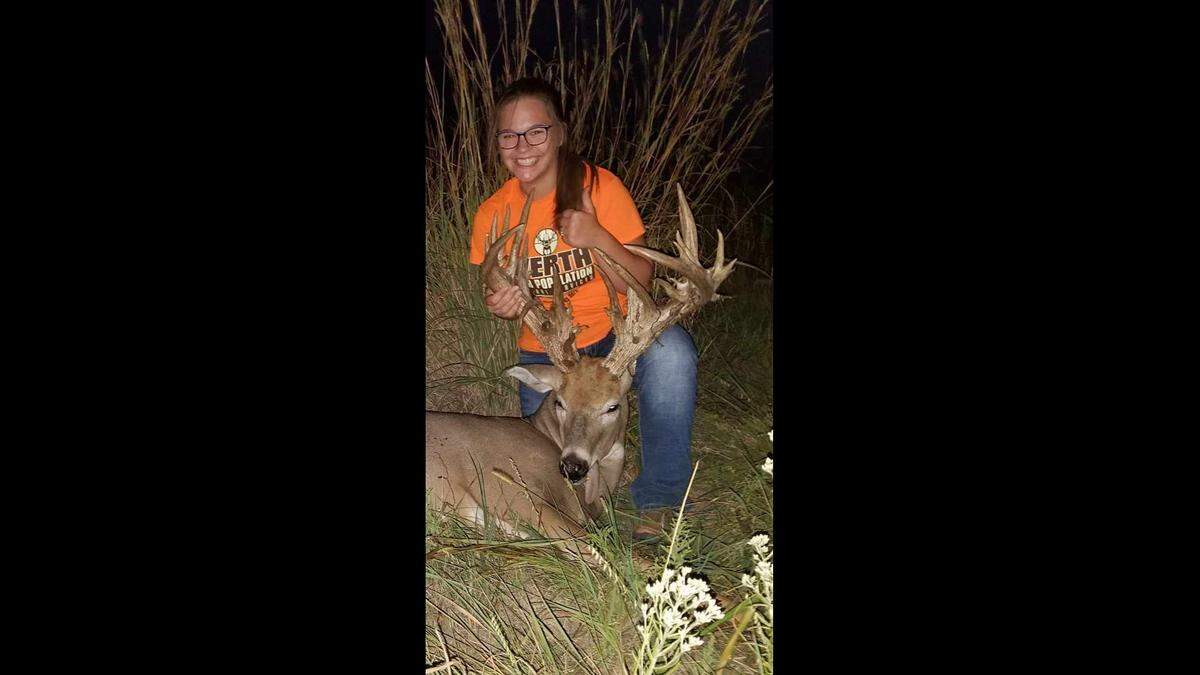
The buck was dead. He scored 273 ⅜ inches with 21 points on one side and 22 on the other.
Paslie had shot through both lungs with her father’s .270, which he won at a Pheasants Forever banquet and recently learned his daughter is now claiming as her own.
“And the realization hit then, because when I was trying to hold his horns and my hands could not go around him,” she said. “All my adrenaline kicked in and I was shaking. My dad and I were pretty pumped but then again it was getting dark so we knew we had to take care of him.”
Her father asked where he had come from. She suspected he had been under the tree the whole time. They went and checked and found the grass matted down where he was lying down.
He ran about 30 yards before falling where they found him.
She said it helped that it happened so quickly, not giving her adrenaline time to build up like if they had seen him come in from off in the distance.
The glow of the hunt
They took photos with the deer.
Then Kurt Werth told her to call her grandfather and asked him to help. Werth started making the mile walk back to the truck. Instead, the first thing she did when her father walked away, was call her sister.
“The first thing that comes out of her mouth was, ‘You killed my deer,”’ she said. “And I said, ‘No, I killed my deer.’”
“Just sister love right there. We were both laughing. By the end of the phone call, I told her, ‘We got the Werth buck.”’
She called her grandfather, too, telling him she got the deer. He drove out to help.
“And he was so excited,” she said. “It was honestly cracking me up.”
And, in the truck cab, was her grandmother. She hadn’t come out to the farm over hunting affairs before, but this was a big deal.
The buck had become a hot topic around town and in the Werth home.
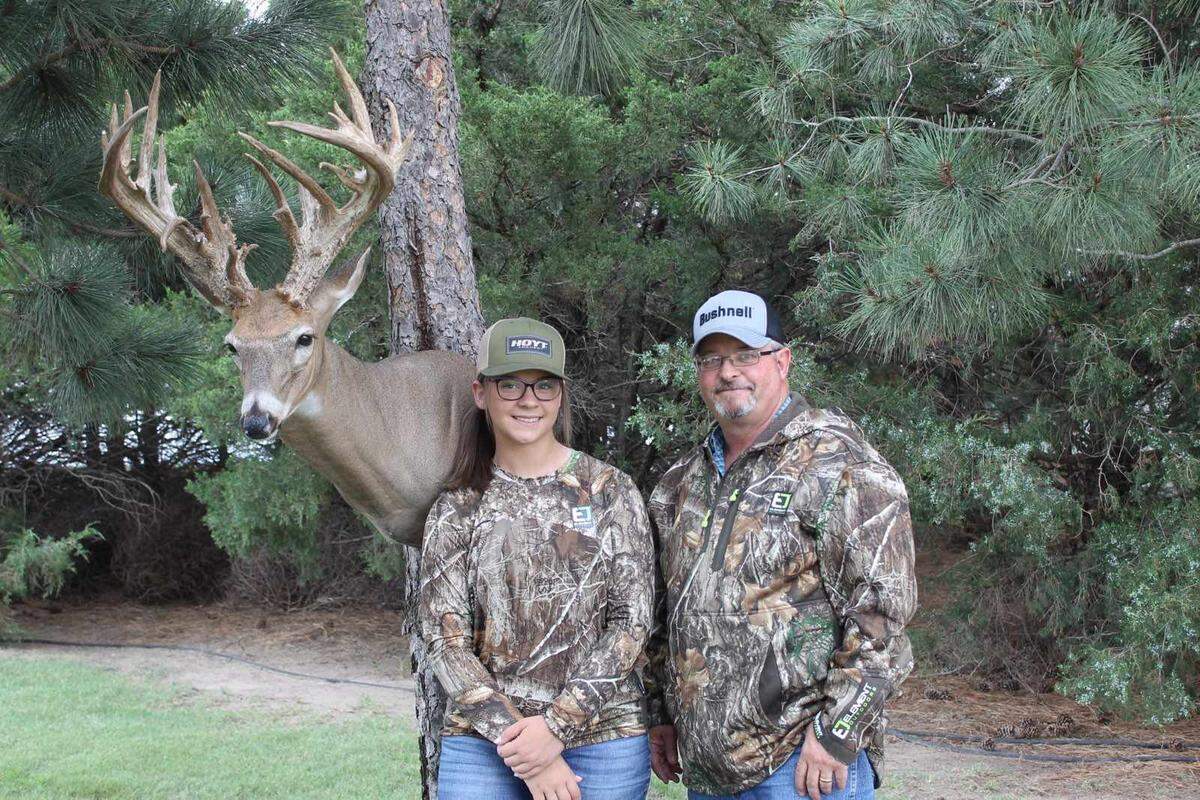
People eventually would tell her she had ruined herself for hunting, since she shot a record at the age of 14, making it hard to do better.
“It’s more of a joke, but I told people I can go for the typical record,” she said.
She was invited to different sportsmen shows in Kansas, Illinois, Iowa and Alabama. The best part of the whole ordeal was having the hunt with her father.
“It’s honestly the greatest thing,” she said. “My dad’s always been on my side and always helped me … now I could probably go hunt by myself, but I choose for him to go with me because I know these are memories I will never get back. I like spending time with him.”
For Kurt Werth, it was more memorable having one of his children get the buck than shooting it himself.
“I wanted one of my girls to get him and not a neighbor or an outfitter or someone else. The day he showed up and she pulled the trigger, that was one of my best days ever. ... When your children are born and they get married and all that, those are special days. But that was a special day, cause we had put in a lot of hours and days in and multiple years watching him grow.
“When she finally got to pull the trigger and took him, I think I did a little hooting and hollering when we walked up to him.”
Score: 273 ⅜ inches
Weapon: .270
Date: Sept. 6, 2020
Approx. time: 8 p.m.
Location: Private property in Kiowa County, Kansas
More hunting stories, newsletter sign up
The Eagle has compiled a list of the Top 10 non-typical whitetail bucks ever killed in Kansas. The list includes the No. 2 overall buck in the country. Read about them here.
And, you can follow Eagle staffers Michael Stavola and Chance Swaim as they write about hunting in Kansas.
The two will provide Kansas-based scouting reports, tips and tricks, tales from the woods, wild game recipes, DIY projects, photos and more. Sign up for our free Open Season newsletter here.
This story was originally published November 22, 2024 at 1:33 PM.