
New tank-like chairs help disabled Kansas hunters roll through the mud in pursuit of game
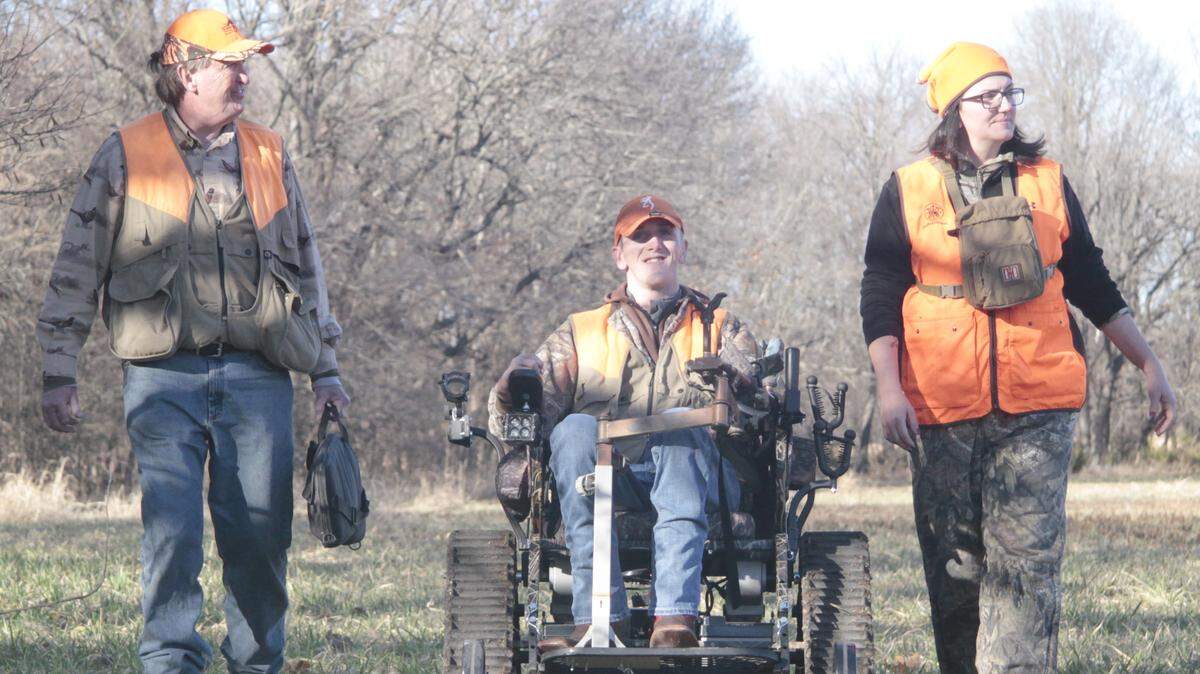
For 39 seasons Floyd Powell of Neodesha sat in a wheelchair and watched as others brought deer from the southeast Kansas woodlands. It’s been that many years since a train smashed his family’s car in rural Greenwood County.
The eleven-year-old laid covered in a sheet for over an hour because deputies thought he was dead, then spent six months in a Wichita hospital. Since, he’s been a quadriplegic.
This year things are different. After decades of desire Powell finally got his first deer, actually three of them. He has his own hunting stories to tell and plenty of his own venison.
If possible, Lonnie Powell is even happier than his gushing brother.
“You have no idea what this means to all of us,” said Lonnie Powell, also of Neodesha. “He gets so excited the night before a hunt he can barely sleep. Us, too.”
Not your grandma’s wheelchair
Powell’s long-awaited success is largely due to the state’s new Adaptive Sportsmen of Kansas program. Managed by the Kansas Department of Wildlife, Parks and Tourism, it provides track chairs for disabled hunters.
The chairs are a cross between an ultra-comfy electric recliner and a bulldozer. Tank-like tracks easily carry disabled hunters through deep muck. They climb hills like mechanical goats.
“We got these as a way to provide people with mobility issues a way to get out and hunt,” said Mike Miller, ASK committee chairman. “We’ve done a variety of hunts for disabled folks. While the demand has never been really high, we’re thinking providing equipment like this could increase interest.”
Miller stressed the program is in its infancy and won’t ready for widespread public use for months. Powell and Jak Kerschen, a 19-year-old quadriplegic from Goddard, were part of special test hunts so track-chair staff and volunteers “get things ironed out.”
That’s appropriate wording since taking disabled hunters can come with plenty of wrinkles. In addition to the track chairs, many require more-specialized equipment.
More specialized gear, health considerations
Jessica Rice coordinated and guided on Powell and Kerschen’s hunts in the rugged Chautauqua Hills in southern Elk County. She learned the standard, tent-like blinds many able-bodied hunters use are too small for a track chair hunter and guide. One super-sized blind was eventually donated by a hunter. A department camouflaged trailer designed for bird watching has also served well.
Firearms also needed to be adapted for Powell and Kerschen.
While many paraplegics have enough upper body control to hold and aim a gun, quadriplegics do not. Denny Kerschen, Jak’s father, and ASK volunteers eventually found special gun rests that completely hold a firearm and can be adjusted in many ways. The rests are rock solid when bolted to a track chair’s footrest.
They learned AR-style rifles work best for such disabled hunters. ARs normally have less recoil than standard rifles. The straight-down handgrip can be used by hunters with limited hand control and finger use, like Powell.
Denny Kerschen said the vertical magazine system of an AR is perfect for attaching any of several firing aids.
“Jak can’t pull a trigger, so his uncle made an apparatus that attaches to the rifle and Jack pushes down on a lever to fire the gun,” said Denny Kerschen. “There are so many things out there these days that help disabled people enjoy shooting.”
Other specialized gear includes a large syringe and surgical tubing that can be pressed by a hand, foot or finger to fire the rifle. Another apparatus allows the severely disabled to blow into a tube to fire a gun.
Jak Kerschen, a quadriplegic since a rural auto accident when he was 15, said a bracket that attaches a cell phone to the back of a rifle’s scope has been “the biggest game-changer” to getting him literally on target.
Put on camera mode, the phone allows him to aim the rifle from about any angle. With the special rest, firing aid and scope adapter, Kerschen can keep shots within a poker chip at 200 yards.
Physical limitations vary from hunter to hunter and day to day. Rice initially invited Powell and Kerschen during an early-September season designed to accommodate hunters with disabilities and youth. The first afternoon Powell got his first deer, a nice doe. Kerschen had opportunities at does and small bucks but was holding out for bigger antlers. The following day a few hours of fishing left both hunters too tired and hot to hunt a second afternoon.
Denny Kerschen said most don’t realize how quickly the health of a disabled person can change.
“Jak lost his ability to sweat so we really have to watch him in the heat,” he said. “His diaphragm is also paralyzed, so catching a cold be serious.”
Happy hunters
Fortunately, the weather was mild when the hunters met Rice and volunteers Dec. 6 at Markel’s Flying Elk Ranch. It’s 4,000 acres managed as much for wildlife as livestock. Deer trails between rugged, rock ridges and lush food plots are large enough to show up on Google Earth and similar apps. The ranch is known for hosting special deer hunts for disabled veterans and youth.
Track Chairs easily took Powell and Kerschen to blinds placed on remote food plots by ranch manager Rick Mitchell and volunteer Greg Pickett. Kerschen shot a nine-point buck and two does during one sit.
Lonnie Powell brought his brother in September. Daulton Powell, Lonnie’s son, insisted in bringing “Uncle Floyd” in December.
An avid hunter, Daulton Powell hinted his uncle should hold out for a trophy buck.
“I came to shoot deer,” Floyd Powell said in his slow, deep, gravely voice. “I want the meat.”
A parade of does started within minutes of entering the blind. Then a young buck with tiny antlers fed into easy rifle range. Daulton Powell repeatedly told his uncle to be patient, a bigger buck might appear.
After 10 minutes of watching, Floyd Powell insisted it was the deer he wanted. The shot was good and the young buck was quickly down.
Before they left the blind, a gorgeous ten-pointer trotted into sight. Legally limited to shooting one antlered buck, the Powells could only watch the trophy-class buck browse and pester does.
Though his nephew was dismayed at what could have been had his uncle waited, the hunter in the track chair did nothing but smile.
“Nooooo,” was Floyd Powell’s answer when asked if he was disappointed he didn’t get the bigger buck. “I just shot the biggest buck of my life. I’m very happy.”
Thanks to a new state program, he might get the chance to get an even bigger one next season.
This story was originally published January 6, 2020 at 5:01 AM.