
One scale at a time
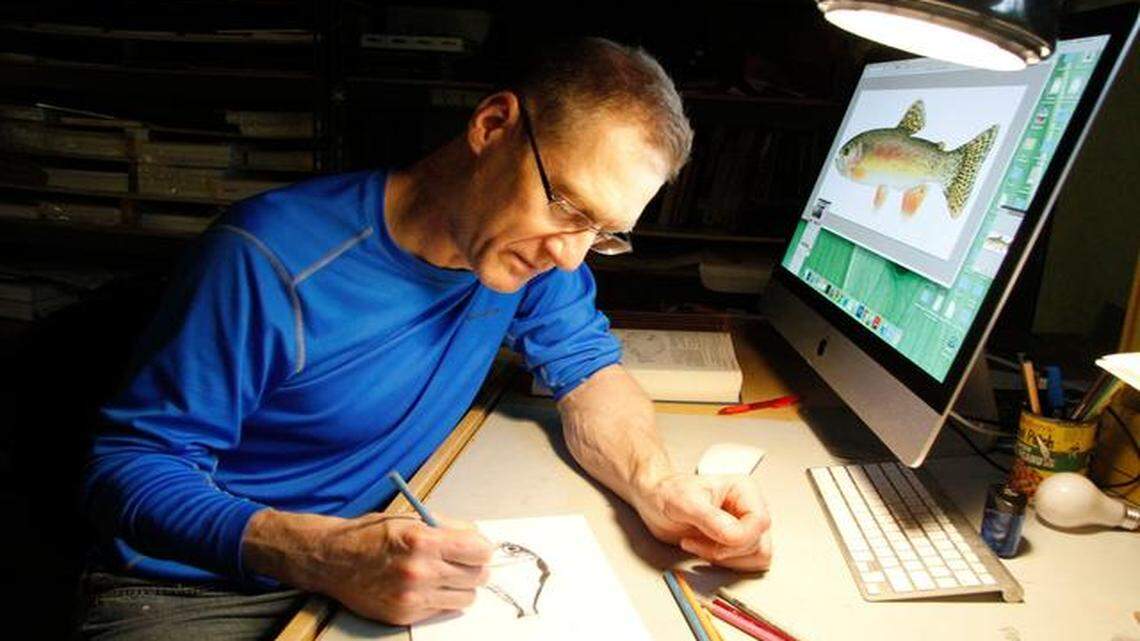
You probably won’t find any of Joseph Tomelleri’s artwork in a fancy French museum or affluent New York art gallery, but you might in fly shops, outdoors stores and angling lodges literally all over the world. Some say the eastern Kansas native, now living in Leawood, may be the most prolific, and talented, fish artist in the world.
"Joseph Tomelleri is the best fish illustrator I've ever seen,” Audubon executive editor Gary Soucie once wrote. “That he does it all with colored pencils is truly an artistic tour de force. Wow.”
To date he’s drawn close to 1,000 different kinds of fish, mostly North American fresh and saltwater species. Those drawings have appeared on about everything from framed prints to limited-edition decorative beer cans.
“They’ve ended up on magazine covers, signs, advertisements, T-shirts, greeting cards,” said Tomelleri, “and about anything you can imagine that could hold the picture of a fish.” Though he’s always liked fish and fishing, Tomelleri said he’s had little formal art training and had no career goals of being an artist.
“Growing up I really wanted to be a forest ranger,” he said. “I got my masters degree in biology.”
Tomelleri was a student at Fort Hays State University when he and some fellow students decided to do a booklet on the fish species of western Kansas in 1987. When a friend was struggling to get good photographs of the fish, Tomelleri said, “Shoot, how about if I just draw them.”
From then on, his drawings began drawing attention. Ned Kehde, a Kansas writer, got In-Fishermen to look at some of Tomelleri’s catfish drawings for their magazine. Eventually they purchased images of many more fish, too. He teamed up with University Press of Kansas to make Fishes of the Central United States in 1990. He’s been swimming in the fast lane ever since. Most projects start with his favorite part of the job.
“That’s easy, going out and collecting the fish,” he said with a wide smile, when asked what he likes the most. “It might be by seine, electro-shocking or, if I’m lucky, hook and line.”
He has a collection of preserved fish at his in-home studio. Often such a specimen sits as a reference, within inches of where he’s drawing. In addition to trying to create perfect colors and body shapes, Tomelleri takes detail down to numbers of rows of scales per fish, and scales per row. Every scale is drawn individually to be the proper size and shape.
“That takes a lot of discipline,” he said. “It might take two days to put all of the scales on a trout.” A single drawing can take from 10 to 80 hours, depending on the details of a fish.
He often has to blend pencil colors to exact the vibrant colors of spawning fish. His background in biology and personal interest in fish and fishing helps him discern, and duplicate, minute differences that may separate one species of minnow from another.
Such attention to minute detail has made his drawings popular with those publishing scientific books. The looks-wet realism of popular species of trout, salmon and other gamefish have a been made into a line of posters, framed drawings and clothing decorations for such prominent lines as Simms and Eddie Bauer. He’s not just into the glamour species.
Last week on his desk he had a preserved hatchet fish, a fish of the deep Atlantic that would appear bland to most eyes. Tomelleri pointed out characteristics that made the five-inch fish special. To Tomelleri all species of fish are special. Rather than bass or walleye, he spends much of his local angling time fly-casting for common and grass carp. Both of the nearly world-wide species can be challenging to catch because of their brains and tough to land because of their brawn and size. His best “grassy” was 37 inches long. His best common carp around 20 pounds. In his eyes, the gold or silver sides of what most anglers consider trash fish hold great beauty, too.
But to talk fish and fishing with the artist, and to see the images on his computer, is to quickly learn that he has an even deeper respect for mostly unheard of species of trout that inhabit the rugged high country of the Mexican Sierra Madres. It’s there that he gets to combine his interests and skills as a biologist, artist and angler helping others research 10 species of vibrant trout few anglers outside the area have seen or even heard about.
“It’s about the last frontier in North America, where you can go and still be able to discover fish,” he said. Through his drawings, however, some of the continent’s most remote and beautiful fish can be appreciated by others around the world.
To see more of Tomelleri’s work go to americanfishes.com.
This story was originally published April 11, 2015 at 6:16 PM with the headline "One scale at a time."