
Over easy, not scrambled
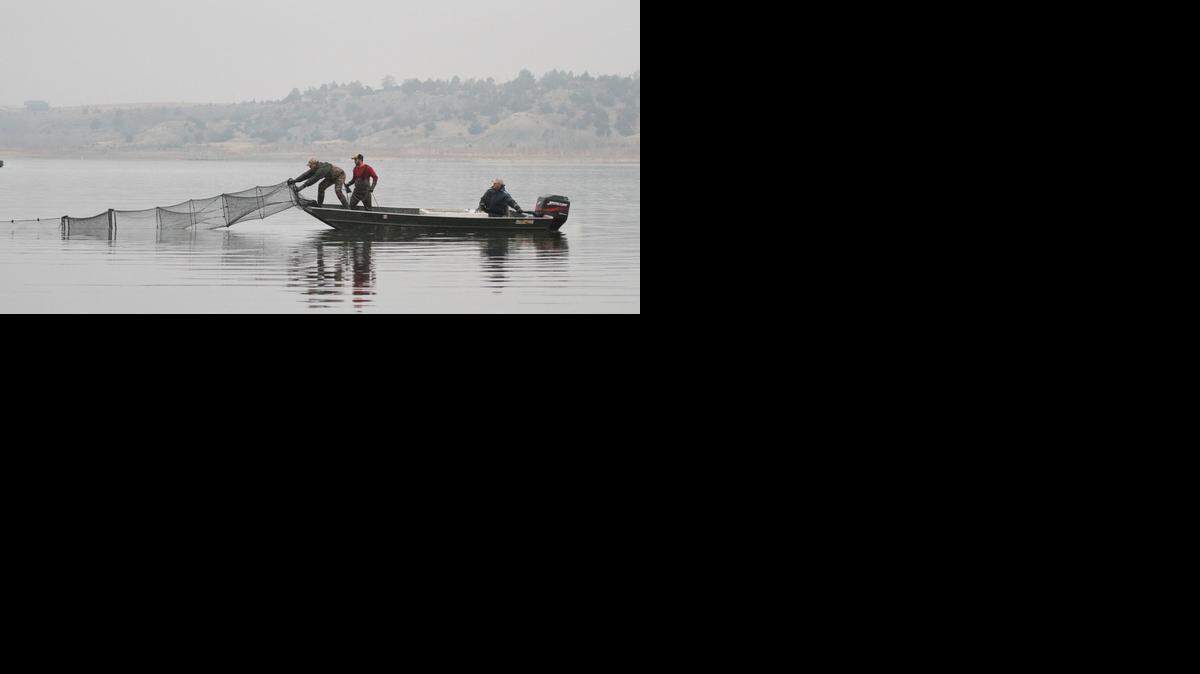
It’s a memorable day when most Kansas anglers can scoop a limit of five walleye aboard with a dip net.
Thursday, Dave Spalsbury was scooping the fish up about 125,000 at a time.
OK, so he was only using a quart-sized measuring cup, and the speck-sized eggs had only been “walleye” the hour or so since they’d been taken from females and mixed with semen from males. Still, it’s because of millions of those tiny eggs that Kansas walleye fishermen should have good walleye fishing for years to come.
“On a good day, at the peak (of the walleye spawn) we can take seven to maybe 10 million eggs,” Spalsbury said as he ran his hand smoothly across the belly of a fish of about 6 pounds. “Some of these big females surely have over 100,000 eggs in them.”
That was Thursday morning, when Spalsbury, the Kansas Department of Wildlife, Parks and Tourism fisheries biologist for Cedar Bluff Reservoir, and a seven-man crew collected about 3 million walleye eggs.
Kyle Austin, Wildlife and Parks hatchery program manager, said their goal is to gather 104 million walleye eggs this spring in Kansas. He’s hoping that will result in 70 to 80 million tiny walleye or saugeye being hatched.
Odds of such high results are good, thanks to several decades of experience and some ultra-fertile fish in Cedar Bluff, Hillsdale and Milford reservoirs.
Though currently at only about 3,000 acres of water, which is less than half its intended size, western Kansas’ Cedar Bluff is the state’s giant when it comes to producing walleye eggs.
Thursday was the second morning Spalsbury and team had run nets on or near Cedar Bluff’s dam. Though many people believe the spawn is triggered solely by a water temperature in the low 40s, Spalsbury said the fish respond as much to the length of daylight.
That morning they had 33 females. Each brought promise to the future of walleye fishing in Kansas.
The team of biologists treat those eggs, and fish, with utmost care and caution. Fish are carefully removed from nets and placed in an on-boat tank of well-oxygenated water. After the last of the nets are run, the fish are taken to large pontoon boat converted into a covered hatchery facility with big livewells, water pumps and assorted supplies.
After emptying two to four females of their eggs in a clean plastic pan, the sperm of some male walleye was added. A clay solution was added to the mixture to keep the eggs from clumping. A big turkey feather was used to slowly stir the mixture so eggs aren’t crushed.
Throughout the system, Cedar Bluff’s water was run through a diverse system of filters to insure purity. Fish are wiped down before they’re milked. Any impurity within eggs is delicately removed with a feather.
After the fertilization process, the eggs were cleaned and soaked in ideal water conditions for at least an hour, then driven directly to hatcheries at Pratt. Most other lakes will ship theirs to the bigger hatchery at Milford.
Spalsbury said they should hatch within about 10 days. Some may be kept in hatchery rearing ponds for weeks, until the fish are big enough to be stocked as fingerlings to better avoid high numbers of predatory fish, like the white perch at Cheney and El Dorado reservoirs.
Many of the tiniest fry, though, could be stocked in some lakes, while fisheries biologists are still taking eggs at others. Spalsbury said walleye are often worked at Cedar Bluff for about 12 days, until the state figures they’ve reached their quota for the year.
Thursday morning’s egg-taking began with barely enough light to see across the water. The air was so calm, the outboards of both boats could be heard across the lake. Running the 11 nets went well, as did the milking of males and females. All swam away when released, as Spalsbury said more than 99 percent of the handled fish do. Many tagged fish have been milked for several years.
All of the biologists ended the morning dry, warm and happy. It’s not always that way.
“This was probably the easiest day (of working spawning walleye) I’ve ever had,” said Scott Waters, Wildlife and Parks biologist for Glen Elder Reservoir, who spends five to seven days a year working the walleye spawn at Cedar Bluff. “It’s very rare in western Kansas to get a day this calm. About any wind blowing hard can make things a lot harder.”
Biologists talked of mornings in past springs when waves crashed over the sides of the boats, and turned to ice within seconds.
“It has its time when it can be very dangerous work,” said Brian Fisher. “It can be miserable handing those wet nets when the conditions get like that.”
But such conditions aren’t in the forecast, at least not extreme cold. Spalsbury said the forecasted daytime highs of around 70 degrees should encourage female walleye to head to the shallows where his nets are waiting. Full-time biologists, like Spalsbury and Waters, hope the process proceeds quickly.
Most of the others on hand would probably prefer the process take some time. Fisher and five others were college students, all carrying outdoor-related majors, hired to help with the egg-taking process. Fisher said the mid-semester money is nice, but it’s not the best part of the job.
“It’s a very, very good experience for guys like us. We not only get experience in the field, but it also can lead to summer jobs,” said Fisher, a Fort Hays State University undergrad. “This, plus those summer jobs, are the kind of things that help lead to jobs when we’re out of school. This is a huge deal for us. I really appreciate the opportunity.”
This story was originally published March 20, 2015 at 5:54 PM with the headline "Over easy, not scrambled."