
Shocker bass team tackles college tournaments
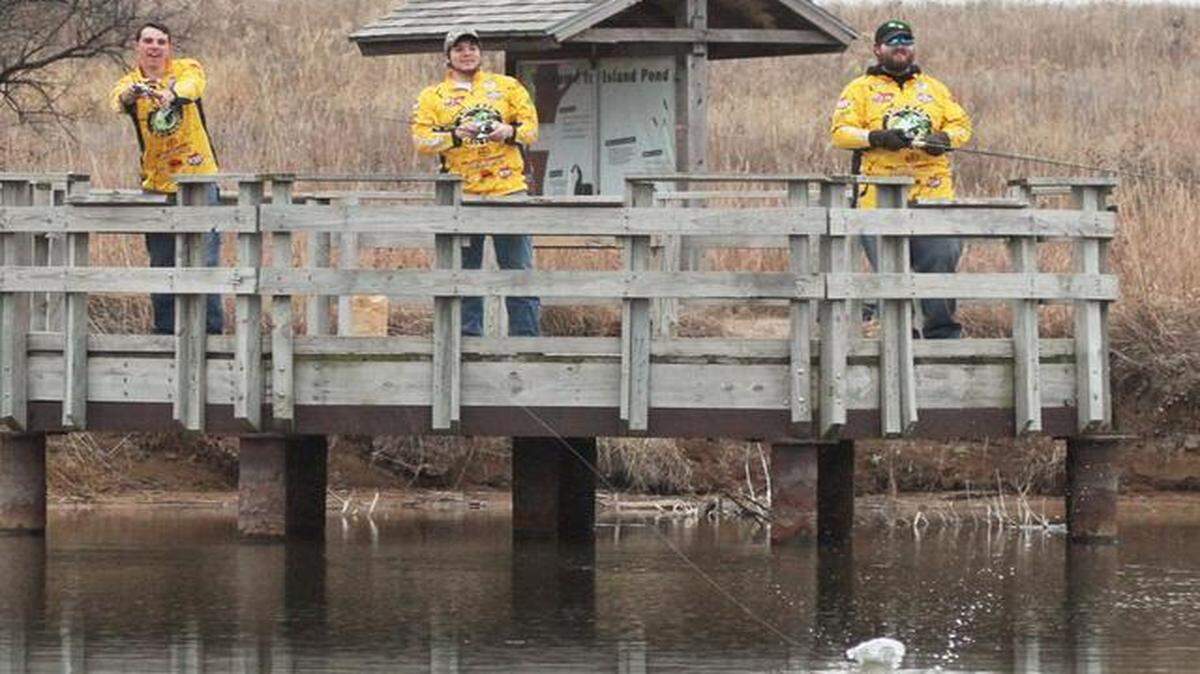
Pre-med major John Wright studies often in his final semester at Wichita State. Along with the assorted courses on advanced biology, he’s currently cramming in as much knowledge as he can get about Kentucky Lake.
“I’ll be there about the whole week of spring break, fishing a big tournament,” said Wright, Shocker Bass Team president. “(Collegiate bass fishing) is almost like having another job to go along with school and work. It takes a lot of time and preparation.”
Wright, a senior, said the 14 members of Wichita State’s fishing team hope this will be a breakout year in the rapidly growing world of collegiate bass fishing.
“When we held our first tournament in 2009 we had 91 schools,” said Kevin Hunt, FLW College Fishing tournament director. “Right now we’re at about 650 schools that have fishing teams. That ranges from two-year community colleges to most major universities.”
Hunt said their organization divides the nation into five divisions, each having four major college tournaments. Some of those tournaments may have up to 100 boats, each with two anglers from the same team. Anglers from those divisions fish toward a national collegiate championship.
In April, 2012, Kansas State angler Ryan Patterson won the FLW college championship on South Carolina’s Lake Murray and netted around $100,000 in cash and prizes. (Patterson was fishing alone, against two-person teams, because of his partner’s last-minute disqualification.) On most college teams the winnings, that are largely paid in equipment, are given to the team.
Catching fish not the only challenge
Wright said such equipment and funding would be a God-send.
“Finances are always a big thing. When you’re already living on Ramon noodles you normally don’t have a lot of cash to spare,” he said. Last year the university recognized the team as a sport club, so the school now donates some money to the team.
“It’s not a lot of money, but it’s helped us get going,” said Wright, “that and getting a few local sponsors to help us out.” Most of the local sponsors, he said, are area businesses run by avid bass fishermen who offer advice as well as some financial support. Some national fishing equipment companies offer college teams discounts on gear to encourage the sport. The bass club has held several fund raisers, including selling clothing with the team’s name and logo.
It would take a lot of t-shirt profits to afford one the team’s biggest challenges — coming up with enough boats.
“Right now we have a couple of guys on the team who have boats but only one of them is running 100 percent so we’re working on the other one. A couple of members have dads who will probably let them borrow their boats. We’ll never have enough.”
Wright said a lack of bass tournament experience is another challenge. The Shocker Bass Team is at a sizable disadvantage at college tournaments since many southern college teams have members that were on high school bass teams or at least had great bass fishing lakes nearby, with youth fishing tournaments as common as soccer tournaments.
The Wichita State squad has figured out a way for members to learn from non-student veterans.
As well as the FLW tour, Wright said the Wichita State team will fish a similar collegiate circuit offered by Cabela’s. They’re also going to try to make as many tournaments sponsored by the Kansas Bass Nation and Bass Federation of Kansas, a pair of local circuits. Wright said a lot of those entrants are longtime tournament bass anglers, some with regional and national success.
Club members who don’t have a boat can attend such tournaments as a co-angler, meaning they’ll be fishing from the back of a boat owned, and piloted, by a circuit member. Wright compared the opportunities to attending a college class taught by an esteemed professor.
“Most of those guys are really great to fish with, and you can just stay in the back of the boat and listen and most will tell you why they pick a spot and why they’re fishing it a certain way,” Wright said. “When you do that you don’t have to worry anything about the boat. You can just work at getting better at fishing. It’s a great opportunity to learn a lot from the best of the best.”
Freshman Ashlin Bohl, from Ulysses, said such experience might help her learn a lot in a hurry.
“It’s all really a lot different than what I grew up with, pond fishing from the bank,” she said. “That’s a big difference from fishing from a boat, in a lake where there’s so much water.” Bohl said she’s learned a lot from weekly team meetings, where the members discuss upcoming tournaments and lakes, listen to guest speakers and try to learn more about equipment.
Balancing the time
How long they can fish, and where, depend on another common problem all team members face — a lack of time.
Freshman Alex Ast said they may meet at a local pond and fish from shore. If the members with access to boats, like himself, can gather at the same time they may head to a lake.
“It’s hard to work with everyone’s schedule with school, and work,” Ast said. “It seems like time is one of our biggest problems. I set my school schedule so I have all of my classes on Tuesday and Thursday, meaning I can be open for Friday-Monday tournament deals and not miss any classes.”
Still, Wright said even when they can find time to travel and fish, the fact that they are students usually works its way into the daily lives of team members.
“I’ll probably be spending a lot of (weekend) nights in motels looking at lake reports, trying to figure out where I’ll fish the next day and at the same time I’ll be going through a biology book,” he said. “I still have to be ready for (medical school) admissions tests.”
To learn more about the Shocker Bass Team go to ShockerBassTeam on Facebook, @ShockerBass on Twitter or e-mail jtwright@wichita.edu.
This story was originally published February 21, 2015 at 3:56 PM with the headline "Shocker bass team tackles college tournaments."