
A century before Banana Ball, Wichita had its own baseball circus
A century before Banana Ball sold out three nights in Wichita, the city had already discovered the strange magic of a baseball circus: Put clowns on the field, firefighters in the dugout and let curiosity do the rest.
There were acrobats turning handsprings on the basepaths. A circus band playing between innings. Sideshow performers sitting in the box seats. A famous clown dressed as a police officer. A firefighter in center field trying to catch fly balls from the back of a motorcycle.
It is those details that make Banana Ball’s arrival in Wichita feel less like a novelty and more like history winking at itself.
Banana Ball, the fast-paced, entertainment-first version of baseball created and popularized by the Savannah Bananas, has become a national draw by turning the sport into something closer to a ballpark variety show: unusual rules, choreographed player routines, crowd participation, trick plays and the constant promise that the next inning might bring something more memorable than the score. The baseball is real, but the entertainment is the hook.
The Firefighters will take on the Coconuts at 7 p.m. Thursday through Saturday, May 7-9, at Equity Bank Park with all three games sold out for months and crowds that could challenge the ballpark record of 10,442 fans set during a Wind Surge game on Sept. 16, 2023.
But Wichita has seen the Firefighters in a baseball circus before.
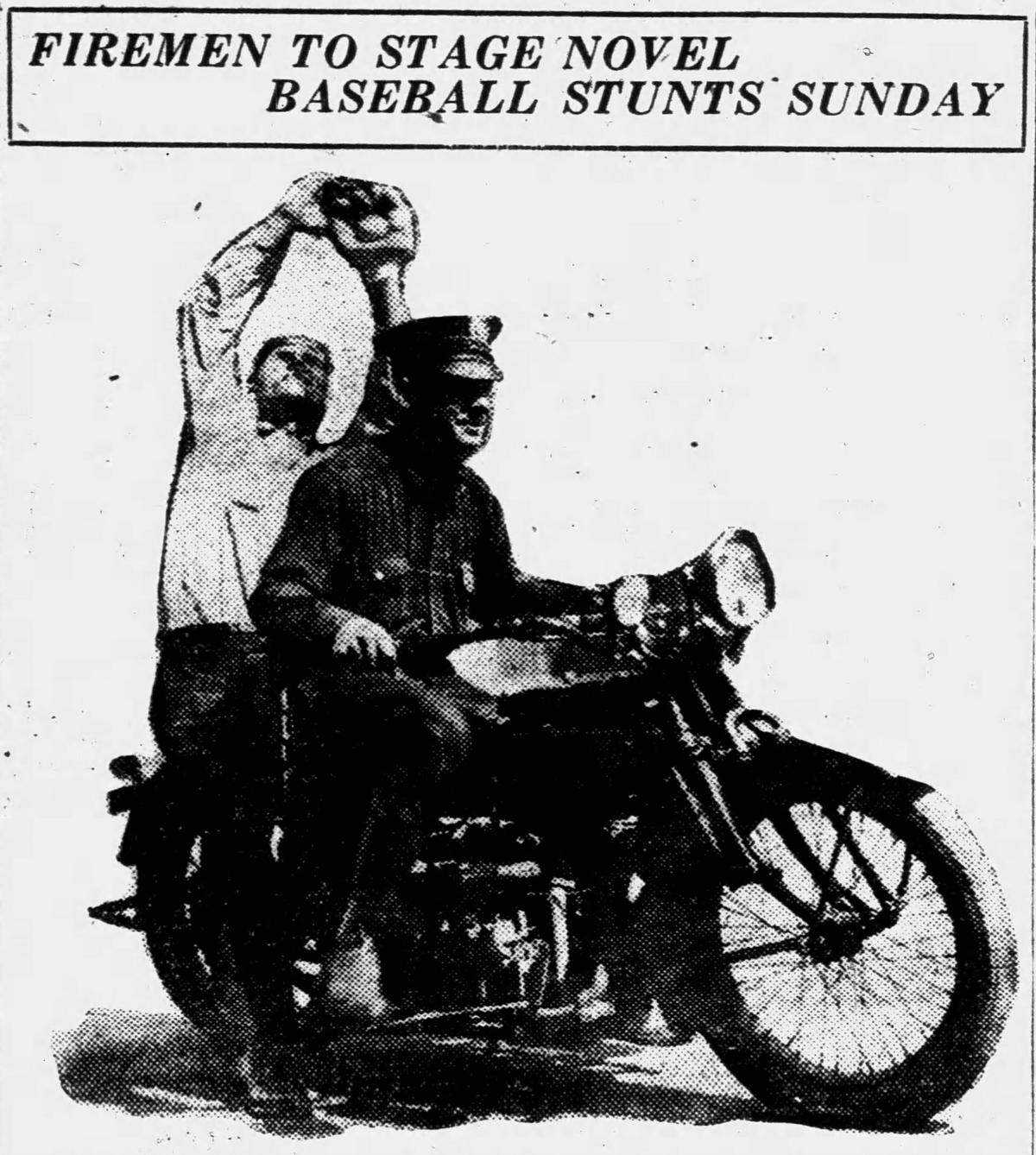
In 1925, it was not a Banana Ball team carrying the name. It was Wichita’s actual firemen who took the field at Island Park against the Sparks Circus team in a game The Eagle described at the time as “a cross between a fine exhibition of baseball and a day at the circus.”
That description now reads like a scouting report on Banana Ball written 100 years early.
The uniforms were different. The ballpark was different. The show traveled by circus train instead of spreading through viral clips. But the appeal was strikingly familiar: Baseball was still baseball, only with enough showmanship wrapped around it to make even a casual fan wonder what might happen next.
The Sparks Circus-Firemen game was played on Aug. 16, 1925, one day before the circus was scheduled to open in Wichita. The timing was no accident. Circuses were not allowed to stage regular Sunday shows in Wichita at the time, leaving the clowns and roustabouts with a free day and an idea.
According to later accounts in The Eagle, an advance man for Sparks Circus came to town trying to drum up interest in the coming show. He asked Eagle sports editor, Pete Lightner, if the circus team could pick up a few dollars on Sunday by playing a baseball game against a local opponent.
Lightner turned to a young writer in the sports department named Raymond Dumont, years before Dumont would become one of the country’s most inventive baseball promoters.
“Hell, I’ll put it on,” Dumont said.
That was the start.
Dumont was still in his teens, but he already had the instinct that would define his career: If there was a crowd to be found, he would find a way to bring it through the gate.
The circus challenge was not designed to find elite competition. It was designed to create a show. Dumont found the perfect local opponent almost literally next door, where the fire station stood near The Eagle office.
He convinced fire department leaders to put together a team to face the circus roustabouts with proceeds going to the firemen’s pension fund. He also promised to bring along some clowns to help sell tickets.
The result was one of the strangest baseball games Wichita had ever seen.
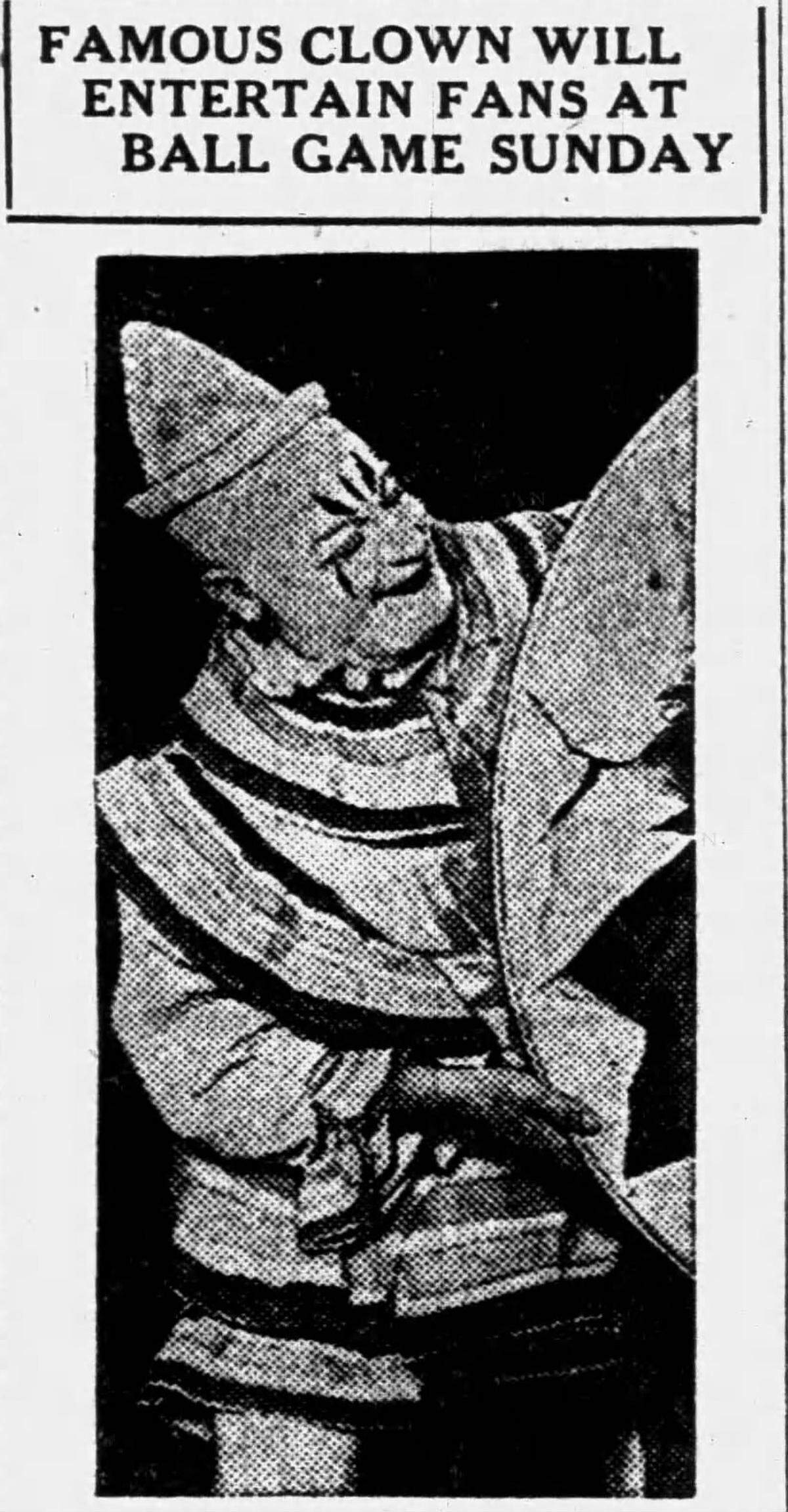
The Sparks Circus team was made up of clowns, acrobats and animal trainers. Abe “Korkey” Goldstein, one of the era’s signature clown cops, was part of the attraction, bringing a Keystone Kop-style act built around a comic policeman’s oversized coat, brass buttons, helmet, nightstick and pratfalls. A circus clown umpired the bases. The circus band played before the game and at the end of each inning. Members of the traveling show troupe, including sideshow performers billed in the 1925 Eagle story as the bearded lady and the half woman, watched from a reserved section in the box seats.
The circus team was known to run the bases backward and sometimes play without gloves. Performers turned handsprings between bases. One sideshow performer billed as the “fat man” played in the outfield. The firemen had their own tricks ready, too, most memorably Happy Barlow playing center field while riding behind a police officer on a motorcycle, glove in hand, chasing fly balls across the grass.
The circus team won the game 6-0, but the score was almost beside the point. The game drew 3,400 fans, according to Dumont’s later recollection, topping the previous local high-watermark for an amateur baseball crowd.
“The ball clubs weren’t any good,” Dumont told The Eagle in 1970. “They were just a couple of sandlot teams but the fans came out to see the clowns.”
A century later, that line still explains plenty.
Banana Ball’s rise has been built on a similar understanding. Fans will come for baseball, but many will remember the dancing, the gags, the rule twists and the feeling that something unscripted and ridiculous might happen before the night is over. The draw is not the competition. It is the promise of a show.
Dumont learned that lesson in 1925 and would spend the rest of his career applying it.
In a 1962 profile, The Eagle described Dumont as “a human dynamo” who was “the very soul of optimism.”
That optimism became one of Wichita baseball’s great engines.
Dumont started the first Kansas state tournament in 1931, then founded the National Baseball Congress in 1935, building Wichita into one of the country’s great gathering places for semipro baseball. Each August, teams from across the country flocked to Wichita for the NBC national tournament, which still runs today. Dumont was also instrumental in the building of Lawrence Stadium, later renamed Lawrence-Dumont Stadium in 1978.
But many of the ideas that made Dumont famous can be traced back to the day he realized fans would fill a ballpark to see clowns play firefighters.
“I must admit,” Dumont told The Eagle, “that seeking out the clowns to furnish a gate lure for fans was the beginning of so many ideas which I later used to stimulate interest for the fans.”
Some of those ideas became classic Dumont.
He used a lady umpire. He staged games in the middle of the night for graveyard-shift workers. One year, he had players run the bases backward. He came up with an air device that dusted off home plate. His favorite invention was an electric timer that would pep up if a pitcher failed to throw within 20 seconds — a showman’s attempt to speed up baseball decades before pitch clocks became part of the modern game.
The circus game also helped give Dumont the confidence to think bigger about what could draw Wichita fans. Its success helped bring the Kansas City Monarchs to town, giving local fans a chance to see one of the most important franchises in Black baseball history at a time when Black players were still barred from organized baseball. The Monarchs’ history included some of the sport’s greatest names, from Jackie Robinson to Satchel Paige to Larry Doby.
Dumont later boasted that when he brought the Monarchs to Wichita, the organized league team in town knew it could not compete for the same audience. The Western League weekday games seldom drew more than 700 fans, while the Monarchs game sold out the ballpark with 4,000 fans.
That was Dumont’s genius. He did not see promotion as a cheap substitute for baseball. He saw it as a way to make people pay attention, whether the attraction was clowns, a midnight first pitch, a faster-paced game or some of the best baseball players in the world.
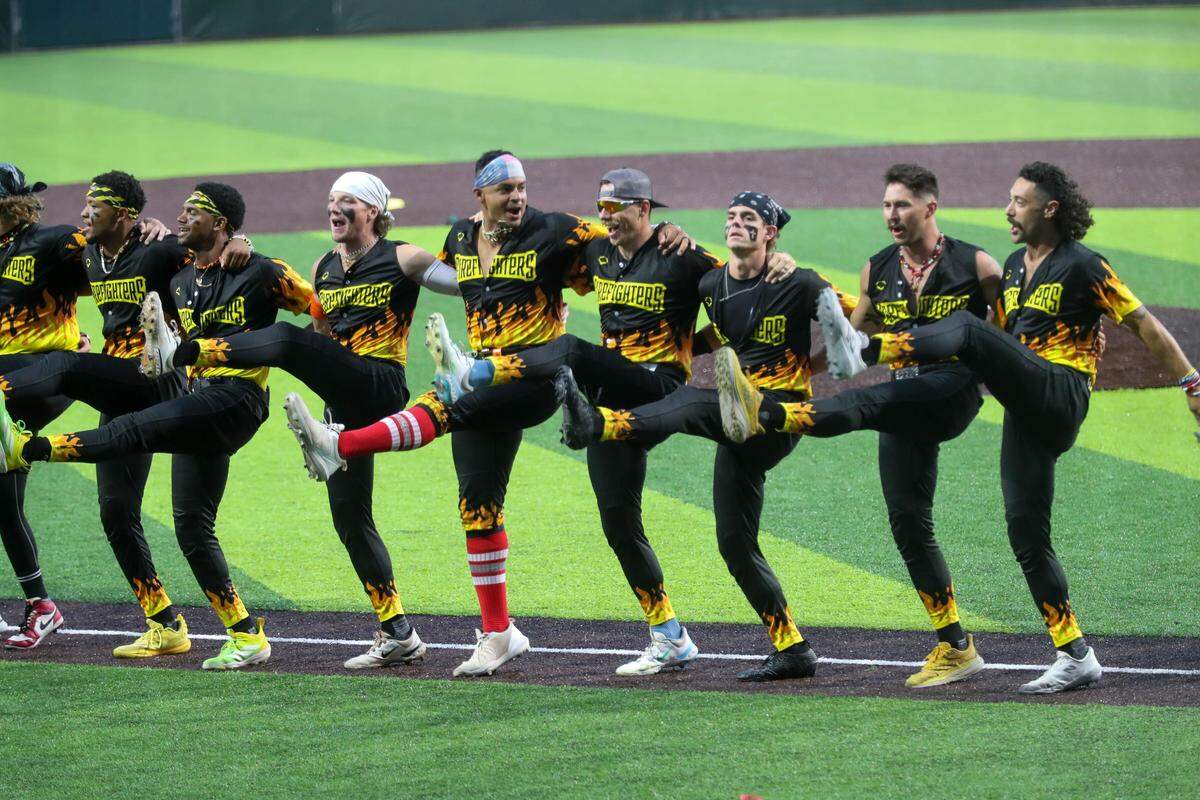
That is what makes this week’s Banana Ball visit feel less like a one-off spectacle and more like a century-old Wichita story coming back around.
The modern version comes with polished entertainment, choreographed moments and teams built for an audience that wants baseball to move faster and feel louder. But the instinct behind it is not new to Wichita. In 1925, a circus came to town, a young Eagle sportswriter saw an opening and the city packed Island Park to watch baseball become something bigger, stranger and more theatrical than a box score.
Now, a century later, the Firefighters are coming to Wichita again — this time as a Banana Ball team, but with a name that makes the historical circle hard to miss.
There will be no Sparks Circus band at Equity Bank Park. No sideshow performers in the box seats. No center fielder chasing fly balls from the back of a motorcycle.
But the strange magic is familiar.
Dumont understood something in 1925 that modern baseball keeps rediscovering: Fans will come for the game, but they remember the show.
This story was originally published May 7, 2026 at 7:00 AM.
.jpg)