
Before Ohtani, there was Hilton Smith. Wichita honors a Negro Leagues legend
AI-generated summary reviewed by our newsroom.
- Wichita posthumously inducted Hilton Smith into the NBC Hall of Fame.
- Smith’s two-way play and dominant 1935–36 NBC World Series performance earned acclaim.
- Smith influenced MLB integration, scouted after retirement, joined Cooperstown in 2001.
Hilton Smith’s path to baseball immortality finally circled back to Wichita on Thursday night, nearly a century after his brilliance helped define the inaugural National Baseball Congress World Series in 1935.
One of the greatest pitchers the Negro Leagues ever produced, Smith was inducted posthumously into the NBC Hall of Fame during a ceremony at the B-29 Doc Hangar in a long-overdue recognition.
Negro Leagues Baseball Museum president Bob Kendrick made the drive from Kansas City to Wichita to ensure Smith’s moment was properly honored. For Kendrick, the induction represented more than another plaque on the wall. It was a continuation of a deep historical thread that ties the NBC World Series to Black baseball history.
“There’s always been a great connection between this tournament and the work that we do at the Negro League Baseball Museum,” Kendrick said. “Particularly considering that legendary team from Bismarck, North Dakota. Given the connection of the number of Negro League players who have participated in this tournament, it absolutely hits home for me.”
That connection traces directly to the 1935 and 1936 NBC World Series when Smith starred for the Bismarck (N.D.) Churchills, an integrated team that stood in stark contrast to Major League Baseball’s segregation at the time. The Churchills won the 1935 NBC title behind a roster that included Smith and fellow Hall of Famer Satchel Paige. Smith returned the following summer and delivered another one of the most dominant performances in tournament history.
In 1936, Smith appeared in all seven of Bismarck’s games — four as a pitcher, two in right field and one as a pinch hitter — going 4-0 with three complete games while allowing just three runs in 30.1 innings. He struck out 25 batters and hit .313 across the two tournaments, underscoring a versatility that Kendrick believes has long been overlooked.
Often labeled simply as an elite pitcher, Smith was also a true two-way star — a point Kendrick relishes emphasizing in today’s baseball climate.
“Since everybody’s become so enamored with the phenom by the name of Shohei Ohtani, and rightfully so, it gives me the opportunity to talk about the two-way greatness of Hilton Smith,” Kendrick said. “When he wasn’t pitching for the Monarchs, he was a tremendous outfielder who had a lifetime batting average close to .300. He was a sensational athlete.”
Kendrick believes Smith’s greatness has long been overshadowed since his entire career essentially overlapped with Paige as his teammate.
“I say unfortunate, which isn’t really the right word, but Hilton was always on the same team as Satchel,” Kendrick said with a laugh. “And when Satchel Paige walked in a room, the room lit up. And you know he was in the room. And if you didn’t know he was in the room, he was going to let you know. But Hilton Smith was the polar opposite. He was quiet, so unassuming and workmanlike.”
While Paige became baseball’s most famous showman, Smith quietly built a resume that placed him among the sport’s elite. After signing with the Kansas City Monarchs following his NBC success in Wichita, Smith compiled a remarkable 93-11 record from 1939-42, earned six consecutive Negro League all-star selections and helped lead the Monarchs to seven pennants.
Smith’s pitching repertoire was legendary. Known as the “Master of the Curveball,” he won a pitching Triple Crown in 1938 and led the Negro American League in strikeouts three times.
“He possessed one of the greatest curveballs this sport has ever seen,” Kendrick said. “The late, great Buck O’Neil used to say it was the greatest curveball he ever saw. Monte Irvin used to say that you could know that his curveball was coming, but the break on it was so sharp that you still couldn’t hit it. Hilton was a special, special individual.”
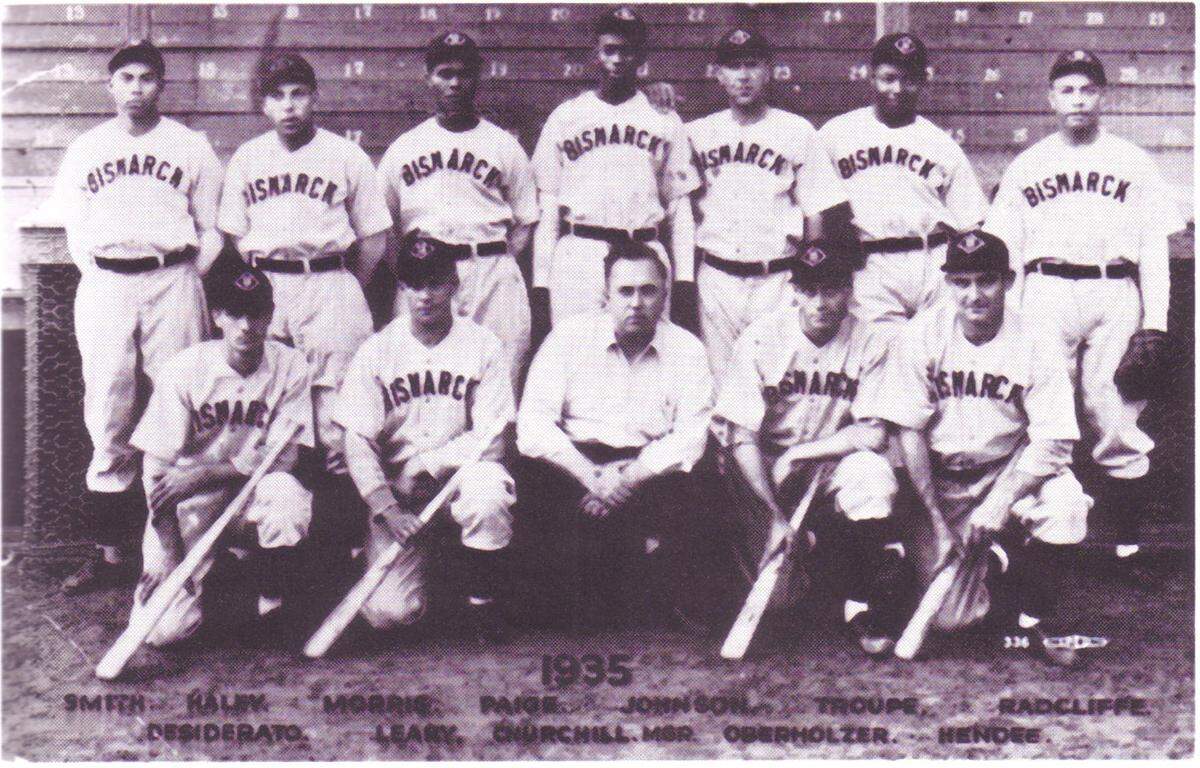
Smith’s greatness extended beyond statistics. During a barnstorming tour, he famously recommended a young Jackie Robinson to Monarchs ownership, helping open the door for the man who would later break Major League Baseball’s color barrier. When Robinson signed with the Dodgers in 1947, the organization attempted to sign Smith as well, but by then he was 40 years old and nearing the end of his playing career.
After retiring in 1948, Smith became a scout for the Chicago Cubs. In his mid-70s, he quietly wrote to the National Baseball Hall of Fame in Cooperstown, outlining his qualifications for induction. He never received a response. Smith died in 1983 and it wasn’t until 2001 that he was finally elected to the National Baseball Hall of Fame.
That history made Thursday’s ceremony especially meaningful. Kendrick attended alongside Smith’s grandson as the 2026 NBC Hall of Fame class that also included Seattle Cheney Studs veteran Garrett Breda and former Wichita State standout and current Tabor College coach Mark Standiford was celebrated. John Olerud, a two-time World Series champion, served as the featured speaker.
For Kendrick, the moment was both celebratory and personal.
“I’ve not had very many disappointments in my lifetime, but not getting to meet Hilton is one of those,” Kendrick said. “But I’ve had the honor to get to know the Smith family and his family is very near and dear to me, so that’s what makes this so special to be here and to see him rightly celebrated.”
This story was originally published January 30, 2026 at 7:01 AM.
.jpg)