Established Royals share important advice for the next wave of MLB Draft picks
AI-generated summary reviewed by our newsroom.
- The Royals hold five picks in the top 100 of the 2025 MLB Draft in Atlanta.
- Veterans emphasize mindset, adaptability and patience as keys to MLB success.
- Many players shift roles or teams before securing long-term major league roles.
Lucas Erceg had reason to celebrate. His wildest dreams were coming true.
It was 2016 and he was hosting an MLB Draft party with family and close friends. As he watched other names fly off the draft board, Erceg could see his baseball future taking shape on the horizon.
Then it was his turn to hear the words that would change his life:
With the 46th pick, the Milwaukee Brewers select ... third baseman Lucas Erceg.”
“I figured my future would be with the Brewers as a third baseman,” recalled Erceg, now a trusted veteran relief pitcher with the Kansas City Royals.
Most Major League Baseball players experienced a similar rush at that dreamlike point in their careers. The MLB Draft is where it all begins, where long-awaited fantasies transition into something of a coronation.
But on this lifelong journey, everyone walks his own path.
Erceg indeed started out as a third baseman in the minor leagues. But now he’s one of the best relievers in the American League.
A well-known Royals teammate, superstar Bobby Witt Jr., was drafted second overall as a shortstop in 2019. He remains a shortstop in Kansas City, a two-time All-Star with a plethora of awards to his credit.
Others, such as Royals first baseman Vinnie Pasquantino, were lesser-known prospects (he played at Old Dominion). Speedster Tyler Tolbert cut his teeth at Alabama Birmingham (UAB), while rookie pitcher and St. Joseph, Missouri native Noah Cameron was a seventh-round pick out of Central Arkansas.
Once a player is selected by a major-league club, there are some commonalities in the journey. Each path begins with the same opportunity: They are given a chance to make it to the big leagues one day, but it’s up to them to first make it happen in the minors.
A new crop of major-league hopefuls begins the journey this weekend, when the 2025 MLB Draft takes place in Atlanta. Rounds 1-3 are Sunday and Rounds 4-20 follow Monday afternoon.
The Royals have five selections in the first three rounds of this year’s draft. Their picks include Nos. 23, 28, 61, 71 and 97 — five in the top 100 on Sunday — and KC will make 22 selections overall.
“Getting drafted was one of the most special days of my life,” Witt said. “It was kind of just a life-changing moment hearing my name called. That’s something that I always wanted to do and then I was able to do it around my teammates and everything. So it was good.”
This week, some Royals shared advice with The Star for the next generation of aspiring big-leaguers.
Staying the course
Tolbert talked about his first minor-league assignment within the Royals organization. He was 21 and spent part of his first pro season with Idaho Falls in the Pioneer League.
The Pioneer League afforded Tolbert an opportunity to develop his skills. There were less glamorous aspects, too, like hotel accommodations at the local Comfort Inn and 15-hour bus rides between cities.
But Tolbert couldn’t have been happier. He was living out his dream while remaining vigilant, even if the unyielding sacrifices he made along the way weren’t always easy.
“When I got to Idaho and just while we were traveling, I thought it was the best thing in the world,” he said. “It’s a grind, and back then, we weren’t making a lot. … You’ve got to have that belief and take it one day at a time.”
Tolbert made his MLB debut earlier this season. But first he had to climb his way up through every level in the Royals’ minor-league system.
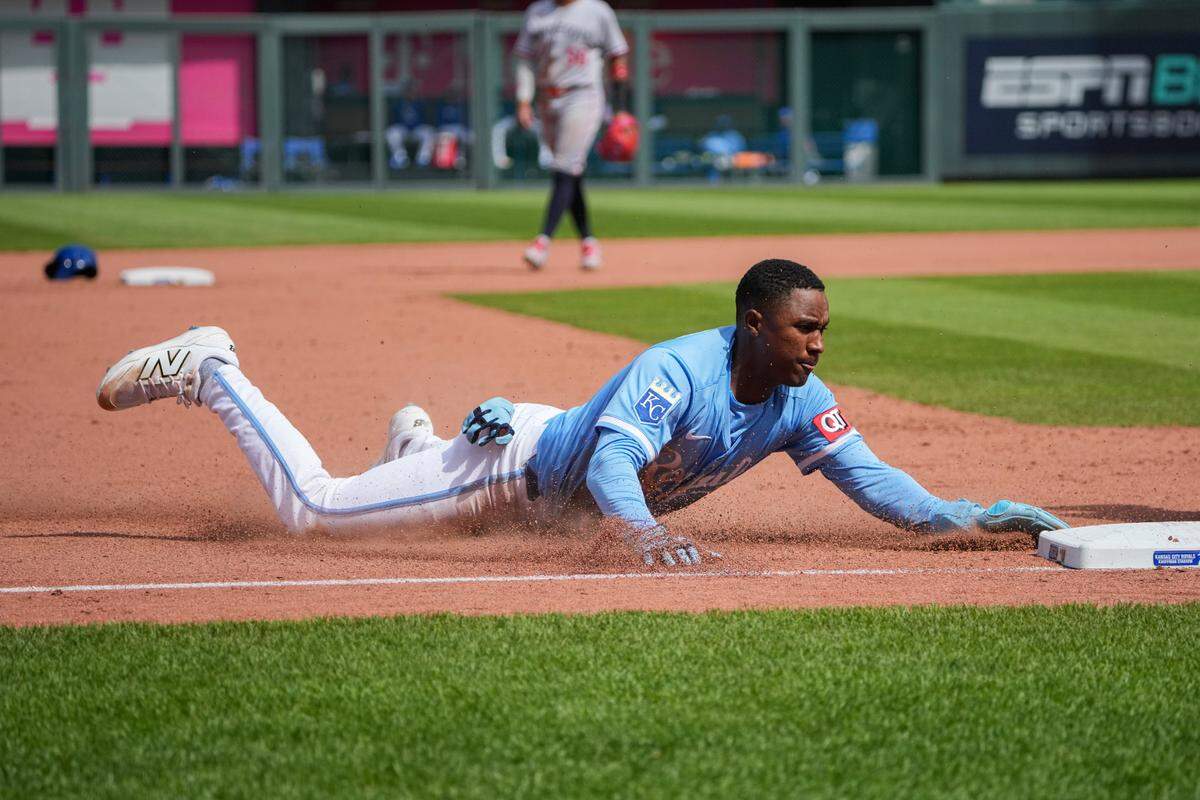
Each stop taught him valuable lessons. He developed plate discipline at the Double-A level and worked to generate more bat speed against Triple-A pitching.
“Nothing is going to be given to you,” he said. “You’ve got to go out there and earn your keep every night.”
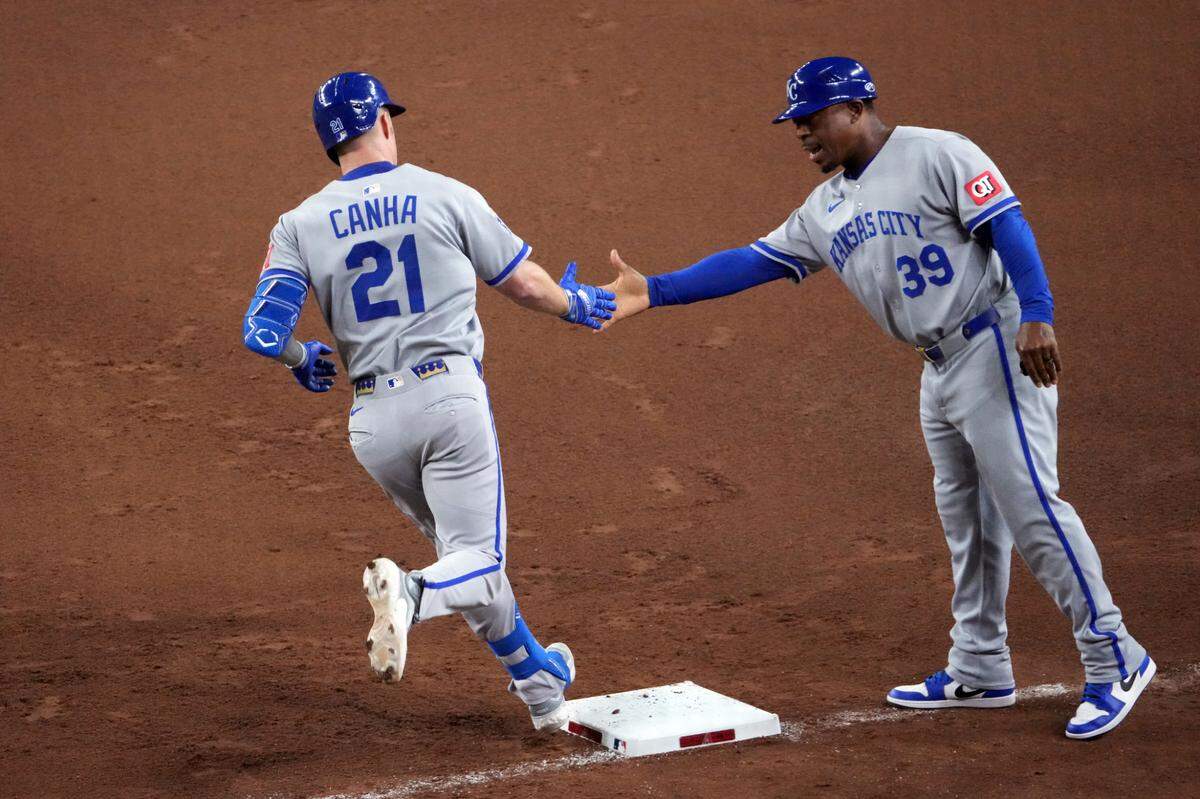
KC outfielder Mark Canha, a well-traveled veteran, agreed. He just reached 10 years of MLB service time — a major career benchmark — and is still fine-tuning parts of his game at age 36.
“Development doesn’t stop in the big leagues,” he said. “You have to try and learn and soak up as much as you can. Learn things about the game as they are happening to you, because you are going to learn the hard way.
“You have to take those failures and not get emotional about them or discouraged by them. Take them for what they are, and that’s learning experiences. That’s the best way to approach it.”
The Marlins made Canha their seventh-round pick in 2010. From there, it took him five years to reach the majors — not with the Marlins, but with the Athletics. He was 26 by then and recorded three hits and four RBIs against the Rangers in his big-league debut.
Canha’s story is not uncommon. Vivid dreams on draft night can sometimes fade into a different reality. Some guys start out as two-way players, pitching and fielding a position like Royals rookie Jac Caglianone.
Then, after arriving in the minors, they often start focusing on playing just one position, as Caglianone did when he stopped pitching and focused on playing right field.
Others find their niche quickly and remain with a single organization. But the experience varies. A player might not work out for one club, but that doesn’t preclude another from taking a chance on him.
“You certainly have to pay your dues,” Canha said, “and it’s not always fun. But it prepares you for being here.”
Riding the wave
Still other curveballs can await a player after the draft night buzz has subsided.
A hot start in High-A ball, for instance, doesn’t always lead to success in Double-A. This is a humbling reality for many.
No one can play at a perfect level all the time.
“Every year is a little bit of an adjustment from High-A to Double-A,” Royals utilityman Nick Loftin said. “Then there’s Double-A to Triple-A and then to the big leagues. There are adjustments that need to be made, and that comes with time and experience. … In baseball, nobody has it figured out.”
As the pitcher Erceg put it, half the battle is just riding the proverbial wave. The Royals’ fireman reliever showed developmental traits as a hitter, but his career took a fateful detour in 2021. He started pitching and reached a plateau that carried him toward the majors.
Fellow Royal Michael Lorenzen journeyed a similar route. He has major-league experience as both a position player and starting pitcher. He has thrown a no-hitter and is now a veteran presence in KC’s starting rotation.
Both men endured ebbs and flows along the way. But adversity helped shape them into the respective best versions of themselves as major-leaguers with the Royals.
“Don’t expect that wave to take you the whole path,” Erceg said, “because waves kind of flush out and you’ve got to go back out and kind of ride the next wave.”
Sometimes the next wave is even bigger than the one that preceded it. That’s where physical and mental adjustments can carry a player forward.
“The most important adjustments that you have to make are up top ...” Erceg said, referring to mental aspects of the game. “A good mindset is going to take you to the next level and create that consistency and that success.”
The future awaits
This weekend will be a special time for a host of recent high school graduates and college prospects. Collectively, they’ll be awaiting direction for their first steps as pro ballplayers.
No player can control where he lands in the draft, but each can dictate his own performance once he is assigned to his first minor-league team. Major-league clubs, meanwhile, will be drafting based on needs, or perhaps a desire to improve organizational depth at specific positions.
As Tolbert said, fit is less important than joining a club that’s willing to develop and guide the player down his own path.
“You want to go to an organization that is going to fit your style of play and help develop you,” Tolbert said. “It’s not about what you look like right now, but what you are going to look like years in advance. A 21-year-old me is way different than the 26-year-old me now.”
And that projection — a world of possibility — is why the MLB Draft teems with excitement and optimism and investment toward a potentially bankable future.
One step at a time.
“You’ve just got to continue on that path,” said Loftin, a former No. 32 overall selection. “Even though you might not be having that success, you’ve just got to continue to keep going.”
This story was originally published July 10, 2025 at 5:30 AM with the headline "Established Royals share important advice for the next wave of MLB Draft picks."