Here’s what’s behind Michael A. Taylor’s offensive renaissance for Kansas City Royals
Michael A. Taylor, the Kansas City Royals and that large patch of grass in center field at Kauffman Stadium snapped together like they were crafted by LEGO.
The Royals, who play home games in the American League’s largest outfield, place a premium on having elite defenders in the outfield — particularly in center. And they’d been in search of a full-time center fielder since Lorenzo Cain’s departure.
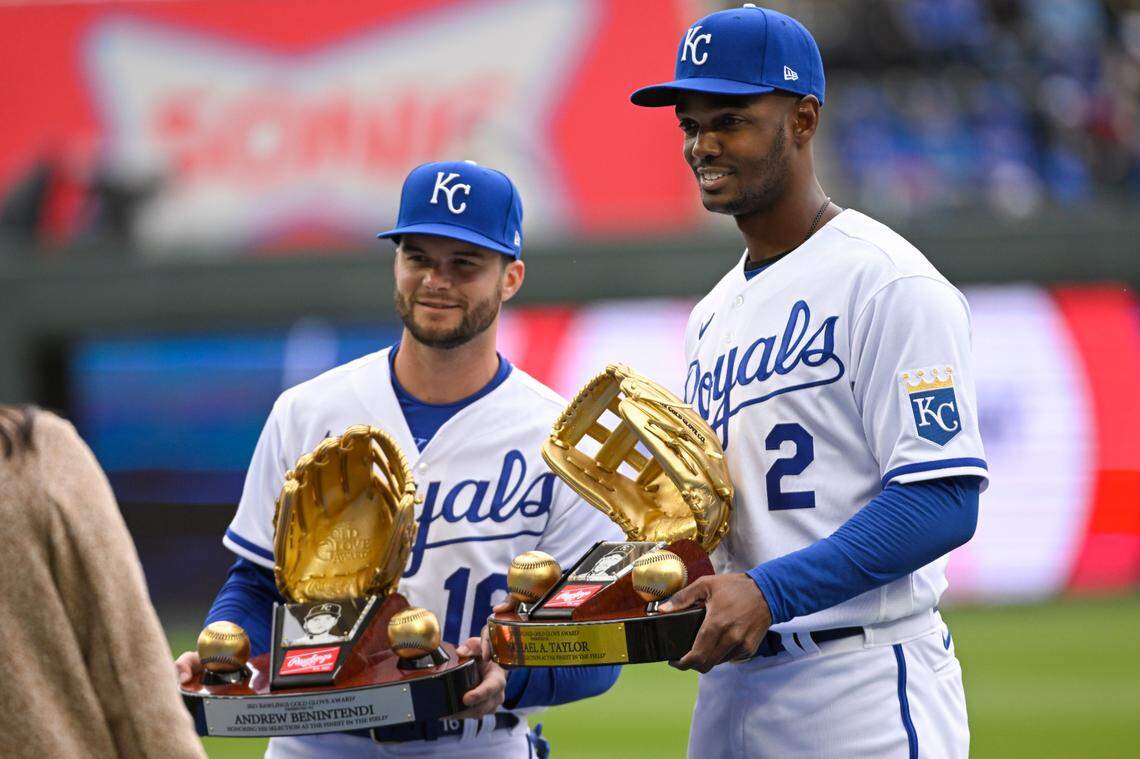
Taylor, who signed a two-year contract extension at the end of last season, absolutely fit the bill as a defender. He proved that beyond a shadow of a doubt in 2021 by turning in one of the best defensive seasons of any player in the majors, a performance that earned him the AL Gold Glove at his position.
And so far this season, Taylor has also shown the offensive improvement that he and Royals officials insisted was well within reach.
The 31-year-old entered Friday’s series opener against the Athletics in Oakland with a batting average (.272) and on-base percentage (.361) that would mark career highs for a full season.
Not coincidentally, he has also recorded a lower strikeout percentage (20.3%) and higher walk rate (12%) than any previous season in his career.
A career year in his ninth big-league season ... isn’t that the sort of thing that typical projections said wouldn’t happen? Aren’t players simply who they are at a certain stage of their career? Isn’t hoping for significant improvement at this stage supposedly foolhardy?
“I think we fall into the trap of what the data tells us — there’s certain things that guys probably won’t improve on over time,” Royals manager Mike Matheny said. “Chase rates, strike zone discipline, strikeout rates, they say those are kind of what you see it what you get.
“I love it when guys figure out ways to beat what the odds say. Michael is one of those. He’s a smart player who is conscientious and is always looking for ways to get better.”
Taylor said that, from the time he signed with the Royals before the 2021 season, he felt he had strides left to make offensively.
In fact, that was part of the conversations he had with president of baseball operations Dayton Moore and Matheny prior to signing with Kansas City. It was also part of the sentiment expressed by both sides when Taylor signed the extension.
Taylor reiterated at spring training that he was not content to simply be known as an elite defender, saying, “I don’t necessarily want to be a defensive center fielder.”
“I think I can be more of a threat offensively than I have been in the years past,” Taylor said in March. “I’ve had times when I’ve shown that, but I haven’t been able to put it together for an extended period of time. I’m making changes right now that I believe is going to help me do that.”
A little more than two months into this season, Taylor seems to have been clairvoyant.
Taylor hitting the fastball
A split second makes a huge difference when trying to hit a ball that’s traveling 95 mph or faster. Every fraction of a moment counts.
Taylor may have stolen back a couple fractions of a second from opposing pitchers this season.
“I’ve made some swing changes, just trying to shorten up my swing,” he said, “and I think that’s given me a little bit more time at the plate to make decisions, which is allowing me to swing at more strikes.”
During the end of his tenure with the Washington Nationals, Taylor began eliminating the leg kick in his swing. He continued that swing change into last season. But he’s taken further steps since joining the Royals to refine his approach at the plate.
Specifically, his hands had a tendency to drift a little too far away from his body when he started his swing. And sometimes his bat wouldn’t have the direct path to the ball that he desired.
He’s worked constantly this season on keeping his hands tighter to his body and getting the barrel of his bat into the hitting zone quicker.
What sort of difference does that make?
“I feel like when you can get to fastballs, then that allows you to slow things down,” Taylor said. “But if you feel like you can’t get to the fastball, then you feel like you have to rush and speed up. So then you’re making decisions (with the ball) further away.
“When I know I can let that ball travel and still get to it if he throws me 96, then I can see the slider, the changeup, everything, a lot longer and you don’t feel rushed.”
Taylor’s batting averages against four-seam fastballs (.255), sinkers (.385) and cutters (.625) are all up from last season (four-seamers .202, sinkers .290, cutters .375). He’s made a huge jump from his final season as the everyday center fielder for the Nationals in 2018 (four-seam .155, sinkers .235, cutters .375).
“I felt like last year I fouled off a lot of good pitches to hit, which puts me in bad counts and then I’m finding myself in too many two-strike counts,” Taylor said. “When you don’t feel like you can get to that fastball, it just speeds you up.”
Taylor has enjoyed this renaissance at the plate despite missing 14 games while on the major-league Injured List following a bout with COVID. Since returning, he has slashed .371/.439/.571 with two home runs and a double in 11 games.
Four-time Silver Slugger winner Salvador Perez recently quipped that all of his Royals teammates should get COVID if it means coming back and hitting like Taylor.
Solidifying center
Cain, acquired in the trade that sent Zack Greinke to the Milwaukee Brewers, spent 2011-17 with the Royals. He anchored their outfield defense and played a key role in the club’s back-to-back World Series appearances in 2014 and 2015. He won the Wilson Defensive Player of the Year award in 2012, 2013 and 2014.
In 2018, the season after Cain signed a wintertime free-agent deal with the Brewers, the Royals started nine different players in center field. None garnered more than 31 starts.
Before the 2019 season, they signed speedster Billy Hamilton, figuring he’d hold down that spot. He started 80 games before being claimed off waivers by the Atlanta Braves. The Royals started seven players in center that season, none logging more time than Hamilton.
In the pandemic-shortened 2020 season, Whit Merrifield saw a team-high 20 starts in center field as one of six players to start games there during the Royals’ abbreviated 60-game slate.
Following the 2020 season, the Royals targeted Taylor and moved aggressively to sign him early in the offseason.
Taylor’s 135 starts in center last season were the most for a Royals player since Cain started 151 there in 2017. Last season, the Fielding Bible and the SABR Defensive Index each rated Taylor the best defensive center fielder in the majors.
He led all defenders in the majors in ultimate zone rating (UZR), a metric that aims to measure the combined impact of a defensive player’s arm, range and ability to avoid errors. He also led all MLB center fielders with 19 defensive runs saved, 15 outs above average and 11 outfield assists.
A rare mix of athleticism and baseball IQ
When Taylor uncorks a throw from center field, it’s not a “toss.” It’s nothing less than an attack on the senses.
From the stands or pressbox, it’s gasp-inducing the first time one witnesses it. From left field, previously uninitiated teammate Andrew Benintendi heard and saw what he could only describe as an “explosion.”
Even with the adrenaline of being in the middle of the play and reacting to events unfolding at blink-and-you-miss-it speed, infielder Nicky Lopez immediately felt the pressure on his glove as he stepped in front of the ball slicing through the air.
“When he threw that first cutoff and relay to me, I caught the ball and my glove went back a little bit,” Lopez said. “I’m like, ‘Wow! He’s got some arm strength.’ I would love to see him on the mound one time.”
In short, it didn’t take long to recognize there was something different about the projectile blur of cowhide and stitching shooting across the playing field at Kauffman Stadium. Taylor cut down two runners at the plate in ill-considered attempts to score during last year’s season opener.
At 6-foot-4 and 215 pounds, Taylor covers ground like a much smaller defender while also using his length to his advantage. He creates an enormous catch radius; everything hit into the air seems to be within his range.
“He’s massive,” Benintendi said earlier this spring. “That definitely stood out when I first met him. He’s every bit of 6-4, and he’s big, too. He’s a big dude.”
In the first month of this season, Taylor made one of his best catches when he stuck a foot on the wall, leaped high and robbed a home run from the first row of the outfield stands at Busch Stadium.
Taylor’s athleticism sometimes overshadows the way he constantly processes situations and conditions. He’s constantly reading swings, looking in for the catcher’s signs. He’s looking for a heads-up as to what sort of pitch is coming and what contact that might yield, and he’s become adept at assessing the swirling winds at Kauffman and how they might affect balls hit in the air.
“In general, he’s a great dude,” Benintendi said. “He’s selfless. He works hard. He comes in, does what he needs to do and heads back to his family. If everybody could do it the way he does it, it would be a treat.
“He’s been great to play next to, as well. I think the thing that jumped out the most was his arm. That ball just explodes out of his hand, and it’s fun to go see him go get a ball in left-center field and watch him throw it to third base. It just jumps out of his hand. He covers a lot of ground too. He’s one of my favorites on this team, by far.”
This story was originally published June 17, 2022 at 3:34 PM with the headline "Here’s what’s behind Michael A. Taylor’s offensive renaissance for Kansas City Royals."