
GM Dayton Moore enjoys the Royals’ moment
On the day after his night of validation, Dayton Moore strode into his team’s clubhouse and slipped on a Royals pullover. He poured himself a cup of black coffee. He had been up late the night before, much later than usual, even if he said he was “probably the first one home” from an after-hours party for the front office and coaching staff at Ditka’s steakhouse.
Moore walked out into the visitors’ dugout at U.S. Cellular Field. The corks, bottle caps and puddles of spilled alcohol had been swept away, but the fact remained: The Royals were headed to the playoffs for the first time since 1985. It took nearly a decade, but Moore had built a team that gave a generation of fans their first definitive triumph.
The Royals will end the longest postseason drought in the four major North American professional sports leagues this week. The night before, as his players poured onto the field, Moore felt an emotion that revealed the complexity of his eight-plus seasons as general manager.
“Relief,” he said.
Moore arrived in 2006 as a savior. He looked like an ideal fit for the job. He soaked up the franchise’s history as a kid growing up in Wichita. He learned the art of team-building after more than a decade in Atlanta. Royals officials and rivals executives alike laud his faith and character.
But the slog of six consecutive losing seasons sullied his reputation within the city. A controversial trade two winters ago transformed 2014 into a deadline. For the first time in decades, a season with the Royals not in the playoffs would be considered a failure.
On Friday night, Moore combined celebration with exhalation, and exhibited the characteristics that have united his organization during his tenure. The Royals clinched in the same ballpark where two months prior Moore had issued a vote of confidence for manager Ned Yost and a team with a losing record. The players rewarded Moore for his faith. And the fans were rewarded for their patience.
“The thing that I’m most proud of is we have grown the game of baseball in the Kansas City area,” Moore said. “There’s a renewed interest. There’s a following — that has always been there. But I believe a group of young people, we’ve captured their interest and rekindled the passion of a lot of our fanbase in the game of baseball and the Kansas City Royals.”
Moore, 47, projects stoicism. He wears a suit and tie to the office. He shakes hands. He remembers names. He rarely swears. He never criticizes his players publicly.
He asks about your relatives. After he demoted outfielder Alex Gordon in 2010, Moore instructed him to worry about family before baseball. Moore never asked Gordon about his on-field progress. “I always felt like he really did care about me,” Gordon said.
He cares about your stability. When pitcher Danny Duffy walked away from the game in 2010, he called Moore a few months into his sabbatical. Duffy told him he was ready to return. Moore told him to wait another week. “A lot of people would just be like ‘Oh, hurry up,’” Duffy said. “He never pressured me to come back.”
For this weekend, Moore invited a sizable contingent of scouts, executives and other officials to U.S. Cellular Field. As the players gallivanted, the group massed in the back of the clubhouse, soaking in Cook’s Brut and Miller Lite. The next morning, multiple rival officials reached out to The Star to praise this decision by Moore. “That’s why people would run through a wall for him,” one executive said.
Raul Ibañez ignited his career in Kansas City from 2001 to 2003. The growth of this organization be traced to Moore, he explained, to his ability to connect with individuals and unite them as a group.
“He’s a great human being,” Ibañez said. “These guys really want to break their back for him, and for the organization, because of the way that he does things.”
So Moore’s appeal to others in the game is obvious. As the Royals approach the postseason, an offseason of intrigue awaits. The Atlanta Braves have an opening for their general managerial position. Moore could become a candidate. He has refused to discuss the matter.
“I don’t know what’s going to happen,” said George Brett, the franchise icon, Hall of Famer and Royals vice president of baseball operations. “I hope he stays.”
Moore grew up a Royals fan in Wichita, but his baseball education occurred in Atlanta. The organization plucked him from a coaching position at his alma mater, George Mason University, in 1994. Two decades later, Moore insists he still has never even fashioned a resume. He says he has never applied for a job. People seek him out.
The Braves hired Moore as a scout. He graduated to the front office two years later and began scooping up titles. He studied player development. He ran an international scouting department. John Schuerholz, the general manager of the Royals from 1982 to 1990, groomed Moore to replace him in that role with the Braves.
Until, of course, David Glass visited Atlanta in 2006.
During Glass’ first six years of owning the Royals, the franchise went to seed. It was not just the losing. The stories have become legend, a caricature of an organization trafficking in slapstick: Scouts without cell phones, running out of money midway through a draft, a season without a team picture. The restrictions handcuffed Moore’s predecessor, Allard Baird.
When Moore interviewed for this job, he presented conditions. In order to abdicate his likely promotion to the top spot in Atlanta, he required assurances from Glass that the organization would funnel money into hiring the game’s best scouts and signing the most promising amateur players. Glass agreed, tired of the losing, willing to trust Moore.
“I don’t think Mr. Glass gave the other guy the luxury to do the things that he’s allowed Dayton to do,” Brett said. “But Dayton’s done a tremendous job, and he convinced the Glasses, ‘If you want me to come here, then this is what we’ve got to do.’”
At the start, the tangible successes occurred away from the big-league level. He proved willing to tangle with Scott Boras, the super-agent who often advises the most talented prospects in each class. Moore built a commendable international scouting department — “one of the best,” one rival scouting director said — out of virtually nothing. The club refurbished its ballpark.
Moore strove to repair the damage wrought before his arrival. He felt a connection with the past was imperative to the organization’s future.
“One of the things I heard when we first came here is, ‘I’m tired of everybody talking about 1985,’” Moore said. “We were kind of the opposite. We needed to restore that sense of pride, acknowledge it, and embrace it. But also, build from it. It’s what good organizations do.”
Yet as the view in the background looked promising, the foreground was unsightly. Moore’s managerial appointment of Trey Hillman proved disastrous. A pair of lucrative contracts for Jose Guillen and Gil Meche backfired. In the draft, the club chose Christian Colon over White Sox ace Chris Sale and Bubba Starling over budding Nationals superstar Anthony Rendon.
And the losses piled up. In an inadvertent manner, Brett captured the source of some discontent. He explained how, when during the 2006 interviews Moore informed the owners “‘I’ve got a five-year plan, a six-year plan, a seven-year …,’” Brett said. “I don’t know how many years he told David Glass it was. But he had a plan.”
The organization branded 2012 as “Our Time,” only to see the season fizzle into the team’s fifth 90-loss season under Moore’s watch. The acquisition of James Shields for Wil Myers incited howls after its consummation and derision after the season’s completion, when Tampa Bay made the playoffs with Myers as the American League Rookie of the Year.
The Royals won 86 games, not enough to reach October, but enough to inspire Moore to remark “in a small way, it feels like we won the World Series.” He absorbed another torrent of invective. By now, eight years into this role, he insists he does not require shelter from unrest.
“There’s no question that will surprise me,” Moore said. “There’s no mistake that will catch me off-guard. There is no criticism that I’m not aware of. Because I’m a pretty good self-evaluator when it comes to this stuff. I’m an honest evaluator. I know where we make our mistakes.
“I’ve learned to decipher the difference between your critics looking at you with a critical eye or a critical spirit. A critical eye? We can have a discussion and a lot of times, we can have a very healthy discussion.
“If somebody looks at you and evaluates you with a critical spirit? I can’t help that person. Those issues are much deeper than I have the ability to fix, to influence.”
On Thursday afternoon, Moore leaned on the dugout railing during batting practice. Into the cage stepped Eric Hosmer, the striking, 6-foot-4 first baseman. Standing nearby, ready to hit, were Mike Moustakas and Salvador Perez.
Hosmer was the No. 3 pick in the 2007 draft. Moustakas was chosen second the year before. Perez was signed on their first scouting expedition to Venezuela, a masterstroke for assistant general manager Rene Francisco. A few years ago, the trio represented the next generation of Kansas City superstars, a group assembled by spending in the draft as never before and scouting with an acumen not displayed by this organization in a generation.
Yet at times this summer, the trio formed another layer in the exhausting tapestry of this season, a nightly crucible for the fans and front office alike. The offense was intermittent. The Royals survived thanks to reliance on pitching and defense, the hallmarks Moore imported from Atlanta. The formula was effective but taxing, with low-scoring victories and constant tension.
As Moore watched his players hit on Monday, a fan called out to him and offered encouragement. Moore managed a smile.
“Good,” Moore said. “I’m glad you’re enjoying it.”
As the Royals inched closer to clinching, their front office exhibited visible signs of nervousness. They had spent nearly a decade building toward this moment. Moore staked his reputation on his process. Now, in the final hour, they found themselves almost helpless. There were no more moves to make, no more acquisitions to ponder. The players would decide their fate.
Brett arrived on Thursday night. He took a 90-minute walk through downtown the next morning, and gauged the general manager’s stress level.
“He was fine,” Brett said. “Now, we’ll see how he is in the third inning. We’ll see how we all are in the third inning. Because it’s more nervous sitting up there than it is playing.”
In the evening, Moore gathered inside a suite at U.S. Cellular Field. He surrounded himself with organizational lifers and his own lieutenants. The tension among the group was palpable. The television cameras captured their angst.
“That one was hard to watch,” assistant general manager J.J. Picollo said. “We got that three-run lead, and just wanted that game to be over.”
When Perez gloved the last out, Brett thrust his arms in the air and accepted a bear hug from pro scouting director Gene Watson. Team president Dan Glass pumped his fist. Art Stewart, the 87-year-old scout, appeared on the verge of tears.
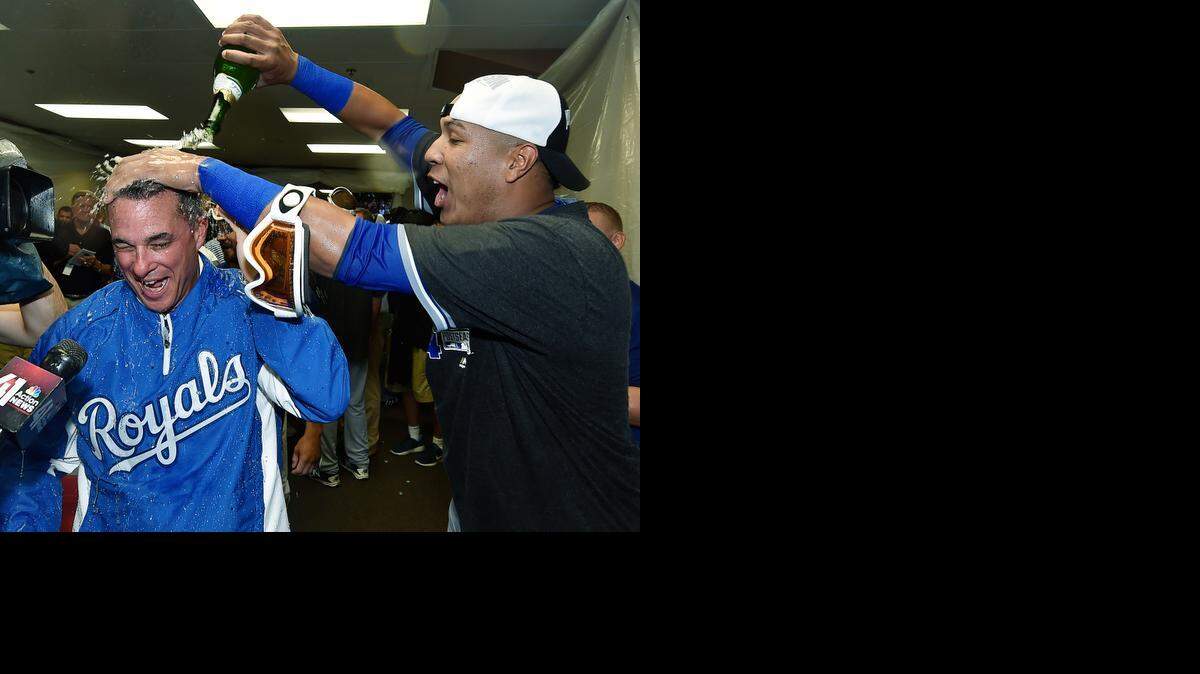
Moore stood in the background. He stepped into focus to offer fist-bumps and embraces. The members of the front office rode an elevator down to the clubhouse. In the center of the room, the players huddled around ice chests packed with champagne. Jeremy Guthrie grabbed Moore and forced him onto a makeshift podium.
After each victory, the Royals celebrate in this manner. They elect a player of the game and douse him with water. Shields brought the ceremony with him from Tampa Bay. Moore had watched enough of these to understand the script.
“I’ve got something to say!” he shouted.
Then he stepped down and let his players do the talking.
This story was originally published September 27, 2014 at 8:36 PM with the headline "GM Dayton Moore enjoys the Royals’ moment."