
How a Wichita Open caddie crisis became another story of Wichita’s resilience
By Wednesday night, less than 12 hours before the first tee shot of the Wichita Open, the tournament had a crisis it could not play through.
Not flooded greens.
Not storm-damaged grandstands.
Not another weather delay.
Caddies.
The tournament required 81 of them. It was still six short. And under PGA Tour Americas rules, that was not a minor inconvenience. Every player in the 156-man field needed a caddie to play.
“Guys could have played if there was a limb on the ground,” Wichita Open caddie master Eric Johnsen said. “They couldn’t play without a caddie.”
By Sunday evening, Dawson Armstrong had delivered the tournament’s signature moment, outlasting Harry Lord and Corey Pereira in a six-hole playoff to win at 12 under.
But the story that saved the week began before most spectators knew there was a problem.
The Wichita Open, played every year since 1990, needed people willing to carry golf bags through long days, early wake-up calls, weather stoppages and an accelerated weekend finish — all for $50 per day and the satisfaction of helping keep one of Wichita’s signature sporting events alive.
By the end of the week, Wichita had answered the call so completely that the tournament went from being 20 caddies short on Wednesday to having seven more than it needed by Thursday morning.
“It was just the power of the human side of people just wanting to do good,” tournament director Dusty Buell said. “This has always been more than just a golf tournament. And this just showed how people just want to step up and do good for their fellow man. That’s what Wichita is all about.”
The caddie shortage was a new problem created by a new era.
For more than three decades, the Wichita Open operated as one of the original stops on what became the Korn Ferry Tour. Most of those players traveled with their own caddies, which meant the tournament generally needed to provide only about two dozen local caddies.
That changed when the Wichita Open shifted affiliations this past fall as part of golf’s larger developmental-tour overhaul. For the first time, the tournament became part of PGA Tour Americas, the circuit created in 2024 from the merger of PGA Tour Latinoamérica and PGA Tour Canada.
The prize money is not the same as the Korn Ferry Tour and far fewer players travel with full-time caddies. In the weeks leading into the tournament, Johnsen said 27 players had requested local caddies.
Then the requests kept coming.
And coming.
By Tuesday of tournament week, the number had tripled.
Johnsen, in his first year as the tournament’s official caddie master after helping behind the scenes for years, started working the phones. His week became a blur of texts, calls and favors cashed in from two decades around Wichita golf.
He called golf coaches. He called former players. He called local pros. He leaned heavily on his network at Kapaun Mt. Carmel, where he has long been a coach in the golf program. The caddie list started to stretch across generations, from incoming high school freshmen to retired workers nearing 70.
By Wednesday night, when the tournament was still six caddies short, Johnsen expanded the search beyond golfers. Kapaun football coach Weston Schartz answered the call and dismissed four football players from morning workouts Thursday so they could report to Crestview and carry bags instead.
The help did not stop there. Pros from Prairie Dunes, Flint Hills National and Wichita Country Club reached out. Crestview members recruited. Wichita Open volunteers spread the word. One person called another, who called another, who knew someone else willing to help.
“It was a lot like last year,” Buell said. “You don’t know you have it until you have it at the end.”
Buell knew that feeling too well.
Last year, in his first tournament after taking over for longtime host Roy Turner, a massive storm ripped through Wichita and damaged Crestview. Buell still remembers arriving at the course around 4 a.m., seeing damaged grandstands and tree debris scattered across the property and feeling his heart sink.
One year later, he arrived early Friday morning to another unsettling sight. Torrential rain had hammered the course. Two greens looked like island greens. Water rushed over bridges. The tournament, already delayed on Thursday, could not restart Friday until 2 p.m.
This time, Buell said, he did not panic the same way.
The previous year had hardened him. He had watched volunteers and tournament staff attack an overwhelming problem one task at a time until the course was playable again. So when he saw the flooding this year, he trusted Crestview’s reputation for shedding water and focused on everything else around the tournament.
The storms had already disrupted the popular pro-am, an especially painful blow because sponsors are so central to making the tournament work. Buell said he worried about whether sponsors would feel short-changed by the disjointed week, but their response was nothing but gracious.
“The amount of patience and grace that we’ve been given has truly been incredible,” Buell said. “They keep coming back and supporting us.”
The volunteers did the same.
They endured stops and starts Thursday and Friday, then longer days Saturday and Sunday as the tournament raced to complete 72 holes. The second round did not finish until Saturday. The third round was not completed until Sunday morning. The final day turned into a marathon.
The caddies felt every bit of that.
There was one situation early in the tournament when a caddie needed medical attention and had to be replaced. The Wichita Open had someone ready. On Saturday morning, after a weather-delayed restart created 7 a.m. tee times, one young caddie overslept and missed his assignment.
Johnsen went home, woke up his 25-year-old son, who had planned to watch the tournament as a spectator, and put him on the bag.
Johnsen even caddied himself.
“Without him, we didn’t have a Plan B,” Buell said of Johnsen. “Without him, we would be having a different conversation right now.
”Johnsen has helped the Wichita Open for roughly two decades and he said he has never seen anything quite like this year’s level of volunteer commitment.
Buell saw the same thing.
“It’s never about any one person or one company,” Buell said. “It’s about showcasing Wichita.”
One of those local caddies ended up with the best view of the tournament.
Max Farber began the week hoping to play. The recent Bishop Carroll graduate and All-Metro golfer, who is signed to play Division II golf at Washburn, entered a Monday qualifier trying to earn his own spot in the Wichita Open field.
When that did not happen, he found another way inside the ropes.
Farber had been talking with local golfer Lucas Scheufler, who caddied for Armstrong at the 2024 Wichita Open. Scheufler offered to put in a good word if Farber was interested in caddying for Armstrong this year.
Farber texted Armstrong and told him he was going to try to qualify. If he did not make it, Farber told him, “I’m all yours for the week.” Armstrong accepted.
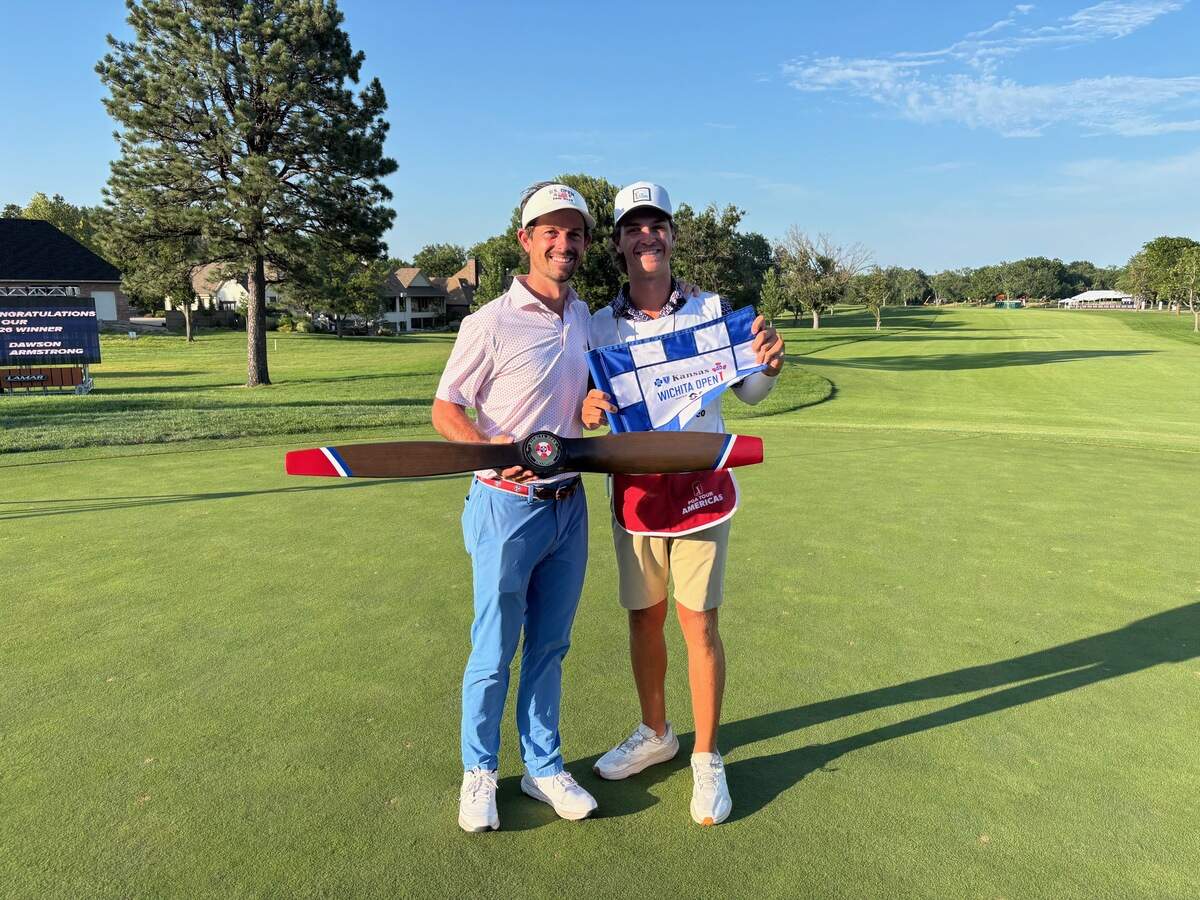
Farber had caddied before at country clubs when he was younger, mostly to make extra money on weekends. This was different. This was his first time carrying the bag for a professional golfer in tournament competition.
His own playing background helped. Farber knew Crestview. He understood the demands of tournament golf. He could occasionally offer course knowledge. But more than anything, he treated the week as an education.
“I just wanted to try to learn as much as I could,” Farber said.
If he could not play in the Wichita Open, he wanted to study someone who could.
“If I wasn’t going to play in it this week, then I wanted to soak up as much as I could and learn as much as I could to improve my game,” Farber said. “That was my goal this week and honestly, I learned way more than I could have ever asked for.”
He learned how a professional golfer thinks through trouble.
Armstrong was 11 under through two rounds and near the top of the leaderboard before his third round started to unravel Saturday evening. After playing the front nine in 3 over, he was slipping back from the lead pack and Farber could sense the frustration building.
His job became less about yardages and more about steadiness. There was still plenty of golf left. There were still chances to recover. In a week defined by patience, Farber reminded Armstrong that he needed some of his own.
He salvaged a 1-over 71 in the third round, leaving him five shots behind Harry Lord entering the final round Sunday. Then Crestview got tougher. The wind picked up. The newer tee boxes stretched the course. Par became valuable.
Farber watched Armstrong survive one stressful hole after another, missing greens, playing delicate chips and leaving himself nerve-testing par putts. Again and again, Armstrong made them.
What stuck with Farber was the discipline. There were moments when Armstrong could have tried to be the hero. Instead, he took his medicine, played away from big numbers and trusted his putter to save him.
Armstrong stayed patient, then made his move. Two birdies on the back nine lifted him into a three-way tie at 12 under with Lord and Corey Pereira, sending the Wichita Open to a sudden-death playoff.
Farber’s long Sunday was not close to finished.
He had already caddied Armstrong’s final eight holes of the third round and all 18 holes of the fourth. Now came six more playoff holes.
Thirty-two holes in one day.
“I remember thinking this was the worst year I could have picked to be a caddie,” Farber said with a laugh. “I was getting up at 5 a.m. and not getting home until 9:30. All of the caddies, really, we were just out there grinding.”
Armstrong kept grinding, too.
On the fifth playoff hole, the par-3 No. 17, Armstrong missed the green and left himself about 12 feet for par to keep the tournament alive.
He made it.
One hole later, Armstrong won the Wichita Open.
As far as tournament officials know, Farber became only the second local caddie to carry the winning bag at the Wichita Open. The other was also recruited by Johnsen: former Kapaun golfer Eric Ewers, who caddied for Rob Oppenheim during his 2015 victory.
“I guess we make a pretty good team,” Farber said with a laugh. “I told him if he comes back next year to play in Wichita, you know who to call.”
It was the perfect ending to the tournament’s hidden story.
A local golfer who wanted to play in the Wichita Open wound up helping win it. A tournament that feared it might not have enough caddies wound up with enough to spare. A community that had already rescued the event from storm damage one year earlier rallied again, this time by carrying bags.
The Wichita Open did not get an easy week. It got flooded greens, delayed rounds, exhausted volunteers, scrambled tee times and a caddie shortage that threatened to stop the tournament before it could start.
When the tournament needed help, Wichita picked up the bag.
“What I’ve learned on this job is that when things seem impossible, you just have to continue to keep doing the next best thing we can,” Buell said. “I know if we just keep doing that, then we can get through anything. There’s nothing that can stop us.”
.jpg)