
Daniel Kihle’s experience in Cape Cod League builds his confidence at WSU
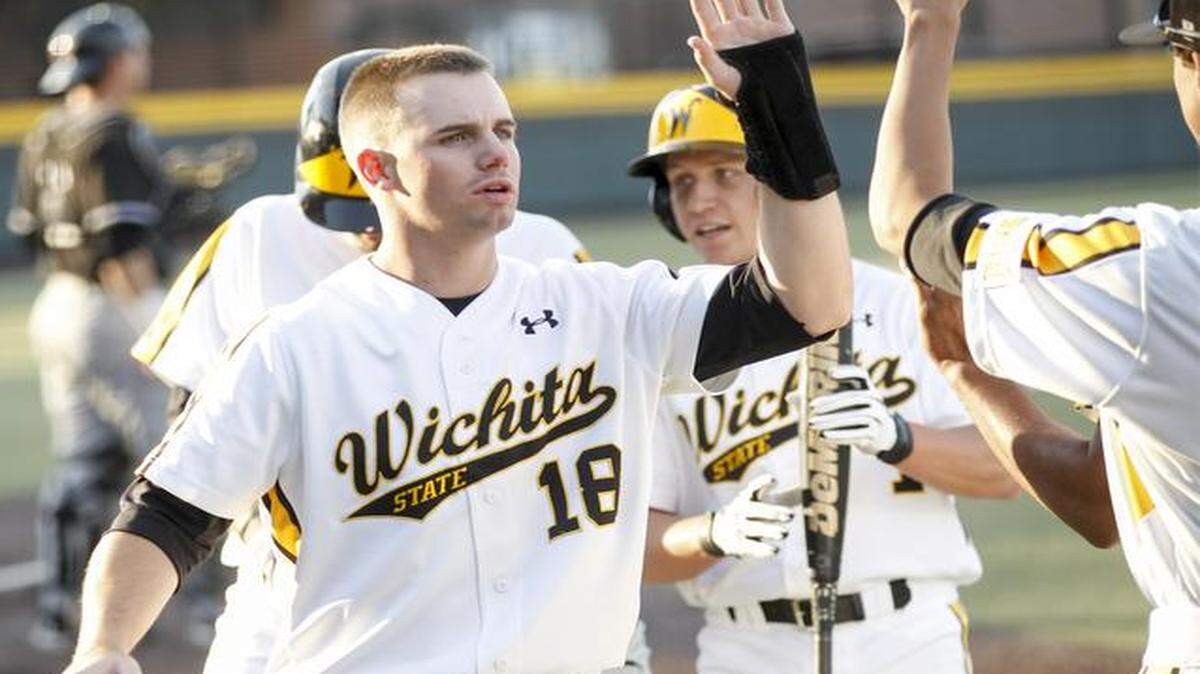
Outfielder Daniel Kihle walked on at Wichita State without grand expectations. Perhaps he could pinch run. Perhaps he could play in a blowout. When you’re a walk-on from Andale High, you don’t know what to expect.
He certainly didn’t expect to spend the summer in the Cape Cod League with the nation’s best baseball prospects. And it didn’t come easily for Kihle, a junior who hit .313 with 12 doubles and three home runs last season for WSU. The Hyannis Harbor (Mass.) Hawks offered him a two-week contract with no guarantees the team would keep him for the rest of the summer.
“They said I was going to have to work my way on, and there was a good chance I would be there only be there for a week or two and then get sent home,” he said. “I told my dad, all I need is a chance. I got a chance at Wichita State.”
July 1 is the final day for cuts in the Cape Cod League and coaches said the decision came down to Kihle or a shortstop. Kihle hit a two-run home run, his third of the summer, in a 4-2 win over Falmouth on June 30. The next morning, an email arrived telling him to spend the rest of the summer in the Cape.
“That sealed the deal and made me relax a lot,” he said. “I was pressing the whole first half of the summer.”
Given that chance, Kihle stayed in the lineup and produced. He played in the All-Star Game and finished the summer hitting .261 with five home runs and eight doubles in the wood-bat league.
The reputation of the Cape is that players return with a significant boost in confidence after facing college baseball’s top arms. It worked for former Shocker Casey Gillaspie, who gave his time in the Cape credit for a monster junior season before Tampa Bay drafted him in the first round in June.
“You face a bunch of the top guys in the country,” Kihle said. “It lets you know you can hit most guys. You’re going to get at least one good pitch to hit. You’ve just got to be ready for it.”
Last season, Kihle played in 40 games, missing almost three weeks with a broken hamate bone, and ranked second with a .456 slugging percentage behind Gillaspie’s .682. During his hot streaks, he was WSU’s best threat for extra-base power behind Gillaspie. Kihle struck out 45 times and walked eight in 160 at-bats. In the Cape, he struck out 39 times and walked 17 in 142 at-bats.
“I’ve been working on cutting down on strikeouts — getting that one pitch I want and hit it hard,” he said.
That work continues in fall baseball for the Shockers.
“He’s much more confident,” WSU coach Todd Butler said. “He played very well (in the Cape). It’s the best league in the country. Big arms. High draft picks.”
The Shockers will end their team practices this week and hold a public Halloween “Screamage” on Thursday at Eck Stadium. They conclude their three-game fall scrimmage series at 5 p.m. Sunday. The fall is a good time for coaches to evaluate defense, leadership and work habits. It is more difficult to grade pitching and hitting.
Several returners, with a season under Butler to learn from, are handling the leadership role in a way that pleases Butler. Kihle, as well as sophomore pitcher Sam Tewes, are prime examples.
“(Kihle) is demanding from his teammates and he’s not letting performance and results get in the way of his leadership,” Butler said. “They’re policing the team inside the locker room. I hear more about, ‘This is how we do it as Shockers.’ Last year, we were all learning each other. This year, we have guys back that are teaching and coaching, also.”
Kihle’s view of leadership is, in part, being a voice from the outfield when a pitch or play isn’t executed and also about praising his teammates when things go right. He sees teammates such as shortstop Tanner Kirk, catcher Bob Arens and outfielders Mikel Mucha and Michael Burns also trying to keep things in line on the field, in class and in the locker room.
“If the first pitch of an at-bat is a ball, I’m hounding them that can’t happen,” Kihle said. “(Coaches) want everyone locked in on every pitch, and so that’s kind of my thing. They pretty much hear from me every play. There are a bunch of guys who are leading every day.”
And leading off — Butler envisioned Tanner Dearman as a speedy, pesky lead-off hitter last season, one capable of creating havoc on defenses with his legs.
It didn’t work out as well as Butler wanted. Dearman hit first for about half the season before losing that spot to Kihle. Dearman hit .232 with an on-base percentage of .307, and stole 20 bases. His defensive limitations forced Butler to use him as the designated hitter, with occasional starts in left field.
Dearman is playing the way Butler envisions again this fall. He has improved his routes to the ball in the outfield, clearing the way for Butler to use a player with more power at DH. On Saturday, Dearman slapped a single past the first baseman and went from first to third on Kihle’s base hit to left.
“He can be a fantastic lead-off hitter,” Butler said. “He’s very aggressive. He’s stealing bases on command.”
Dearman hit a team-best .429 in 10 scrimmages, walking 15 times and striking out three for a .600 on-base percentage.
Dearman played second base and outfield in his first two seasons at WSU. Butler wants him in the outfield and he is playing left and center this fall. Dearman played infield in high school, so reading balls off the bat and taking the best path is a new challenge, one he hopes to solve with repetition.
“It’s like taking a ground ball,” he said. “To get good at that, you’ve got to take them over and over. I had more difficulty with balls over my head. I’ve got to rotate my head, get around, and find it again.”
Dearman noticed the 27 newcomers this season, several of whom play the outfield. He knew that playing time would not come easily.
“I knew I needed to have a good fall to have a chance to play this spring,” he said. “I was a lot more motivated this fall than I’ve been in the the past. I’m more focused at the field. I do all my repetition drills, all my maintenance drills that (coaches) have given to us.”
Around the horn — Butler expects Tewes, WSU’s lone returner from the weekend rotation, to start and throw around 30 pitches in Sunday’s scrimmage. He strained his ulnar collateral ligament in the summer and is working his way back into full action.
“He threw against hitters the other day and he was 88-92 (mph),” Butler said. “He feels comfortable with his arm. He’ll continue to throw against hitters through November before we shut it down.”
Write Tewes, if healthy, into WSU’s rotation next spring. Butler also mentioned junior transfers Sam Hilliard, Isaac Anderson, Willie Schwanke and Jon Ferrendelli as top candidates. Hilliard and Schwanke are both hitting and Hilliard is the likely starter at first base.
“He’s a true two-way player,” Butler said. “Very good on the mound. Very good hitter. The question is, do we want to start him on the weekend, or do we want to pitch in those mid-week games that are so big.”
Schwanke went 4 for 4 with a home run and a double in Saturday’s scrimmage to help the Gold win 10-5. He started and gave up six hits and three runs in three innings.
From the freshman class, Tyler Jones could join the rotation.
▪ Catcher is the position with the most mystery. Junior transfer Ryan Tinkham offers the best bat and he will play first and DH. A shoulder injury kept him from throwing this fall, so while Butler is pleased with his receiving and blocking abilities, his arm strength and accuracy are unknown.
“He looks like he can be an offensive guy that can hit 3, 4, 5, or 6 for us,” Butler said. “He’s kind of that swing guy. We know he’s probably going to be in the lineup, but if he catches it gives us an opportunity to maybe put two more hitters in the lineup.”
In two fall series scrimmages, Tinkham is 4 for 7 with four RBI and two doubles.
Arens, Brandon Kimbrel and freshmen Gunnar Troutwine and Taylor Sanagorski are catching this fall. Arens is the most experienced of the group and his contributions are important, regardless of how much he plays.
“He’s a coach on the field,” Butler said. “He knows everything going on and he helps the new guys.”
▪ Third baseman Chase Rader, a transfer from Coffeyville Community College, is another player slowed by an injury. He suffered a sprained right shoulder early in fall practices.
He went 1 for 3 in Friday’s scrimmage as the DH.
“He’s not throwing yet,” Butler said. “He should be fine.”
▪ Butler is also eager to see how his bullpen unfolds. Junior transfers Chase Williams and John Hayes and returner T.J. Looney offer the potential of power arms, if they can find the strike zone. Looney struck out six and walked 15 in nine appearances last season.
“Those three guys are big men who have good arms,” Butler said. “It would be nice to be able to go seventh, eighth and ninth innings with those three guys.”
Reach Paul Suellentrop at 316-269-6760 or psuellentrop@wichitaeagle.com. Follow him on Twitter: @paulsuellentrop.
This story was originally published October 25, 2014 at 3:41 PM with the headline "Daniel Kihle’s experience in Cape Cod League builds his confidence at WSU."