
Wichita wants to become ‘the next Dayton.’ What is the NCAA tradeoff?
AI-generated summary reviewed by our newsroom.
- Wichita will host the NCAA expanded opening round at INTRUST Bank Arena in 2027 and 2028.
- The agreement is only a two-year commitment with hopes to prove worthiness for permanence.
- Officials say annual opening-round hosting likely would remove Wichita from first- and.
Wichita is betting that having March Madness every year will be worth giving up the chance to host some of the tournament’s biggest teams.
The NCAA announced Thursday that INTRUST Bank Arena will host the newly expanded opening round in 2027 and 2028. The agreement is only a two-year commitment for now, but local organizers hope Wichita can prove itself worthy of becoming a permanent host alongside Dayton, Ohio. If that happens, officials believe the annual commitment most likely would take the city out of consideration for future first- and second-round games.
That makes the shift especially notable because Wichita is not moving away from a model that failed — it is betting that a different one can deliver even greater long-term value.
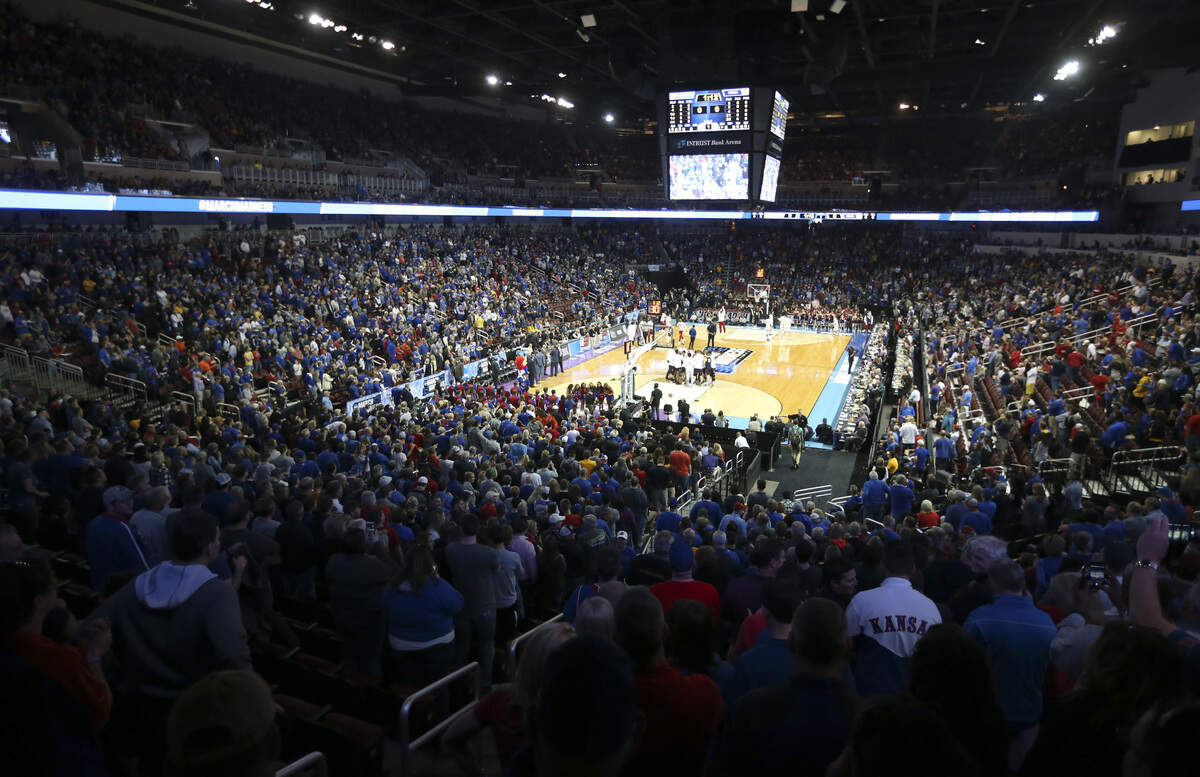
In 2018, Kansas arrived as a No. 1 seed during St. Patrick’s Day weekend, sending waves of KU fans into downtown and turning the return of March Madness into a four-day celebration.
Seven years later, Wichita proved it did not need the dream draw.
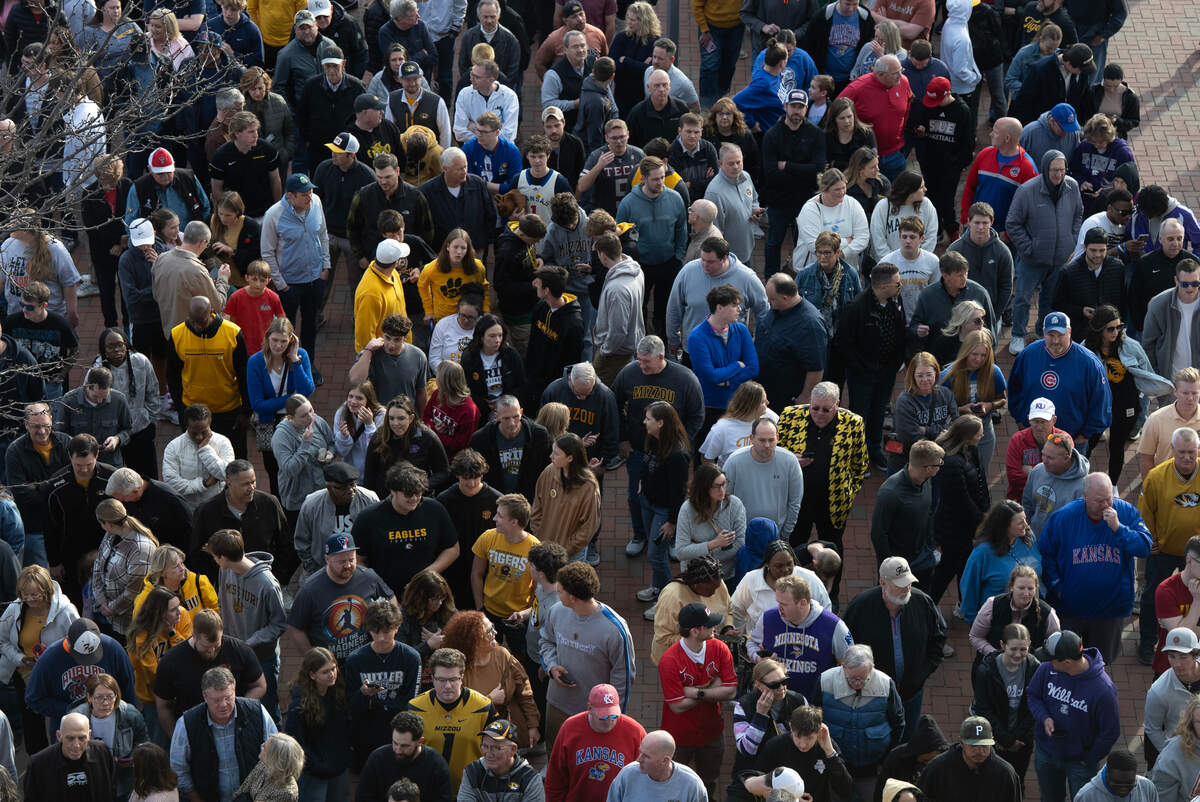
No in-state team came to town in 2025, yet fans following Houston, Gonzaga, Texas Tech and Missouri still packed INTRUST Bank Arena and poured into downtown restaurants, bars and fan events. The tournament generated an estimated $7 million in economic impact.
Now Wichita is pursuing a different model: fewer marquee teams, but potentially a permanent place at the beginning of March Madness.
The NCAA tournament will expand from 68 to 76 teams beginning in 2027. Wichita and Dayton will each host six opening-round games — three Tuesday and three Wednesday following Selection Sunday — involving the lowest-seeded automatic qualifiers and the final at-large teams selected for the field.
For Wichita, the decision comes down to consistency versus prestige.
The opening round could provide annual NCAA basketball, two nights of concentrated national exposure and a chance to build a signature event around the beginning of the tournament.
The tradeoff would be giving up the chance to host No. 1 seeds, national championship contenders and second-round games with trips to the Sweet 16 at stake.
“We could have kept trying to be in that four-to-five-year rotation or let’s go after this and try to make it an annual tradition in Wichita,” said Josh Howell, vice president of sports development at Visit Wichita. “It felt like a no-brainer to us.”
The next two years will test whether that confidence is justified.
Wichita has already proved the traditional model works
Wichita is not moving away from a model that failed.
The city earned three first- and second-round assignments over an eight-year span — in 2018, 2021 and 2025 — although the 2021 tournament was moved to Indiana because of the COVID-19 pandemic.
The success of both the KU-driven 2018 tournament and the 2025 event without an in-state team gave local officials confidence Wichita could remain competitive for future bids.
But no future assignment is guaranteed.
The opening round offers a different kind of opportunity: NCAA tournament games in consecutive years and a chance to prove Wichita deserves a permanent place on the March Madness calendar.
The appeal of owning March Madness’ opening stage
Dayton has spent more than two decades building an identity around the beginning of the NCAA tournament.
When the bracket is revealed on Selection Sunday, “First Four in Dayton” has become part of the language of March Madness.
Teams know the destination. Fans recognize the event. The city has become synonymous with the opening stage of the tournament.
Wichita wants to create the same connection.
“Our goal is to be the next Dayton,” said Brad Pittman, Wichita State’s senior associate athletic director for facilities and operations. “We still have a lot of work to do and we’re going to continue to work on that. But we think this being in Wichita (long term) would be a great thing for us. That’s our goal.”
One of the largest potential benefits is national exposure.
During the traditional first round, Wichita is one of eight host cities competing for attention while dozens of games are played across the country.
The opening round offers a less crowded stage.
For two nights, Wichita and Dayton will be the only cities hosting men’s NCAA tournament games.
Wichita should be mentioned repeatedly during the Selection Sunday broadcast when teams receive their assignments, then featured throughout six nationally televised games during the following two nights.
“Whenever the bracket is announced, you always hear about the First Four in Dayton,” Howell said. “They have owned that event and those nights with all eyes on Dayton. But now Wichita is in there, so it’s pretty cool to have two nights where you and one other city own the NCAA Tournament.”
Pittman described the exposure more directly.
“You’re on national TV for six hours two straight nights, so it’s basically a national infomercial for your city and your community,” Pittman said. “March Madness is that marquee event every year that people tune into, so anytime you’re able to position your community in that limelight, it’s a good thing.”
That exposure also raises the stakes. Strong crowds could reinforce Wichita’s reputation as a basketball city and help turn “March Madness starts in Wichita” into a recognizable identity. Sparse attendance for lower-profile games, however, would be just as visible during the city’s two-year audition.
Annual hosting also will provide more consistent economic value.
Visit Wichita has not yet projected the opening round’s economic impact, but even if the event falls short of the roughly $7 million generated by the 2025 first and second rounds, hosting annually should create a larger cumulative impact than one major weekend every four or five years.
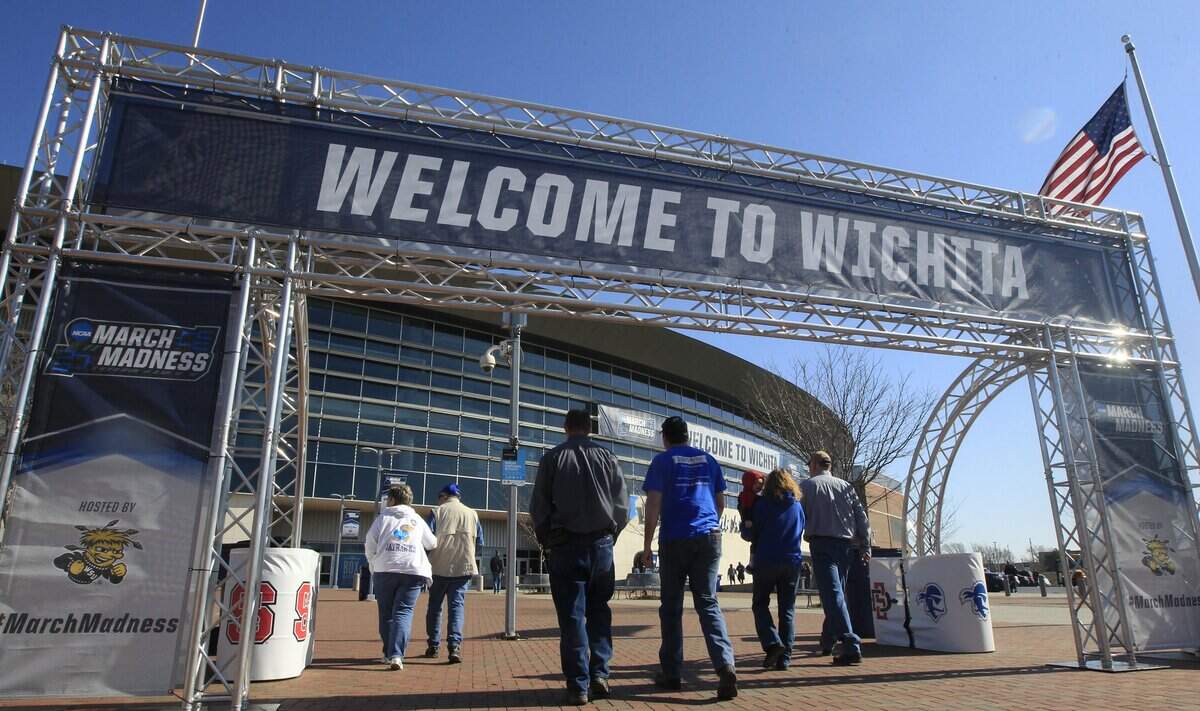
Instead of an occasional surge, downtown hotels, restaurants and businesses could receive predictable March Madness traffic each spring.
The opening round also will bring more teams to Wichita.
Traditional first- and second-round sites begin with eight teams. Wichita will welcome 12.
That means four additional schools, four additional team travel parties and four additional fan bases.
The size of those followings will vary. Some No. 15 and No. 16 seeds may bring relatively few fans, while at-large teams from major conferences could attract larger groups.
But local organizers believe the additional volume could help offset the absence of the top seeds Wichita hosted in 2018 and 2025.
There also is a significant local possibility.
The NCAA removed a rule that previously prohibited a school from playing at a tournament site where it was serving as the host. The NCAA has since confirmed to Wichita State that the Shockers would be eligible to play an opening-round game at INTRUST Bank Arena.
If WSU earns an at-large bid in 2027 or 2028 and lands among the final 12 at-large teams selected, the committee could assign the Shockers to Wichita.
That scenario could create enormous ticket demand and turn a neutral-site NCAA tournament game into something resembling a home atmosphere.
What Wichita would lose in star power and prestige
For basketball fans, the trade may be more difficult to evaluate.
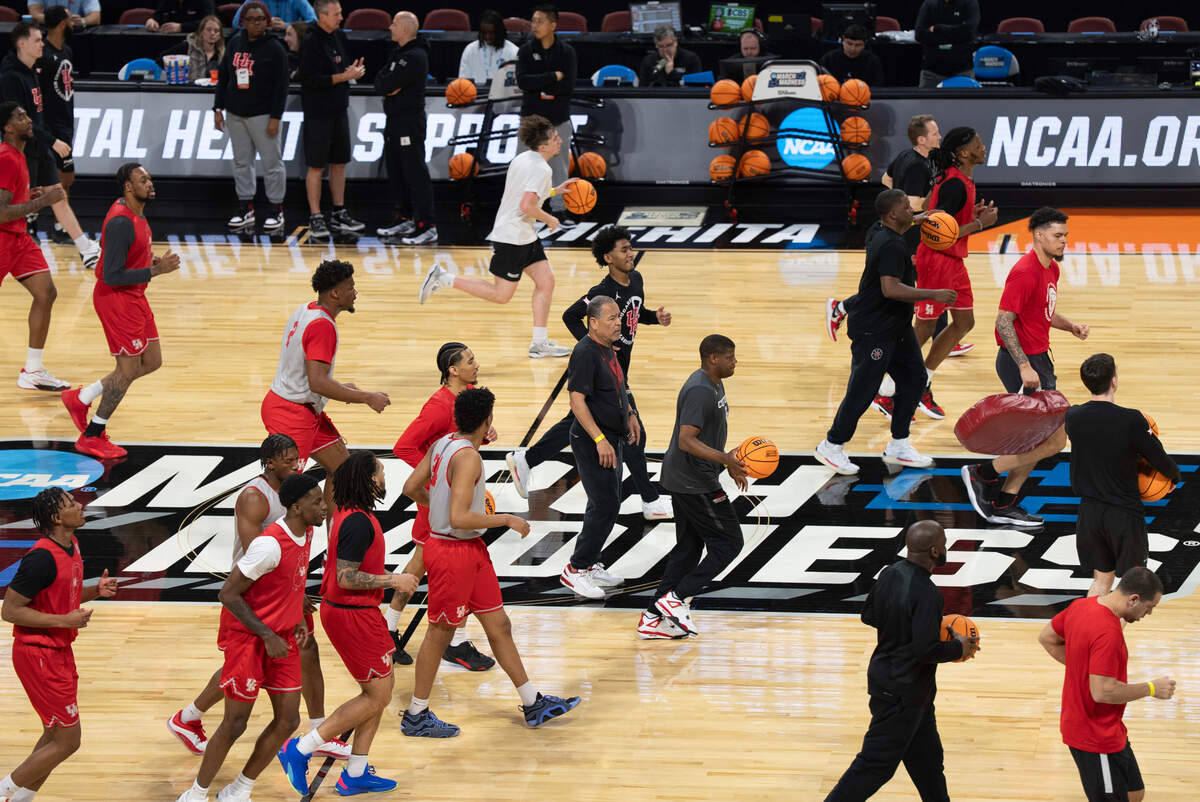
The opening round will not bring the top of the bracket to Wichita .There will be no No. 1 seed beginning a national championship run downtown. Wichita will not host a second-round game with a trip to the Sweet 16 at stake.
The city also will be less likely to see the tournament’s biggest stars, most recognizable coaches and highest-profile programs.
The opening round will bring a different level of team.
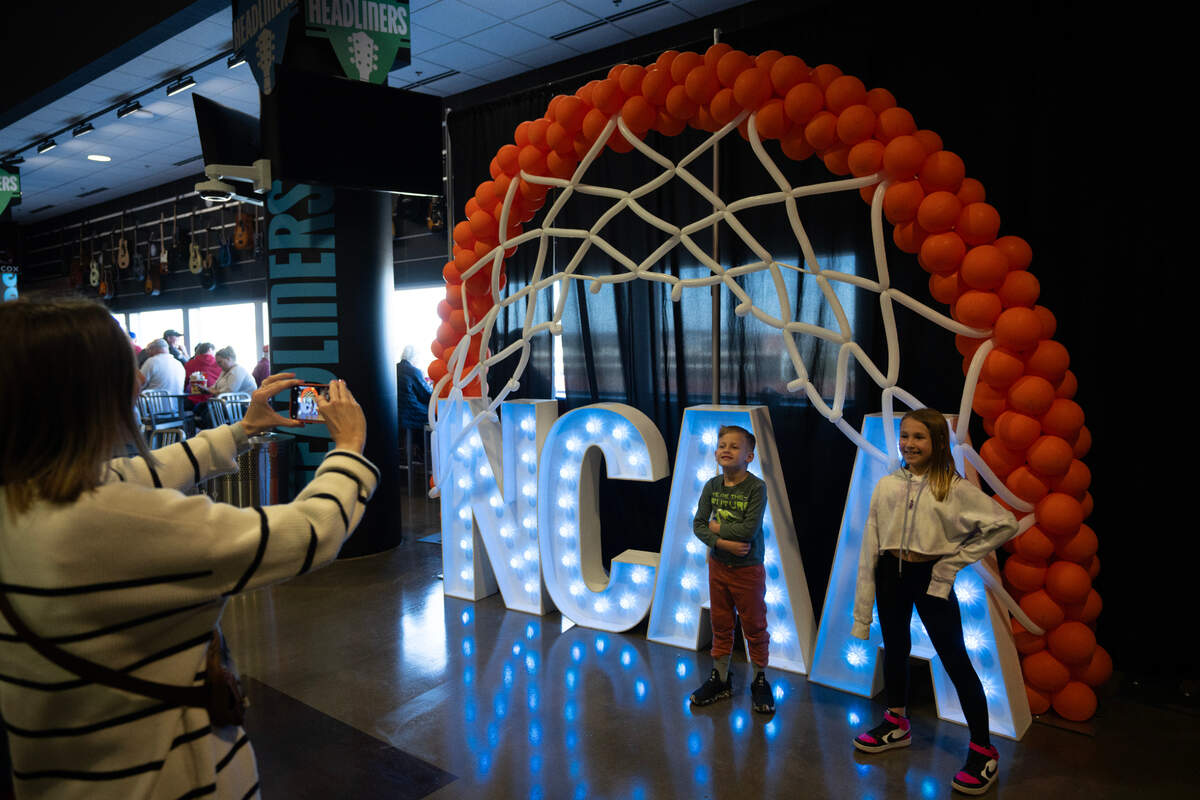
The expanded tournament will send the 12 lowest-seeded automatic qualifiers and 12 lowest-seeded at-large teams to Wichita and Dayton. The automatic qualifiers likely will be No. 15 and No. 16 seeds from smaller conferences, while the at-large games should feature more recognizable programs near the bubble.
Attendance may be the largest practical concern.
Wichita will not learn which teams are coming until Selection Sunday, less than 48 hours before the first games.
Some participating schools will have small alumni bases. Others could be thousands of miles away.
The short turnaround gives visiting fans little time to request off work, arrange travel, reserve hotels and purchase tickets.
The Tuesday-Wednesday schedule also may be more difficult for local fans than the Thursday-Saturday format Wichita hosted in 2025.
Ticket prices have not been established and will be announced later, but Pittman expects opening-round admission to be less expensive than tickets for traditional first- and second-round games.
That could make the event more accessible to local fans interested in attending March Madness regardless of which teams are assigned to Wichita.
Geography also may help.
With two host sites for opening-round games, Pittman expects the selection committee will have opportunities to send teams from the region to INTRUST Bank Arena, potentially creating one or more fan bases within driving distance.
And while the names may not carry the same weight, Pittman believes the competition can still sell the event.
“People are going to want to be there because it’s March Madness,” Pittman said. “From a competition standpoint, you’re going to have a lot of evenly-matched games. And what makes March Madness so special is those close games.”
His argument centers on the unpredictability and finality that make the NCAA tournament compelling.
Fans remember Michigan’s buzzer-beater in Wichita because a close game produced one of the iconic moments of that year’s March Madness — and helped launch the Wolverines on a run to the national championship game.
Pittman believes local fans will attend for the possibility of witnessing another moment like it, regardless of the names on the jerseys.
What kind of teams will Wichita actually get?
The quality of Wichita’s at-large matchups may depend on one of the largest unanswered questions surrounding expansion:
How will the selection committee use the eight additional spots?
The most likely pool includes middle-of-the-pack power-conference teams that finish near the NCAA tournament cut line, along with the occasional elite mid-major that dominates its league but fails to win its conference tournament.
Those are different types of teams.
One could be a recognizable program from the Big 12, SEC, Big Ten, ACC or Big East that finished around the middle of its conference standings but built a resume strong enough to receive one of the final bids.
The other could be a 25-win mid-major that controlled its league throughout the regular season, lost once in its conference tournament and otherwise might have been excluded from March Madness.
Whether expansion primarily rewards more power-conference teams or creates additional opportunities for high-achieving mid-majors will shape the appeal of Wichita’s field.
The 2026 First Four offered a useful snapshot of what those matchups could look like.
The final four at-large teams were Texas, N.C. State, SMU and Miami (Ohio) — a mix of recognizable power-conference programs and a 31-win mid-major. The lowest-seeded automatic qualifiers were Howard, UMBC, Prairie View A&M and Lehigh.
“Whenever you host an event like this, you can’t control who ends up coming,” Howell said. “All we can control is to make sure we give our teams and our fans the best possible experience.”
Opening-round teams also are not necessarily tournament afterthoughts.
VCU began its 2011 run in the First Four before winning five games and reaching the Final Four .UCLA accomplished the same feat in 2021. Three other First Four teams have advanced to the Sweet 16.
Wichita may not host the signature upset, but it could host the beginning of the tournament’s next memorable run.
The challenge will be convincing fans to view the opening round not as a preliminary event, but as the first chapter of March Madness.
The gamble: Can two years become an annual tradition?
For all of the potential benefits, Wichita still has only a two-year commitment.
The NCAA has not identified specific attendance, economic or operational benchmarks the city must meet to continue hosting beyond 2028.
Local organizers do not know exactly what the NCAA will value most when it evaluates Wichita’s performance.
They are operating with a straightforward goal: make the experience successful enough that the NCAA wants to return.
Strong local attendance will be critical. So will smooth operations and an atmosphere that translates well on national television.
The city is trading the possibility of hosting the tournament’s biggest names for the chance to become one of the names most closely associated with the tournament itself.
The traditional model brought KU fans downtown, national championship contenders to INTRUST Bank Arena and an estimated $7 million economic impact in 2025.
The opening round offers something different: six games, 12 teams, two nights of concentrated national exposure and the possibility of making March Madness an annual Wichita tradition.
“When you can host the NCAA Tournament in any iteration every year, that was something that seemed like a no-brainer to us,” Howell said. “You’ve seen how Dayton has embraced it and they’ve become synonymous with it. Now Wichita has got to embrace it and own it.”
Wichita already has proved it can successfully host March Madness when the bracket delivers the perfect draw.
It also has proved it can succeed without an in-state team.
The next two years will test a different proposition: Can annual March Madness become more valuable than occasional marquee games?
Wichita will soon find out whether owning the beginning of the NCAA Tournament is worth giving up the chance to host some of its biggest teams.
And whether a two-year opportunity can become a tradition.
This story was originally published July 10, 2026 at 7:01 AM.
.jpg)