
The NCAA changed eligibility. How Wichita State’s roster changed with it
The NCAA’s new eligibility rule has already changed the way the Wichita State men’s basketball roster should be viewed before the Shockers have even played a game.
A WSU roster that once would have been sorted neatly into freshmen, sophomores, juniors and seniors now requires a deeper reading. Some “seniors” may not actually be entering their final season. Some “sophomores” may now have four years left. Some players who already used a redshirt will not gain anything from the rule, while others who played immediately at previous schools suddenly have longer runways than their class labels suggest.
The NCAA’s new eligibility model, which was approved this week, replaces the old system that generally gave athletes four seasons to play within a five-year clock. Under the new rule, most Division I athletes will have a five-year window of eligibility tied to when they first enroll full time in college or when they reach the academic year after their 19th birthday, whichever comes first. That means many players who competed immediately and never used a redshirt can now gain an extra season, while players who already used a redshirt often will not see their timeline change.
But the NCAA has cautioned that the popular “5-for-5” shorthand does not apply cleanly to every case. The new rule is tied to age and enrollment, not simply a blanket guarantee of five playing seasons for every athlete.
The five-year eligibility period begins with the earlier of two triggers: when an athlete first enrolls full time at any college, including a junior college or international school, or the start of the academic year after the athlete turns 19. Once that clock starts, it runs continuously. In practical terms, it means traditional redshirts and most eligibility waivers are being phased out.

The rule appears to directly benefit at least six current Shockers: Dillon Battie, Jordan Frison, Bryce Heard, Noah Hill, Cyr Malonga and Desmeon Jones. Jaret Valencia could also have a path to another season depending on how his medical redshirt status is resolved, though WSU currently lists him as a redshirt senior.
For WSU, the headline is this: the Shockers now have more potential multi-year pieces than the old roster sheet would suggest.
That extra year could be huge for WSU if Mills and his staff can retain the right pieces in the transfer-portal era. Frison is expected to be a standout point guard for the Shockers this season and now has a chance to be more than a one-year solution with two years of eligibility remaining. Battie, coming off a breakout season at WSU, now has three years left instead of two. The same goes for Bryce Heard, an upside swing from the portal who now has three years remaining, while young frontcourt prospect Noah Hill suddenly has four years left to develop instead of three.
That reshapes the way WSU head coach Paul Mills and his staff can plan roster building.
For fans, though, it also means the old roster language is becoming less useful.
A note on terminology: For this story, players are described by where they stand in their college basketball timeline rather than strictly by the traditional freshman, sophomore, junior and senior labels. The old system can now be misleading, because a player listed as a senior may still have two seasons remaining, while a player listed as a sophomore may now have four. The clearer way to view WSU’s roster is by years of eligibility remaining.
Here is how the new rule affects the Shockers, player by player:
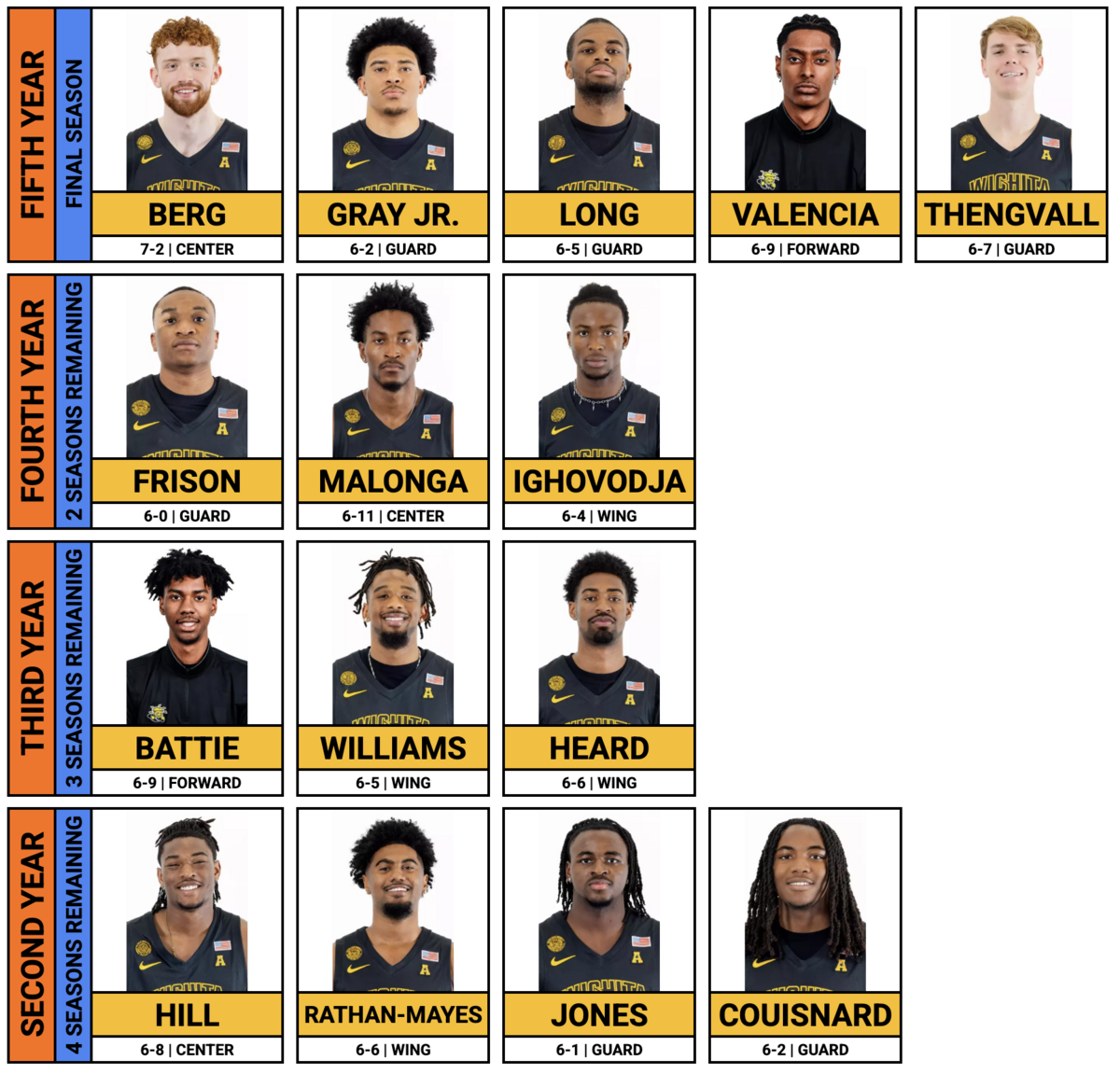
Dillon Battie, third-year player
Battie, a 6-foot-9 forward, is one of the most important WSU players affected by the new rule. He played his first college season at Temple, then transferred to WSU and had a breakout season last year. The new model gives Battie three years of eligibility remaining, making him a potential long-term building block for the Shockers.
Will Berg, fifth-year player
Berg, a 7-2 center, is one of the players whose timeline does not change. He redshirted earlier in his career at Purdue, so the move to a five-year eligibility model does not add another season. This is expected to be his final year at WSU.
Pierre Couisnard, second-year player
Couisnard, a 6-2 guard and the son of WSU assistant coach P.J. Couisnard, redshirted last season as a de facto walk-on. Because that year was already preserved under the previous system, the new rule does not appear to change his timeline. He has four years of eligibility remaining.
Jordan Frison, fourth-year player
Frison, a 6-foot point guard and transfer from Chattanooga, is one of the clearest beneficiaries of the new model. He began his college career with two seasons at Division II Pittsburg State, then played last season at Chattanooga before transferring to WSU. The new rule gives Frison two years of eligibility remaining with the Shockers.
Mike Gray Jr., fifth-year player
Gray, a 6-2 guard and returning Shocker, is one of the cases where the new rule does not extend the timeline. He needed a retroactive medical redshirt just to be eligible to play this season. This is expected to be his final year at WSU.
Bryce Heard, third-year player
Heard, a 6-6 wing and transfer from Dayton, now has a longer runway at WSU than his old class label would suggest. He spent the last two seasons at the Division I level before transferring to the Shockers. Under the new model, Heard has three years of eligibility remaining.
Noah Hill, second-year player
Hill, a 6-8 center, is another young WSU player who gains an extra year under the new rule. He played as a freshman last season for the Shockers, which means the five-year model now gives him four years of eligibility remaining. That makes Hill a longer-term developmental piece in WSU’s frontcourt.
Joy Ighovodja, fourth-year player
Ighovodja, a 6-4 wing, took a redshirt season last year at WSU. Because that preserved a year under the old system, the new rule does not add another season to his timeline. He has two years of eligibility remaining.
Desmeon Jones, second-year player
Jones, a 5-11 point guard, is one of the more interesting cases on WSU’s roster. He spent his first college season at Blinn College before transferring to WSU, but the new eligibility model gives him four years remaining. Instead of being viewed as a somewhat limited-time JUCO addition, Jones now profiles as a long-term backcourt piece.
Jahari Long, fifth-year player
Long, a 6-5 guard and transfer from George Mason, is in the same category as Gray. He needed a retroactive medical redshirt just to be eligible to play this season. This is expected to be his final year of college basketball.
Cyr Malonga, fourth-year player
Malonga, a 6-11 center, is another transfer whose timeline expands under the new rule. He played his first two seasons at East Carolina, then spent last season at New Mexico State before transferring to WSU. Because this season will only be his fourth year in college, Malonga now has two years of eligibility remaining.
Tyrus Rathan-Mayes, second-year player
Rathan-Mayes, a 6-6 wing, redshirted last season at WSU. That means his timeline was already protected under the previous eligibility model. The new rule does not add another season in his case, leaving him with four years of eligibility remaining.
Henry Thengvall, fifth-year player
Thengvall, a 6-7 forward, already used a redshirt earlier in his college career. Because of that, the NCAA’s new rule does not change his eligibility timeline. This is expected to be his final year with the Shockers.
Jaret Valencia, fifth-year player
Valencia, a 6-9 forward, is one of the more complicated cases on WSU’s roster. He redshirted his first season at Monmouth, played two seasons there, then missed most of last season at WSU because of injury. It remains unclear whether he has received an additional year through a medical redshirt, and WSU currently lists him as a redshirt senior. For now, the safest reading is that this is his final season unless WSU confirms another year of eligibility.
T.J. Williams, third-year player
Williams, a 6-5 wing, redshirted during his first year at WSU, then played his first college season last year. Because that redshirt year already fit within the old eligibility structure, the new rule does not add another season. Williams has three years of eligibility remaining.
.jpg)