
A deep dive into Jordan Frison’s game as Wichita State’s new point guard
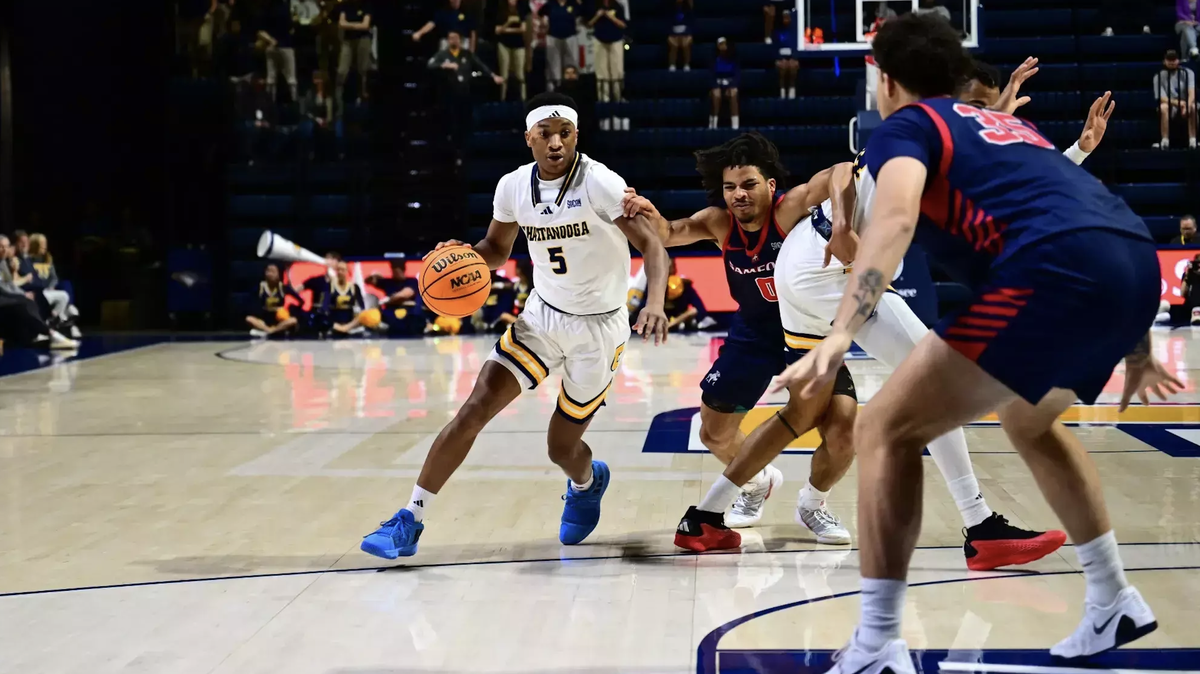
On film, Jordan Frison does not look like a guard in a hurry.
That is part of what makes him effective. He probes, waits, shifts a defense out of shape and then attacks the opening it gives him, whether with a soft pull-up, drive to the rim or timely pass. It is a style built more on feel than force, and it could make him an ideal table-setter for Wichita State’s next offense.
That patience is also what makes Frison such an interesting study as a transfer addition.
At first glance, his numbers at Chattanooga paint the picture of a highly efficient lead guard. But the deeper you dig, the more his profile starts to look like one Wichita State fans should find intriguing. Frison was not just productive. He was productive in the areas that tend to matter most for a point guard tasked with running an offense: decision-making, pick-and-roll command, paint pressure and shot selection.
The bigger question is not whether Frison can play. It is how well his game will translate when the floor shrinks, the defenders get longer and the margin for error tightens in the American.
That is what makes it worth trying to unpack his game piece by piece.
Why Frison’s efficiency numbers stand out
Frison averaged 16.4 points and 4.0 assists at Chattanooga, solid traditional numbers for a lead guard.
But the advanced stats suggest he was even better than those surface numbers indicate. He was one of the most efficient high-usage guards in the country, scoring at a high level without wasting possessions. He shot 60% on 2-pointers, 46% from 3 and 82% at the foul line, while also taking care of the ball at an elite level for someone who had the offense in his hands so often.
In simple terms, Frison produced like a primary playmaker without the sloppy shot selection or turnover issues that often come with that role.
It is one thing for a low-usage role player to post glossy percentages by only taking open shots. It is another for a lead guard to use a quarter of a team’s possessions and still avoid empty trips. That is one of the biggest selling points in Frison’s profile. He is not just careful. He is efficient without being passive, which is a much harder balance to strike.
The pick-and-roll game is where Frison shines
The most eye-popping part of Frison’s statistical profile comes in the ball-screen offense.
Per Synergy, among 478 players nationally who averaged at least three possessions per game as a pick-and-roll ball-handler, Frison ranked second in the country in efficiency at 1.18 points per possession. He shot 63% in those situations and produced 1.36 points per shot, which was the best figure in the country under those qualifiers. He shot 65% on 2-pointers and 56% on limited 3-point volume as a pick-and-roll ball-handler.
Those are absurd numbers and they match the film.
Frison plays with a patience that lets him manipulate the defense. He does not simply come off a screen and race downhill. He is comfortable resetting the action if he does not like the angle. He waits for the big defender to commit. He forces help defenders to show their hand. Then he punishes whatever choice the defense makes.
That is where his feel stands out. If the big hangs back, Frison can get into his pull-up. If the lane opens, he can finish at the rim. If the help rotates over, he can pick out the open man. He may not throw a ton of highlight-reel passes, but he consistently makes the right one, and that style should appeal to WSU coach Paul Mills, who has repeatedly talked during his tenure about valuing guards who keep stacking singles and doubles instead of forcing home-run plays.
Frison’s mid-range game is a real weapon
For all the attention paid to 3-point shooting in modern basketball, Frison’s mid-range game might be one of the most important parts of his offensive value.
He absolutely loves pull-up jumpers working out of the pick and roll, and he doesn’t take them as bailout shots. He takes them as an answer to what the defense is giving him. Per Synergy, Frison shot 67% on 2-point jumpers when he was operating as a pick-and-roll ball-handler, making 26 of 39. Overall, he shot 53% on 2-point jumpers for the season, going 52 for 99.
Those are excellent numbers.
What makes that part of his game especially useful is that it keeps him from forcing bad shots at the rim. When Frison gets downhill and sees a big sliding over to challenge, he is comfortable stopping short and popping from 6 to 16 feet instead of trying to finish through length. His shot selection is a major part of why his efficiency is so strong. He understands when the defense has taken away the rim and knows how to punish it anyway.
What also stands out is how comfortable Frison looks in his spots. Much like Kenyon Giles, he seems largely unbothered by a hard contest if he has already created the space he wants in the mid-range. He does not need the same kind of off-balance fades or body contortions Giles used to get those shots off, but there is a similar level of feel and confidence once he gets where he wants to go. Frison knows his spots, trusts his touch and looks comfortable rising up even when a defender is closing hard.
That gives WSU a scorer who can still create offense late in possessions, even if he is not the kind of high-volume 3-point bomber that stretches defenses the way Giles did.
Frison finishes at the rim better than you might expect
Frison is not just a jump shooter or a pick-and-roll orchestrator. He also finished very well at the basket.
Per Synergy, he made 69% of his shots at the rim on fairly high volume, going 67 of 97. What is more impressive is that when isolating just half-court attempts at the rim, that number actually climbed to 71% (46 of 65). That is an encouraging sign because it shows his efficiency around the basket was not inflated by transition run-outs. He was getting there and scoring against set defenses, too.
For a 6-foot guard, that speaks to real craft.
Frison is good at reading when he has a clear path to the basket and when he needs to make a different play. If he gets the opposing big on an island, he can finish. If the big rotates over, he can get him in the air and dump it off to a teammate. If the help is waiting early, he can stop for a short jumper. Those reads happen quickly, and the film suggests they are one of the strongest translation traits in his game.
It is easy to imagine that showing up right away with Will Berg as a screen-and-roll partner. Frison has shown a knack for stringing along the opposing big in drop coverage, making him commit, then slipping a pass to the roller for an easy finish. That kind of chemistry could become a staple in WSU’s new offense.
The passing is more subtle than flashy
Frison averaged 4.0 assists at Chattanooga, but the tape and tracking numbers suggest his passing impact may have been even better than that number shows.
According to Synergy, Chattanooga shot just 30% on kick-out 3-pointers created off Frison’s passes, which was below what the shot quality on those looks would normally predict. In other words, Frison may have created more quality offense than the final assist totals captured.
That fits what shows up on film.
He is not a home-run passer hunting highlights. He is more of a steady table-setter who probes the paint, forces the help and delivers simple, on-time passes that produce efficient shots. He is especially good at “upgrading” possessions, making the extra pass or the “one more” swing when the defense rotates. That is the kind of passing that coaches love, even if it doesn’t always end up on a mixtape.
His career assist numbers back that up. He averaged 5.1 assists as a freshman at Pittsburg State, then 6.1 as a sophomore before posting 4.0 at Chattanooga. More importantly, his decision-making actually improved as he moved up a level. He had a 1.81 assist-to-turnover ratio as a sophomore at Pitt State, then improved that to 2.43 at Chattanooga with just 53 turnovers in 957 minutes.
Simply put, Frison makes good decisions over and over. That is one of the clearest themes in his game.
How real is Frison’s 3-point shot?
Frison’s 3-point shooting numbers are encouraging, but the details — and the development arc behind them — are worth parsing.
Because this was not always a strength in his game.
In two seasons at Pittsburg State, Frison made 62 total 3-pointers in 61 games and shot 32% from beyond the arc. Per Synergy, he struggled from deep as a sophomore, making 31% of his pull-up 3s and 30% of his catch-and-shoot attempts. That is what makes last season at Chattanooga so intriguing. Frison did not just maintain his game after moving up to Division I. He clearly added a reliable 3-point shot to his arsenal.
Against Division I competition, more than 80% of his 3-point attempts came on catch-and-shoot looks with 83 of his 103 total attempts coming in those situations. He made 40% of those shots, which is a real positive because it shows he can function away from the ball and punish defenses when they help off of him.
That matters at WSU because while Frison projects as the team’s main ball-handler, he should still be able to play off secondary creators if Paul Mills adds more playmaking and shooting around him. The fact he worked to turn a weakness into a weapon is also an encouraging sign for how coachable and adaptable his game might be.
What Frison is not, at least not yet, is a high-volume pull-up 3-point threat. He did make 9 of 20 off-the-bounce 3s, but he usually prefers to get downhill or stop in the mid-range rather than firing from deep off the dribble. That makes him a very different type of scorer than Giles, who stressed defenses with sheer 3-point volume and range.
Frison can shoot it now. He just bends the defense in a different way.
The biggest question is the spacing around Frison
This may be the most important fit question in the entire evaluation.
In his first two seasons at Pitt State, Frison was surrounded by shooting. The Gorillas were consistently near the top of the MIAA in 3-pointers made and 3-point accuracy. This past season at Chattanooga, he once again played in a spaced-out offense. The Mocs ranked 18th nationally in 3-point rate, meaning Frison spent much of the year operating with the floor spread wide around him.
That court geometry could be changing this season in Wichita.
WSU ranked 300th nationally in 3-point rate this past season and is replacing 77% of its made 3s. While there is still time for Mills to reshape the roster, it is fair to expect Frison will spend plenty of time on the floor with at least two non-shooting threats, especially with Dillon Battie, T.J. Williams and Berg all slotted for major frontcourt roles. Battie and Williams may eventually develop perimeter shots, but neither currently profiles as a volume shooter and Berg is not a pick-and-pop big.
Frison has spent his career thriving in spacious environments where help defenders had longer distances to cover and shooters punished late rotations. At WSU, he may have to navigate tighter driving lanes and quicker help. That does not mean he cannot do it. It just means his adjustment will not be as simple as dropping his old film into a new uniform.
Can Frison’s game translate to a higher level?
This is the fair pushback in the evaluation.
Frison was excellent at Pittsburg State and won MIAA Player of the Year honors, but even as strong as the MIAA is for Division II, it’s still multiple levels down from the American. He was also very good at Chattanooga, but he did it for a 13-19 team that ranked No. 301 nationally on KenPom in the Southern Conference, which finished No. 23 of 31 leagues. Per KenPom, Frison has played only three career games against top-100 competition and all of them came in the first 11 games of this past season. For comparison, WSU played 15 games against top-100 competition last season.
So yes, there is a jump coming.
Part of that jump is not just league quality, but athlete quality. In both the MIAA and SoCon, Frison was able to thrive in environments that generally do not feature the same level of long, athletic perimeter defenders and rim-protecting big men that seem to populate the American every season. At WSU, he is likely to see better athletes on the ball, defenders with more length bothering his handle and pull-up game, and then, if he does get by the first line, more size and shot-blocking waiting for him at the rim than he has consistently seen before.
That is where the adjustment will come.
But there is also a solid argument for why Frison is a strong bet to handle the leap. The numbers that tend to travel — efficiency, decision-making, finishing, foul drawing and passing feel — are all present in his profile. More importantly, the film suggests he is not a guard who succeeds only because he is quicker than everyone else or because he can overwhelm lesser defenders with pure talent. He succeeds because he processes the game quickly, understands angles and consistently makes the right read. That kind of intelligence should give him a chance to adjust, even when the windows get tighter and the athletes get better.
WSU also has recent proof that strong SoCon players can scale up. Both Giles (UNC Greensboro) and Karon Boyd (East Tennessee State) made the jump last season and became all-conference players for the Shockers in the American.
That does not guarantee anything for Frison. But when the efficiency is backed up by the film, it is easier to believe he has a real chance to make the jump and keep doing at WSU what he has done everywhere else: run offense efficiently and make winning plays.
The advanced metrics like Frison, too
Frison’s broader advanced profile offers more evidence for optimism.
On Bart Torvik, his PRPG! — Points Over Replacement Per Adjusted Game — ranked third in the Southern Conference at 3.4. It is a metric that tries to estimate a player’s value above replacement while accounting for usage, efficiency and opponent strength. For a useful point of reference, that 3.4 is higher than the 3.2 Giles posted at UNC Greensboro before transferring to Wichita State.
Frison is not as strong in Evan Miya’s overall Bayesian Performance Rating, where he was 19th in the SoCon at 1.71. But that number is dragged down heavily by his defensive environment on a poor Chattanooga team. On offense, which is the area Wichita State is really buying, his 2.59 offensive BPR ranked sixth in the SoCon and compared favorably to Giles’ 2.20 offensive BPR before coming to WSU.
Those metrics do not prove Frison will become a star in the American. But they do reinforce the idea that WSU is not just betting on raw production. The Shockers are betting on an offensive profile built on efficient habits.
What about Frison’s defense?
Defense is unlikely to be the reason Frison wins games for Wichita State and the Shockers do not need him to be a plus defender to justify his role.
Watching the film, it is clear Frison is not headed for all-defensive honors in the American. He is small, his closeouts can be compromised by size, and he is not the kind of guard who regularly blows up possessions at the point of attack. At Chattanooga, he was often assigned to the opponent’s weakest shooter away from the ball, which kept him in help but also exposed the limitations of a 6-foot defender trying to recover out to shooters.
Still, context matters here.
Sometimes a player can be a victim of his environment and Frison spent last season in a bad one defensively. Chattanooga ranked No. 328 nationally on KenPom, switched everything without much success, offered little rim protection, rarely forced turnovers and struggled on the glass. Frison was part of those problems, but he was also playing in a system that did not give him much margin for error.
Wichita State should be a much better setting for him. The Shockers finished with a top-50 defense last season and found a formula that worked by leaning into drop coverage with 7-foot-2 center Berg protecting the paint while the other four defenders switched perimeter actions around him. That kind of back-line rim protection has the ability to erase a lot of mistakes, which should make life easier on Frison. He is also likely to be deployed in a role that makes sense for his skill set, probably guarding the opponent’s weakest perimeter threat, helping from the gaps and being asked more to stay connected within the scheme than carry a heavy burden on the ball.
That does not mean Frison is suddenly going to become a stopper. But it is fair to assume WSU is betting that his activity, effort and overall engagement on that end will increase when he is dropped into a much more competitive team and a far better defensive structure.
And really, that is all the Shockers need. They do not need Frison to be a defensive playmaker. They just need him to hold up well enough within the system so that the offensive value he brings can shine through.
The bottom line on Jordan Frison at Wichita State
Frison is not a like-for-like replacement for anyone Wichita State had last season.
He is not going to replace Giles’ shot volume, 3-point gravity or the way he could detonate a game with a barrage of deep makes. That is not Frison’s game. He does most of his damage by getting into the paint, pulling up from mid-range, finishing at the rim, drawing fouls and creating the right shot for someone else.
But that does not make him less interesting. In some ways, it makes him more interesting.
Frison looks like a true point guard whose biggest strength is his judgment. He understands angles. He understands timing. He understands when to score and when to pass. He has produced elite pick-and-roll numbers, efficient scoring numbers and strong playmaking numbers without piling up mistakes. That kind of profile gives WSU a real chance to build efficient offense around him, especially if Mills can put enough spacing and secondary shooting on the floor next to him.
There are real questions about the level jump and about how he will look when the floor is more crowded than it has been at any point in his career. Those questions are fair.
But the more you study Frison, the more it becomes clear why Wichita State wanted him.
He may not overwhelm you at first glance. He may not play with a blur of speed or with a scorer’s heat-check mentality. But possession after possession, read after read, he has shown an ability to make the right play.
And for a point guard, that is the most important trait of all.
This story was originally published April 14, 2026 at 6:02 AM.
.jpg)