
How Paul Mills’ daily rebounding obsession has fueled Wichita State’s success
AI-generated summary reviewed by our newsroom.
- Wichita State built success on daily rebounding drills that win possession battles.
- WSU ranks fourth nationally in offensive rebounding percentage and sets program highs.
- Coach Paul Mills emphasizes rebounding and care of the ball as the team’s catalyst.
Long after most seasons start to fray, Wichita State has found a way to keep its footing.
The Shockers are still playing in late March not because they shoot the ball beautifully and not because they overwhelm teams with dazzling offensive efficiency. In many ways, it’s the opposite. Wichita State has built its margin for error on muscle, repetition and a daily obsession with the most punishing part of the game: going to get the ball after a miss.
That identity has turned WSU into one of the nation’s most relentless rebounding teams and given Paul Mills a formula sturdy enough to travel into March. The Shockers (23-11) will look to continue controlling the game in the second round of the National Invitation Tournament in Sunday’s 7:30 p.m. game against Oklahoma State at Gallagher-Iba Arena and broadcast on ESPN2.
“It’s the catalyst,” Mills said of WSU’s rebounding. “These are possession games and you have to win the possession battle. The way you win the possession battle is you rebound and you take care of the basketball.”
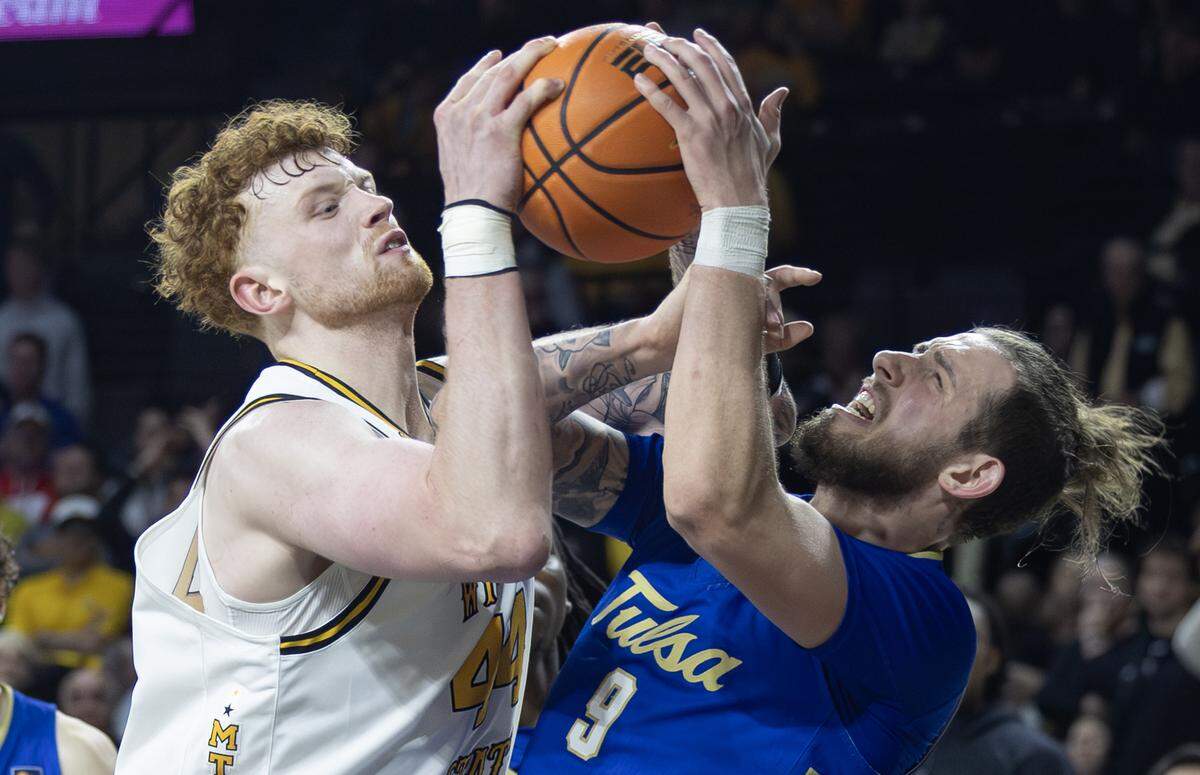
That philosophy is stamped all over the numbers.
Wichita State ranks No. 4 nationally in offensive rebounding percentage at 38.3%, a program-best mark in the KenPom era, and the Shockers are on pace to shatter the school record in offensive rebounds per game at 14.8. They’ve posted 10 or more offensive rebounds in 28 straight games, the longest such streak in the country, and WSU has tied or won the rebounding battle in 30 of 34 games this season.
That is not some accidental statistical quirk. It is the architecture of the team.
Mills wanted this from the start. He has said WSU intentionally recruited for rebounding because he believes the possession battle is the surest way to raise a team’s floor. That helps explain why portal additions such as Will Berg, Emmanuel Okorafor, Karon Boyd and Dillon Battie made so much sense to the staff. They were not just big bodies — they were players with signs of rebounding instinct, timing and appetite. And one of Mills’ biggest internal success stories has been the development of T.J. Williams, the returner Mills challenged early in the year to become much more forceful on the glass.
Against Wyoming on Tuesday, all of that showed up in one bruising snapshot. Wichita State matched its season high with 55 rebounds, its most in a game since 2017, grabbed 17 offensive boards and turned in a defensive rebounding rate of 81% against a Wyoming team that had been solid on the glass in the Mountain West. It was the fifth 50-rebound game of the season for the Shockers and Williams, who was maligned for his rebounding effort five months ago, authored the best rebounding game of his career with 14 boards.
Wyoming coach Sundance Wicks left thoroughly convinced.
“They are unbelievable pursuers of the basketball,” Wicks said. “They just have an ability to keep pressure on you. There’s going to be long rebounds and those are going to be pursued rebounds. You’ve got to be willing to go get in a pile because they are unbelievable in pursuing it.”
The key word there is pursuers.
Rebounding, at least the way Mills teaches it, is not passive. It is not standing and waiting. It is not being content to get nudged under the rim and hope the ball falls kindly. WSU works those habits constantly with assistant coach Josh Eilert playing a major role in teaching technique and positioning. Mills said the Shockers drill rebounding every day, usually with at least two rebounding segments in practice and often begin practice with one.
“I’m a big believer in what you emphasize is probably who you are,” Mills said.
The emphasis can get granular. WSU runs 5-on-0 rebounding drills to teach spacing, pursuit lanes and floor balance. Some players are assigned as get-back defenders. Others are designated crashers, responsible for attacking specific rebounding zones. If a rebound hits the floor in those drills, Mills said there are consequences. Sometimes there are even consequences if a player grabs the ball but got to the wrong spot to begin with.
That is how a team becomes this deliberate. The Shockers do not just chase misses harder than most teams. They chase them smarter.
Mills said WSU teaches its big men to read the angle of the shot and work toward the opposite side of the rim because that is where so many misses land. Watch one of Wichita State’s centers when a shot goes up and he is pinned on the near block and there are times he will slip underneath the basket and relocate to the opposite side before the ball even touches iron. It looks subtle in real time. Over 40 minutes, it becomes punishing.
And it has to because Wichita State is still compensating elsewhere.
For all of its strengths, WSU is not a good shooting team. The Shockers rank just No. 274 nationally in effective field-goal percentage, which is why rebounding is not merely helpful to their offense but essential to it. WSU survives by creating second shots, extending possessions and squeezing value out of misses that would end many other teams’ trips. Mills, an analytics believer, understands that putbacks are among the most efficient shots in basketball and that offensive rebounds can also create cleaner kickout 3s against a bent defense.
“It’s usually not the first shot that beats you,” Mills said. “It’s the second shot.”
Wichita State’s rebounding works because it is tied to temperament.
“It’s really about desire,” Mills said. “You have to have guys on the court who have a hunger and a desire.”
That hunger has made the Shockers unusually durable from game to game. Even when shots misfire, even when the offense turns ragged, they can still grind out a workable formula. WSU has been No. 1 in the American in rebound margin in each of the last two seasons and this season the identity has hardened into something stronger — a team that can weather bad shooting nights because it keeps manufacturing more chances than the opponent.
That matters even more on Sunday because Oklahoma State presents a very different kind of problem.
The Cowboys are 20-14 and play at one of the fastest tempos in the country. On their home floor, they average 88.8 points per game, which means Wichita State’s rebounding may be asked to do double duty — not only stealing extra possessions, but helping keep a high-possession game from turning into a track meet on Oklahoma State’s terms. The Cowboys are much more ordinary on the glass, ranking around the national middle in both offensive and defensive rebounding rates, but they can pressure opponents with pace and scoring volume, especially in Stillwater.
There is also the uncertainty of Oklahoma State’s rotation.
The Cowboys beat Davidson 84-80 in the first round while missing injured frontcourt pieces Parsa Fallah and Andrija Vukovic and also without three important perimeter scorers — Anthony Roy, Vyctorius Miller and Isaiah Coleman — for disciplinary reasons. Oklahoma State coach Steve Lutz said after the game that Roy, Miller and Coleman were still “working through the process,” leaving their status for Sunday unsettled.
“I haven’t decided (if they will play Sunday),” Lutz said after the Davidson win. “We’re still working through the process. They’ve got to meet the standards and the expectations of the program and they’re working towards that right now.”
That uncertainty may affect Oklahoma State’s scoring punch, but it should not change Wichita State’s central mission. The Shockers do not need Sunday to look pretty. They need it to look like them.
They need Berg, who ranks among the national leaders in offensive rebounding percentage, to keep carving out space. They need Okorafor, Battie, Boyd and Williams to keep turning misses into 50-50 balls that feel 70-30 in WSU’s favor. And they need their guards to finish possessions the way Mills said they have learned to do better as the season has unfolded.
There is a reason the Shockers are still standing while so many seasons have already ended. They have built a style that travels, a style that does not require perfection, only persistence.
“Having been in the NIT before, I know a lot of it has to do with just wanting to play,” Mills said after the Wyoming win. “I thought we wanted to play, we just didn’t have the legs. And then there’s a little bit of grit involved and you’ve got to dig a little bit deeper if this is really what you want to do. We saw some of that.”
This story was originally published March 20, 2026 at 12:07 PM.
.jpg)