
Dre Kindell can flip games for Wichita State. So what’s the next step?
AI-generated summary reviewed by our newsroom.
- Dre Kindell shifts Wichita State's offense, sparking pace and paint scoring.
- He produced a career-high 19 points and 2 assists in Wofford win at Koch Arena.
- Kindell averages 9.2 points, 3.4 assists and a 3.15 assist-to-turnover ratio.
The game tends to change the first time Dre Kindell checks in for the Wichita State men’s basketball team.
The Shockers had been fine early in Wednesday’s game against Wofford, but it wasn’t until the backup point guard came off the bench that the offense snapped into sharper focus. The pace quickened. The paint opened. Defenders were suddenly backpedaling and scrambling.
“We leveled up when Dre came into the game,” Wichita State head coach Paul Mills said.
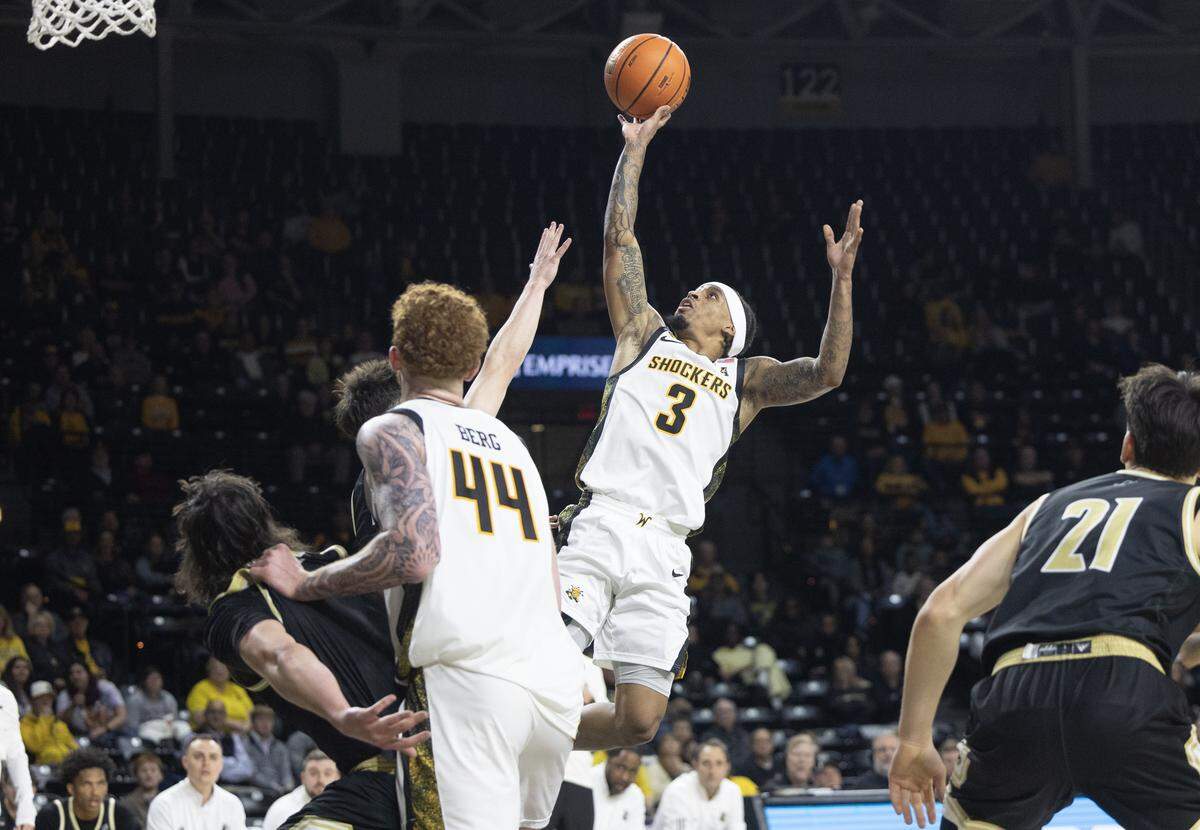
Kindell was once again the spark for WSU, as he turned in a career-best night in his young Division I career with a career-high 19 points to go with two assists and a steal in an 84-73 win over Wofford at Koch Arena.
It was the latest example of a trend that has quietly taken shape through nonconference play: WSU simply looks more dangerous when Kindell is on the floor and in attack mode.
The 5-foot-11 point guard is averaging 9.2 points and 3.4 assists while shooting 52.7% from the field, a reflection of his disciplined shot selection. He owns by far the best assist-to-turnover ratio on the roster with 41 assists (more than double anyone else on WSU) against just 13 turnovers this season — a 3.15 ratio that would be impressive for any point guard.
Because Kindell rarely wastes possessions, his advanced statistics stand out even more. He boasts an offensive rating of 130.4, a top-150 mark nationally, along with a 28.7% assist rate that also ranks among the nation’s best. His turnover percentage of 12.6% is elite for a guard responsible for as many reads as he makes.
“That’s just kind of how I’ve always been in my game,” Kindell said. “I just want to take the best shots for the team. I’ve never really been a selfish player, so I just try to take what’s best for myself and the team.”
All of it has fueled a growing question as conference play approaches: how long can WSU afford to keep this version of Kindell coming off the bench?
To be clear, he’s hardly buried in the rotation. Kindell is averaging 22.4 minutes per game, the fifth-most on the team. But his impact often arrives five or six minutes into the game when the Shockers are still searching for rhythm. When Kindell enters, the rhythm usually finds him.
There is a noticeable difference in tempo. Mike Gray Jr., the starting point guard, is methodical and deliberate, content to probe until a possession reveals itself. Kindell prefers to force the issue. He plays fast and that speed bends defenses.
In the pick-and-roll game, Kindell’s willingness to attack immediately puts defenders on their heels. If they don’t react decisively, he is starting to show he can punish them after performances like the one on Wednesday. On the perimeter, WSU has increasingly designed actions that put the ball in his hands and rely on his ability to win 1-on-1 off the dribble. Once he turns the corner, the decision tree opens — finish at the rim, dump it off to a big, or spray it out to shooters. More often than not, he chooses correctly.
“I feel like nobody can guard Dre,” fellow WSU guard Kenyon Giles said. “He’s a blur. So it’s really relieving knowing he’s got the ball and he’s going to make the right play.”
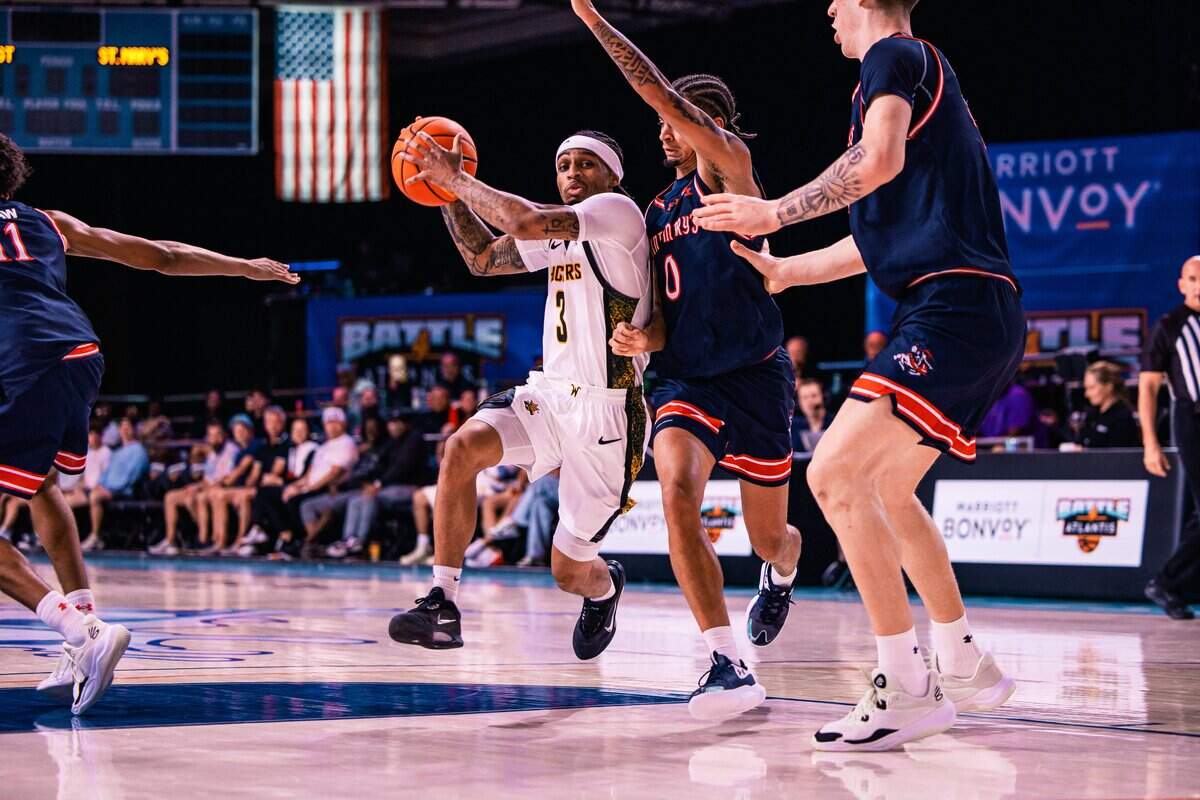
Wednesday was a case study in what happens when Kindell balances that playmaking with aggression. Against Wofford, he made five of his six shots from the field and repeatedly put pressure on the rim. He drew seven fouls and earned free throws on six separate occasions, four of them coming on direct, forceful drives that led to fouls.
After a late stumble at the foul line in the loss to DePaul, Kindell bounced back by knocking down eight of nine free throws.
“Just my coaches and teammates telling me that I pass so much, they told me to go in there and play off two feet,” Kindell said. “I just tried to create for myself and then create for others.”
His ability to score adds another layer of stress for defenses because of how difficult he is to keep in front. Getting downhill is rarely the problem. The challenge, particularly in his transition from junior college to Division I, has been deciding when to be a scorer and when to be a facilitator.
There have been moments this season when opponents know he wants to drive and kick, so they stay fanned out on the perimeter, daring him to finish. It’s a familiar dilemma for WSU fans who watched former Shocker Bijan Cortes navigate the same balance last season.
When he does look to score, everything else becomes easier. Either the help doesn’t come and Kindell has a clear lane to attack or the defense collapses and Kindell finds shooters like Giles and Gray for open shots on the perimeter.
“When (Giles) is knocking down shots, it’s definitely going to be easier for me to get in there and finish,” Kindell said. “Now they’re going to have to step over, then I can kick it to him. And you know how that goes, he’s not going to miss.”
The highlight moments Wednesday illustrated his confidence. Late in the first half, Kindell crossed a Wofford defender so sharply that the defender lost his footing. As Kindell sidestepped into a 3-pointer, the defender clipped his legs. The ball splashed through anyway for a 4-point play.
Early in the second half, he toyed with another defender out front, waited for the angle, then blew by him and finished through contact while drawing another foul. Later, with Wofford hanging around, Kindell baited a cross-court pass, broke on it like a defensive back and turned the steal into a basket — a pick-six that helped WSU reassert control.
Those highlight-reel plays come from a work ethic that has impressed everyone on WSU since the moment he arrived on campus in the summer. Mills recalled hearing a basketball bouncing inside Koch Arena at 8:30 a.m. Wednesday — hours before shootaround — and finding Kindell already deep into a workout.
“He just loves the game of basketball,” Mills said. “His care factor is through the roof. He really absorbs everything that he’s being taught. It usually takes 12-15 games and he’s starting to figure things out.”
There are still plenty of lessons to learn. Kindell’s eagerness occasionally spills over, like fouling 94 feet from the basket on Wednesday with WSU in the bonus. Those are the kind of mistakes that Mills wants him to eliminate from his game.
If Wednesday was any indication, Kindell’s understanding is starting to catch up to his talent.
“There’s no such thing as a perfect player, but it’s their response afterward,” Mills said. “Do they immediately understand, ‘What I just did put our team in a bad situation?’ I think Dre understands that.”
This story was originally published December 18, 2025 at 6:02 AM.
.jpg)