
Wichita State is learning how to read the game. It’s helping the offense blossom
During the sequence that best defined Wichita State’s 75-58 win over Milwaukee this past Saturday, the ball found its way through three Shockers before touching the rim.
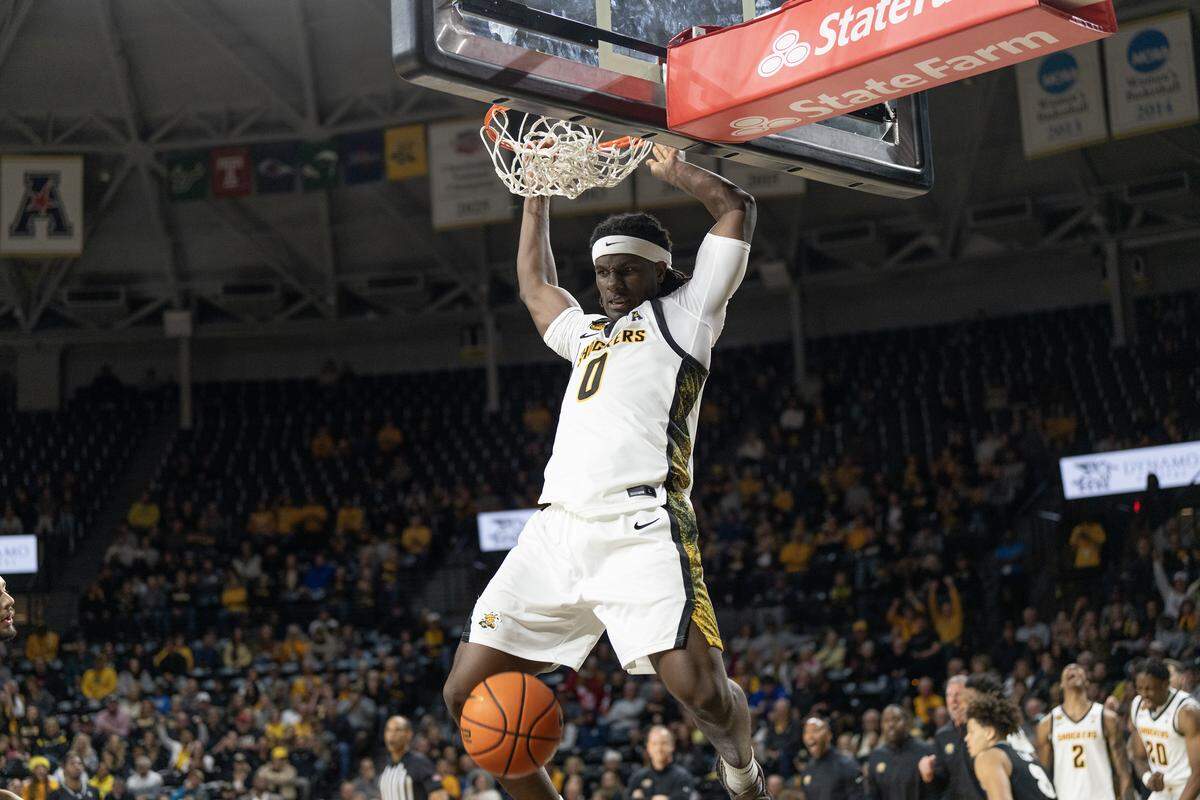
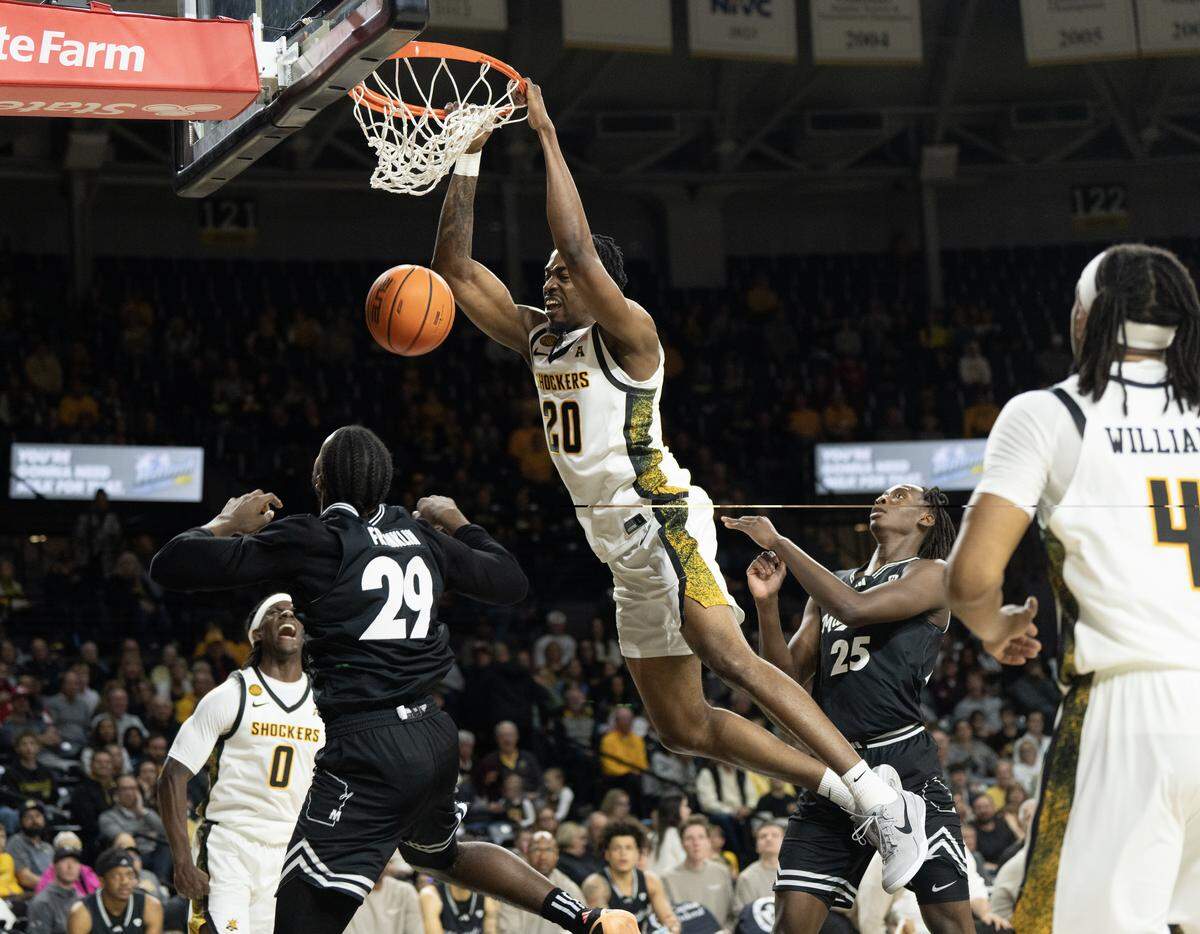
Mike Gray Jr. initiated a pick-and-roll action high up the floor, Will Berg slipped the blitz to receive the pass and found Karon Boyd soaring down the middle of the lane for a dunk that brought the nearly 6,000 fans inside Koch Arena to their feet.
But the most important person in the play never touched the ball.
Kenyon Giles stood in the weak-side corner, hands ready but feet planted. And because he was standing there — defenders refuse to abandon the senior shooting 58.8% from 3 with 20 makes in just five games — Milwaukee’s help defender stayed glued to him instead of rotating to Boyd.
The dunk was nice. But the lesson was more important.
“You need real-game environments in order to understand what’s occurring,” WSU head coach Paul Mills said. “That was my favorite play of the night. That was an organic offensive possession where guys understood what we needed to do. I was really proud of that one.”
It’s early, but it appears that the third iteration of Mills’ Shockers is his best yet at recognizing mismatches and diagnosing coverages in real time, an emerging identity that has powered a 4-1 start and a meaningful offensive jump entering Wednesday’s Battle 4 Atlantis opener against Saint Mary’s.
The Shockers are producing 1.16 points per possession through five games, up from 1.03 last season, and while the schedule has been mostly favorable, the film reveals something more sustainable than hot shooting: they’re finally reading the floor and they’re punishing mistakes.
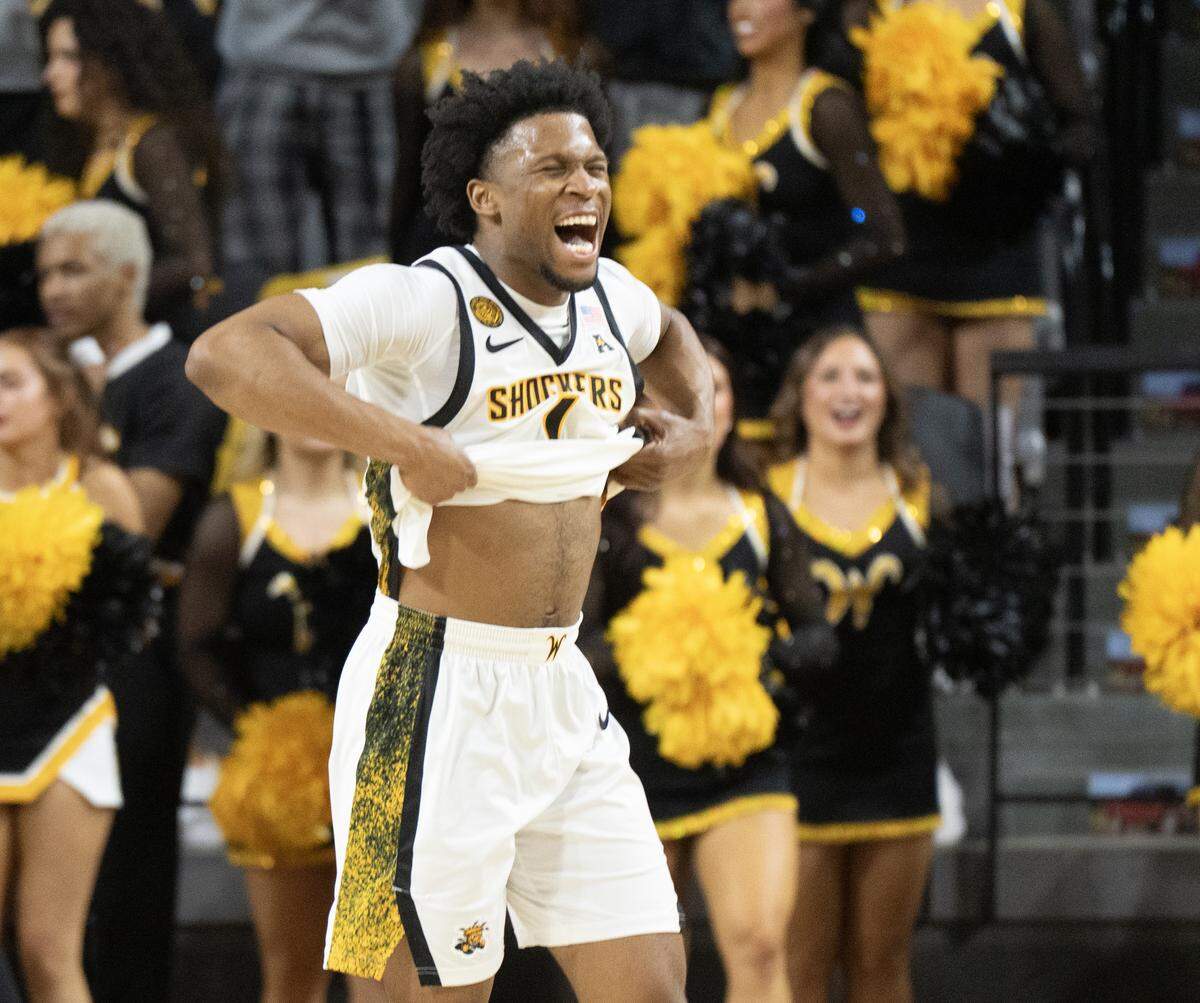
How Giles’ gravity changes the Shockers’ geometry
After Giles detonated for 24 points on just 13 field-goal attempts, Milwaukee coach Bart Lundy didn’t hide his admiration for the weapon the Shockers have this season.
“You can’t leave (Giles) and he stretches the floor,” Lundy said. “So we’re doing all of that stuff with the ball-screen coverage and we’re down one guy on the backside supporting because you can’t leave him to bump the tag or help in the gaps. So what he does for them is make you play 4-on-4 and he makes their schemes better.”
This is what opponents now face: Any time Giles is spotted in the corner, one defender becomes functionally unavailable. If opponents are built on help-heavy principles, like Milwaukee’s aggressive blitzing on ball screens, the entire structure becomes fragile.
That fragility cracked in the second half when WSU exploded for 1.47 points per possession, already the third time this season the team has achieved that mark in a half.
Another example of Giles being smart with his usage came in the second half following an offensive rebound scramble that left Milwaukee’s power forward guarding the 5-foot-10 dynamo on the perimeter. Giles didn’t force the issue. Instead, he backed out, waited for the paint to clear, then skated past the mismatch and floated in a high left-handed kiss off the backboard.
It looked simple. It was actually growth.
“That level of fluidity during the game, where players are recognizing stuff, that’s pretty important,” head coach Paul Mills said.
After Boise State had face-guarded Giles the previous game, Giles anticipated denial against Milwaukee. When the Panthers shut off a designed play to him early in the first half, Giles told the staff during a dead ball to start using him as a screener.
Mills credited his star guard for being cerebral enough to understand what is happening in real time. To Giles, he just wants to make the right play every time. And as the game wears on, he explains why it seems like he improves.
“In the first few minutes, everybody is fresh and you know that hard hedge is going to be hard,” he said. “But as the game goes, I know they’re going to get tired and we’re in shape. That’s how I got those shots at the end. … I’m not really tripping over the attention early because I know it’s going to die down as the game goes.”
And he’s right: WSU closed on a 19-6 run against Milwaukee, mirroring a 15-2 run the Shockers used to close out UNC Asheville. As legs go, coverages begin to crack and the Shockers are becoming better at learning how to exploit them.
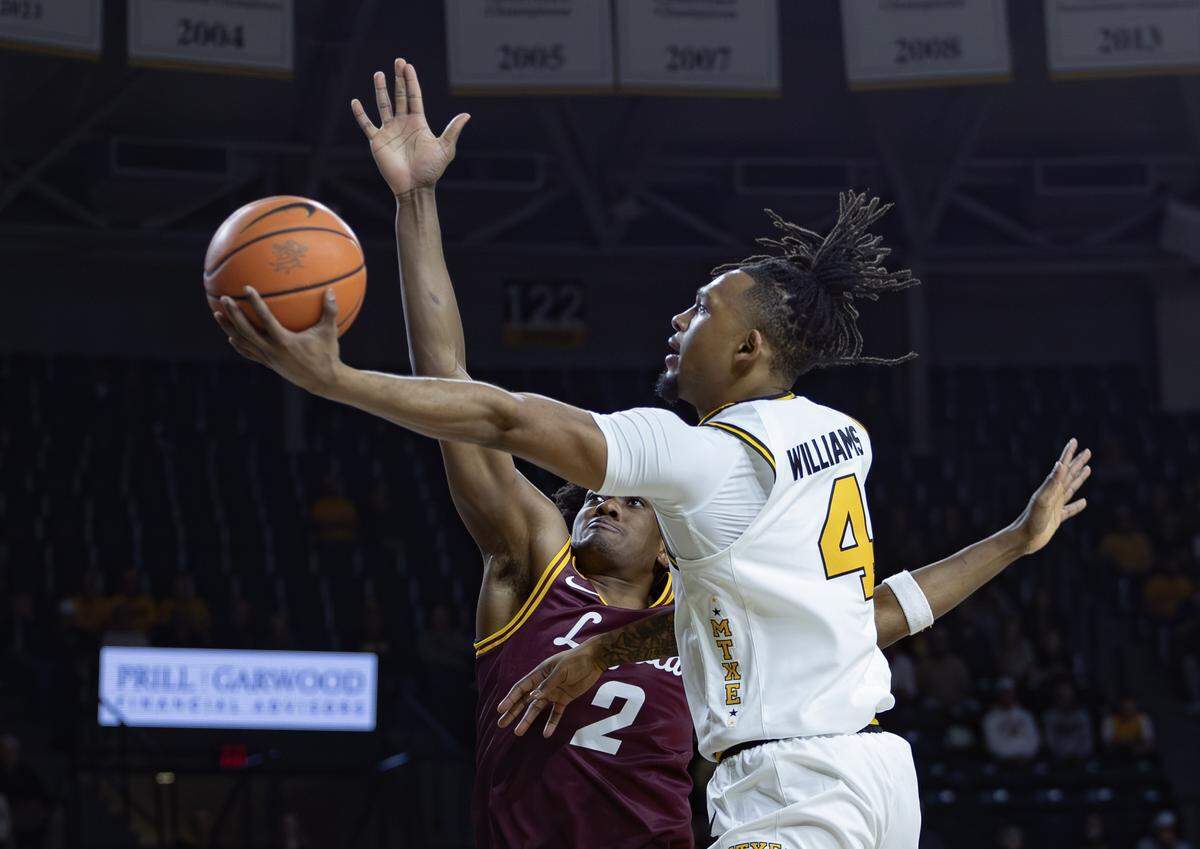
How WSU found the right mismatch in T.J. Williams
If Giles is the gravitational center of the offense, redshirt freshman T.J. Williams is the one who might benefit the most from the gaps it creates. And against Milwaukee, no WSU player took better advantage of those openings.
Milwaukee unintentionally did WSU a favor by stashing its power forward on the 6-foot-5 Williams, hoping to hide him defensively. But Williams plays the position more like a point guard on offense, and once the Shockers recognized the matchup, they sharpened their attack.
“I learned this from coach (Rick) Majerus, you always have to ask the questions, ‘Who is guarding me? And who is guarding my teammate?’” Mills said. “The way they were guarding, T.J. had the advantage and the players on the floor recognized it.”
Williams didn’t need prompting. After a quiet three-shot performance at Boise State, the Wichita native set the tone early this past Saturday whenever he caught the ball in the middle of the floor by immediately going downhill with wide-open space — a newfound luxury in WSU’s offense created by shooters like Giles and Mike Gray Jr.
“They gravitate towards (Gray and Giles) a lot, so that just helps the rest of us out,” Williams said. “That’s 3-on-3 basketball out there. It feels like we have a whole lot of space. I just try to get into the paint, try to create for whoever or I can create for me if I have an open shot.”
Milwaukee’s press disrupted WSU’s rhythm early, but it also created openings the Panthers struggled to cover when Williams and Boyd attacked in space. The pair combined for 27 points and 11 two-point baskets, as Williams raced by slower-footed defenders and Boyd muscled his way to post-up scores.
After Mills made his halftime adjustment, the Shockers’ offense found its groove.
“I thought their adjustments to use (Williams) and (Boyd) to drive us was really effective,” Lundy said. “Give (Mills) credit for a great adjustment there.”
What stood out was how Williams read the game’s flow. He understood that waiting to run a set wasn’t always the answer; sometimes the right play was to attack before the defense could get organized. Not every attempt landed — a few were forced — but it’s rare to see a freshman willing to assert himself that decisively while sharing the floor with two dynamic guards.
“We were just trying to get out and play, not really trying to get into our sets with 18 seconds left,” Williams said. “Coach told us if we get an advantage, we’re going to push and try to get in the paint and attract the defense. We didn’t want to sit around and wait for anything.”
It’s not just Wichita State’s offense recognizing themes
The improved reads aren’t limited to the offense.
Senior center Emmanuel Okorafor provided one of the subtler but most impressive in-game adjustments when Milwaukee repeatedly tried to back-screen him after involving him in the initial ball-screen coverage. Instead of getting clipped, Okorafor altered his vision mid-game, anticipated the second screen and blew it up.
Last season, WSU wasn’t doing this in November. Mills said he continues to harp on a message to drive home the point.
“We can’t let missed shots define us,” Mills said. “We need to operate in the 95%. What I mean by that is 5% of the game, the ball is in your hands, and the other 95% the ball isn’t. So you need to be conscientious of the things that you need to do.”
That’s why WSU transformed shootaround this year. It’s now more like a lab — a live-action classroom where guards are asked to identify coverages on the fly so that performances like the one against Milwaukee happen more naturally.
And the longer the game goes, the easier the puzzle pieces align.
Why it matters for WSU against Saint Mary’s
All this recognition will be put to its most serious test Wednesday at the Battle 4 Atlantis.
It’s one thing to diagnose problems at home, surrounded by the comfort of Koch Arena and the lift that comes from a friendly crowd. It’s harder to do it away from home, where communication strains and possessions tighten.
The Shockers learned that lesson in their first test of the season at Boise State, a night where they struggled to solve the Broncos’ pressure but still managed to give themselves a chance in the final minute. They’ll almost certainly need a sharper level of problem-solving to create that same opportunity against a high-quality Saint Mary’s squad.
There are few programs in the country more committed to its defensive structure than Saint Mary’s under head coach Randy Bennett, who has guided the Gaels to a top-15 finish in defensive efficiency five straight seasons. They currently sit 20th nationally while holding opponents to some of the lowest shooting efficiency in America.
The Gaels will be disciplined. They will not panic on defense. They will rotate on time. They will load the paint and make WSU prove it can identify where the advantage is — and attack it without hesitation.
The Shockers weren’t capable of that consistently a year ago. They might be now.
Wednesday will be the next challenge to see where WSU is on its season-long quest to fulfill its potential.
This story was originally published November 25, 2025 at 7:03 AM.
.jpg)