
Film review: How Wichita State used space to generate quality offense without assists
Entering his second season with the Wichita State men’s basketball team, coach Paul Mills had three pillars for how he wanted the Shockers to play.
“We’re going to rebound the ball, we’re going to take care of the ball and we’re going to share the ball,” Mills said before the season. “Those are non-negotiables.”
All three are considered a work in progress, even in WSU’s 2-0 start with two wins over 2024 NCAA Tournament teams with veteran rosters. But some questions can be raised when evaluating the team’s play through those distinct lenses.
Such as: Is it a problem WSU’s offense generated only 12 assists on 32 baskets in its 89-69 victory over Montana State at Koch Arena this past Saturday?
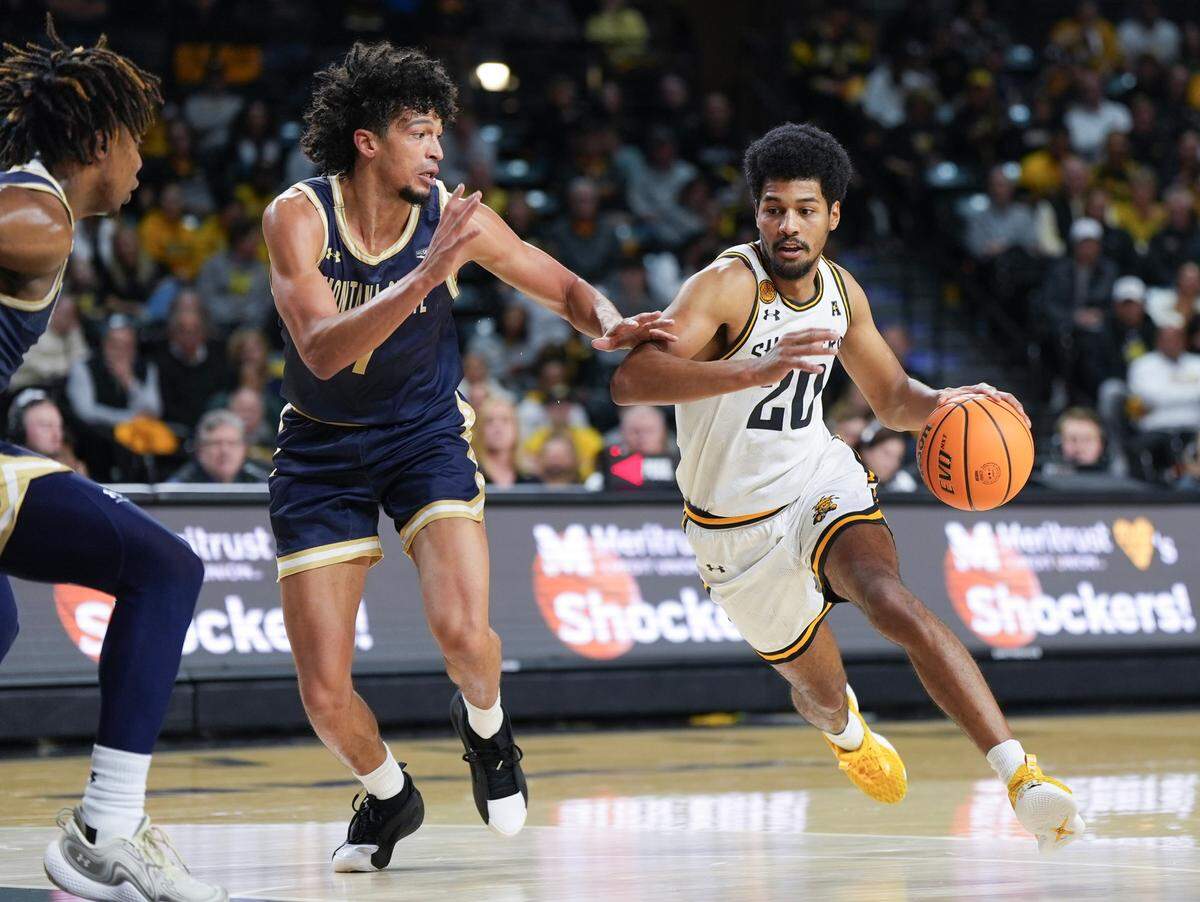
While assists can be the result of pretty offense, there are other avenues to efficient play, as WSU proved against the Bobcats. A film analysis conducted by The Eagle examined how Mills strategically put his players in advantageous 1-on-1 situations by manipulating Montana State’s switching defense and creating space to attack to help the Shockers generate a robust 1.29 points per possession.
WSU’s game plan revolved around a simple truth: The Shockers had more dynamic athletes on the perimeter. And because Montana State played a switch-everything defense, Mills knew it would only take a slight manipulation each time down the floor to find the 1-on-1 matchup that WSU could exploit.
On the first play of the game, WSU immediately sent Bijan Cortes to screen for Justin Hill with the sole purpose of switching the targeted defender, Tyler Patterson, onto WSU’s best ball handler. It only took one purposeful dribble for Hill to draw a second defender, which opened a lane for Harlond Beverly to attack on a kick-out pass and ultimately score a layup.
A major theme of WSU’s victory was manufacturing ways to put Hill in advantageous matchups, often going downhill. To give Hill the matchup WSU wanted, Mills designed a simple “Get” action for the senior point guard, meaning he would pass the ball to the wing and immediately go “get” the ball back. The short pass was designed to force the preferred Montana State defender to switch onto Hill and allow him to attack a backpedaling defender.
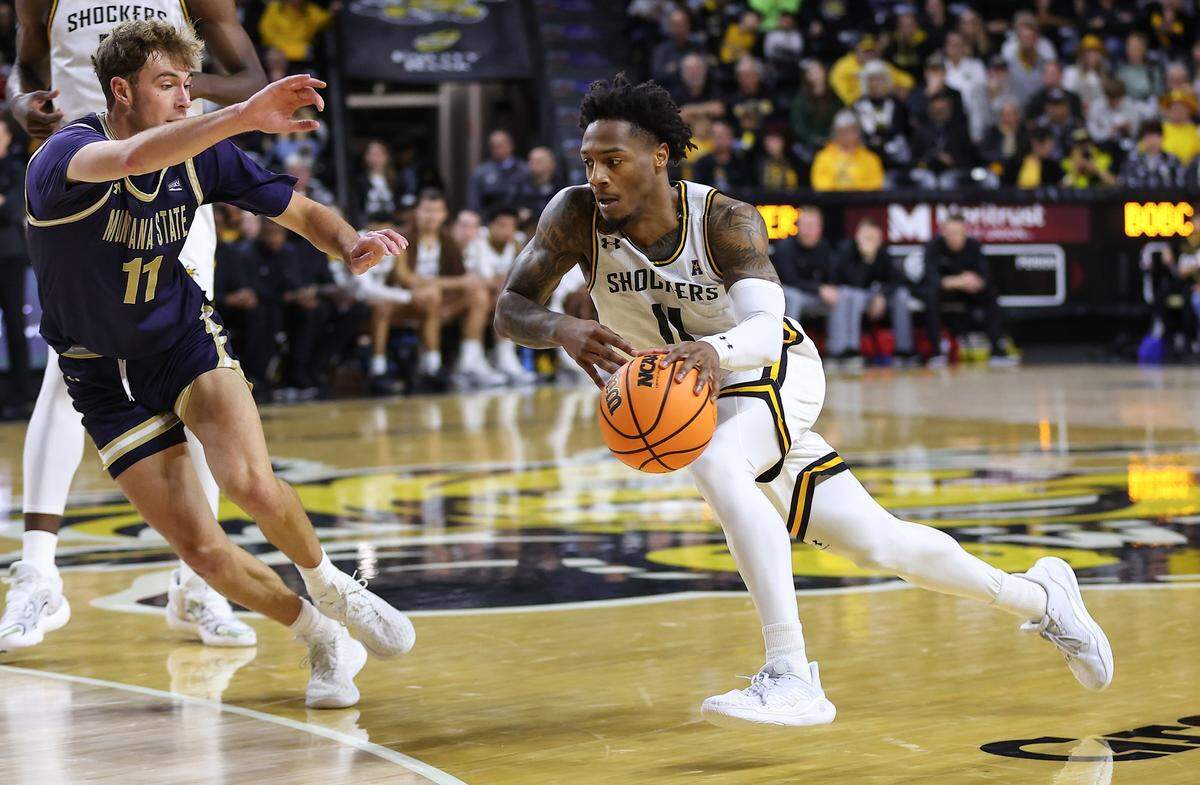
In total, Mills dialed up the “Get” action for Hill 10 times, with WSU scoring 18 points on those possessions and Hill scoring or assisting on 16 of those points. The play produced perhaps the most memorable stretch of the game when Hill ruthlessly went after Patterson, dropping him on a crossover for a pull-up jumper and then hitting a step-back 3 over him moments later.
But Hill wasn’t the only beneficiary of Mills’ game plan to give WSU space to attack.
The Shockers suffered through ill-timed clumps of turnovers last season in large part because driving lanes were clogged and ball handlers like Beverly, Cortes and Xavier Bell tried too many times to force their way to the hoop. In the win over Montana State, Mills found ways to unclog driving lanes for the trio.
On the game’s second possession, WSU ran a play that isolated Beverly, a right-handed player, on the perimeter and cleared out the entire right side of the court. It put the defender on an island with no help, which gave the senior all the space he needed to go to work 1-on-1 with a crossover that catapulted him to the rim for an easy right-handed finish.
Later in the game, WSU tapped into a play that has become a staple for Bell, a dominant left-handed player, to get to the rim with his left hand. With the ball in Bell’s hands at the top, WSU started the play with its bigs at each elbow and then had the left-elbow player cut across the court to essentially clear out the left side for Bell to attack. The sudden movement created momentary confusion in Montana State’s defense and allowed the Wichita native a free path to the rim for an easy score.
While those were manufactured clear-outs where WSU was following a script, the Shockers also showed improved spacing in the natural rhythm of their offense to open up driving lanes. One example came early in the game when WSU dialed up a pick-and-roll between Cortes and Quincy Ballard. Because Beverly was tucked away in the deep left corner, the help defender was pulled far enough away to give Cortes the sliver of space he needed to drive down the left side of the lane for another point-blank layup.
Another example of improved spacing came early in the second half after WSU executed a quick-hitter to Ballard for an easy dunk. When Montana State adjusted the next time WSU tried to run it, it was easy to imagine last season’s team stalling out when the first option of a play wasn’t there. But this year’s version of the Shockers flowed straight into secondary action, as Cortes raced up top to blur a screen and catch a pass on the wing. Slipping the screen gave him a step on the defender on the catch, as Cortes attacked the paint and kicked to a moving Corey Washington on the opposite wing with a gap to attack the paint again.
The play ended with Washington exploiting the advantage and earning a trip to the free throw line.
None of those plays involved an assist, but WSU didn’t need a single pass to leverage the defense and create golden scoring chances at the rim.
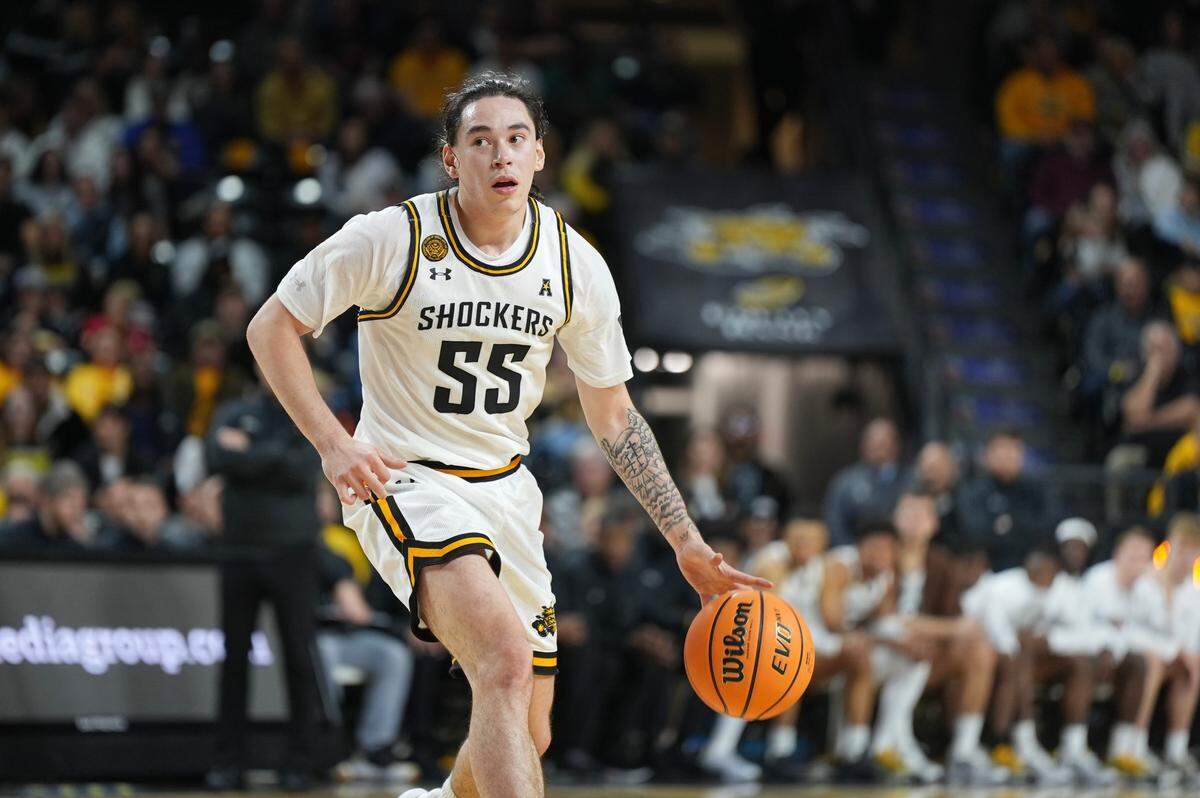
In the end, WSU bludgeoned Montana State in the halfcourt with 55 points — nearly four-fifths of WSU’s total halfcourt points — on possessions that ended at the rim. The Shockers scored 19 of their 22 halfcourt baskets near the rim and pumped out 1.38 points per possession on their rim attacks. Only eight of those baskets were assisted.
While Mills has stated he would like to see WSU share the ball more this season, the Montana State game shows a low assist rate doesn’t equate to a struggling offense. In fact, Oral Roberts finished top-70 in offensive efficiency while ranking near the bottom in the country in assist rate during Mills’ final four years in Tulsa.
WSU hasn’t had an offense like that since its American Athletic Conference championship run in 2021. There’s a long way to go, but the Shockers are already threatening that level — currently No. 73 — with fewer than half of their baskets coming on assists.
This story was originally published November 12, 2024 at 6:02 AM.
.jpg)