
AAC seeking basketball scheduling alliance to bolster strength of nonconference games
It wasn’t long ago when the American Athletic Conference had the unquestioned title of featuring the strongest basketball league outside of the power structure.
But that title has been lost following the departures of Connecticut, Houston, Cincinnati, SMU and UCF in the conference realignment carousel, paired with increasingly weak nonconference scheduling.
Add it up and the American went from routinely sending three or more teams to the NCAA tournament to being a two-bid league for four straight seasons now.
The AAC came dangerously close to becoming a one-bid league last season, if not for a UAB run to capture the AAC tournament title, as the conference dropped to the No. 9-rated conference in the country by Ken Pomeroy’s metrics — the lowest it had been in nine years.
New AAC commissioner Tim Pernetti is already looking to shake things up in his first year at the helm. At the conference’s media day on Monday, Pernetti announced he plans on moving the conference tournament out of Fort Worth following this season and is entertaining the idea of playing it on a campus site again.
But more importantly, Pernetti said he is pursuing scheduling alliances with other conferences that could help boost the American’s strength in the coming years.
“I can’t control what other schools decide to do is best for them, but how we’re attacking it is by talking to other conferences about the prospect of a scheduling alliance and partnerships and creating new events,” Pernetti said. “We’re going to try to create something consistent because scheduling is brutal, absolutely brutal.”
That would be a welcome change to some of the programs in the AAC who have proven capable of punching above their weight but don’t have the level of prestige to command home-and-home series with the type of opponents who can make a difference to an at-large resume.
Second-year Charlotte head coach Aaron Fearne sounded demoralized when discussing the challenges he faced in compiling a nonconference schedule for this upcoming season. In the end, the 49ers had to settle for playing competitive mid-major opponents like Utah State, Richmond, Davidson, East Tennessee State and Georgia State when power-conference teams passed.
“Scheduling has become almost impossible,” Fearne said. “It’s extremely difficult to get those quality games that you want to play because those teams don’t want to play you. It’s very difficult to do that. A number of teams we reached out to play didn’t want to, so it makes it difficult when you get to the end of the season and you need those quality wins, those quality opponents.”
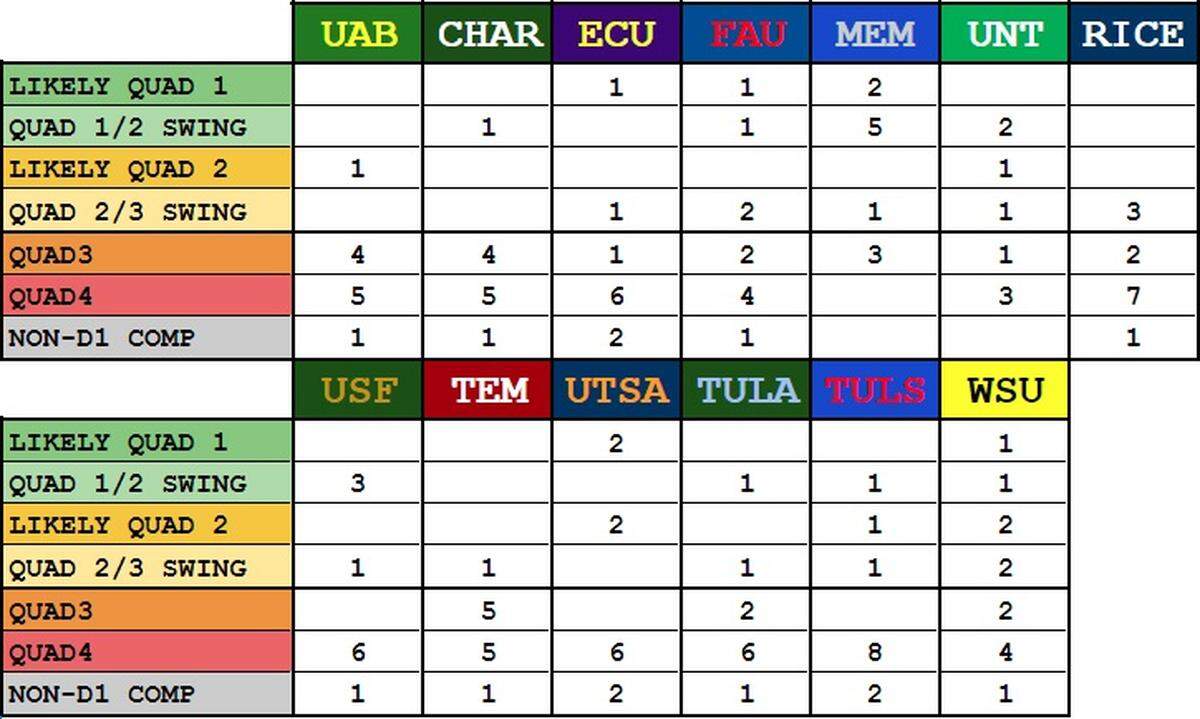
Memphis, on the other hand, has never had a problem scheduling big-name opponents under head coach Penny Hardaway. In fact, Hardaway may have assembled his most ambitious nonconference schedule yet, as every opponent is projected as a top-125 team by KenPom, which could land the Tigers up to as many as 10 opportunities for Quad 1 or Quad 2 wins.
It’s an extreme way to chase an at-large bid, but Hardaway argues it’s almost necessary with how the selection committee has viewed the strength of the American in recent seasons.
“It’s because they don’t respect (the AAC) and I hate to say that, but we have to get our points by playing quote-unquote the bigger teams around the country,” said Hardaway after scheduling Mississippi, Mississippi State, Clemson, Virginia and Missouri this season. “And the other part is that I want to know what it feels like to play the best early, so I can get the bar for our guys and see where we’re at.”
The Memphis model isn’t likely a realistic one for the majority of the conference to follow, but it’s also clear improvements need to be made to bolster the strength of the conference in November and December.
Florida Atlantic may have laid the blueprint for AAC teams looking to build an at-large resume, as Dusty May was able to land the Owls in a competitive multi-team event that netted three quality games, then scheduled three more quality games on neutral sites against Arizona, Illinois and St. Bonaventure.
Even with a pair of Quad 4 losses and an underwhelming performance in conference play, FAU earned a No. 8 seed in the NCAA tournament because it played a top-40 nonconference schedule with six Quad 1 or Quad 2 games — the kind that get the attention of the selection committee.
“You have to take five or six Quad 1 swings to have a chance of being an at-large bid,” said first-year head coach John Jakus, May’s successor at FAU.
But outside of Memphis, no other AAC contender scheduled aggressively enough to come anywhere close to the desired five swings at a Quad 1 victory.
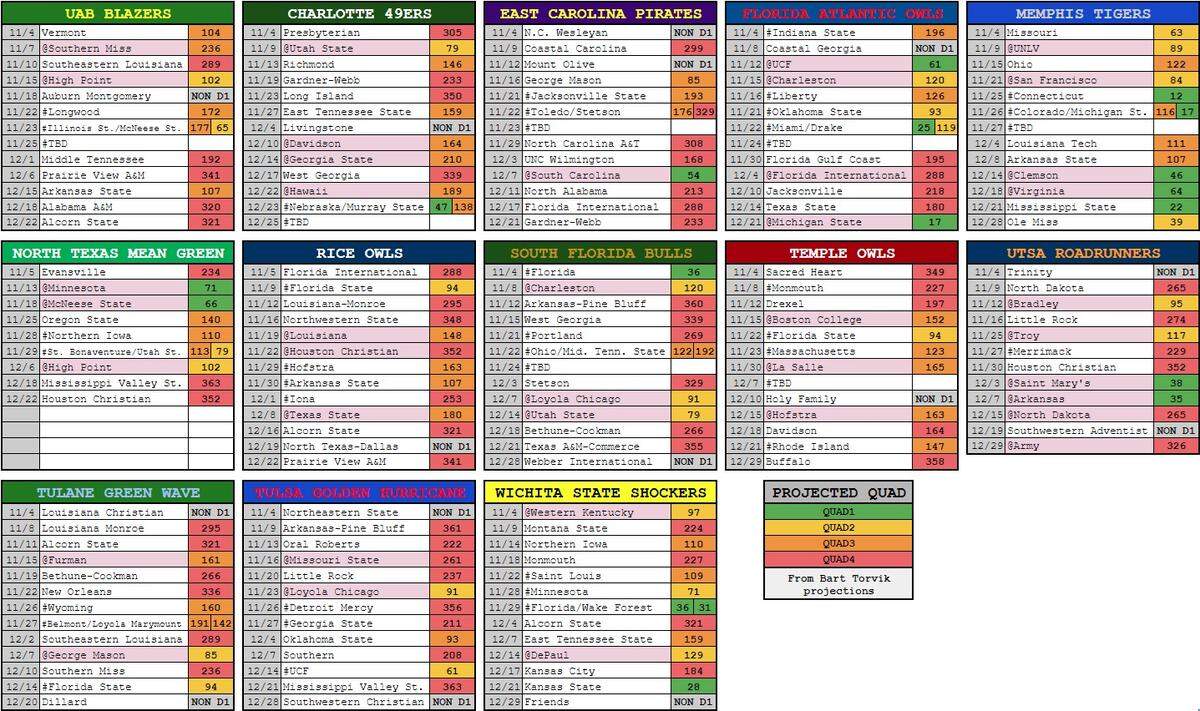
It’s impossible to accurately predict in October how nonconference schedules will look in March, but Bart Torvik’s preseason projections give a baseline for where opponents are generally expected to finish. Using Torvik’s projections, the five other top-six teams picked in the American (UAB, South Florida, Wichita State, FAU and Temple) combined to account for just seven potential Quad 1 games and nine potential Quad 2 games.
WSU figures to rank near the top of the AAC in nonconference strength of schedule with six potential games that could fall in the Quad 1 or Quad 2 buckets.
“It’s not lost on me that less than 20% of the (total NCAA) teams go, so 80% of the teams aren’t going to make the field,” WSU head coach Paul Mills said. “And you do realize where the bids are at, so you understand how good you have to be and the schedule that you need to even give yourself a chance.”
Quad 1 games (a top-30 team in the NET) are extremely difficult to schedule at home for AAC teams, but Quad 1 possibilities expand when teams are willing to be creative. Playing a top-50 team on a neutral site or a top-75 team on the road will net a Quad 1 victory.
That’s the strategy employed by North Texas, which has scheduled three road games against Minnesota (No. 71), McNeese State (No. 66) and High Point (No. 102) that could all finish as Quad 1 opportunities.
“We feel like the best way to be our best at the end of the season is to challenge ourselves in the non-league,” North Texas head coach Russ Hodge said. “You learn a lot about yourself going through those ups and downs. There’s not any falseness surrounding yourself. You can schedule easy and play a lot of home games and be 7-0, but are you really better being 7-0 than if you were 4-3 but you lost a couple close games to (tough) teams? I think that’s been part of our past success for being good late and then we’ve been rewarded because of our strength of schedule, whether that’s with seeding or postseason opportunities.”
While it will be up to the head coaches to build up their own programs and make them attractive partners in the scheduling process, a scheduling alliance with a conference like the Mountain West or Atlantic 10 could be an easy way to give top AAC teams a readymade quality game on the schedule every year.
Pernetti said it is his job to help make that happen and the work begins even before the season tips off.
“A commissioner’s job is to make sure that his conference and his membership stay in the conversation and stay relevant in the conversation,” Pernetti said. “That’s not just about fighting for your conference, it’s about making sure that you’re creating a narrative in the public with the media about what’s happening. The reality of this conference is that we have institutions that have the guts to step up and schedule aggressively outside the conference. That’s great that we’re doing that, but we also have to show really well in the nonconference.”
This story was originally published October 16, 2024 at 6:00 AM.
.jpg)