
‘Winning is in the details’: Examining the chess match between FAU and Wichita State
In every college basketball game, there is a game-within-the-game being played.
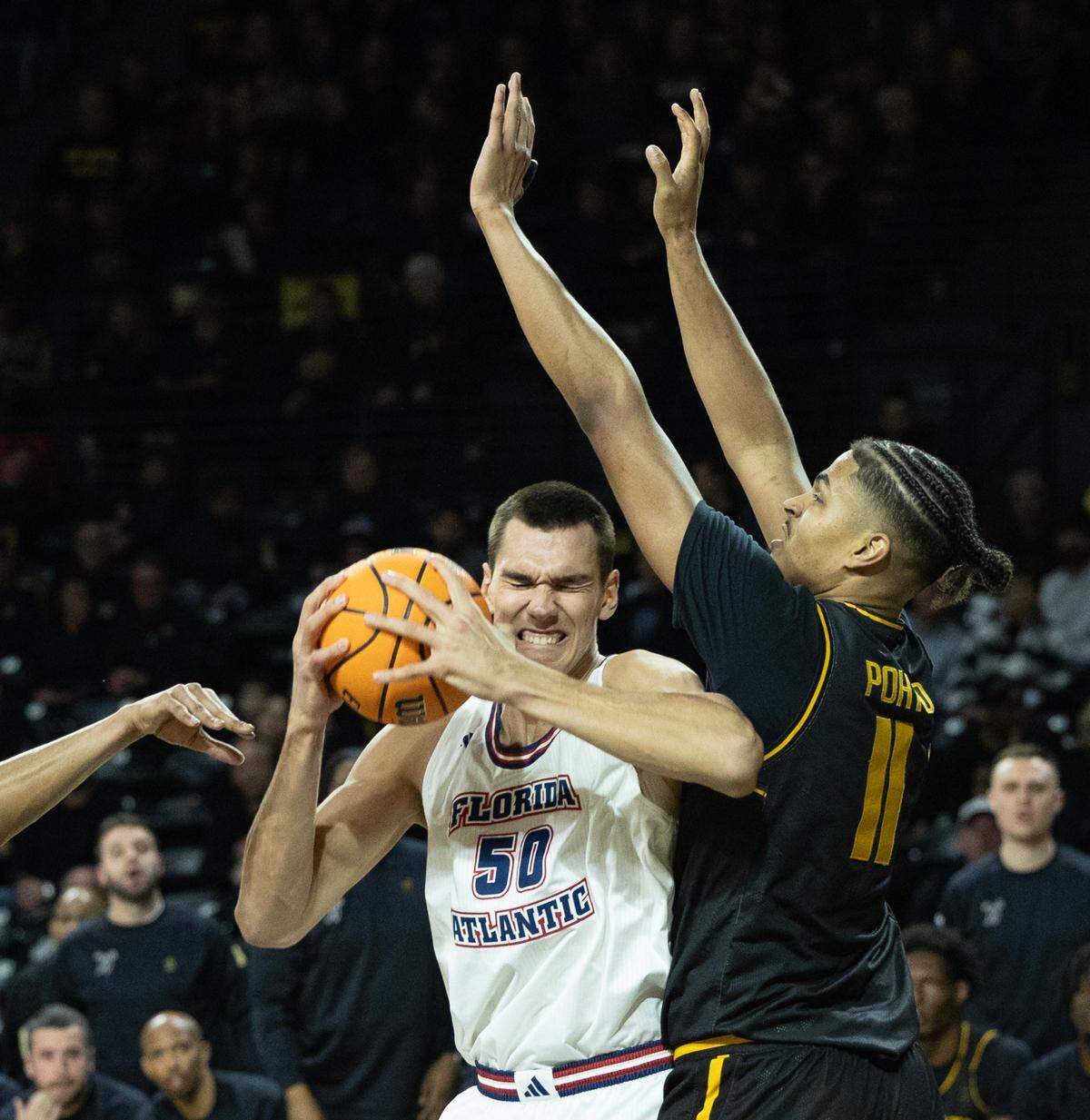
The final box score shows Florida Atlantic defeated Wichita State 95-82 in overtime on Sunday at Koch Arena, but how exactly did the Owls mange to win in their first trip to Koch Arena? What did the Shockers do to push the No. 20-ranked team in the country to the brink?
An extensive film study by The Eagle takes the reader inside the game-within-the-game, which centered around how FAU defended WSU in the pick and roll. Here are the four major themes from the game, which delves into the chess match that developed between Dusty May and Paul Mills.
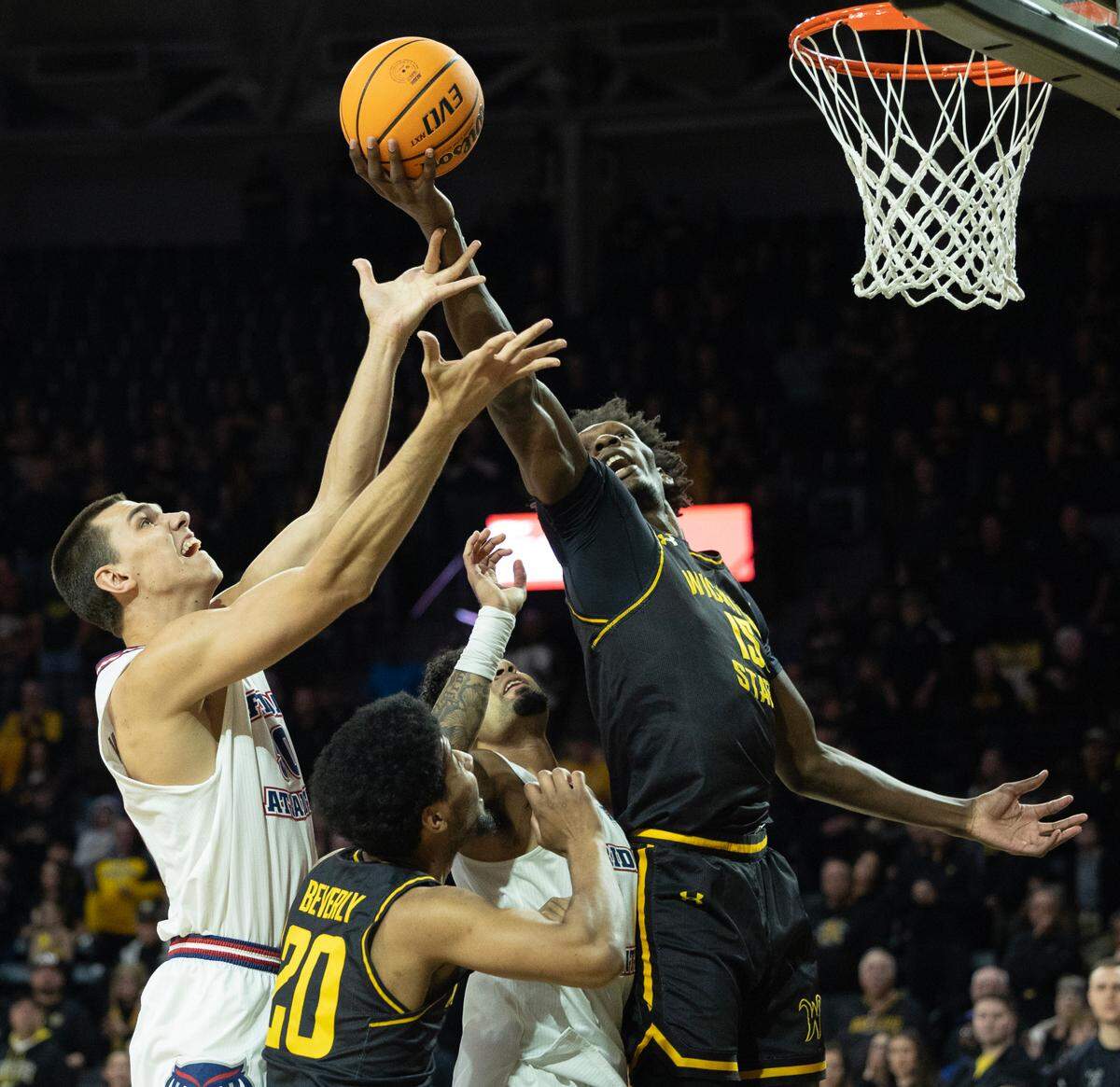
The strategy FAU used in Wichita State rematch game
In the first meeting in Boca Raton on Jan. 18, WSU’s cavalry of downhill drivers (Harlond Beverly, Xavier Bell and Bijan Cortes) consistently exploited Florida Atlantic’s pick-and-roll coverage. The Shockers scored 42 points and 1.17 points per possession, close to their peak productivity this season, on possessions initiated by a ball screen.
FAU deployed Vlad Goldin, an elite shot-blocker at 7-foot-1, in drop coverage, meaning the big man dropped back in the paint to protect the rim when WSU’s center set a ball screen on the perimeter. The source for FAU’s headaches centered around its choice to have defenders chase Beverly, Bell and Cortes over the top of screens, ceding the advantage to the ball handler and placing Goldin under a barrage of 2-on-1 disadvantages that WSU capitalized on with alley-oop lobs and downhill layups.
Three weeks later for the rematch in Wichita, FAU coach Dusty May made a shrewd adjustment. Instead of his guards chasing Beverly, Bell and Cortes over the top of screens, the Owls went out of their way to go under screens against the trio.
It’s been a popular strategy in American Athletic Conference play, as defenses are content whenever Beverly, Bell or Cortes — combined 25% 3-point shooters this season — hoist away from outside. Going under screens also allowed FAU to shrink the floor and limit the number of downhill drives that proved so costly in the first meeting.
WSU still scored the bulk of its points from the pick-and-roll game, but FAU’s coverage change confined the Shockers’ efficiency to 0.91 PPP. Part of the drastic drop-off from the 1.17 PP mark in Boca Raton had to do with 17 turnovers committed in Wichita, a sign of the indecisive play-making against a defense that ranked fifth nationally in limiting assists.
“You can’t think pass against those guys, you have to think shot,” WSU head coach Paul Mills said. “Early in the game, we were thinking pass way too much. If that’s what they’re going to give you, those 4-to-6-foot shots at the rim, then you have to take them.”
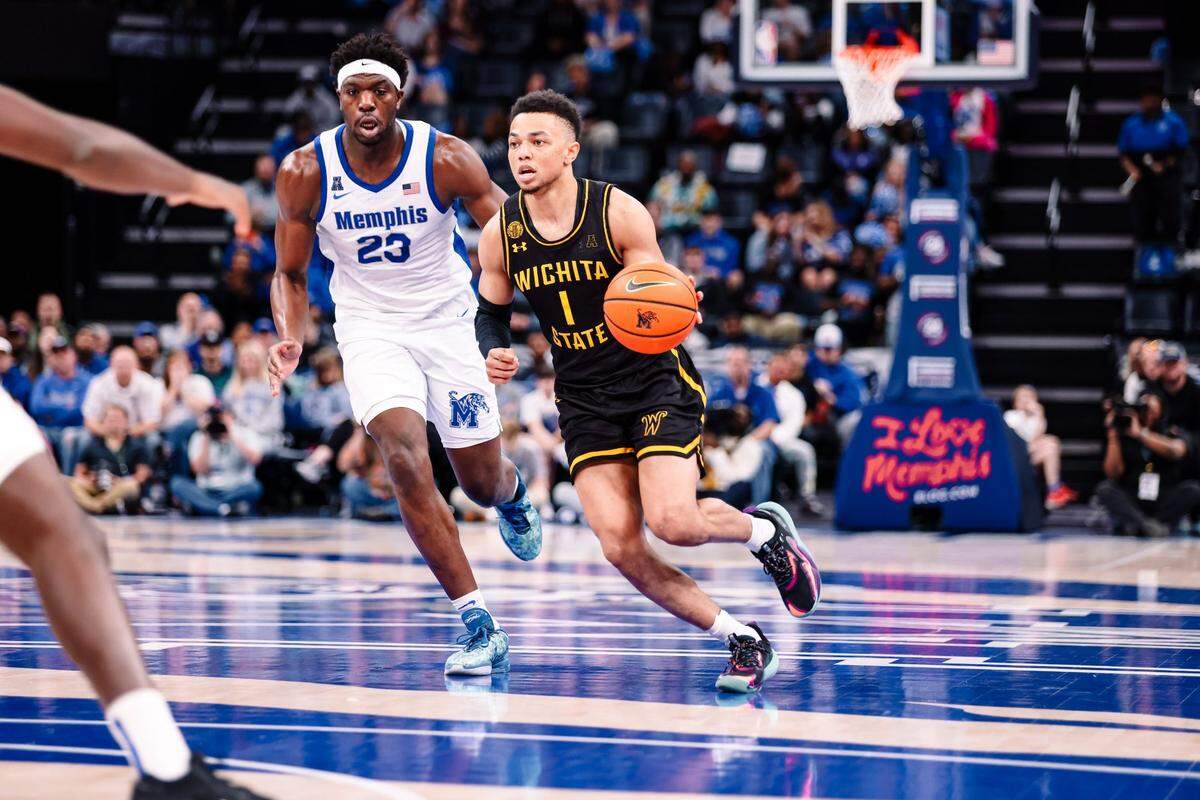
How Xavier Bell used space to his advantage
FAU’s new strategy quieted Harlond Beverly and Bijan Cortes in the pick-and-roll game, but the trade-off was giving up a 25-point explosion to Xavier Bell.
The Wichita native turned what FAU believed was its advantage — giving him space — into his advantage. Instead of being deterred from driving when his defender would drop below the screen, Bell exploited the space by building his speed for a drive, then used his physicality as a former football star to bump off defenders and create space for a score.
Midway through the second half, Bell took his allotted running start, hammered his lead shoulder into a back-pedaling Johnell Davis and buried him underneath the rim while he finished a layup on the other side.
When FAU would dip under ball screens for Bell, sometimes as low as the free-throw line, he used the leverage to reach his comfort zone, then pummeled the Owls with an assembly line of left-handed floaters.
“You just keep setting (the screen) lower and you get it lower and lower,” Mills said. “Eventually a bluff is going to get called.”
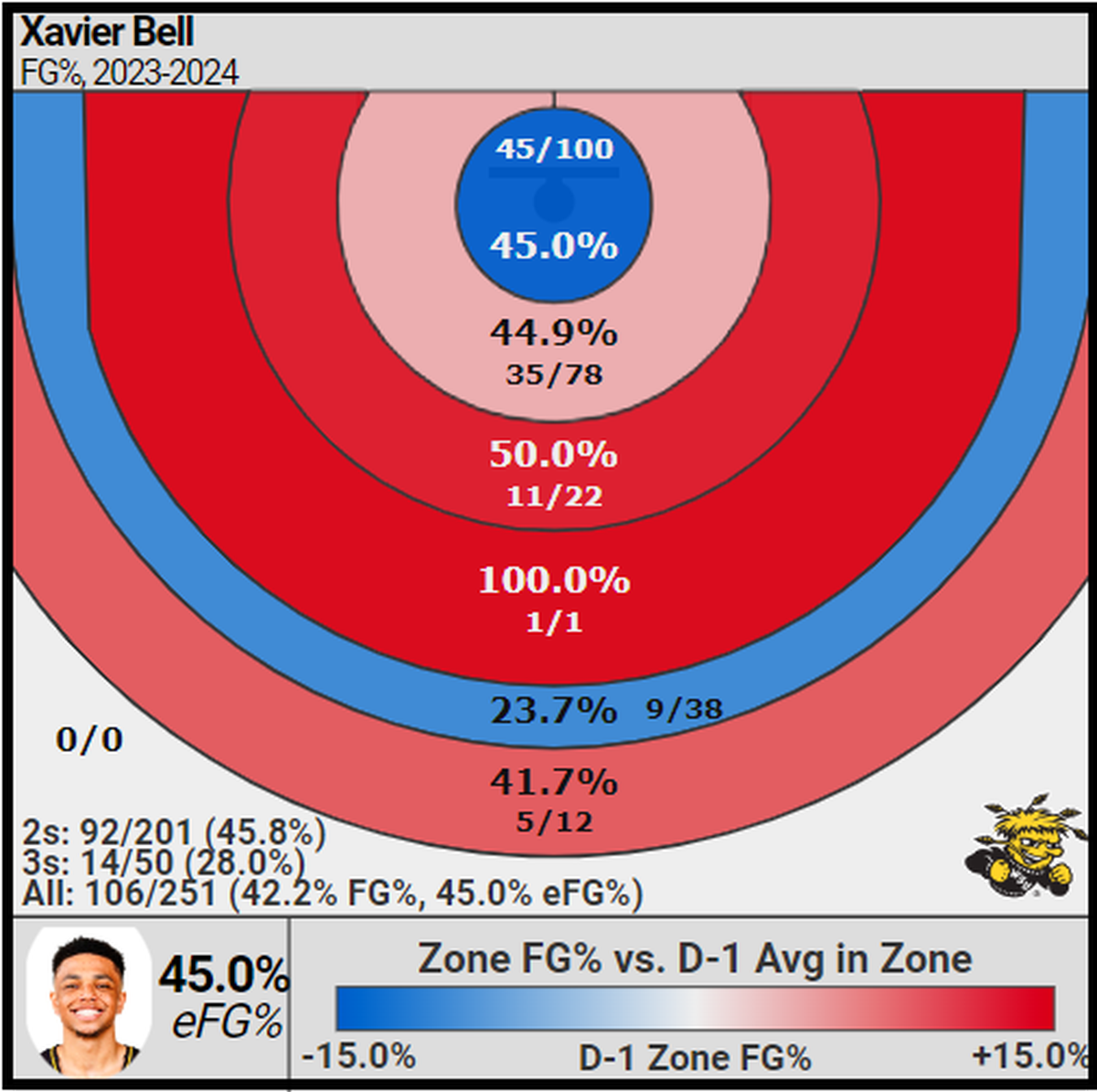
Eight of Bell’s 10 field goals were scored between 4 and 15 feet from the basket, which is usually a range where FAU is comfortable allowing shots. But that distance is where Bell has thrived this season, converting on 46% of his chances, according to CBB Analytics.
“Typically, those 12-foot 2s are usually what we want them to shoot,” FAU head coach Dusty May said. “But there were several timeouts where we started to question whether going forward if we needed to change our game plan.”
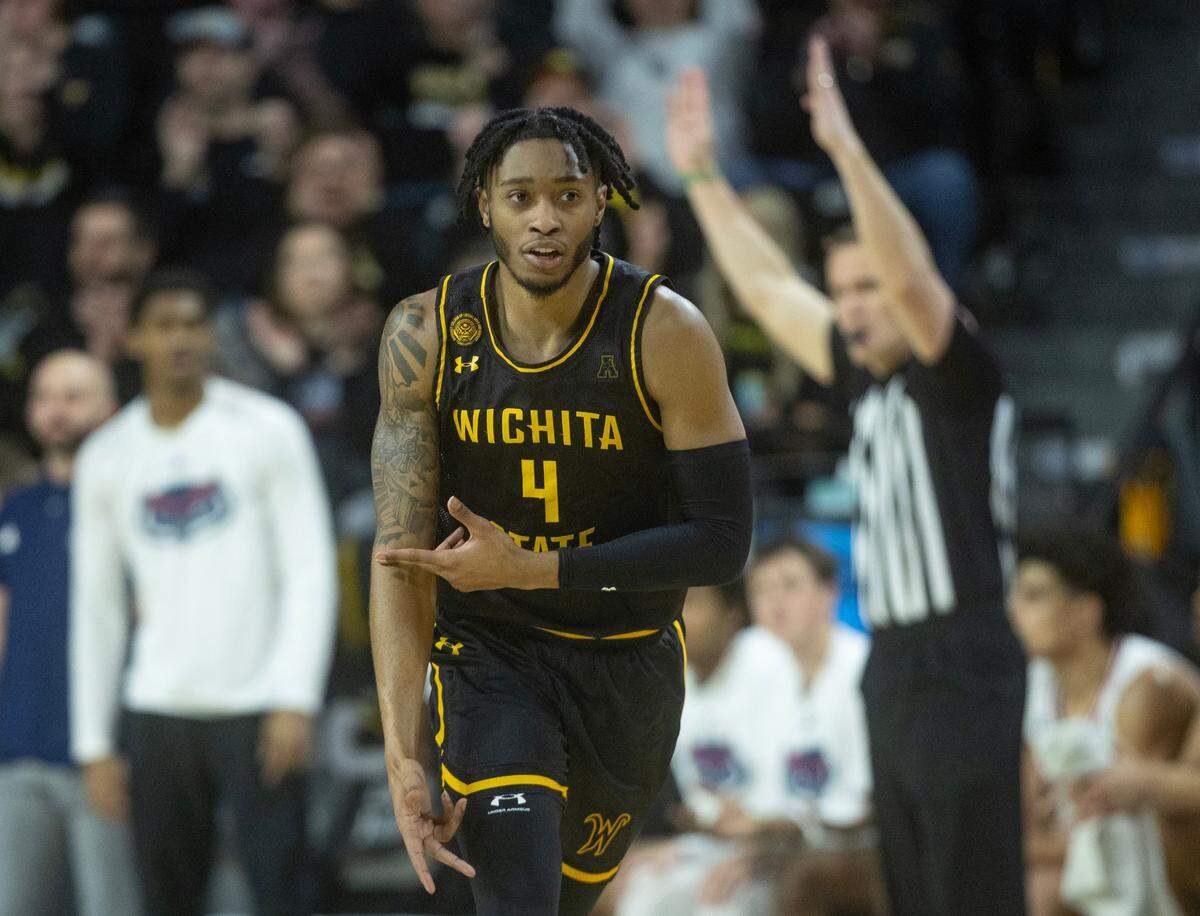
Colby Rogers shows off his progress
Not only did Colby Rogers come to Wichita State to prove himself against better competition, he came to level up his all-around game and develop into a better prospect for the pro game.
“Colby and I had a long meeting before the season,” Mills said, “and the reality is if he wants a chance in the future, he’s going to have to be a ball handler and he’s going to have to be able to make pick-and-roll reads.”
For 43 minutes on Sunday, Rogers was hounded by FAU’s best defenders, Alijah Martin and Brandon Weatherspoon, and still produced 21 points on 76% true shooting. It was the type of performance in the pick-and-roll game, given the degree of difficulty, that demonstrated his growth as a player this season.
Rogers is the top line of every scouting report on WSU and the only player who commands shooting gravity, which means Rogers is operating with little to no spacing every time he comes off a ball screen. It’s not unusual for him to have a lanky defender trailing him off a screen, a 7-footer directly in front of him and a help defender firmly planted in the potential driving lane.
Against FAU, Rogers executed an array of pro-ready moves to inflict damage at all three levels. To score from 3, Rogers took one jab step to shift the defender’s balance, dribbled off the screen and pulled up with his high release point that comfortably sailed over the contests and into the basket. To score from the mid-range, Rogers gained an advantage coming off a screen, maintained it by keeping his defender in jail with his hip and using an escape dribble and side-step to flow into an uncontested jumper. And to score at the rim, Rogers beat his defender off the bounce by rejecting a screen and using his body as a shield to finish a critical layup late in the game.
“I just try to keep it simple: make the read and go,” Rogers said. “The worst thing to do against a team like that is to overthink and try to do too much. The best thing is to just make a read and attack it, then play off two feet. And when you get in certain situations, (the defense) is going to tell you where the ball should go, whether that’s taking the shot, whether that’s a kick-out, whether that’s a drive. You’ve got to maintain aggressiveness and just play basketball and keep it simple.”
Rogers has honed his ability to score out of the pick-and-roll, but his ability to create for others remains a work in progress, as evidenced by his four turnovers against FAU. But Rogers showed his potential late in the first half when he came off a screen and like a magnet, attracted three defenders, and slotted a one-handed bounce pass through the crowd to hit a rolling Quincy Ballard for a rim-rattling jam.
With WSU trailing 72-70 in the final minute of regulation, Rogers also made the right read when a help defender cheated over too far and he kicked out to Xavier Bell for a go-ahead 3-pointer with 44 seconds left.
And Mills even found a way to weaponize Rogers’ shooting gravity in the screening game. FAU face-guarded Rogers in the corner to try to prevent easy dribble hand-off exchanges between him and Kenny Pohto to initiate one of WSU’s favorite plays, so Mills made a clever adjustment late in the first half.
With FAU expecting a dribble hand-off to Rogers, Pohto began dribbling toward Rogers, but instead of Rogers retrieving a hand-off, he stepped up to set a back screen on Pohto’s defender to spring the Swedish big man to the basket. Pohto’s shot missed, but Ronnie DeGray III was there for the tip-in and to steal two points for WSU on the tiny twist.
The chess match between Dusty May and Paul Mills
To try to finish off the Shockers, FAU coach Dusty May tried to throw Colby Rogers for a loop late in the game by switching his pick-and-roll coverage.
After allowing Rogers to dribble off of screens with the big in drop coverage, FAU started to blitz Rogers on ball screens with back-up big Tre Carroll effectively double-teaming him to force the ball out of his hands. It was a success the first time the Owls tried it, as Rogers gave it up to center Quincy Ballard, who immediately committed a turnover out of his comfort zone on the perimeter.
“These are one-possession games, so the first blitz leads to a turnover by Q where he’s trying to throw to Xavier at the rim,” Mills said. “It’s like, ‘What are we thinking here?’ That’s probably not a pass we should be making. So you’re not happy that we didn’t handle it well there.”
Less than a minute later, Mills made the counter to FAU’s blitz coverage. WSU cleared the right side of the floor for a Rogers-Ballard ball screen, counting on FAU to blitz Rogers again and when the Owls did, Ballard slipped the screen and took the quick pass from Rogers all the way to the rim for a foul.
The play was enough of a threat to force FAU to abandon blitzing, but Mills said Ballard could have had a dunk (he made 1 of 2 free throws) if WSU executed the details of the play better.
“Winning is in the details and that didn’t go over very well (with me),” Mills said. “It got us a quality shot, but if we can be a little bit tighter on that, improve the angle of where we caught the ball, you can get better. Sometimes guys have to play through that and you’ve got to see it on film to learn from it and just realize that stuff matters.”
The final in-game adjustment by May down the stretch was to bring Vlad Goldin to the level of the screen, rather than have him camp out in drop coverage by the free-throw line. WSU’s guards succeeded in forcing Goldin to back pedal and get stuck in no man’s land, like when he wasn’t close enough to contest a Rogers jumper and not in position to box out Ballard, which left the WSU big man free for an easy tip-in.
On a crucial possession with WSU trailing 74-73 in the final 30 seconds, Bell zoomed off a ball screen and with Goldin extended past the 3-point line, the WSU guard gained an advantage and earned a foul call at the rim. Bell split the free throws to tie the game and force overtime.
“Even when we adjusted our ball-screen coverage, they adjusted on the fly,” May said. “They had great solutions for everything.”
While the collapse in overtime made for a sour ending, WSU can find solace in its ability to problem-solve every coverage FAU presented.
“Winning is in the details and we have to be better on details,” Mills said.
.jpg)