
‘A star in his role’: Quincy Ballard on historic pace for Wichita State basketball
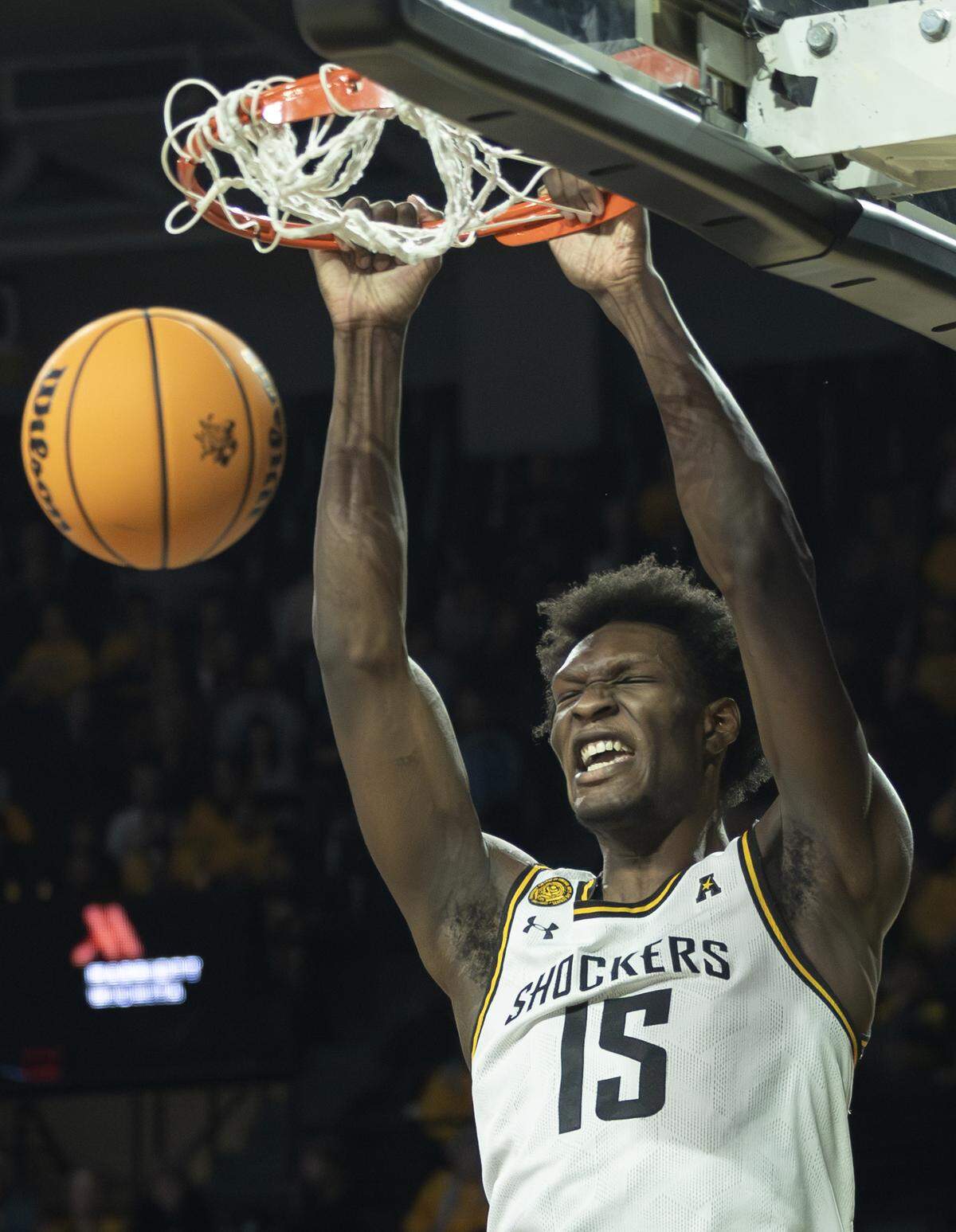
Every second Quincy Ballard is on the floor, the dynamics of the game being played shift for the Wichita State men’s basketball team.
A box score cannot capture the global impact of the 6-foot-11 big man who is involved centrally in almost everything that occurs at both ends of the floor.
Shooting gravity has become a popular term in modern basketball with sharpshooters such as WSU’s Colby Rogers stretching the defense horizontally with the threat of outside shooting. Ballard, on the other hand, applies an entirely different, but just as effective type of stress on the defense with premier vertical spacing.
Ballard showcased the power of vertical spacing in Wichita State’s 84-64 win over UTSA at Koch Arena on Wednesday.
Not only did he convert three separate alley-oops in scoring 11 points, Ballard paved the way for five more layups for WSU simply because his defender was hesitant to leave him due to the lob threat. And that’s what powerful vertical spacing can do for an offense: serve as a black hole in the best way, sucking defenders toward Ballard and freeing teammates for open shots.
“This is my first time playing with somebody who is a big lob threat like this,” WSU guard Harlond Beverly said. “I can’t imagine somebody better in the league at catching lobs than him. He’s a big plus for our team.”
Even though WSU hasn’t fully exploited Ballard’s vast potential as a rim-runner this season, he constantly bends the defense as a roller in WSU’s ball-screen-happy offense.
Over the last 12 games, Ballard is shooting 77.4% from the field (41-of-53) and his season-long percentage of 70.6% is on pace to shatter WSU’s single-season program record of 61.6% set by Steve Grayer in 1987-88. Ballard only attempts 4.4 shots per game, which prevents him from ranking first nationally in field goal percentage, but defenses must respect his finishing ability.
“He’s a star in his role,” WSU junior Xavier Bell said about Ballard. “He knows what he needs to do and the coaching staff works with him and walks him through finishes around the rim. And I think that’s really helped him along the way.”
When Ballard is on the floor, he anchors WSU’s defense with his drop coverage in the pick-and-roll game. He rarely leaves the paint, which allows WSU’s guards to funnel drives his way and rely on his rim protection to fortify the defense.
Ballard is still raw, which shouldn’t be a surprise considering he had 248 career minutes the past three years, but he has rapidly developed in his first season with an expanded role and under the tutelage of WSU assistant coach Quincy Acy.
Ballard swatted three more shots on Wednesday, giving him 53 for the season, which already ranks ninth all-time in program history. Depending on WSU’s conference tournament run, Ballard could end up challenging the 62-year-old WSU record of 80 blocks held by Gene Wiley from 1961-62.
“He had seven blocked shots and probably altered another four,” ECU head coach Michael Schwartz said after Ballard matched his career-high in blocks in a Jan. 24 game. “I know for sure we had one late in the game where it probably would have been a big basket for us, but then he got up there and contested it. He’s a dynamic player.”
The eye test indicates Ballard positively impacts games for the Shockers, but analytics don’t align. In the first nine American Athletic Conference games, WSU had a negative-15-point net rating with Ballard on the floor with the team’s defense torched for 1.15 points per possession.
When opponents downsize, it’s difficult for a near 7-footer to defend smaller and quicker players who operate along the perimeter. That’s why the coaching staff has preferred closing games with Kenny Pohto, who gives the team a little more versatility on defense.
But a lot of Ballard’s poor on-off numbers revolve around poor shooting luck, as box-score data compiled by Hoop-Explorer.com shows opponents have made a scorching-hot 41% of 3-pointers with Ballard on the floor. But in areas where Ballard has much more of an impact, opponents are shooting just 32% on mid-range jumpers and 52% at the rim — both elite marks — when Ballard is on the floor. For comparison, AAC opponents are converting 62% of the time at the rim with Pohto on the floor.
“Q is a game-changer with his height and length and athletic ability, altering shots and blocking shots,” WSU guard Colby Rogers said. “That allows us as guards to pressure up on the ball and we know if they drive, they have to finish against Q and nine times out of 10 they’re probably going to miss it. And then on offense, he’s just a vertical threat and not too many people can jump with him. He puts a lot of pressure on the rim and that helps our offense.”
Blocks only tell part of the story on Ballard’s defensive impact. There are a handful of shots every game where his combination of athleticism, length and timing alter into misses and even more times when his simple presence alone in the paint deters opponents from even attempting a shot.
It’s natural to assume WSU’s guards did the heavy-lifting in limiting UTSA leading scorer Jordan Ivy-Curry, who was averaging 18.8 points, to just five points on 1-of-10 shooting. It’s correct WSU’s contingent of Beverly, Rogers, Bell and Bijan Cortes did well to contain Ivy-Curry, but there’s a reason why Mills made sure Ballard received credit for forcing the dynamic scorer into misses around the rim and on pull-up jumpers.
“Those bigs, Q and KP, had a lot to do with being able to kind of bottle up (Ivy-Curry),” Mills said. “When (opposing guards) see that jersey and they see that length, it’s not something that they really want to pursue. That’s not a matchup that’s advantageous for guards, so his presence alone will make players do things that are maybe out of their norm.”
.jpg)