
A closer look at the breakout season for Wichita State basketball’s Quincy Ballard
When the Wichita State men’s basketball team lines up for conditioning drills, an unusual suspect consistently finishes near the front of the pack.
Few may expect 6-foot-11 junior Quincy Ballard to be able to move as well as he does for his size, but WSU head coach Paul Mills says he is one of the most well-conditioned athletes on the team.
“Quincy is fast, and I mean fast not just for a 7-footer, but fast for a normal human being,” Mills said on his radio show. “He can really move for a guy his size. We’ve got to keep him in tremendous shape.”
That level of conditioning has spurred Ballard to a breakout campaign in his second season with the Shockers. After playing just 248 minutes in the first three years of his career, Ballard has already surpassed that total (285 minutes) in 12 games and is averaging 23.8 minutes per game as WSU’s starting center entering Saturday’s 3 p.m. Kansas City showdown against Kansas at T-Mobile Center.
He has been particularly effective the past six games with averages of 8.8 points, 6.8 rebounds and 2.3 blocks while shooting 75.9% from the field and 90% on free throws. His season-long effective field goal percentage of 68.8% ranks 18th nationally, while his block rate of 9.7% ranks 29th nationally.
Mills likes to point out the current WSU coaching staff wasn’t around last season — when Ballard averaged 2.1 points, 2.1 rebounds and 1.4 blocks — to have a proper gauge for how much he has improved. But Mills credits the development since the spring to assistant coach Quincy Acy, a former standout center himself at Baylor who played seven years in the NBA.
“Quincy Acy has been phenomenal with him,” Mills said. “Quincy (Ballard) is a really bright kid and he absorbs things really well. If you tell him what he can do to improve, he’s going to listen. I’m a big believer in the better we can get Quincy Ballard, the better we can get the team. Individual development is a big part of our routine and I think Quincy Ballard would be the first one to tell you Quincy Acy has done phenomenal work helping him.”

The biggest area where Acy has helped develop Ballard’s game is at the foul line.
In his first three years in college, Ballard was shooting 40.7% (11-of-27) on free throws. It reminded Acy of when he was a freshman at Baylor and shot 56.9% from the line. By the time he was a senior, he made 78.2% of his free throws and went on to become a 75.9% free throw shooter in the NBA.
Acy helped Ballard alter his release point, and Ballard has since invested the time to turn what was a liability into a strength. He is shooting 66.7% (12-of-18) on free throws this season and has made 10 of his last 11 foul shots, dating back to the Myrtle Beach Invitational.
“Free-throw shooting is the psychology of the mind,” Mills said. “First, what are you telling yourself? What is being fed into your brain? If you’re getting negative thoughts, that won’t be good. You have to make sure the right things are going in. And then it’s your work ethic. If you know you’re putting in the time, you’re going to have confidence.”
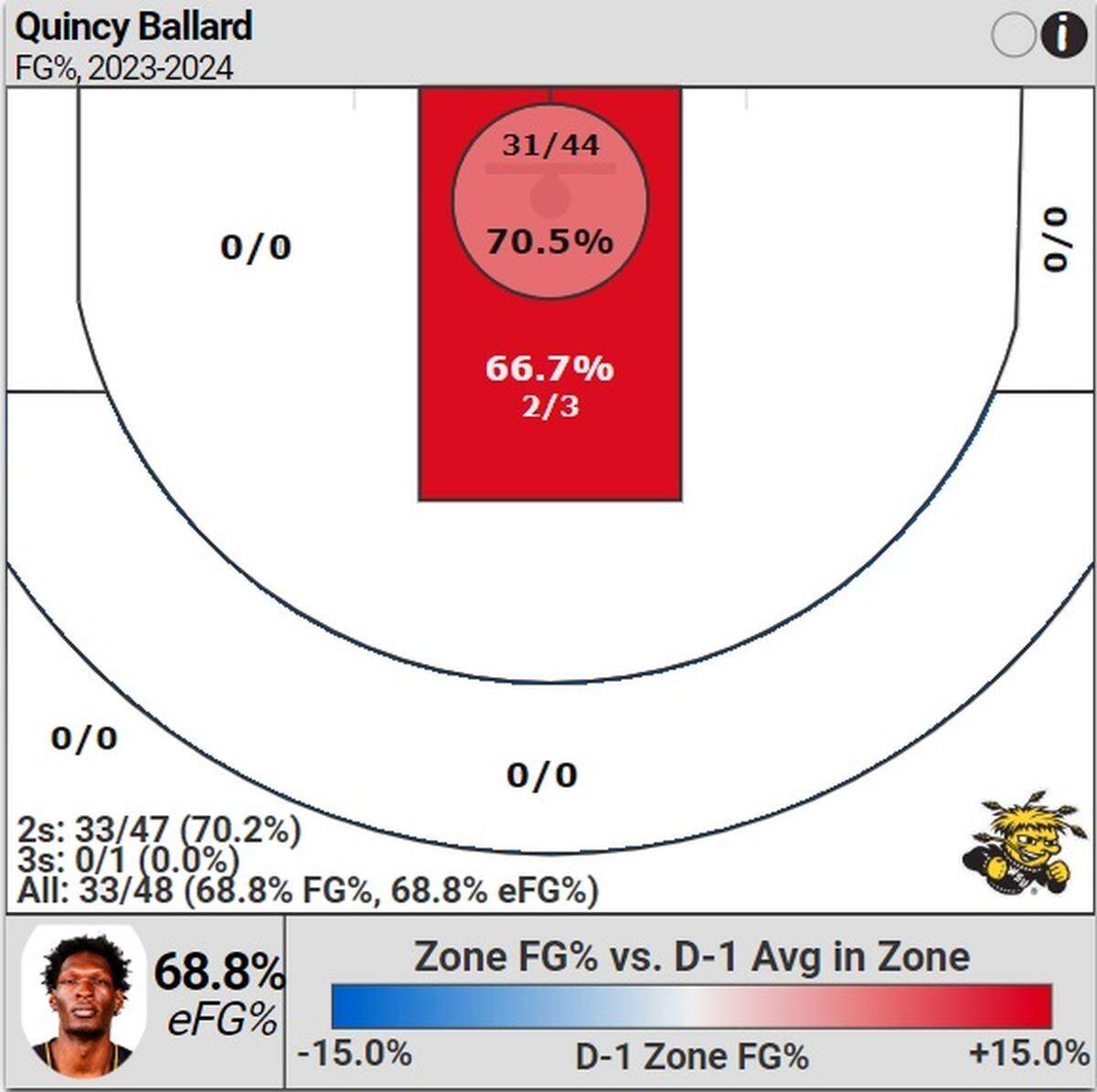
Ballard isn’t a back-to-the-basket big man, rather a vertical threat in the pick-and-roll game as a lob target, a force on offensive rebound put-backs and a dangerous option cutting to the basket. That’s why all 47 of his field-goal attempts (a 3-pointer was incorrectly assigned to him earlier this season) have come in the paint, where he is converting 68.8% of the time.
The introduction of point guard Bijan Cortes should bring more daring alley-oop attempts in the pick-and-roll game, but up until now, Ballard has been most effective when he roams the dunker spot — which Mills calls “the porch” — along the baseline just outside of the lane.
When a WSU guard drives and forces the big-man defender to come over and contest, Ballard has been able to shuffle over for a dump-off pass or alley-oop dunk. He’s also found success ducking in underneath the rim when Kenny Pohto, his frontcourt mate, catches around the free-throw line for high-low passing.
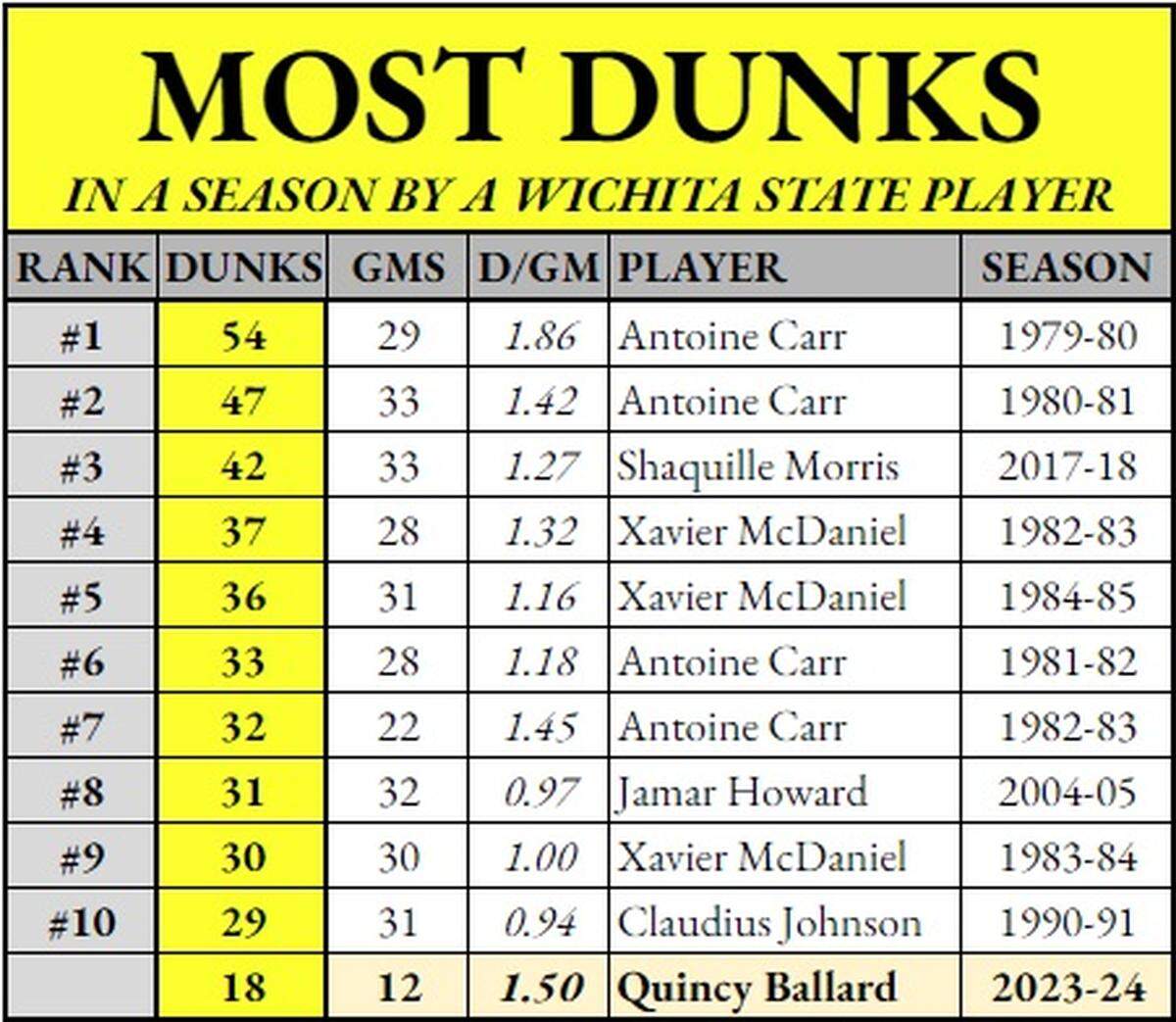
Ballard is scoring 1.80 points per possession on cuts, which is No. 1 in the country for a player with at least 20 attempts this season, per Synergy. He already has 18 dunks this season and is on pace for the most dunks in a season by a WSU player in more than four decades, a program record of 54 slams held by Antoine Carr in 1979-80.
Mills believes there’s an easy way to feed Ballard for even more dunks going forward.
“I think his spacing in that four-foot area we call the porch can improve,” Mills said. “If we can get players out of the middle of the lane and get (Ballard) lower on the porch, it’s going to allow for more driving angles, more passing angles and he’s going to be able to catch lobs, dump downs, and finish around the rim or convert at the line. If we can explain the spacing a little better on where he needs to be, I think you’re going to see his attempts hopefully (increase).”
There have been times this season when Ballard is supposed to be hugging the baseline but has drifted too far up near the block area. Occupied blocks are a huge no-no in Mills’ system because they clog up driving lanes for the guards and often lead to heavily-contested shots at the rim.
For a player with such limited experience on the court, Ballard has been a quick learner when it comes to the importance of spacing. But like anyone learning a new system, he’s a work in progress.
“A lot of people who watch basketball understand spacing — get as far away from the basketball as possible,” Mills said. “But re-spacing is the bigger issue. Everybody knows how to space, but very few people know how to re-space.
“People hear me say this all the time: ‘Spacing is like breathing. It’s continuous.’ You just can’t stand in one area. The area where you see the hashmarks on the baseline that people refer to as the dunker, knowing how to move in that little bit of space is harder than what you realize, especially when the ball is moving. That’s not something where you just snap your fingers and all of a sudden it happens. It takes time.”
.jpg)