
How small-town athlete found self-confidence at Wichita State to become AAC track champion
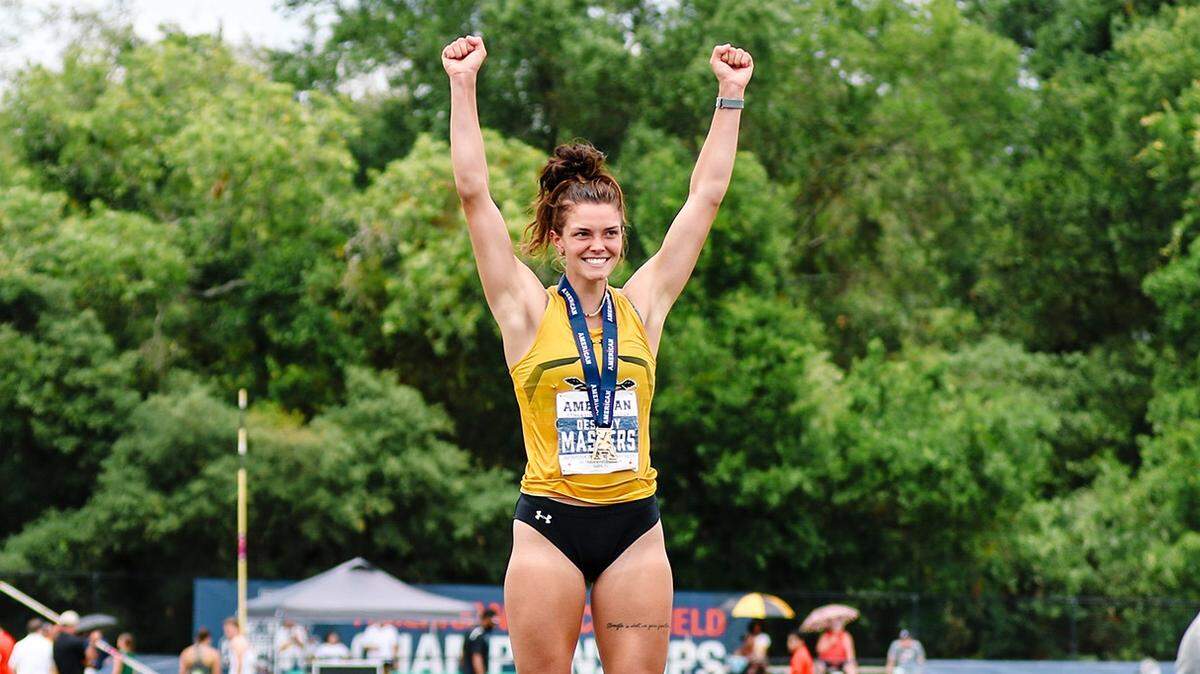
Standing at the starting line, Destiny Masters knew she was 800 meters away from a breakthrough.
At stake was a personal-best score in the heptathlon that would not only cement her status among the greats in Wichita State history, but also make her a conference champion.
All that separated her from glory was her least-favorite event, the race she dreads the most.
“She absolutely hates the 800,” WSU track and field head coach Steve Rainbolt said. “She has some real emotional difficulties with the 800. It can be a very intimidating race for someone who is explosive, but not wired for endurance. I know the 800 isn’t exactly an endurance event, but it is to her.”
Masters, a fourth-year sophomore, wasn’t even considering a college track and field career until Rainbolt convinced her to come to WSU. She arrived as a mostly unheralded jumper from Bluestem, a nearby Class 2A high school.
And now here she was, four years later, primed for a breakout performance at last weekend’s American Athletic Conference Outdoor Championships, needing the fastest 800 time of her life in the finale of the seven-event contest in the sticky afternoon heat in Tampa, Florida.
“I knew Bolt believed in me,” Masters said of her coach. “Honestly, he probably believed in me more than I believed in myself.”
Masters had been a long-shot to win, trailing Tulane All-America multi Kristen O’Handley by 89 points entering the 800, which is O’Handley’s specialty and Masters’ bane.
But in a stunning development, Masters went from the underdog to the favorite when O’Handley had to pull out of the 800 when she tripped and injured her ankle before the first turn of the race. Runners were pulled off the track and the race was reset without O’Handley, leaving Masters with a narrow 21-point lead over Tulane’s Margot Temines.
“My brain was so scrambled after that because my whole plan was to try to attach myself to (O’Handley) and go from there,” Masters said. “After that, I didn’t know who to follow now. I had a plan, then I had to switch it at the last second.”
Temines had run much faster times than Masters in the 800, but Masters took an aggressive approach and pushed the pace during the first lap. She not only led Temines entering the bell lap, but she was in second place — a high-risk, high-reward strategy that would have backfired if her tank hit empty on the backstretch.
“I was so stressed out because I could hear people on my shoulder and then saw some begin to pass me, so I knew I had to give everything I had or I was not going to get first,” Masters said. “I couldn’t even see straight. But I knew I had to give it all I had and I did.”
Masters stayed in front of Temines from start to finish, as her time of 2 minutes, 27.47 seconds was nearly a five-second improvement on her career-best time in the event.
The substantial PR sealed Masters’ dramatic win as WSU’s only AAC champion on the men’s or women’s team and catapulted her heptathlon score to 5,557 points, a USF Track and Field stadium record, the fourth-best mark in WSU program history and the 29th-best score in NCAA Division I this season.
“We definitely saw something like this coming, but it truly was an issue of her just needing to put it all together,” Rainbolt said. “There’s a lot more there. A lot more. She can be even better than this, but to see her battle through her demons with the 800 and become a champion, that meant the world to me.”
Rainbolt has made a career out of turning small-town Kansas kids into tremendous multi-event athletes. There wasn’t much to indicate Masters would be the next protege, as her best marks in high jump (5 feet, 2 inches) and long jump (17 feet, 4¾) were solid, but hardly indicative of a future heptathlon standout.
But Rainbolt’s ability to identify untapped potential is perhaps the biggest reason why the Shockers have won 35 conference team championships in his 23 seasons.
“I would like to think it’s because we are possibility thinkers here,” Rainbolt said. “Destiny was a good athlete in high school, but she had a long way to go. It was evident she had some ability, but there were a lot of things that were not evident. We didn’t know if she could throw anything, we didn’t know if she could hurdle. But if we identify evidence of some possibility of some talent, we start thinking of what the possibilities might be.”
Masters has blossomed under Rainbolt’s tutelage, as the jumping events have always been her best events. In fact, she broke the AAC meet record in both the high jump (5-10¾) and long jump (19-9¾) without her personal-best marks. Her explosiveness has allowed her to find instant success in the sprinting events, as her times in the 100 hurdles (13.83) and 200 (26.12) are competitive.
Even with a lean frame, Masters has built up enough strength to score well enough in the shot put (36-1¼) to remain competitive and her athleticism has made her a good javelin thrower (120-11).
She’s becoming a better all-around athlete than she ever imagined possible. And after victories like the one this past weekend, Masters’ belief in herself continues to grow.
“I honestly never pictured myself here when I was doing high school track,” Masters said. “This wasn’t in my plans at all. It took me four years to get to this point in my life and I’m so very happy right now. I couldn’t thank Bolt any more than I already have.
“I definitely am believing in myself more and more every time I do something like this. I know I can do more.”
This story was originally published May 18, 2023 at 7:00 AM.
.jpg)