
‘I’ve got to do better’: Isaac Brown takes blame for Shockers’ disappointing season
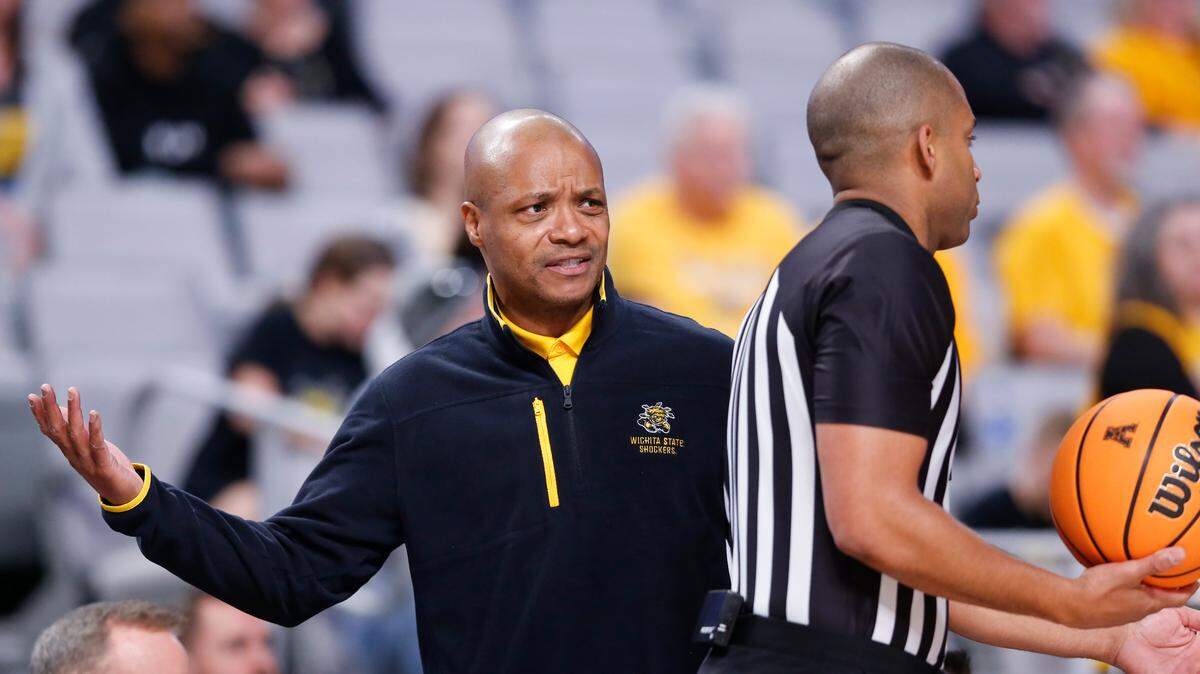
The first two seasons in charge of the Wichita State men’s basketball team have given Isaac Brown the full range of life as a head coach.
He received universal praise, from his peers to the national media to former players, for the job he did as an interim last season, leading the Shockers to an improbable American Athletic Conference championship and NCAA Tournament berth, which earned Brown a $6 million, five-year contract.
And now the 52-year-old, first-time head coach is facing waves of criticism from a fan base that expected much more from the follow-up in his first year as full-time coach than the 15-13 season the Shockers completed in disappointing fashion on Thursday with an early exit from the AAC tournament in a 73-67 loss to Tulsa, sealing the first March without WSU postseason basketball since 2008.
Brown shouldered the entirety of the blame in his postgame remarks from Fort Worth.
“I take all that. That’s on me,” Brown said when asked why the season failed to live up to expectations. “It ain’t on the players. I take all of that.
“We won a championship last year. We didn’t win a championship this year. We’re never happy not being in the postseason. We’ve got to do better. I’ve got to do better as a coach.”
On paper, WSU was poised to contend for another conference title and trip to March Madness this year. WSU returned four of its top-five scorers from last season’s team, a foundation that featured a wealth of talent in Tyson Etienne (preseason AAC Player of the Year), Ricky Council IV (this year’s AAC Sixth Man of the Year) and a pair of four-year veterans in Dexter Dennis (this year’s AAC Defensive Player of the Year) and Morris Udeze.
The Shockers had to replace starting point guard Alterique Gilbert (10.3 points, 4.1 assists) and power forward Trey Wade (6.7 points, 5.6 rebounds), but the emergence of Craig Porter (7.3 points, 3.6 assists) and improvement by Council (12.0 points, 5.4 rebounds) this season seemingly made up for those losses.
But those pieces did not add up to a successful season for the Shockers.
“This year we had the same expectations, if not more, but it really didn’t pan out for us,” Dennis said. “We had high expectations and the fans had high hopes, but that didn’t happen and obviously it’s a let down for us, for coach Brown, for the fans.”
“I don’t really have much to say,” Council said. “I’m disappointed in myself, disappointed in the team. It’s a tough way to go out.”
Significant issues developed at both ends of the floor for the Shockers, which had an elite defense erode over the course of the season and an offense that finished with one of the worst shooting seasons in program history.
Of the many problems on offense, one of the most important was this season’s usage of Etienne, who won AAC Co-Player of the Year last season primarily playing off the ball and hunting catch-and-shoot looks. After considering the NBA Draft last summer and receiving requests to create more on the ball in pick-and-roll situations, Etienne had the ball in his hands more this season, which turned out to be unfruitful for both parties.
With its best shooter on the ball more, WSU did not have the additional outside shooting to properly space the floor and support Etienne in the role. The more catch-and-shoot looks coming off screens that were replaced by dribble jumpers, the star guard saw his efficiency (114.7 offensive rating last season dipped to 99.3 this season) and his three-point shooting percentage (39.2% last season dipped to 32.6%) drastically decline.
WSU’s lack of crisp play often forced Etienne to bail out the offense with a difficult shot at the end of the shot clock, but he shared a portion of the blame with too quick of a trigger on what became too many contested jump shots.
“I had some good spots, had some bad spots and all I can do is learn from it,” Etienne said. “I’ll get back to the drawing board, get back to the lab, work on myself, work on my game and trust the journey that I’m on. I know it’s going to be a great one. We’ve got to be able to take the wins and take the lessons, too. This year was a lesson for me and a lesson for the team. I’m going to continue to run the marathon and trust the journey that I’m on.”
But Etienne wasn’t the only player to struggle in Brown’s system, which leaned more into the ball-screen and dribble-drive offense this season. There are faint traces of Gregg Marshall’s fingerprints left, but Brown has given the players much more freedom on offense — which turned from a blessing last season to more of a curse this season.
Whether the offense was missing discipline or structure, or both, too often WSU’s offense lacked a sense of urgency. The ball rarely moved crisply. The players rarely moved with purpose. Too many possessions ended too early with a rushed shot or dragged on too late and ended with a low-percentage shot to beat the shot clock.
“We’ve got to do a better job of turning down a good shot and getting a better shot,” Brown said. “And that starts with the head coach.”
But WSU’s problem wasn’t turning down good shots, it was finding them. That was never more evident than examining where the final offensive numbers of the 2021-22 season finished in program history.
In totality, they are staggering:
The 40.3% shooting percentage is the worst since 1998 and the third-worst shooting season since 1957, although it’s fair to point out it wasn’t far off from the last three seasons: 40.8% in 2019, 40.7% in 2020 and 40.5% in 2021.
The evidence of settling too often from beyond the arc was evident by the team finishing with the highest three-point rate (41.4% of WSU’s shots were three-pointers) in program history. It didn’t help matters that WSU’s 31.2% accuracy on triples was the sixth-worst since the three-point line was introduced in 1986. Per Synergy, WSU ranked No. 295 in the country at catch-and-shoot efficiency, despite generating the 36th-most unguarded looks.
The lack of cohesion on offense was evident by the team’s average of 12.0 assists per game, the second-fewest in program history and fewest since 1970. WSU’s 51.1% assist rate (percentage of field goals assisted) was the fifth-worst in program history and lowest since 1978. And by averaging 12.9 turnovers, it was the first team to average more turnovers than assists since 2009.
Synergy’s advanced numbers pull back the curtains even further: WSU ranked No. 282 in its halfcourt offense and No. 247 in its transition offense (despite ranking in the bottom-30 in turnover rate on fast breaks). WSU was also among the worst in the nation at out-of-bounds plays, ranking No. 347 and scoring a paltry 0.60 points per possession. WSU’s 104.4 adjusted efficiency offensive rating on KenPom was the worst since 2009.
The lone bright spot was WSU breaking the school record with its 75.3% team free throw percentage, breaking the 2012 team’s mark of 74.8%. But even that achievement was somewhat muted because WSU only attempted 18.5 foul shots per game and had the second-lowest foul rate of the last 25 seasons.
Brown again took responsibility for WSU’s shortcomings this season.
“I’ve got to do a better job of making sure the ball moves,” Brown said. “I’ve got to do a better job of putting those guys in position to do a better job. I take all of that on me. In order for us to be great, I’ve got to do a better job and I know next year we will. We’re not going to stop the fight.”
It was not a particularly aesthetically-pleasing style of basketball to view and once the wins stopped coming as frequently this season, attendance at Koch Arena noticeably dipped and vocal displeasure of the program’s trajectory increased.
Despite the growing criticism, Brown, who is under contract through the 2025-26 season with $5 million left on his contract, has retained the confidence from athletic director Darron Boatright.
Brown also received support from the players following the end of the season.
“It’s not only on him, it’s on us too,” Udeze said. “We are the players who go out and play the game. I would say (to fans) to stop getting on him. As players, we play. He gives us stuff to execute and they shouldn’t criticize him as much. Give him that chance.”
Even though it was not the season any of them imagined, Brown said at the podium that he was pleased with everything other than the on-court results this season.
“It’s not just about basketball, it’s about doing the right thing in the classroom and off the court,” Brown said. “All year long I slept good at night knowing that these guys did the right thing off the floor and in the classroom. I want them to continue to grow and we’ve got to get better next year. I told them the work starts soon. Take a week or two off and we’ll get back at it.”
This story was originally published March 11, 2022 at 6:00 AM.
.jpg)