
How the ghost screen made Craig Porter a late-game star for Wichita State basketball
The Wichita State men’s basketball team seems to have found an action it can turn to late in close games to generate good offense.
With March Madness right around the corner — the Shockers are headed to Fort Worth for the American Athletic Conference tournament to play Tulsa at 2 p.m. Thursday — that’s an encouraging development for a team that struggled to close games during the first three months of the season.
Since the start of February, the Shockers are turning more and more to “ghost” screens late in games, which has coincided with a dramatic increase in late-game efficiency and Craig Porter’s meteoric rise as a closer.
What is a ghost screen?
A ghost screen is essentially a fake screen designed to take advantage of defenses that like to switch screens between guards.
For WSU, the play typically begins with the team spreading the floor, keeping the paint clear and point guard Craig Porter dribbling out front. WSU will send a scorer, usually Tyson Etienne, darting up the floor to pretend like he is preparing to set a ball screen, only to run a ghost screen.
Right before Etienne arrives to set the screen on Porter’s defender, he will slip away before making contact and sprint to the open area on the three-point line.
Why is a ghost screen so effective for WSU?
The action applies a lot of pressure for the defense to communicate quickly and act decisively.
The principle of many defenses would call for the two defenders to switch the guard-to-guard screen, but that can go haywire when Etienne executes the ghost screen and pops to the perimeter.
In a split-second, the two defenders have to decide who is staying in front of Porter on the ball and who is chasing Etienne to the three-point line. If they don’t communicate the switch, Porter can hit Etienne for an open three-pointer.
What happens far more often is the on-ball defender is so concerned about what he thinks could be a screen coming that he gives up a driving angle. Porter has absolutely feasted on these momentary lapses of defense, exploding down the cleared runway to the rim and either finishing a layup or short jumper.
The action works so well for WSU because it has a shooter (Etienne) that the defense must account for and a ball handler (Porter) who is excellent attacking downhill and making the right read quickly. The Shockers also have the luxury of being able to insert Ricky Council IV into either role. And it’s never a bad idea to involve two of your three best scorers.
“They put you in a tough spot with that action,” South Florida coach Brian Gregory said earlier this season. “Do you stay on the ball? If you do, then they drive the ball. If you switch it, it’s harder to guard because communication is a big piece of it. And that’s why we didn’t cover it well.”
Just how good has WSU been in ghost screens?
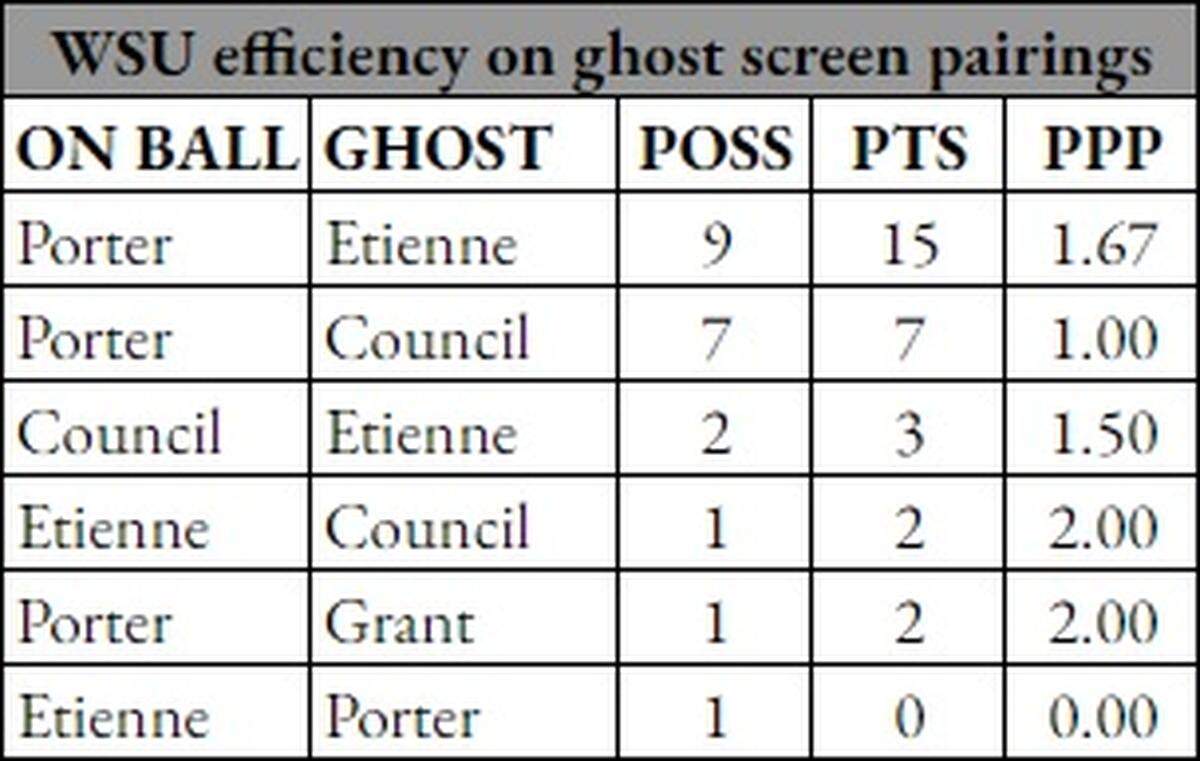
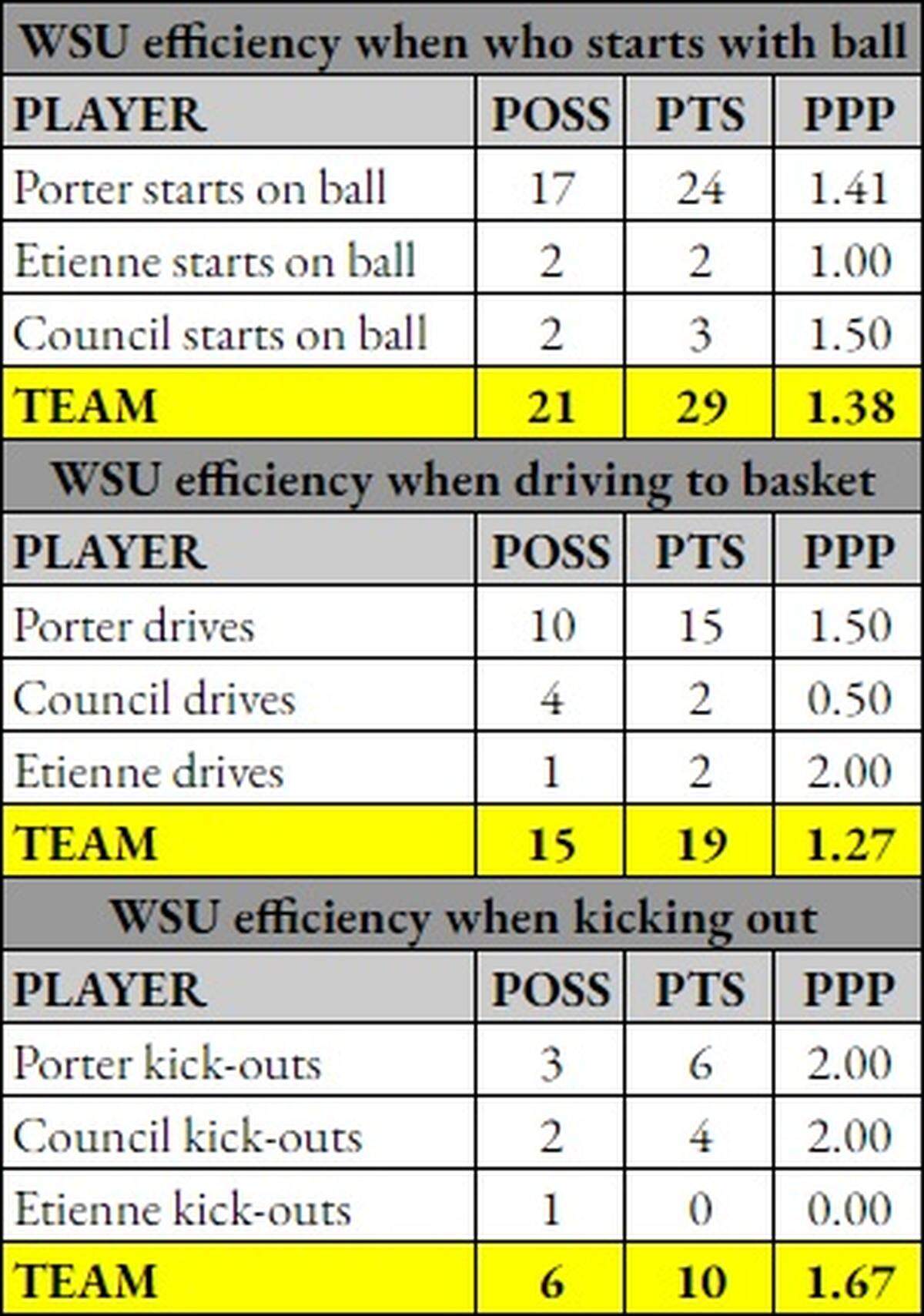
Since the start of February, WSU has run a ghost screen 21 times down the stretch of the second half or in overtime in close games (with the margin eight points or less) and scored 29 points for a sparkling 1.38 points per possession.
WSU scored on 14 of those 21 possessions with three misses coming on three botched layups or dunks and another wide-open miss from three. The point being: WSU almost always either scores or generates a great look from the action.
“It’s been really good for us,” WSU coach Isaac Brown said. “Porter is great at driving the basketball to the rim and when we have Kenny Pohto in the game, we put him (on the three-point line) and that takes their big away from the basket and allows Craig to drive and score the basketball. Ricky is able to do the same thing.”
The action has unlocked Porter and turned him into a crunch-time superstar for the Shockers.
Of those 21 possessions, Porter has started with the ball on 17 of them and WSU has scored 24 points for 1.41 points per possession. Porter scored 15 of those points himself, capitalizing on the indecision created at the point-of-attack by the ghost screen to get downhill and use his size and athleticism to score. He’s also hit Etienne twice for three-pointers on kick-outs after the ghost screen befuddled the two defenders.
“They don’t know if they should switch or not,” Porter said. “Really, it is a choice of who they were going to let score on them.”
While WSU doesn’t score every time like Porter suggests, he’s right in that WSU has been able to score in a variety of ways. The Shockers have scored 19 points on 15 drives to the basket (1.27 PPP) and 10 points on six kick-outs (1.67 PPP).
Porter has been so effective running it that he has forced South Florida, Houston and East Carolina to switch to zone defenses after he exploited the defense in the ghost screen action multiple times.
To prevent teams from loading up to just stop Porter, WSU has introduced a wrinkle involving Council. Instead of having Council execute the ghost screen, he stops just before running by the defender and pops out to receive the pass. Now Porter is the one cutting through on the ghost screen and Council is the one attacking the indecision on defense.
The wrinkle led to an easy Council dunk down the stretch of the East Carolina game. While it was the only chance he has converted in four opportunities in the wrinkle, two of Council’s misses have produced point-blank layups that should fall more times than not.
The Shockers are shooting just 50.6% around the rim on the season, which is well below the national average of 54.1%, per Synergy. But when WSU runs the ghost screen action down the stretch of close games, Porter and Council are shooting 60% at the rim, even with the missed bunnies.
For a team that struggled so much to protect double-digit leads earlier this season as a result of late-game failures, WSU’s ghost screen offense has injected the team with the confidence of having a go-to, bread-and-butter action late in games.
This story was originally published March 8, 2022 at 2:42 PM.
.jpg)