
‘Life isn’t perfect’: Star WSU runner overcame ‘invisible’ disability, wants to inspire
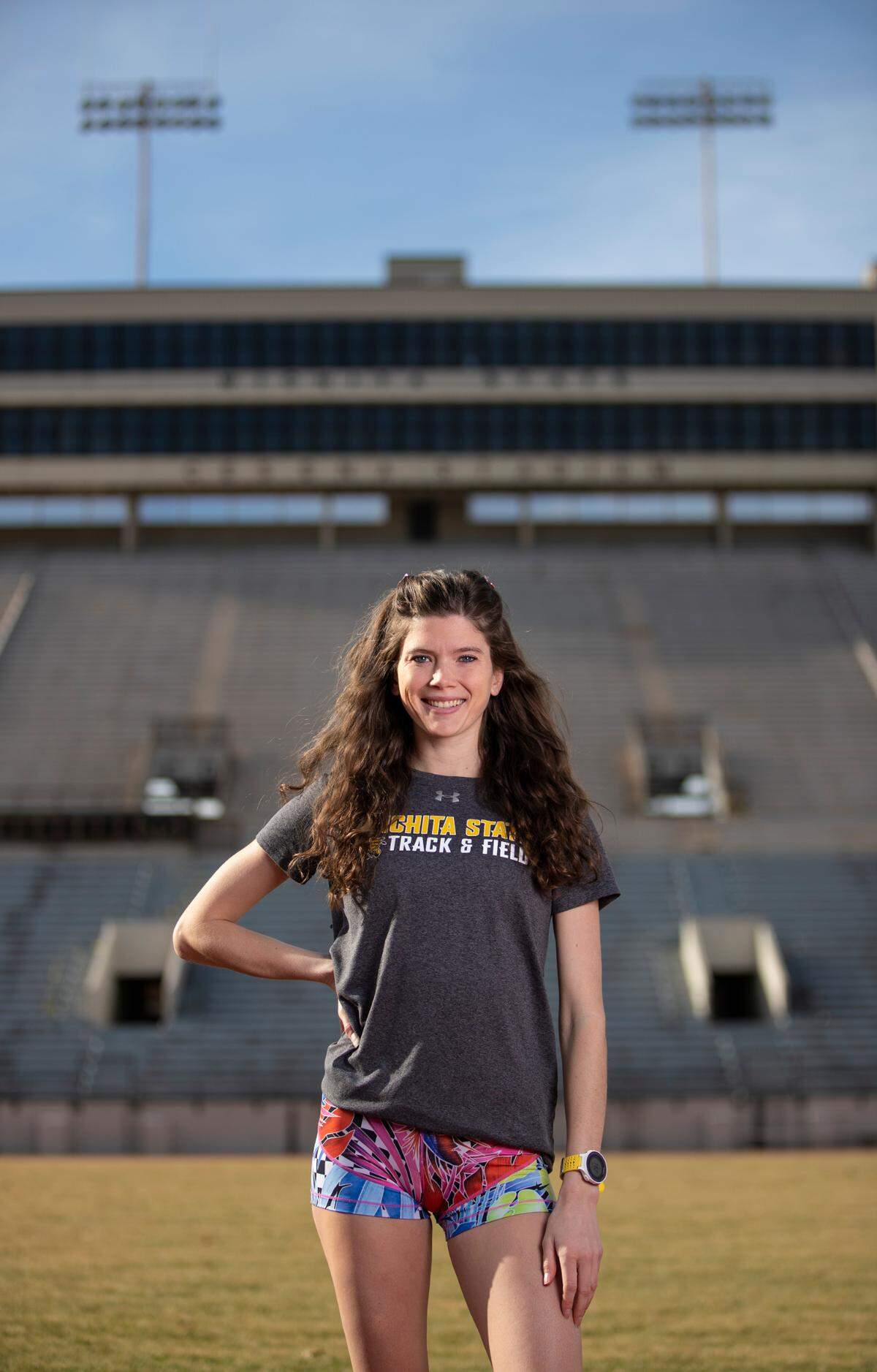
There is a version of Rebekah Topham’s life that seems picture perfect.
A small-town Iowa girl discovers she’s a running prodigy, sets a world record at age 10, produces a record-setting high school career, then heads off to Wichita State University, where she becomes an All-American, wins 15 conference championships and graduates magna cum laude in 2020.
It’s a natural assumption her journey can be explained by countless hours of hard work and dedication, but there’s a part of her journey that many don’t know.
Topham’s Hall-of-Fame career with the Shockers was almost over before it ever began because of a severe learning disability she privately combated throughout college. She was never officially diagnosed with dyslexia, but it’s the easiest way for Topham to describe the troubles she has had processing words and reading since she was a child.
The dropout rate for college students with an “invisible” disability like Topham is nearly three times the rate for all students, according to a 2016 study by the U.S. Department of Education. A stigma still exists surrounding learning disabilities, not only in society, but especially in the hyper-competitive world of Division I college sports.
Topham hopes by sharing her story of triumph that she can help end the stigma for student-athletes with learning disabilities and give others with similar obstacles the courage and confidence to know they can still excel.
“I used to think, ‘Why am I so dumb? Why am I the only one who can’t read?’” Topham said. “I had so many negative thoughts because I never once saw anyone talk about it on social media growing up. People need to read about this stuff and realize that not everything in life is always perfect. Life isn’t perfect. I don’t want people thinking my life is perfect because it’s not.”
‘She didn’t know how to read at all’
The first sign of trouble occurred when Topham was 3.
Rebekah had taken a liking to a certain children’s book and her mother, Lori, would read it to her over and over again. Before long, Rebekah tried reading the story to her mother.
It was the strangest thing, Lori thought. The gist of the story was right, but Rebekah would frequently skip over words or use different ones altogether instead of the ones on the page.
“It didn’t take mom long to figure out that Rebekah had the story memorized and she didn’t know how to read at all,” said Jeff Topham, her father. “It wasn’t like she was trying to be deceiving. She was just this little kid. She probably thought that’s how everybody reads.”
Rebekah, along with her three siblings, were home schooled in the family’s household in Griswold, a community of 994 surrounded by Iowa farmland an hour’s drive straight east of Omaha. Her mother was her teacher, providing a nurturing environment catered to work around her reading problems, while her father was her coach.
Running was the family’s sport of choice and when Jeff would watch the four kids — when Rebekah was 10, her brothers were 12 and 5 and her sister was 8 — he would pull out a stopwatch and time how fast the children could complete the loop through the family’s dining room, kitchen and living room.
Neither of her parents were elite distance runners, but it didn’t take long to discover Rebekah was a running phenom. When she was 8, Rebekah won the first road race she entered, a two-mile race in Hamburg, Iowa that she completed in a little over 13 minutes.
“Once I got a taste of success, I wanted more,” Rebekah said.
Rebekah kept racing across the region and kept winning. The defining race of her childhood came on April 20, 2007 when a 10-year-old Rebekah won the women’s open 5,000-meter race at the Kansas Relays in a time of 18 minutes, 42.08 seconds — a time that would later be recognized as a world record for her age.
By the time she reached high school, Rebekah had won more than 30 national championships in track and cross country. And then in high school, where she competed for Class 1A Griswold while still being home schooled, Rebekah completed one of the greatest running careers in Iowa high school history, becoming the first girl in the state’s history to win four straight cross country state championships, breaking multiple records and adding 11 more state titles on the track.
Rebekah had become a bona fide superstar in the running world, which begged the question: where would she run in college? She had letters from just about every program in the SEC, Big Ten and Big 12, yet it was a question she detested.
“Honestly, I never even thought about going to college because I didn’t think I was smart enough,” Rebekah said. “Of course I wanted to run in college, but I knew I struggled in school. I didn’t think I could go because I couldn’t keep up with the classes.”
In the end, Rebekah’s desire to compete for a team in college outweighed her hesitancy for academics because of her undiagnosed learning disability. But when she sat down to take the ACT during her senior year, her greatest fears were realized.
“I had never seen a bubble sheet in my life before,” Rebekah said. “It took me like five minutes just to figure out what to do with it. I didn’t want to look around because they would think I was cheating. And then I struggled reading so many of the questions, I had to guess on so many of them and I ran out of time.”
Rebekah managed to score well enough to become eligible, but it was clear a monumental challenge awaited her in college.
At Wichita State, Kirk Hunter was ready.
“I never felt like it was a chance we were taking,” said Hunter, WSU’s cross country coach. “What risk is there taking a superstar athlete who’s also a great person? Where she was going to go academically and how that was going to pan out, we didn’t know. But to me, that’s part of the recruiting process. You don’t just stop because it gets difficult. I know there were schools that decided she might be too much work, but I guess I never looked at it that way. In my mind, that’s what we do, we go the extra mile.”
‘We were aware this might not work out’
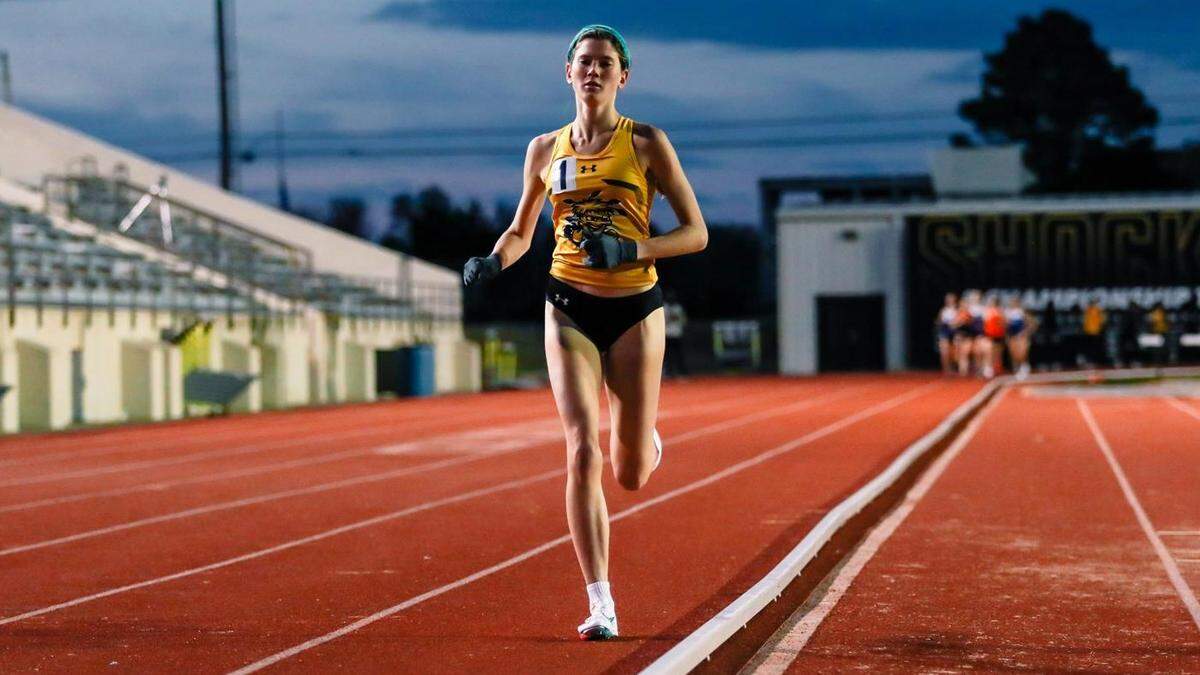
Topham used to tell people she didn’t know how to read and they would laugh it off as a joke.
But it was no joke to her.
“If I would see a word I’ve never seen before, I wouldn’t even know how to start to read it, unless it was something I could sound out,” she said. “I would actually just try to memorize what words looked like. But in college there’s so many big words, I didn’t understand a lot of them.”
When Topham arrived at WSU, she finally gained some clarity through testing. She was diagnosed with a learning disorder, although not dyslexia, which she remains dubious of. But the diagnosis granted her special accommodations, like extended time during exams and an NCAA waiver allowing for a reduced course load.
Still, Topham faced an uphill battle: she struggled to read, had never sat in a traditional classroom, and had never written a paper or had much homework.
“Everything was so terrifying,” she said. “I had so much anxiety and stress. Having a teacher who wasn’t my mom was weird. Even just being in a classroom was weird. I remember showing up 45 minutes early to my first class because I was so nervous.”
“You combine all of those things and it was like a perfect storm of ‘Holy cow, how are we going to make sure this girl will be successful here?’” said Sarah Mathews, who was an academic coordinator at WSU at the time and is now the school’s director of compliance. “We were aware this might not work out. That’s just being realistic considering all of the barriers that she was up against.”
Back home in Iowa, Jeff Topham couldn’t help but think back to his own experience in college. He produced a 1.4 grade-point average his first semester and was placed on academic probation.
“I honestly thought she wasn’t going to make it,” he said.
Rebekah probably wouldn’t have made it, if not for meticulous organization, patience and a thirst to prove herself. She began to view academics as a competition against herself, which brought out the same intensity and fervor once only reserved for races.
She became a perfectionist, which was already grueling and made even more daunting by her reading struggles. On words she didn’t recognize, she used the features of Google to have the definition and word read aloud to her. She relied heavily on spellcheck and when she didn’t know how to spell a word, she said it aloud and had her phone spell it for her.
“When you think about how you learned to read, I can’t even conceptualize what she has to go through,” Mathews said. “It would be like looking at a page all in a different language. You try to figure out the words you recognize and then you have to connect them all together and what they mean. Imagine doing that for almost every line on a page. I mean, that’s exhausting just to think about. That’s what she was doing on every assignment. That takes a toll on you mentally and emotionally.”
Between her own workouts, team practices, doctor appointments (low-iron issues and a myriad of foot injuries), classes, tutoring and cooking (she hasn’t eaten fast food in eight years), Topham had almost no free time. She kept track of it all almost down to the minute in a hand-written daily planner.
The people around her had to temper her perfectionism, just so she could complete all of her work.
“In her life, there’s no second best,” Hunter said. “She’s always striving to be the best and that required an intense amount of hours for her to accomplish what she has. I can’t even fathom it and I was with her for all those years. It’s hard to explain when somebody is just on a different level than a normal Division I athlete.”
“When you’re dealing with someone who is a perfectionist, they’re going to have their frustrations at times,” said Korey Torgerson, WSU’s associate athletic director for student services. “Our role is to help them see the bigger picture and make sure they have the resources they need.”
WSU track and field coach Steve Rainbolt recalled how ecstatic the program was to land Rebekah in recruiting, but knew the challenge would be keeping her eligible to run.
Topham not only remained eligible, she was named to the athletic department honor roll all 10 semesters, was a three-time academic all-conference selection, earned academic All-American status in 2016, and graduated with a sport management degree with honors for a cumulative 3.89 grade-point average.
“I can remember thinking, ‘Well, they probably have her in easy classes that are helping her get going,’” Rainbolt said. “But then she just kept knocking down these classes with a remarkable GPA and it became evident that she was simply doing whatever it took to make good grades. Rebekah is an unbelievably determined young woman.”
‘I don’t want people thinking they’re alone’
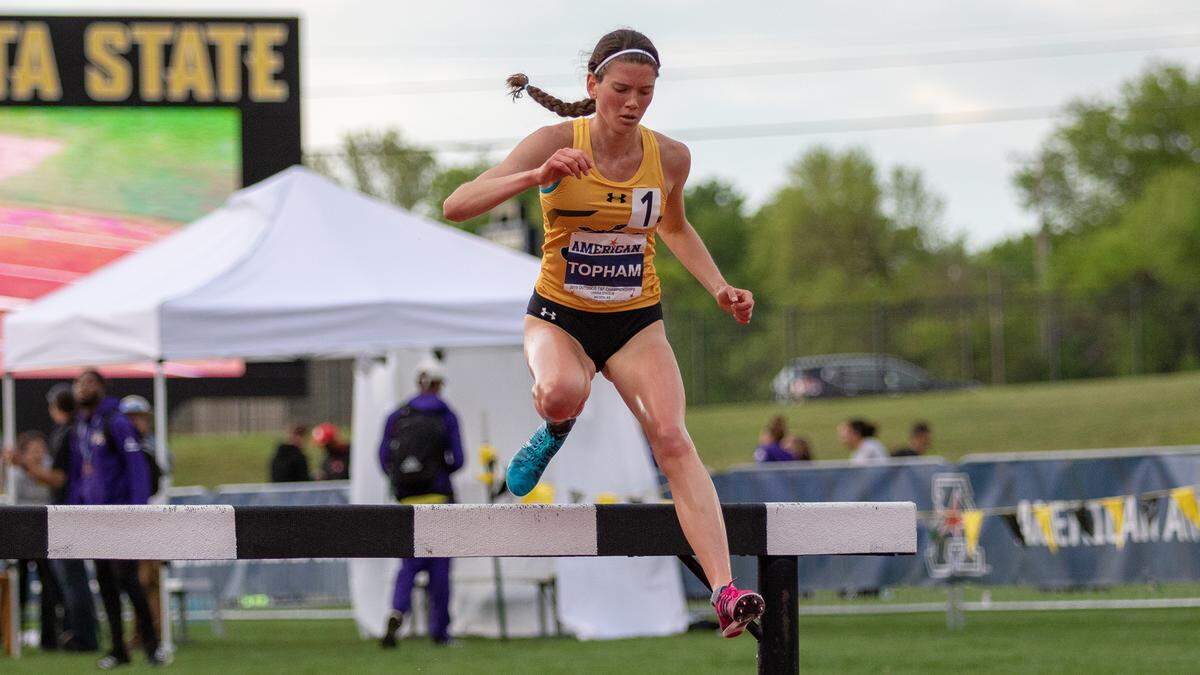
It’s fitting that the steeplechase became Topham’s signature event while at Wichita State.
Not only do competitors run a 3,000-meter race, but they are faced with 28 different barriers and seven water jumps in their laps around the track.
There’s an easy parallel to make with her academic journey, so maybe it’s not surprising Topham owns the WSU record in the event and became an NCAA All-American with her eighth-place finish at the 2019 outdoor championships.
“What I accomplished on the track, it means a lot and I did a lot of hard workouts,” said Topham, who finished her career with 11 conference championships and four conference meet MVPs. “But I never thought of running as hard work because I love it so much. That’s why I think the academic achievements mean more to me because I had to work really, really hard for those.”
She pieced together a surefire Hall of Fame career running for Wichita State, but Topham is revered even more by the academic workers at WSU.
They respected her work ethic and admired her drive, which is why the team was there for Topham every step of the way, not only with the necessary tutoring but mainly the support and encouragement she needed to keep going.
“It’s so important for Rebekah to tell this story because there are so many kids who have learning disabilities but don’t talk about it,” said Sarah Mathews, WSU’s director of compliance. “They really are like an invisible disability and she is proof that you don’t have to be limited by your disability. There are resources here at WSU that can help them and accommodations that can be made to allow them to be successful. Rebekah worked her butt off, utilized every resource available to her and was able to be so successful. It’s really a testament to the person that she is.”
The 10-page papers might be behind her, but Topham’s reading problems persist. It doesn’t pop up near as often now — she has most road signs in Wichita memorized and she says voice texting has saved her — but there are still random moments where she feels slightly embarrassed, like if she’s playing a board game with friends and she has to read something from a card.
She wonders if her learning disability could impact her later in life with what jobs she could work, but for now she has the dream of becoming a coach, like her father. Since graduating, Topham has joined the WSU track and field staff as a volunteer coach and begun training to become a professional runner.
More recently, another option for a potential job has emerged: working with kids with learning disabilities. Topham hopes her story will help others, athlete or not, and help end the stigma surrounding learning disabilities.
“Obviously it’s kind of scary to put it all out there like that, but it’s such a relief to know there’s other people like me out there and know that you’re still loved even if you’re different,” she said. “I used to have so many negative thoughts about myself and I know there are a lot of people who go through life like that. I don’t want people thinking they’re alone. I never imagined I would be here, but I want other people to know this is possible.”
.jpg)