
A complete guide to the 2021-22 American Athletic Conference men’s basketball season
With the start of the American Athletic Conference men’s basketball schedule this week, The Eagle took the time to scout each team and give its predictions for how the conference might shake out.
Houston appeared to be the heavy favorite to win the conference, but its grip on that title loosened some with the news that its best player, Marcus Sasser, was lost for the season. Teams like Memphis, Wichita State, SMU, Central Florida and Cincinnati all probably feel like they have the potential to win the conference and they very well could.
While Houston (even without Sasser) likely has an NCAA Tournament bid locked up, the conference will be scrapping to send a second and third team to the Big Dance. This conference season has the feeling that teams are going to beat up on each other and the top of the conference might take more losses than usual. The Cougars still seem like the clear favorite, while it wouldn’t be a surprise to see the teams ranked from second to sixth finish in any one of those slots from that range.
Here’s the complete guide to the 2021-22 season in the American:
Tier one: 1. Houston. Tier two: 2. Wichita State; 3. Central Florida; 4. Memphis; 5. SMU; 6. Cincinnati. Tier three: 7. Tulsa; 8. Tulane. Tier four: 9. East Carolina; 10. Temple; 11. South Florida.
Player of the Year: SMU’s Kendric Davis. Coach of the Year: Houston’s Kelvin Sampson. Defensive Player of the Year: Houston’s Fabian White. Freshman of the Year: Memphis’ Jalen Duren. Most Improved Player: Houston’s Jamal Shead. Sixth Man of the Year: Wichita State’s Ricky Council.
First team all-conference: SMU’s Kendric Davis; Houston’s Fabian White; Wichita State’s Tyson Etienne; Memphis’ Jalen Duren; UCF’s Darin Green. Second team all-conference: Houston’s Jamal Shead; Wichita State’s Morris Udeze; East Carolina’s Tristen Newton; Tulane’s Jalen Cook; Tulsa’s Jeriah Horne. Third team all-conference: Houston’s Kyler Edwards; Memphis’ DeAndre Williams; UCF’s Darius Perry; Cincinnati’s David DeJulius; Temple’s Damian Dunn. All-freshman team: Memphis’ Jalen Duren; Memphis’ Emoni Bates; Wichita State’s Kenny Pohto; Tulsa’s Anthony Pritchard; East Carolina’s Brandon Johnson; Temple’s Zach Hicks.
1. Houston Cougars (11-2)
Ratings: No. 1 T-Rank, No. 1 ESPN BPI, No. 3 Haslametrics, No. 3 ShotQuality, No. 4 KenPom, No. 5 Sagarin.
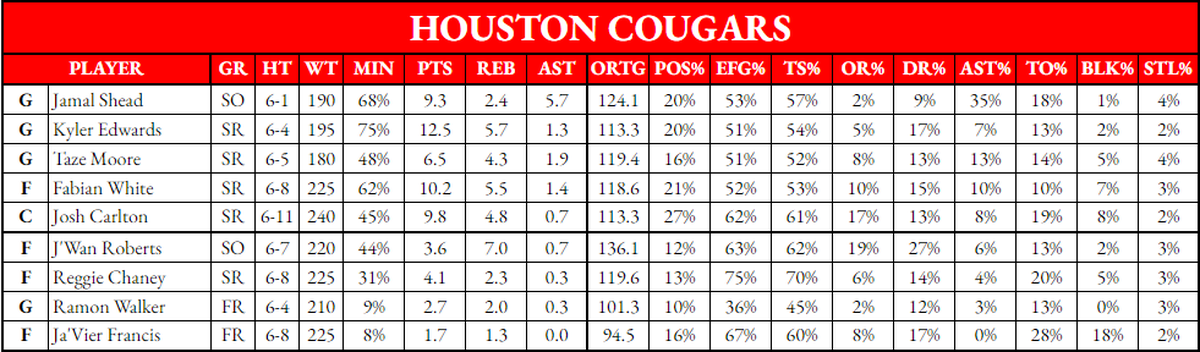
Even with heavy losses off the Final Four team from last season, Houston once again found a way to reload under Kelvin Sampson, who has built the Cougars into a consistent national power. Houston had the look of a team capable of making another deep run in the NCAA Tournament, but received back-to-back blows in December when it lost promising guard Tramon Mark and then its best player, Marcus Sasser, for the season. Sasser was the engine to Houston’s offense, leading the way with 17.7 points, and now the Cougars will have to adjust on the fly and find a way to replace such a big part of their offense. Some might question Houston remaining the top team entering conference play given such a monumental loss, but there’s no coach I trust more than Sampson. While Sasser had helped power Houston to one of the best offenses in the country, Sampson has guided Houston to a top-21 defense in KenPom’s adjusted efficiency metric for the last four seasons. In a conference that prizes defense more than most, Houston’s defense is the reason why it deserves to be considered the team to beat entering conference play. And with the emergence of point guard Jamal Shead and the play of Kyler Edwards and Taze Moore, two transfers, Houston should have enough to still be an efficient offense.
Player to know
It turns out all that Jamal Shead needed was an opportunity. After riding the bench for most of Houston’s run to the Final Four, Shead earned the starting point guard role in his second season in the program and has been one of the biggest breakout stars in the conference. He’s averaging 9.3 points, 5.7 assists and 1.8 steals and his role on offense is only going to increase with the season-ending injury to Marcus Sasser. Shead has had a strong shooting season thus far, drilling 50% of his shots inside the arc and 40% of his three-pointers to go along with a 34.5% assist rate that ranks No. 34 nationally. He’s been excellent scoring in transition (1.48 points per possession) and even better at making reads out of the pick and roll, finding the spot-up shooter or creating the right angle to hit the rolling big man for great looks. If Houston is going to push to reclaim its spot atop the AAC, Shead will have to deliver a standout season leading the offense.
What to know about the offense
Anytime a team loses a player the caliber of Marcus Sasser, things are going to change. While the Cougars have carved out a defensive-first reputation under Sampson, they’ve quietly reeled off six straight seasons of top-40 offense in KenPom’s adjusted efficiency. A staple of that efficiency has been Houston’s relentlessness on the offensive glass and it once again is one of the best offensive rebounding teams in the country, this year checking in at No. 10 currently. Losing Sasser certainly hurts Houston’s outside shooting, but Kyler Edwards (2.2 threes per game at a 35.4% clip), Jamal Shead (40.0%) and Fabian White (38.9%) are all good floor-spacers. As detailed above, Shead has been excellent in his first season in an expanded role running Houston’s offense and his importance only grows in Sasser’s absence. Even if the jumpers aren’t falling, Houston protects itself by crashing the glass so well with White, Josh Carlton and J’Wan Roberts that earn the team so many opportunities at second-chance points. Houston probably no longer has the potential to be one of the nation’s elite offenses, but the Cougars have enough firepower here to maintain a top-40 offense.
Five most popular play types
Play | Count | PPP | %tile Rank |
Marcus Sasser open catch-and-shoot 3-pointer | 37 | 1.30 | 92nd |
Josh Carlton cut drop-off pass at basket for layup | 18 | 1.18 | 83rd |
Fabian White open catch-and-shoot 3-pointer | 18 | 1.15 | 81st |
Marcus Sasser pick and roll off-the-dribble 3-pointer | 31 | 1.08 | 75th |
Kyler Edwards guarded catch-and-shoot 3-pointer | 33 | 0.98 | 63rd |
Note: Data from ShotQuality.
What to know about the defense
Houston as a top-rate defense year-in and year-out under Sampson and even with two key players missing, there’s little doubt the show will go on for the Cougars on the defensive end of the floor. Houston is always athletic, always aggressive and always excellent at protecting the paint. This year is no difference, as Houston is forcing the 12th-most turnovers in the country and has the 12th-best block rate. Josh Carlton has been an excellent addition at center and has been an elite shot-blocker, while Fabian White has regained his form coming off a knee injury and has been a defensive monster so far this season. Throw in an athletic backcourt and the Cougars protect the paint at all costs, which is why they have a top-40 defense in limiting the efficiency of shots at the rim and why they give up the 14th-most three-pointers in the country. But usually teams so much energy just trying to survive Houston’s pressure that they don’t have the legs to make the open three-pointers they are able to produce. It’s been a winning method for Sampson for years and is the biggest reason why the Cougars should once again be the favorites in the AAC.
2. Wichita State Shockers (9-3)
Ratings: No. 61 Sagarin, No. 64 KenPom, No. 65 T-Rank, No. 68 Haslametrics, No. 84 ESPN BPI, No. 100 ShotQuality.
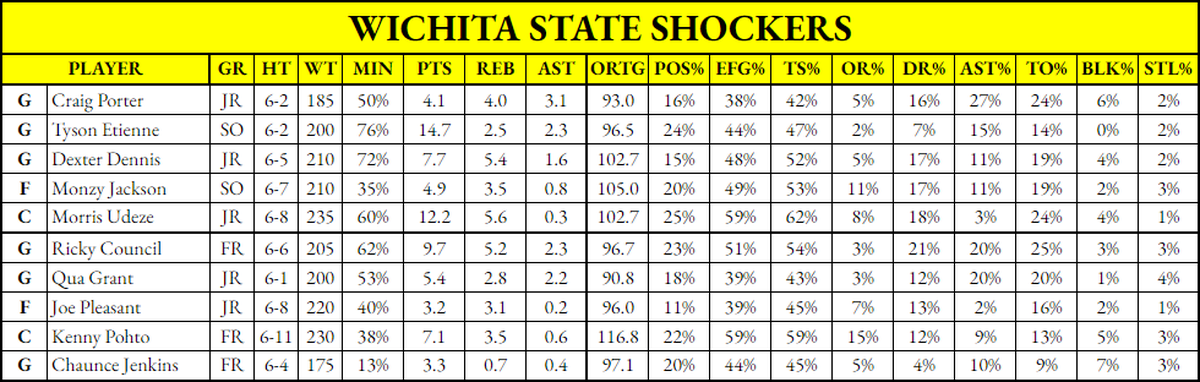
After a Cinderella run to its first AAC championship last season under first-year coach Isaac Brown, the Shockers returned reigning AAC co-MVP Tyson Etienne and a good portion of their core from last season’s NCAA Tournament squad. Wichita State was off to a promising start to the season, going toe-to-toe with Arizona and winning back-to-back road games at Missouri and Oklahoma State to push to a 6-1 record, but that momentum was quelled by disappointing home losses to Kansas State and North Texas that featured long offensive droughts. The team’s defense has been borderline elite this season, currently ranking No. 35 in KenPom’s adjusted efficiency, but the offense has taken a dip with Etienne still looking to replicate his efficiency from last season’s breakout campaign. It’s possible the Shockers never figure it out on the offensive end and they struggle to a middle-of-the-pack finish. Memphis, SMU, UCF and Cincinnati all could very well be in this spot, but WSU earns the nod because it has the best defense of all of those teams — and in this conference, defense is what wins on the road — with the added upside if the offense does click, then the Shockers have the potential to repeat their title given Houston’s injuries.
Player to know
Following an MVP season, Tyson Etienne should be well-known to everybody in the conference. A player who is enjoying the best year of his career is fourth-year junior center Morris Udeze, who is undersized at just 6 foot 8 but has found a way to make it work with averages of 12.2 points and 5.6 rebounds. He’s been able to shake off a slow start to the season, where he was a turnover machine, and now Udeze has averaged 15.9 points on 64% shooting in his last seven games. What’s made it even more impressive is that Udeze is doing it mostly with herky-jerky, back-to-the-basket moves that has made him one of the better low-post scorers in the country. It’s not always going to look pretty, but Udeze knows how to use his wide frame to play bully ball for efficient scoring. He has also been a reliable dump-off target for the rare occasions when WSU’s guards have been able to penetrate and find him with an accurate pass. Udeze is a foul magnet who is drawing more than five fouls per game, a top-100 rate, that has him shooting more than four free throws on average and he is cashing in on them at a 72.5% rate. On a team that is off to another ice-cold shooting start, Udeze has been a much-needed constant source of efficient offense down low.
What to know about the offense
Wichita State was able to win the AAC championship last season despite finishing No. 290 in the country in effective field goal percentage. How did the Shockers pull it off? They rarely turned the ball over, they were a decent offensive rebounding team and they were excellent at drawing fouls and manufacturing points at the line. This season is right in line with WSU’s ice-cold shooting, but the Shockers have tailed off in terms of limiting turnovers, which has actually become a weakness at times, and in drawing fouls. It starts with reigning AAC co-MVP Tyson Etienne, who averaged 16.3 points on great efficiency (114.7 offensive rating) last season and is now down to 14.7 points on not-so-great efficiency (96.5 offensive rating). If Etienne can find his groove in conference play, WSU’s offense will see a major uptick. The Shockers are producing the right looks, but are failing to capitalize on their shots at the rim (No. 286 in the country) and on three-pointers (No. 231 in the country). Morris Udeze gives WSU a solid foundation to play inside-out, but the team needs someone other than Etienne to produce consistently on the perimeter. Ricky Council has shown flashes of becoming a standout, but he has struggled with turnovers. Dexter Dennis seems to be another candidate and his outside shot has typically drastically improved during conference play. The Shockers either need to cut down on their turnovers to maximize possessions or see a noticeable tick up in their shooting if they are going to repeat last season’s success because it seems clear that the offense will determine how far this team can go.
Five most popular play types
Play | Count | PPP | %tile Rank |
Tyson Etienne open catch-and-shoot 3-pointer | 18 | 1.27 | 90th |
Dexter Dennis open catch-and-shoot 3-pointer | 18 | 1.06 | 73rd |
Tyson Etienne guarded catch-and-shoot 3-pointer | 21 | 1.01 | 67th |
Tyson Etienne pick and roll off-the-dribble 3-pointer | 18 | 0.99 | 64th |
Dexter Dennis guarded catch-and-shoot 3-pointer | 22 | 0.72 | 25th |
Note: Data from ShotQuality.
What to know about the defense
In coach Isaac Brown’s second season at the helm, WSU is starting to resemble more like Gregg Marshall’s top teams when it comes to the defensive end. The Shockers currently rank No. 35 in KenPom’s adjusted defensive efficiency and rank as a top-20 defense in the halfcourt. Despite lacking a traditional shot-blocking big man, WSU has the 25th-best block percentage in the country thanks to its array of athletic wing defenders in Dexter Dennis, Craig Porter and Ricky Council. That’s helped the Shockers be one of the best teams in the country at protecting the paint, ranking in the top-30 in limiting efficiency there. WSU gives up a lot of three-pointers, but that’s by design with its gap defense and so far the Shockers have been able to survive with that strategy. They could be vulnerable to good shooting teams like SMU or UCF, but WSU has seemed to find a way to scrap and claw and hold offenses to under their usual scoring efficiency this season. If WSU is going to make a push for a return to the NCAA Tournament and another high AAC finish, then it will do so on the strength of its defense.
3. Central Florida Knights (9-2)
Ratings: No. 44 Haslametrics, No. 51 ESPN BPI, No. 53 KenPom, No. 53 T-Rank, No. 71 Sagarin, No. 107 ShotQuality.
Central Florida is a popular pick to be the dark horse pick in the American that could even emerge as a possible at-large NCAA Tournament team after finishing its nonconference play with an 9-2 record and No. 41 NET ranking, bolstered by Thursday’s marquee win over Michigan. But some skepticism remains when evaluating the ShotQuality data, which reveals that UCF had just an 8% chance of winning based on the shots it took at Miami, its marquee win to date, and was more likely to lose at Temple (42% chance of winning) in a game it ultimately won by 17 points. Working in UCF’s favor is Johnny Dawkins is a good coach and the Knights returned most of their core players from last season, giving them one of the more veteran teams in the conference. After two straight sub-.500 seasons in the American following its NCAA Tournament run in 2019, UCF appears poised to finish in the top-half of the American this season and could be the surprise team to win it.
Player to know
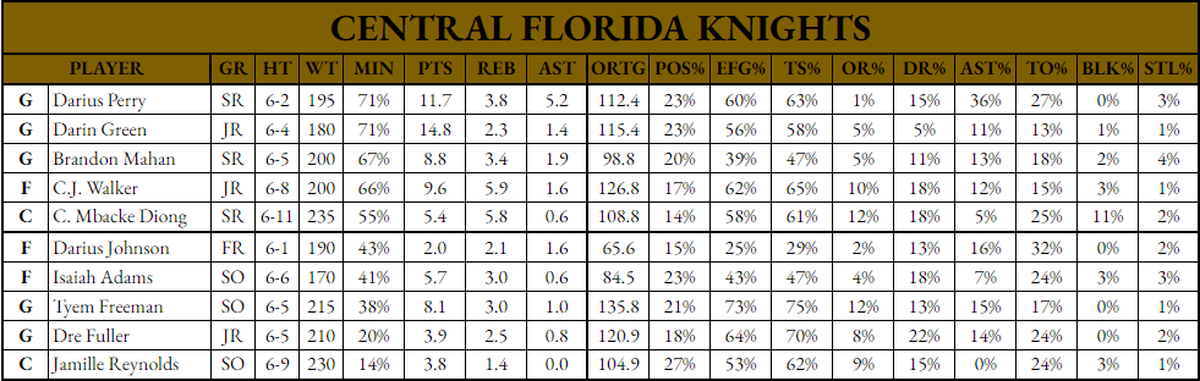
Darin Green, a 6-foot-4 smooth-shooting guard, is entering his third season as one of the AAC’s top sharpshooters. After being an excellent role player the last two seasons, Green has elevated his game to become the team’s leading scorer at 14.8 points per game on a career-best 2.9 three-pointers per game at a 40.8% clip. He isn’t quite a three-level scorer, as driving to the basket isn’t a huge part of his game, but Green is a lethal shooter whether it’s a mid-range jumper or three-pointer. That applies so much pressure on opposing defenses to always account for Green because he’s excellent at moving without the basketball, darting off screens and relocating along the perimeter to make himself available for kick-outs. Not only is he posting an excellent 115.4 offensive rating, but Green’s shooting gravity is also opening up things for his teammates and is a big reason why UCF’s offense has jumped so much so far this season. He’s in the 94th percentile nationally in mid-range efficiency and the 93rd percentile nationally in three-point shooting, making him one of the most dangerous shooting weapons not just in the American but in the country.
What to know about the offense
It’s early, but UCF is flirting with its most potent offense yet in the sixth year under Johnny Dawkins. The elevated play of Green, as detailed above, has a big part in that, but so does the Knights bringing back their top six players from last season and upgrading at center. Point guard Darius Perry is delivering an even more impactful season in his second year back at UCF, making 46% of his three-pointers and handing out 5.2 assists per game, while athletic forward C.J. Walker has become lethal at the rim. UCF is plugging along with the No. 57 offense in KenPom’s adjusted efficiency, even with senior wing Brandon Mahan off to an ice-cold shooting start to the season. It’s been tough for opponents to keep Walker and 6-foot-11 center Cheikh Mbacke Diong off the offensive glass, which has led to UCF making nearly 55% of its two-pointers (top-50 rate). It also helps the Knights are making an impressive 79.4% of their free throws, good for the 12th-best mark in the country. The only weakness in UCF’s offense so far this season has been careless mistakes. The Knights seemed establish at the very least one of the best shooting teams in the conference, if not the top, which allows them to beat anyone on any given night with a hot shooting performance.
Five most popular play types
Play | Count | PPP | %tile Rank |
Darin Green open catch-and-shoot 3-pointer | 28 | 1.34 | 94th |
Darin Green guarded catch-and-shoot 3-pointer | 28 | 1.16 | 82nd |
Darius Perry pick and roll off-the-dribble 3-pointer | 14 | 1.13 | 79th |
Darin Green off-the-dribble short mid-range jumper | 14 | 0.96 | 61st |
Brandon Mahan pick and roll off-the-dribble 3-pointer | 15 | 0.80 | 37th |
Note: Data from ShotQuality.
What to know about the defense
The thing that makes UCF unique in the American is how much it is applying full-court pressure this season, as the Knights press at a top-20 rate and have been pretty effective with it. It also helps explain why UCF is able to force nearly 16 turnovers per game and end 23% of possessions in a turnover, which is a top-30 rate nationally. Opponents have found success with easier two-point shots when they’re able to crack the pressure, but UCF does a fairly decent job at preventing teams at taking too many shots at the rim. The Knights tend to play with fire on a nightly basis, giving up the fourth-highest three-point rate in the country. So far the opposition hasn’t been able to make UCF pay, making an abysmal 27.8% of three-pointers, but that could change because UCF is giving up a ton of open three-pointers. The Knights aren’t a great defensive rebounding team and they’re sometimes prone to send opponents to the line, which isn’t always the best mixture. In a league that prides itself in gritty defenses, UCF probably won’t end up with a top-tier one — but if it can force enough turnovers, it could be good enough to support what should be a top-tier offense and propel UCF near the top of the standings.
4. Memphis Tigers (6-4)
Ratings: No. 27 T-Rank, No. 31 KenPom, No. 34 ESPN BPI, No. 36 Sagarin, No. 39 Haslametrics, No. 47 ShotQuality.
Another highly-anticipated season where Memphis entered with top-10 expectations and a roster full of all-star talent has been derailed once again before the Tigers even enter conference play, as they took four straight losses before finally flashing their potential in a win over Alabama. This isn’t the first time we’ve seen this act from Memphis under Penny Hardaway, but it’s too early to give up on the Tigers just yet. Just last season, Hardaway showed what was possible, as Memphis recovered from a rocky 6-5 start to win 14 of its final 17 games en route to an NIT championship. But expectations were sky-high when Memphis brought back a handful of key players from last season, then added one of the best recruiting classes on top of a handful of instant-impact transfers. Perhaps this is another slow start to the season for Memphis that will end with the Tigers playing their best basketball in February and March. Even with improved offense, Memphis doesn’t seem to have the discipline — it struggles mightily turning the ball over and giving up offensive rebounds — to be consistent enough to bring home a conference championship. There’s no question Memphis has the most talent of any team in the American. This team might have the biggest range of possibilities of any team in the conference, capable of winning the title or bottoming out and missing out on a top-half finish.
Player to know
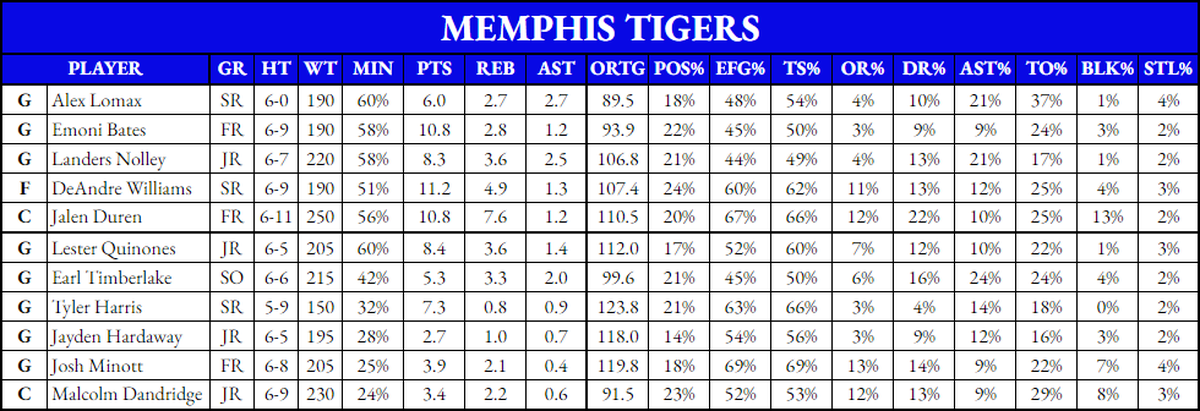
DeAndre Williams continues to be one of the most underrated players in the conference and he’s still one of Memphis’ best players, but it’s a little disappointing to see his assist numbers take such a drastic dip this season. For that reason, let’s focus on Jalen Duren, the latest five-star talent and future NBA Draft lottery pick Hardaway has recruited to Memphis. He’s averaging 10.8 points, 7.6 rebounds and 2.8 blocks and has been Memphis’ most impactful two-way player this season. Duren is such a good athlete for his size, he’s able to beat opposing big men for offensive rebounds and running the floor in transition. On defense, Duren specializes in patrolling the paint and coming over to swat away shots from unsuspecting drivers to the rim. He’s a major reason why Memphis ranks third in the country in block percentage (Duren is No. 17 individually) and top-30 in the country at limiting efficiency at the rim. There’s so much talent up and down Memphis’ roster to pick out just one player to know, but Duren is one that is sure to stand out this season.
What to know about the offense
Hardaway has assembled the most talented offensive group in his four years at Memphis. The Tigers have just about anything you could want in scorers. DeAndre Williams is a crafty player inside the arc; Jalen Duren is a monster on the glass; Emoni Bates is raw, but talented scorer; Lester Quinones is a veteran who can be a deadly shooter; Landers Nolley is a huge wing scorer; Tyler Harris is instant offense off the bench with his three-point shooting; and it’s rare to find such talented scorers like Earl Timberlake and Josh Minott this far down in the rotation. The Tigers are an extremely aggressive bunch and they’re at their best when they’re able to attack the rim over and over again, which leads to either high-percentage looks or trips to the foul line (Memphis ranks third nationally in foul rate). Memphis is once again the most athletic team in the conference and it takes full advantage of that, as it ranks eighth nationally in offensive rebounding percentage. But Memphis’ downfall once again has been taking care of the ball, which has been an annual problem under Hardaway. This year Memphis is turning the ball over at the ninth-highest rate in the country, which is preventing the Tigers from being one of the best offenses in the country.
Five most popular play types
Play | Count | PPP | %tile Rank |
DeAndre Williams cut drop-off pass at basket for layup | 15 | 1.43 | 97th |
Jalen Duren cut drop-off pass at basket for layup | 15 | 1.36 | 94th |
Landers Nolley open catch-and-shoot 3-pointer | 21 | 1.28 | 91st |
Lester Quinones open catch-and-shoot 3-pointer | 14 | 1.20 | 85th |
Lester Quinones guarded catch-and-shoot 3-pointer | 19 | 1.00 | 66th |
Note: Data from ShotQuality.
What to know about the defense
For the last two seasons, Memphis has truly been elite on the defensive end, finishing with the No. 1-ranked defense in KenPom’s adjusted efficiency last season and ranking No. 5 in 2020. The Tigers are still very good defensively this season, but they don’t have the same bite as previous versions. For starters, Memphis has been a terrible (bottom-40) defensive rebounding team, which is confusing since it is so good on the offensive glass and has no shortage of athleticism. Hardaway has liked to go to a full-court press a lot this season, which has been mostly successful but has also made the Tigers vulnerable in transition when they aren’t able to force a turnover of hurried shot. When it comes to the halfcourt setting, Memphis is still elite. Even though it’s allowing a ton of shots at the rim, Memphis skates by because it has such good shot-blockers. There’s some luck involved to explain why Memphis’ previously-elite three-point defense has taken a severe dip this season, but it’s also worth pointing out Memphis is giving up more open threes in the past too. In the past, Memphis could simply overwhelm opponents with its athleticism on the defensive end. That might not be the case anymore this season, but the Tigers still should be one of the better defenses in the conference.
5. SMU Mustangs (9-3)
Ratings: No. 52 ESPN BPI, No. 57 ShotQuality, No. 66 Sagarin, No. 69 KenPom, No. 78 T-Rank, No. 87 Haslametrics.
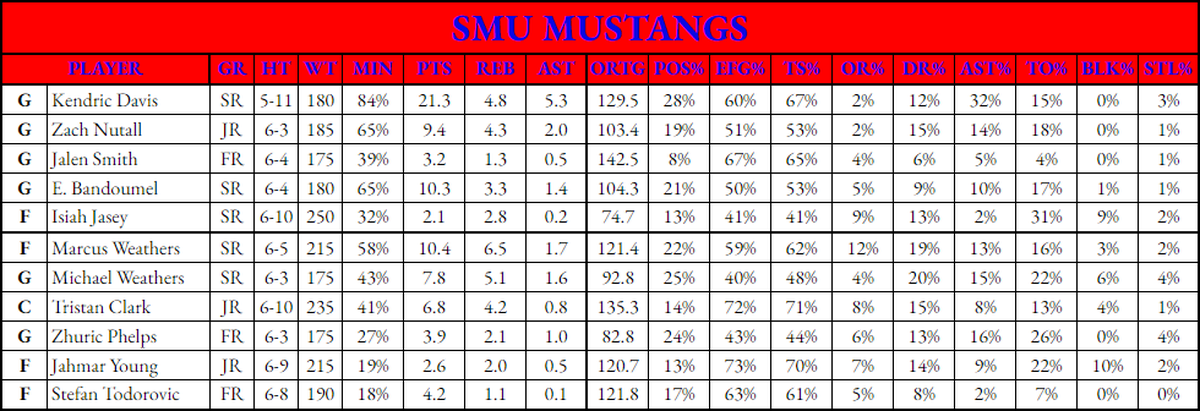
Even with a fairly large exodus from last season’s roster, Tim Jankovich has managed to retool SMU and once again has the Mustangs vying for a top spot in the American. This isn’t the first year where SMU has felt like it has enough talent to push for a top-three finish in the conference, as Jankovich’s teams have mostly disappointed the last four seasons since the memorable 30-win season in 2017. The reason to hope SMU can break through this year is that it has arguably the most valuable player in the conference in do-everything point guard Kendric Davis, who is off to another electric start and averaging 21.3 points, 4.8 rebounds and 5.3 assists per game. If SMU’s season wasn’t ravaged by COVID-19 issues last season, he very well could have forced a three-way share of the AAC MVP honors. With Davis, SMU has a super-charged offense and is capable of beating any team in the conference. But will that be enough? Can the Mustangs scrap together enough defense and find enough support for Davis to make a championship push? Given SMU’s history, it’s hard to put too much faith in the Mustangs, which is why they’re stuck at fourth.
Player to know
As mentioned above, Kendric Davis is arguably the most electric player in the conference. Because SMU only played 11 conference games last season, Davis’ talent largely fell under the radar. If SMU is able to play the bulk of its schedule this season, Davis’ talent will be too much to ignore. He’s a 6-foot point guard who doesn’t rely on size to get by, rather smarts, quickness and a deft shooting touch. Not only is he averaging 21.3 points, but also 5.3 assists. He has a top-70 assist rate in the country and his offensive rating of 129.5 is also a top-70 mark nationally. He is a maestro in the pick-and-roll game, capable of hurting a defense by pulling from long range, pulling up for a mid-range jumper or attacking the basket. And when he drives and collapses the defense, Davis is an expert at picking out the right open shooter dotting the perimeter. He’s been one of the most efficient jump shooters in the country to date and he’s finishing at a high rate at the rim, despite his size. He’s a one-man source for efficient offense, capable of scoring himself or setting teammates up for easy looks. He’ll make a strong push for MVP honors again this season.
What to know about the offense
With Kendric Davis leading the way, SMU has leveled up its offense and its peaking right now at No. 28 in the country. The Mustangs are good at just about everything on the offensive end: they finish well inside, they’re making 38% of their three-pointers, they take care of the ball, they’re a good offensive rebounding team and they draw fouls at a high rate. SMU has shifted to mostly four-guard lineups, as senior transfer Marcus Weathers has been the ideal four man in this offense. The Mustangs are just a difficult team to defend with the floor spaced so well and Davis running the show, deadly in the pick-and-roll game as an efficient scorer on all three levels and excellent at picking out shooters on the perimeter when the defense collapses. Zach Nutall (35.5%) and Emmanuel Bandoumel (40.8%) are being spoon-fed open three-point looks and if they’re going to hit at their current rates, then SMU very well could lay claim to having the best offense in the conference. But what happens when the Mustangs have an off-shooting game and their jumpers aren’t falling? That’s the big question mark heading into conference play.
Five most popular play types
Play | Count | PPP | %tile Rank |
Kendric Davis pick and roll off-the-dribble 3-pointer | 26 | 1.16 | 82nd |
Zach Nutall guarded catch-and-shoot 3-pointer | 39 | 1.14 | 80th |
Zach Nutall open catch-and-shoot 3-pointer | 27 | 1.09 | 76th |
Emmanuel Bandoumel open catch-and-shoot 3-pointer | 44 | 1.00 | 66th |
Emmanuel Bandoumel guarded catch-and-shoot 3-pointer | 19 | 0.96 | 61st |
Note: Data from ShotQuality.
What to know about the defense
Offense has never been an issue for SMU under Jankovich, while the defensive end is usually where the Mustangs come up short. That will once again be the big question mark for the ultimate success of this team. Right now SMU’s defense has actually been pretty good in a halfcourt setting. Where the Mustangs have struggled is giving up points in transition, as they are giving up 1.04 points per possession on fast breaks for a bottom-100 mark. As mentioned above, SMU is an undersized team playing four guards, which explains why they have struggled so much keeping opponents off the offensive glass (No. 235 in defensive rebounding rate). But in terms of shot defense, SMU has been excellent — doing a good job protecting the rim and limiting the number of open threes it allows. If SMU can hold its own better on the glass, then it has the chance to play good enough defense to challenge for an AAC title this season.
6. Cincinnati Bearcats (10-3)
Ratings: No. 59 T-Rank, No. 74 Sagarin, No. 76 KenPom, No. 79 Haslametrics, No. 84 ShotQuality, No. 103 ESPN BPI.
The Wes Miller era is off to a very promising start in Cincinnati, which was not long ago the home to a program stuck in turmoil with a huge divide between the players and the coach that ultimately led to the exit of John Brannen. After a disappointing 12-11 year last season, Cincinnati appears poised to bounce back and collect another 20-win season. Miller took over a dire situation with almost the entire roster in the transfer portal and did well to recruit back many key players that has led to this season’s success. The offense is still a work in progress, but Miller has restored Cincinnati to among the nation’s top defenses. Cincinnati isn’t forcing the number of turnovers his teams at UNC Greensboro did, but the Bearcats have been superb in taking away threes and shots at the rim. It’s been an impressive job by Miller so far this season, highlighted by a 20-point victory over Illinois, and the Bearcats figure to be a tough out for every team in the conference this season and belong on the same tier as many of the teams ahead of them. There’s no doubt Cincinnati’s defense will keep the Bearcats in almost every game this season, but their lack of shooting punch keeps them just outside of the top five.
Player to know
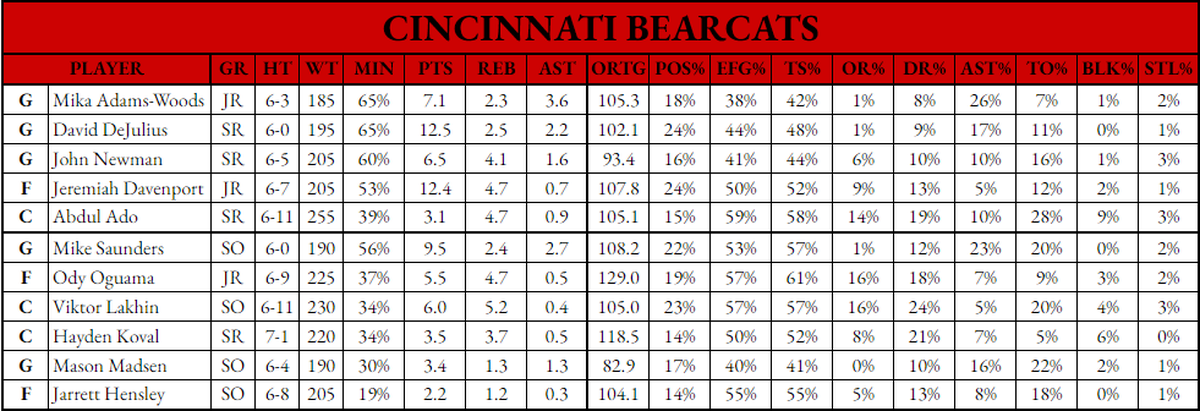
An early candidate for Most Improved Player has been Mike Saunders, the 6-foot sophomore guard who dabbled in the transfer portal (and seriously considered Wichita State) and is now thriving in his second season at Cincinnati. After averaging just 3.5 points on 38.8% shooting with a 31% turnover rate last season, Saunders is now averaging 9.5 points on 45.6% shooting, including shooting 41.9% beyond the arc, while his assist-to-turnover ratio is up to 1.75. Saunders has become an absolute menace in transition for the Bearcats, as he is scoring at 1.26 points per possession (and that goes up to 1.47 points per possession when you count his passing in transition). It’s a common sight for Bearcat fans to see Saunders’ bushy, blonde hair flying down the court, like he was told he is coming out of the game unless he reaches the rim. On a team that doesn’t rely on any one player, Saunders’ offensive punch off the bench has been a valuable asset to the Bearcats and will be needed in conference play in order for Cincinnati to move up.
What to know about the offense
Cincinnati has a rare AAC offense that isn’t centered around one creator, like it did in recent memory with Jarron Cumberland. That can have its benefits and its drawbacks, although Wes Miller has done a good job squeezing out an above-average offense despite rather cold shooting to start the season. The Bearcats find other ways to efficient offense, like rarely turning over the ball, a trait of steady point guard Mika Adams-Woods, who has a top-50 turnover rate in the country, that seems to rub off on his team. Cincinnati has a wealth of big bodies it plays at the four and five, which has translated to it becoming a top-40 offensive rebounding team so far this season. Led by Mike Saunders’ mad dashes to the rim, Cincinnati has actually been rather good in transition. Where the Bearcats run into their issues is when play is bogged down in the halfcourt, as the court shrinks on Cincinnati because it just doesn’t have enough shooting on this roster. If a team can keep them out of transition and off the offensive glass, then Cincinnati is likely to struggle to manufacture points.
Five most popular play types
Play | Count | PPP | %tile Rank |
Jeremiah Davenport open catch-and-shoot 3-pointer | 16 | 1.19 | 84th |
Mika Adams-Woods open catch-and-shoot 3-pointer | 17 | 1.02 | 68th |
Jeremiah Davenport guarded catch-and-shoot 3-pointer | 30 | 0.89 | 51st |
John Newman open catch-and-shoot 3-pointer | 14 | 0.75 | 29th |
David DeJulius pick and roll off-the-dribble 3-pointer | 18 | 0.59 | 8th |
Note: Data from ShotQuality.
What to know about the defense
It hasn’t mattered who the coach has been on the sidelines, Cincinnati seems to always take a great deal of pride in playing top-notch defense. While this Bearcats team isn’t likely to match their predecessors at the peak of the Mick Cronin years, they are awfully good and currently rank No. 5 nationally in effective field goal percentage allowed at 41.1. It’s not like Cincinnati’s defense is anchored by an elite shot-blocker, but the Bearcats have still found a way to be one of the best teams in the country (No. 7 in two-point percentage allowed) at protecting the paint. Under Miller, Cincinnati has excelled in taking away the two most valuable shots in the halfcourt — shots at the rim and three-pointers — evident by ranking in the top-25 in both limiting them and limiting the efficiency of those shots. Cincinnati has been a little vulnerable this season keeping teams off the offensive glass and they’re fouling way too much early in the season, two things that are keeping the Bearcats from entering the truly elite territory. Even with that, Cincinnati has the make-up of one of the best defenses in the American, a badge of honor in one of the best defensive leagues in the country.
7. Tulsa Golden Hurricane (6-5)
Ratings: No. 126 ESPN BPI, No. 135 Sagarin, No. 145 KenPom, No. 154 ShotQuality, No. 156 T-Rank, No. 209 Haslametrics.
After leading Tulsa to an improbable three-way share of the AAC title in 2020, Frank Haith is trying to lead Tulsa back to the NCAA Tournament for the first time since 2016. It doesn’t appear the Golden Hurricane have the defense to pull that off this season, as they have already lost to Air Force (KenPom No. 289) and Loyola Marymount at home and to Oral Roberts on the road. Even with Jeriah Horne back in the fold and UT Arlington transfer Sam Griffin both playing extremely well so far, Tulsa hasn’t been able to find enough of an offensive punch elsewhere — it’s scored less than 60 points in four of five losses — to avoid a somewhat disappointing start to the season. Wins over Rhode Island, Oregon State and Southern Illinois are nice, but ShotQuality projects regression coming on offense, which means Tulsa is likely looking at its second straight bottom-half finish in conference play.
Player to know
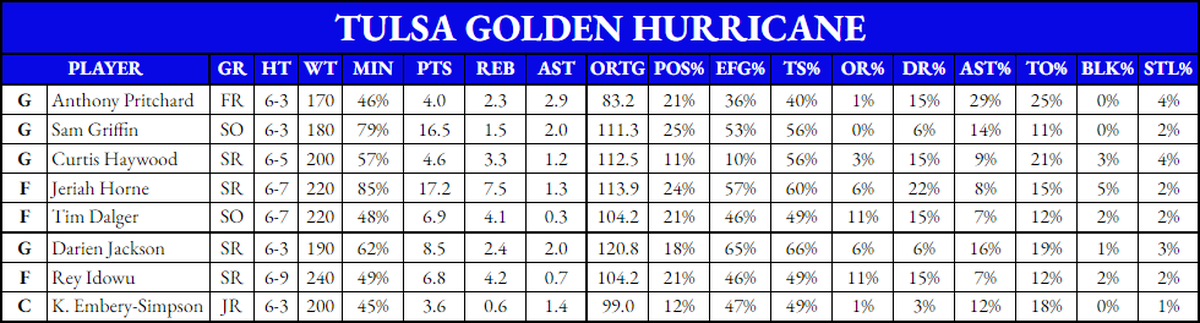
It’s tempting to pick Jeriah Horne, the stretch four who is back at Tulsa to his finish his career after transferring to Colorado for last season. But a more interesting candidate is Sam Griffin, a 6-foot-3 scoring guard who transferred up from UT Arlington and is actually playing even better for Tulsa with a 16.5 scoring average and 111.3 offensive rating. Simply put, Griffin is having an outstanding shooting season. He’s shooting extremely well off the bounce, whether that’s in the mid-range, where he ranks in the 85th percentile nationally in efficiency, or beyond the arc (1.05 points per possession). He also finishes well at the rim for his size and that skill set combined with his shooting has made him absolutely lethal in transition, where he is destroying defenses for 1.69 points per possession so far this season. It remains to be seen if Griffin can maintain his efficiency playing in a defensive-minded league like the AAC, but if he can then Tulsa has one of the best scoring duos in the league.
What to know about the offense
The offense has been powered by Jeriah Horne and Sam Griffin, who are averaging a combined 33.7 points — nearly half of Tulsa’s total output. Horne in particular has been delightful, as he’s returned to Tulsa after playing three seasons there and transferring to Colorado for last season. Back once again, Horne, a stretch four, is playing the best basketball of his career, posting a 113.9 offensive rating on 49/43/84 shooting splits. Thanks to the super efficiency brought by Horne and Griffin, which has bolstered the team’s free throw (78%) and three-point (36%) shooting, Tulsa has actually enjoyed its best offense since 2018. Can Rey Idowu become an inside presence for Tulsa? Can Curtis Haywood, Keyshawn Embery-Simpson and Anthony Pritchard hit enough shots to relieve pressure off Horne and Griffin? If Tulsa can answer those questions, it’s likely Haith will once again out-perform projections. What is troubling is the Golden Hurricane’s shot selection doesn’t rate favorably to date, which suggests they could experience some regression come conference play matched up against a number of tough defenses.
Five most popular play types
Play | Count | PPP | %tile Rank |
Jeriah Horne open catch-and-shoot 3-pointer | 15 | 1.28 | 91st |
Rey Idowu cut drop-off pass at basket for layup | 14 | 1.17 | 83rd |
Sam Griffin off-the-dribble 3-pointer | 13 | 1.05 | 71st |
Jeriah Horne guarded catch-and-shoot 3-pointer | 18 | 1.04 | 70th |
Sam Griffin guarded catch-and-shoot 3-pointer | 21 | 0.95 | 59th |
Note: Data from ShotQuality.
What to know about the defense
Haith has slightly veered away from playing a match-up zone defense this season, as Tulsa is down from its typical 50-50 split to a 60-40 split in favor of man defense this season. The problem is Tulsa hasn’t found much success either way, as it has actually struggled more with its man defense. Regardless, Tulsa’s defense has slipped to No. 169 on KenPom’s adjusted efficiency, which would be the worst in Haith’s eight-year run there. The good news is Tulsa is forcing 16 turnovers per game and on 24% of possessions, a top-25 rate in the country. The bad news is that when opponents don’t turn the ball over, Tulsa’s defense has been entirely too easy to score against. Tulsa has allowed a 54.1 effective field goal percentage, a bottom-50 mark in the country, and has once again struggled on the glass. The Golden Hurricane have been absolutely diced up in the pick-and-roll game this season and they’re giving up way too many open three-pointers, which has resulted in opponents drilling 37% of them. This is the biggest area where Tulsa could make improvements that would propel them up the standings. But if nothing changes, it’s hard to imagine Tulsa escaping the bottom-half of the conference.
8. Tulane Green Wave (3-6)
Ratings: No. 160 KenPom, No. 165 T-Rank, No. 183 Haslametrics, No. 183 ESPN BPI, No. 188 Sagarin, No. 198 ShotQuality.
Entering the third year under Ron Hunter, Tulane is beginning to lay the foundation for the future. Even though Tulane returned 65% of its minutes from last season, the team is still the seventh-youngest team in the country. Relying on that many freshmen and sophomores has led to some growing pains, as Tulane is off to a 3-6 start against a nonconference slate rated No. 277 in the country. If Hunter is able to keep the dynamic duo of Jalen Cook and Jaylen Forbes — a pair of former top-100 recruits who transferred to Tulane from LSU and Alabama, respectively — together, then Tulane could avoid a bottom-three finish in the AAC for the first time since 2015. Expecting that to happen this season may seem a little ahead of schedule, but it’s hard to deny the talent of the trio of Cook, Forbes and Cross. The future seems bright in New Orleans.
Player to know
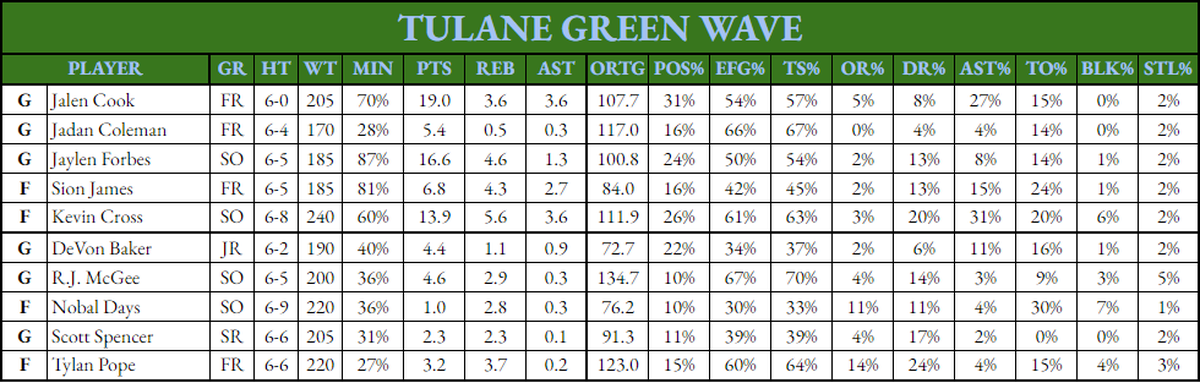
Jalen Cook is a 6-foot point guard who is a former top-100 recruit that transferred to Tulane for his second freshman season after being outside of the rotation last season at LSU. Scoring a player the caliber of Cook was a major win for Hunter and the coach has turned the offense over to him, as Cook has posted a 107.7 offensive rating with a conference-high 30.7% usage rate. The ball is almost always in his hands, usually running a pick and roll where he is most dangerous because he is a three-level scorer and a more-than-capable passer. To boot, he’s dangerous without the ball when he’s spotting up because he is a 43% three-point shooter. If he can continue his efficiency shooting off the dribble on those screens and maintain his effectiveness driving to the basket against AAC competition, he will solidify his place as a rising star in the league.
What to know about the offense
Hunter has built an intriguing foundation with a pair of SEC transfers in Jalen Cook (LSU) and Jaylen Forbes (Alabama), a duo that is averaging a combined 35.6 points this season. With Cook running the show and Forbes hunting three-pointers around the perimeter, Tulane’s shooting percentages have ticked up. It also helps when your two best players are also great three-point shooters, as Cook is averaging 2.0 makes per game at a 43.2% clip and Forbes is averaging 2.7 makes per game at a 37.5% clip. While center Kevin Cross has good vision and passing touch for a big man, their shooting prowess has turned him into an assist machine (3.6 assists per game, 30.7% assist rate) with most of his job requiring simply handing the ball off and using his 6-foot-8, 240-pound frame to shield the defense. Cross makes a good pick-and-roll partner with Cook, as he’s capable of scoring out of the short roll or rolling hard straight to the basket. Tulane’s offense revolves around a little too much off-the-dribble and mid-range shooting to expect the Green Wave to consistently win against the AAC’s wealth of elite defenses, but Cook and Forbes gives Tulane a chance against just about anybody if they’re both on.
Five most popular play types
Play | Count | PPP | %tile Rank |
Jaylen Forbes open catch-and-shoot 3-pointer | 18 | 1.29 | 91st |
Jaylen Forbes perimeter drive to the basket | 14 | 1.24 | 88th |
Jalen Cook pick and roll off-the-dribble 3-pointer | 12 | 1.06 | 73rd |
Jaylen Forbes off-the-dribble 3-pointer | 11 | 1.03 | 69th |
Jaylen Forbes guarded catch-and-shoot 3-pointer | 21 | 0.84 | 43rd |
Note: Data from ShotQuality.
What to know about the defense
Creating havoc and forcing turnovers has long been a calling card for Hunter-coached teams on defense and this Tulane squad is no exception. The Green Wave are forcing nearly 16 turnovers per game out of their trapping zone defense and on nearly 22% of possessions, which ranks No. 59 in the country. But if the opposition can avoid turning the ball over against Tulane, then its chance of success skyrockets. While Tulane is great at forcing turnovers, it’s below average at just about everything else on defense. The Green Wave are giving up the seventh-most open three-pointers in the country and just too many great looks in general, which is why opponents are assisting on 62% of made baskets against Tulane with an effective field goal percentage of 49.9. Another glaring issue has been Tulane’s inability to rebound (No. 300 in allowed offensive rebound rate) out of its zone defense, as it has been routinely crushed by opponents in second-chance points. If Tulane can maintain its effectiveness at forcing turnovers in conference play, then it might be a worthwhile trade-off for what it gives up in the aggressive zone defense.
9. East Carolina Pirates (9-3)
Ratings: No. 137 T-Rank, No. 153 ESPN BPI, No. 153 Haslametrics, No. 155 ShotQuality, No. 169 KenPom, No. 174 Sagarin.
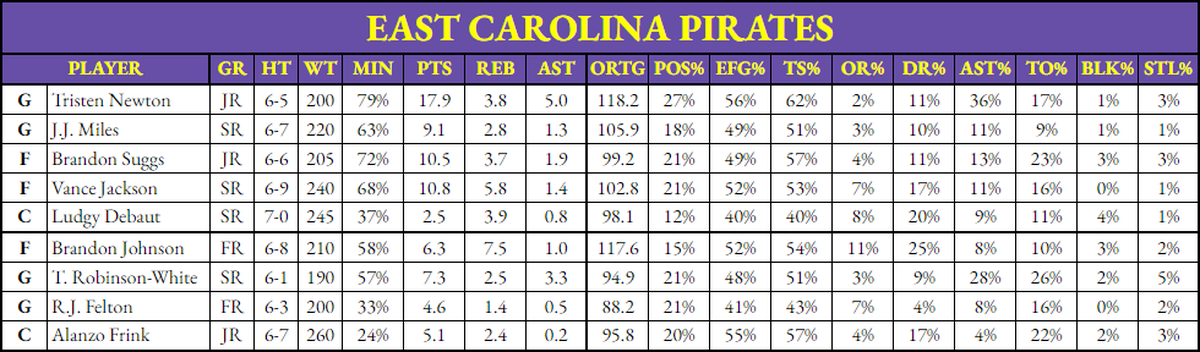
Before conference play has even begun, East Carolina is already on the brink — it only needs 11 — of matching the most wins in a season since 2017. Despite losing all-conference stud Jayden Gardner to Virginia, ECU has improved its offense to date by turning it over to 6-foot-5 sophomore Tristen Newton, who is averaging 17.9 points, 3.8 rebounds, 5.0 assists and 1.5 steals with an extremely efficient 118.2 offensive rating on a high-volume 27% usage rate. ECU coach Joe Dooley also hit a home run in finding Gardner’s replacement in Vance Jackson, a former top-100 recruit who has bounced around at UConn, New Mexico and Arkansas and is now averaging 10.8 points, 5.8 rebounds and drilling 2.2 three-pointers per game at a 38.2% clip. ECU is off to an 8-0 start at home, although there are no wins of note, and has been competitive in all three of its losses to top-125 KenPom teams in Oklahoma (by five), Davidson (by nine) and Liberty (by 10). ECU seems to have its best chance at finishing outside the bottom three in the AAC for the first time since 2015.
Player to know
Tristen Newton is a 6-foot-5 lead guard who is blossoming in his third season at ECU now that Dooley has put the ball in his hands to run most of the offense. As mentioned above, Newton has delivered a rare blend of increased efficiency on increased volume. Maybe that shouldn’t be much of a surprise because Newton has always been a skilled playmaker at ECU, but it would have been hard to expect this kind of success — his assist rate of 35.5% is 32nd-best in the country and he’s lowered his turnover rate to 17.3%. He’s a good enough three-point shooter (34.5%), but where Newton has leveled up the most this season has been inside the arc. He’s scoring 1.34 points per possession on drives to the basket, among the best marks in the country, and he’s been a lethal mid-range shooter in the pick-and-roll game. Throw in the fact that he’s been devastating in transition and Newton has blossomed into one of the most talented offensive players in the conference.
What to know about the offense
Despite losing its best player from last season, Jayden Gardner, East Carolina has managed its best offense under coach Joe Dooley because of how well Tristen Newton has played so far this season. The Pirates are up to No. 161 in KenPom’s adjusted efficiency, which isn’t great, but it’s a drastic improvement over what their output has been recently. Newton has morphed into one of the best playmakers in the country, while the addition of Vance Jackson, a 6-foot-9, 230-pound fifth-year senior, has given ECU’s offense a new dimension with his ability to stretch defenses. He is the ideal center who has the size to hold his own on defense and the shooting (team-best 2.2 three-pointers per game on 38.2% accuracy) to be a mismatch on offense. ECU is making a lot (36.5%) of its three-pointers right now, moving the ball (61.3% assist rate) and finishing well around the rim (1.16 points per possession), which is propping up the offense against lower-level competition. There’s a lot of promise here and if ECU can stave off steep regression, then it should have a rather good offense by AAC standards.
Five most popular play types
Play | Count | PPP | %tile Rank |
Vance Jackson open catch-and-shoot 3-pointer | 22 | 1.14 | 80th |
Vance Jackson guarded catch-and-shoot 3-pointer | 26 | 0.98 | 63rd |
Tristen Newton open catch-and-shoot 3-pointer | 22 | 0.98 | 63rd |
J.J. Miles guarded catch-and-shoot 3-pointer | 29 | 0.82 | 40th |
Tristen Newton guarded catch-and-shoot 3-pointer | 21 | 0.79 | 35th |
Note: Data from ShotQuality.
What to know about the defense
East Carolina has one of the biggest starting lineups in the country with every player at least 6-foot-5 and a 7-foot center in Ludgy Debaut. But that size advantage hasn’t translated much into any tangible advantage for the team, as ECU is just an average rebounding and shot-blocking team. The Pirates have also given up too many good looks, as they rank No. 286 in allowing shots at the rim and three-pointers. Life is only going to become more difficult in AAC play, so ECU would need to make drastic improvements to finish higher than this.
10. Temple Owls (7-5)
Ratings: No. 108 ShotQuality, No. 132 Sagarin, No. 144 KenPom, No. 175 T-Rank, No. 182 ESPN BPI, No. 203 Haslametrics.
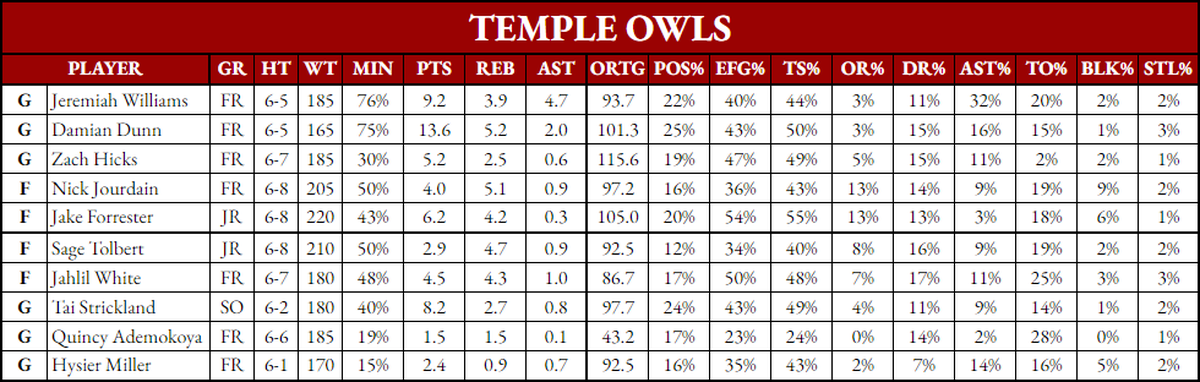
It’s difficult to discuss Temple without first mentioning it was dealt a devastating blow when it lost star Khalif Battle, who was averaging 21.4 points, to a season-ending foot injury at the start of December. It’s a disappointing news for a Temple squad that appeared poised to be a sleeper team in the AAC this season. It remains to be seen if this can be the best team yet under coach Aaron McKie, now in his third season, but dreams of pushing for a top-four finish have diminished without its star player. Without Battle, the offense becomes a major concern for the Owls moving forward, although Damian Dunn is a nice player. Temple has had terrible injury luck under McKie, but he has assembled a very talented young core of freshmen and sophomores, a foundation that should make Temple a player in the AAC in the years to come. But due to Battle’s injury, it appears the Owls are another year away from making serious noise in the conference.
Player to know
Damian Dunn is back for his third freshman season at Temple, where the 6-foot-5 scoring guard is averaging 13.6 points, 5.2 rebounds and 2.0 assists as the new center piece of the offense. In the five games since Battle’s season-ending injury, Dunn has averaged 17 points, including a 27-point outburst against Penn. Dunn is actually a below-average shooter from the floor, but he’s so effective because he’s so hard to stay in front of and he’s a foul magnet. He actually led the country with 8.0 fouls drawn per 40 minutes, which results in a ludicrous 75% foul rate (103 free throws, 138 field goal attempts). So far this season Dunn hasn’t been able to replicate those numbers yet, but he is cashing in on 86% of his free throws and is averaging five trips to the line in his last five games. He won’t have much shooting around him, so he’s likely to be even more dependent on drawing fouls this season.
What to know about the offense
Battle was the kind of star player who was capable of elevating an entire offense by generating so much efficient offense for himself, enough to carry the team. Without him, Temple loses one of the most lethal scoring threats in the conference and a huge piece of its offense. Damian Dunn will do his best to fill in as the lead scorer, but he has nowhere near the same gravity (he is a career 25.8% three-point shooter). Jeremiah Williams is an excellent playmaker and is also skilled at manufacturing trips to the foul line, just like Dunn. In facts, free throws are what power this offense. Temple has the 28th-best foul rate in the country, which makes up a good chunk of its offense. Another way the Owls have survived with such poor shooting is rebounding a good amount of their own misses (No. 61 in offensive rebounding rate), as Jake Forrester and Nick Jourdain have been excellent in giving Temple second chances. Spacing is going to be an issue all season for Temple, so it will rely heavily on free throws and offensive rebounds to keep the offense afloat.
Five most popular play types
Play | Count | PPP | %tile Rank |
Jake Forrester cut drop-off pass at basket for layup | 11 | 1.26 | 89th |
Zach Hicks open catch-and-shoot 3-pointer | 21 | 1.24 | 88th |
Zach Hicks guarded catch-and-shoot 3-pointer | 20 | 1.06 | 73rd |
Damian Dunn guarded catch-and-shoot 3-pointer | 13 | 0.94 | 58th |
Damian Dunn open catch-and-shoot 3-pointer | 12 | 0.89 | 51st |
Note: Data from ShotQuality.
What to know about the defense
Temple has a tradition of being excellent on the defensive end and while this Owls’ squad may not be elite, they are still fairly good. The Owls don’t force many turnovers and sometimes struggle on the glass, but they have been excellent this season in protecting the paint. Temple has the 37th-best two-point defense (44.5%), mostly because it is blocking shots at the 27th-highest rate in the country. Credit once again goes to Jourdain, who has a top-50 block rate at 9.2%, and Forrester, another excellent shot blocker. Opponents are scoring just 0.94 points per possession at the rim, which is a top-50 mark by the Temple defense. If there is hope for the Owls to still make a push for somewhere in the middle of the pack, it’s because of how stingy their defense could be this season with long, rangy athletes one through five.
11. South Florida Bulls (5-7)
Ratings: No. 202 ShotQuality, No. 209 Sagarin, No. 226 ESPN BPI, No. 238 KenPom, No. 243 T-Rank, No. 254 Haslametrics.
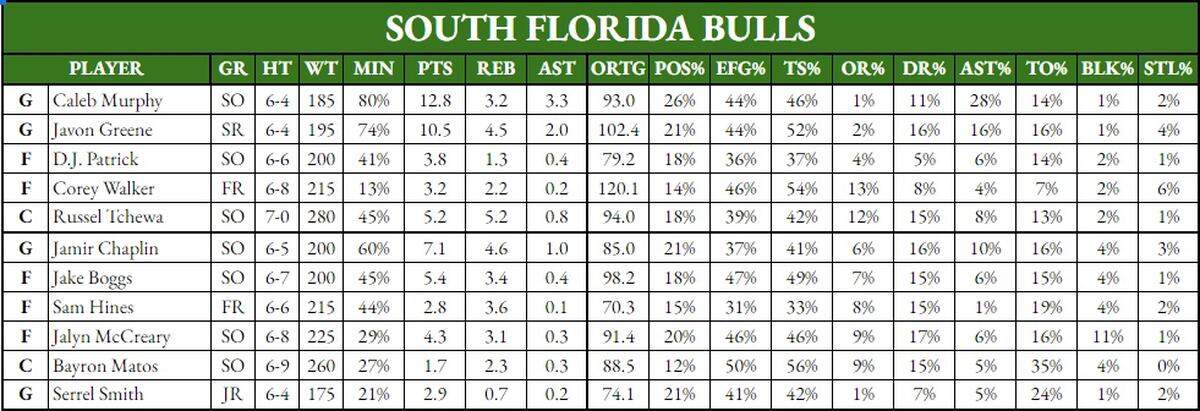
In the fifth year of the Brian Gregory era in Tampa, South Florida has entered into another total rebuild. Gone are 10 of the 13 players from last season’s roster, replaced with a mix of mostly freshmen and sophomores that make up the ninth-youngest roster in the country. That explains a lot about why it’s been such a rocky start for USF, which lost at home to Georgia Southern (by 12) and South Carolina State and needed a late game-winner to edge North Carolina A&T. The defense will keep USF in some games and perhaps pull off an upset over an absent-minded opponent, but it’s hard to put much faith in the Bulls escaping the bottom of the league with how poorly they’ve shot the ball this season.
Player to know
Caleb Murphy, a 6-foot-4 lead guard, is a former top-100 recruit who had a solid debut year last season. Given the reins of the offense full-time this season in his second freshman campaign, Murphy is averaging a team-high 12.8 points and 3.3 assists. The ball is constantly in his hands and Murphy excels at creating his own shot, although his upside is severely capped because he is not a three-point threat (he’s 0-for-8 on triples through 12 games this season). That leaves Murphy mostly pulling up for mid-range jumpers and trying to attack the rim against stacked defenses, a combination that has added up to a less-than-stellar 93.0 offensive rating. Ideally, Murphy would be surrounded by good shooters to space the floor and give him the proper space to operate, but that just isn’t the case at USF.
What to know about the offense
Trying to implement so many new faces into the offense has been a struggle for USF, evident by the Bulls being in the bottom-15 in the country in shot selection, spacing and shot making. The problems revolve around USF’s inability to make a shot from the outside, as the team is shooting just 23.0% on three-pointers, the third-worst mark in the country, which is why USF ranks bottom-10 with its 40.9 effective field goal percentage. Defenses aren’t concerned about kick-outs and USF is reluctant to take threes, which allows the opposition to load up in the paint and is the reason why USF ranks in the bottom-15 in the country in rim-and-three rate and efficiency (1.01 points per possession) when they do take the two most valuable shots in the halfcourt.
Five most popular play types
Play | Count | PPP | %tile Rank |
Javon Greene open catch-and-shoot 3-pointer | 23 | 1.18 | 83rd |
D.J. Patrick open catch-and-shoot 3-pointer | 22 | 0.90 | 52nd |
D.J. Patrick guarded catch-and-shoot 3-pointer | 17 | 0.75 | 29th |
Caleb Murphy pick and roll off-the-dribble long mid-range jumper | 38 | 0.68 | 20th |
Caleb Murphy pick and roll off-the-dribble short mid-range jumper | 18 | 0.66 | 17th |
Note: Data from ShotQuality.
What to know about the defense
Gregory-led teams have historically been pretty stingy on defense and this year’s USF team is no different. The Bulls have survived by protecting the paint well, ranking No. 68 in limiting the number of rim finishes and No. 63 at limiting the efficiency (0.97 points per possession) of opponents once there. Even though USF is one of the best shot-blocking teams (No. 29) in the country, it doesn’t have a dominant shot-blocker — or at least one in the starting lineup. Most of USF’s rim protection comes from wings like Jamir Chaplin, Jake Boggs and Sam Hines, while reserve forward Jalyn McCreary has impeccable timing but plays less than 14 minutes per game. USF loves nothing more than to slow the tempo, stop opponents from running in transition and force them to work through their offense in a halfcourt setting. But by selling out to protect the paint, the Bulls give up a lot of three-pointers and they have been susceptible to giving up those long rebounds and allowing opponents to cash in on second chances in losses.
This story was originally published December 30, 2021 at 6:11 AM.
.jpg)