
Why zone defense bothered Wichita State basketball and how the Shockers conquered it
For the first time this season, the Wichita State men’s basketball team had to solve a zone defense.
Struggling, but ultimately conquering the challenge may very well be the biggest takeaway from the Shockers’ 71-58 win over Norfolk State at Koch Arena on Saturday.
According to the Synergy logs, WSU had faced only six possessions against zone defense before Saturday’s game, when Norfolk State went with its match-up zone for 39 possessions.
How WSU fared against it was a true tale of two halves. The zone threw the Shockers for a loop and they looked like a team unsure of how to attack it, which translated to 0-for-10 shooting and just five points in 17 possessions against the zone in the first half. But after halftime adjustments, WSU shredded the zone in the second half — scoring 26 points in 22 possessions.
“That’s what it’s all about,” WSU star Tyson Etienne said. “It’s December. We want to (keep building toward a peak). We don’t want to be super high and make a dip.
“I know we’ll continue to build on this. It’s not 100%, but it’s something we’re going to continue to get better at.”
Here’s a closer look at why Wichita State struggled and how the Shockers ultimately conquered the zone.
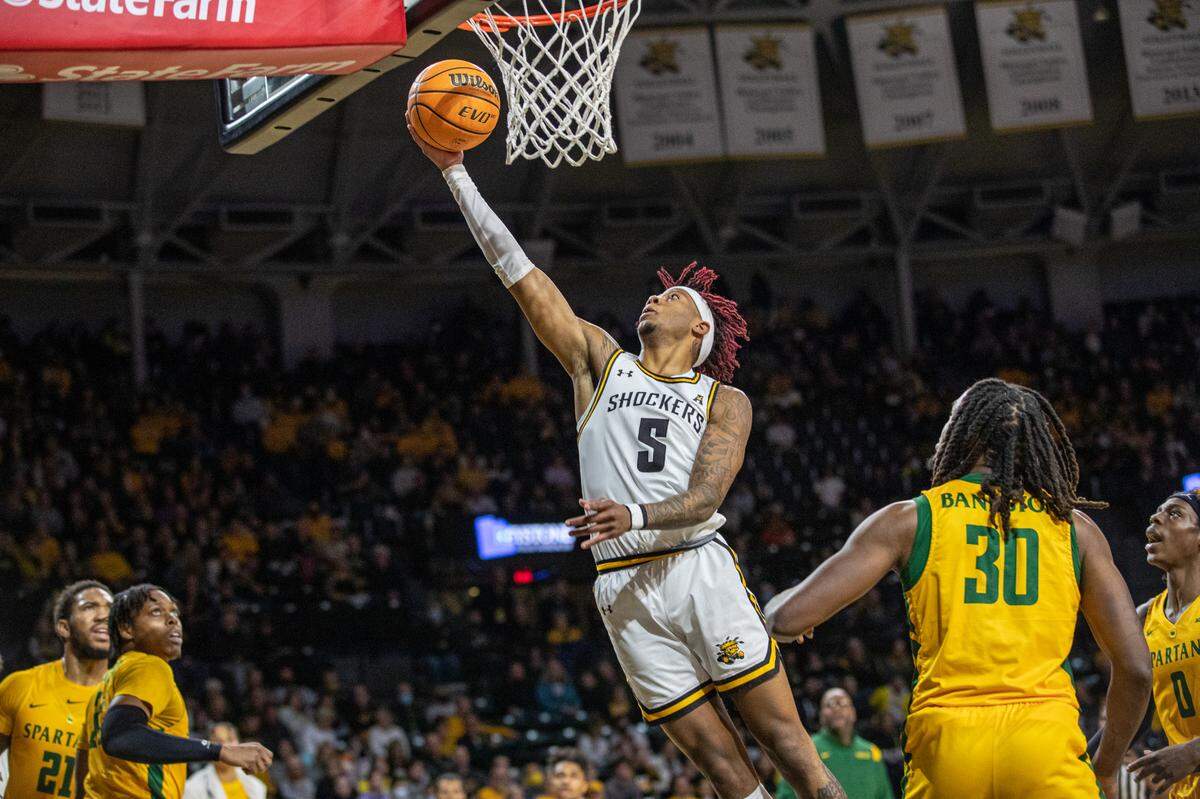
Why Wichita State struggled against the zone
It wouldn’t have been hard to guess Wichita State hadn’t faced much zone defense this season judging by how it reacted once Norfolk State switched to a 3-2 match-up zone midway through the first half.
WSU was such a force on offense for the first six minutes of the game in building a quick, double-digit lead that it was out of pure survival instincts that Norfolk State coach Robert Jones was forced to go zone. And that’s when the Shockers went from dynamic to lethargic.
Sure, WSU coach Isaac Brown’s commitment to “more movement, less dribbles” after the K-State debacle showed with much better ball movement against Norfolk State. But WSU learned the hard way that more passing does not automatically equate to more scoring.
The Shockers were timid with the ball facing the zone in the first half, lacking the creativity and boldness to find the necessary soft spots and gaps to collapse the defense. Too many times WSU passed the ball aimlessly around the perimeter, failing to crack the three-point arc with a single penetrating pass or dribble. There was even a possession or two where WSU’s players looked like they were standing in cement, paralyzed as they tried to process in real time what to do against the zone.
“I thought they had a lot to do with it,” Brown said. “Anytime you get stagnant against man, that happens sometimes when you’re forcing it and taking bad shots. But that match-up zone... it’s really tough.”
WSU fell victim to doing exactly what its opponent wanted it to do: launching shot after shot behind the three-point line. The Shockers finished the first half shooting 0-for-10 from the field against the zone, including 0-for-7 on three-pointers.
“We didn’t do a good job of attacking the match-up zone,” Brown said. “We got really stagnant. In the second half, we were able to attack it. We went with a different (offense). I wish we had called it earlier.”
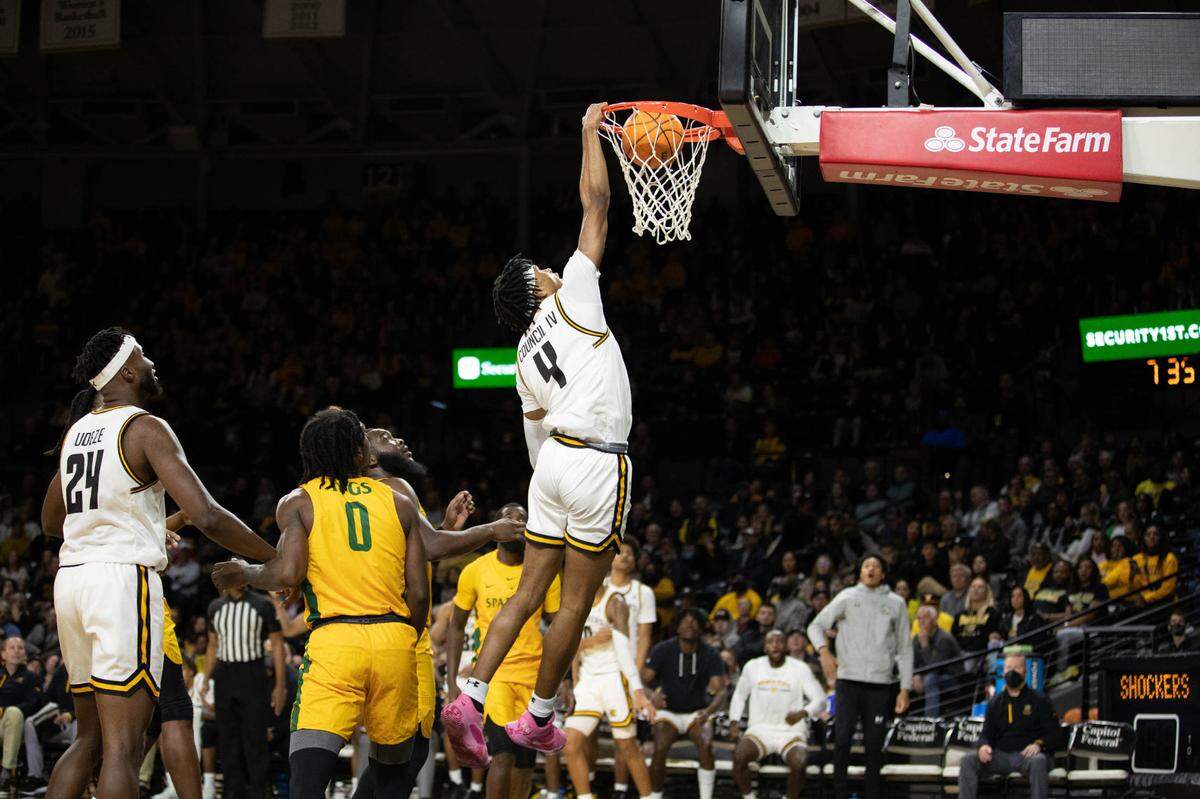
How the Shockers conquered the zone defense
WSU made it clear on its first possession after halftime that it had a new strategy in attacking the zone.
The Shockers ripped off six passes in 12 seconds, as Tyson Etienne, Craig Porter and Dexter Dennis moved the defense with each pass and combined them with penetrating dribbles that sent Norfolk State scrambling and eventually led to a wide-open Dennis lay-in because of the crisp movement.
It was a sign of what was to come for WSU: a clear intention in penetrating the zone with more intentional passing and more aggression off the bounce. The Shockers took more two-pointers than three-pointers in the second half and made 9 of 18 shots, scoring 1.18 points per possession on 22 possessions against Norfolk State’s zone defense.
The WSU coaching staff also introduced a new wrinkle to WSU’s zone offense that proved to be the coup de grâce to Norfolk State. After dotting the perimeter with four players in the first half, Brown took Ricky Council IV, a 6-foot-6 burgeoning play-maker, off the three-point line and asked him to find the soft spot in the middle of the zone defense in the second half.
“At halftime, we drew up a play called ‘Single’ and we put (Council) in the middle of that play,” Brown said. “We want him to get a catch in the middle and everybody else flatten out around him. He was able to drive and score it and make some good passes. I thought that took them out of their match-up zone.”
On the very first possession for Council in his new role, he found an opening around the free throw line and received a pass late in the shot clock. With the floor spaced and the ball in his hands 15 feet away from the goal matched up 1-on-1 with a defender, Council was in his element. He executed a step-back move perfectly paired with a pump fake, leaning into a free-throw line jumper that he tear-dropped in while being fouled from behind by the defender. Council immediately pointed to the WSU bench to recognize the coaching move.
A minute later, Council received another pass around the free throw line with the floor spaced around him. He pivoted and needed only two dribbles to blow past the defender and elevate for an easy, two-handed slam.
“It was just a great call by coach IB,” said Council, who finished with seven points and four assists in the second half. “He wanted me in the middle and I just made plays for myself and others. I think it just opened everything up and helped the team overall.”
After a career-high six assists against Norfolk State, Council has the second-best assist rate (21.6%) on the team. He is rapidly evolving from a one-on-one scorer to a true play-maker that can carry an offense, which is why he’s likely to occupy that role floating in the middle of the zone the next time the Shockers come across one.
“Ricky is going to be a key player for us moving forward,” Porter said. “A big part of that is because he can create for himself and for others. So putting him in that spot is going to be a big key for us. That’s something we’re going to look for from him.”
But don’t be surprised if WSU dusts off the playbook and finds Council at least one this season on a back-side, alley-oop play over the top of the defense. It’s not hard to imagine Etienne throwing the pass with center Morris Udeze providing the blind-side screen on the bottom defender to allow Council to soar for a highlight-reel dunk.
Speaking of Etienne, although Saturday was the first game this season where he failed to record an assist, his true impact on WSU’s offense cannot be captured in a box score.
Even though his shooting percentages have dipped early this season, Etienne still commands so much attention from every defense. It’s the kind of shooting gravity that no other Shocker possesses, as defenders are pulled into Etienne’s orbit every time he spots up on the three-point line. So while Etienne might not be the one making the assist pass, he is bending defenses in a way that is opening up shots for teammates.
How defenses react to WSU’s offense without Etienne on the floor is a stark contrast. The openings Etienne’s presence creates suddenly vanish without the same shooting gravity on the floor. It wasn’t a coincidence WSU outscored Norfolk State by 17 points with Etienne on the court, the highest plus-minus for any player.
There was no better example of this gravity than a possession midway through the second half against Norfolk State’s zone defense when Etienne passed the ball to the top and cut from the right wing all the way through to the left corner. Because Etienne is such a high priority, Norfolk State’s defender on the right wing followed him all the way to the paint to communicate with his teammate that Etienne was cutting through. Meanwhile, Monzy Jackson was spotting up for an open three-pointer he drilled in the space vacated by Etienne — because the defender was so distracted by Etienne.
WSU was far from flawless in its performance against Norfolk State, but it finding positives to build on — improved ball movement, Council’s development as a play-maker and Etienne using his gravity to free others — was an important step in the growth of the team.
Tougher zone defenses are on the way. It’s important to keep in mind Norfolk State ranks No. 230 in KenPom’s defensive efficiency metric. But it was nevertheless a step in the right direction for the Shockers, who should now have a better idea of how to attack a zone defense because of their experience on Saturday.
“Anytime you can move the basketball and it’s not sticking in one person’s hands and you’re not taking 10 dribbles, it’s hard for the defense to guard that,” Brown said. “Anytime you can make the defense shift that helps your offense. We did a great job of moving the basketball, setting screens, rolling to the rim and playing inside-out.
“I felt like we got better tonight.”
This story was originally published December 12, 2021 at 6:50 AM.
.jpg)