
Diagnosing the issues on offense for Wichita State basketball and fixes for Shockers
Changes are coming on offense for the Wichita State men’s basketball team.
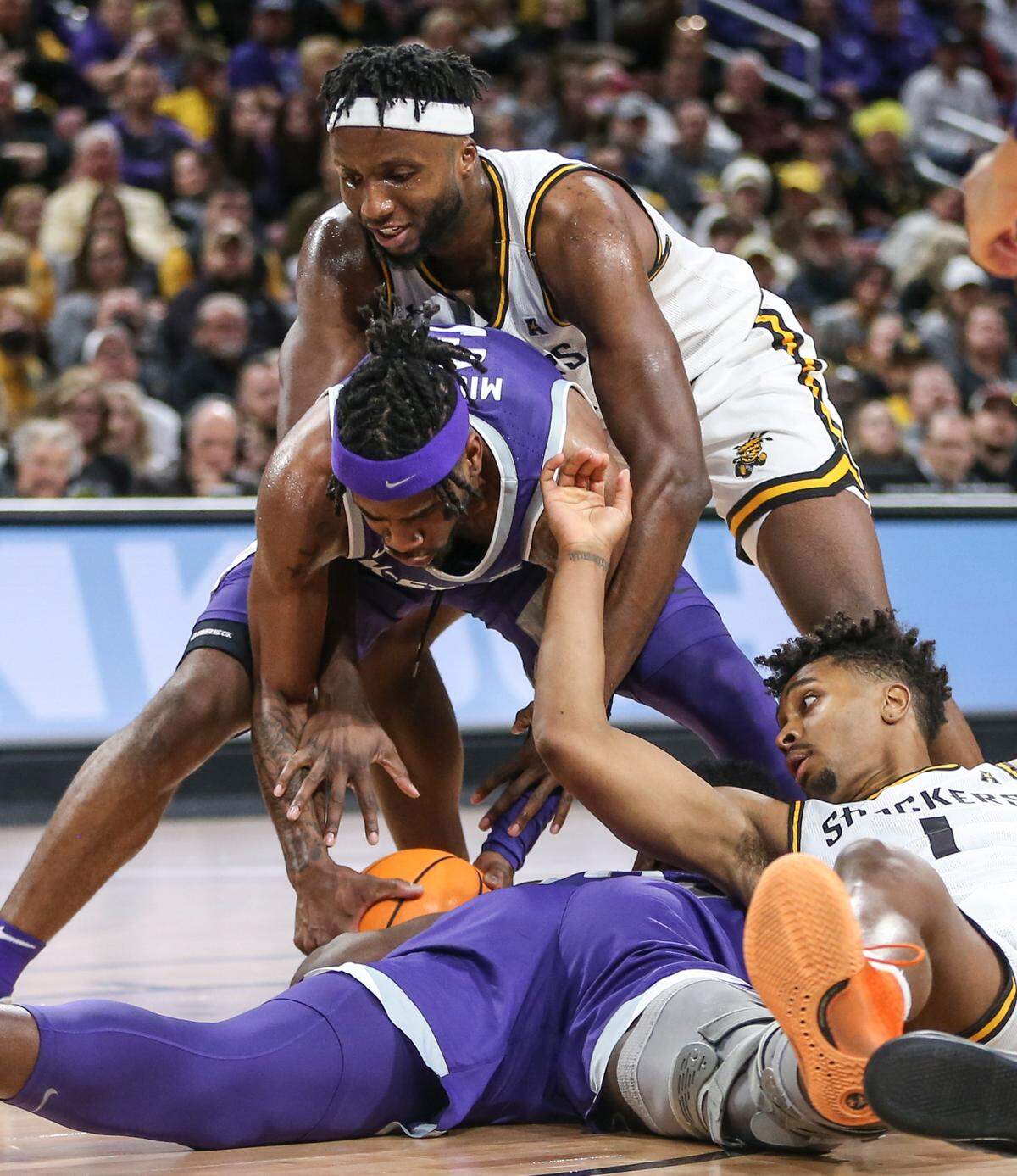
At least that’s what coach Isaac Brown promised this week following the Shockers’ worst offensive showing yet, where two seven-minute scoring droughts doomed them in a 65-59 loss to Kansas State on Sunday.
All of WSU’s worst offensive habits came to the forefront during the K-State game, a fatal mix of poor spacing, poor ball movement, poor screening, poor cutting to go along with poor decision-making to consistently settle for contested jump shots. Somehow, the Shockers were even worse in transition where careless mistakes left them coming away empty too many times.
“That was probably the most painful loss in my eight years at Wichita State, but I know we’re going to learn from that game,” Brown said on his radio show. “Last year when we lost to Missouri and lost to Oklahoma State, we didn’t point fingers, we had to figure out how to get better and we got better. We ended up winning 14 of our next 16 games.
“Sometimes it takes losing a game in order to get better, so hopefully this will help us down the line.”
So what is wrong with Wichita State’s offense? And what has to change starting with Saturday’s 6 p.m. game against Norfolk State at Koch Arena?
Here are the five most pressing issues for the Shockers and how they can fix them.
The problems with the Wichita State basketball offense
Problem 1: Generating enough quality shots anywhere on the court
WSU is among the worst in the country in the quality of its shot selection (No. 335), as judged by ShotQuality, an analytics site that uses more than 90 variables to rate the efficiency of each shot.
It’s not hard to figure out why WSU is posting its worst effective field goal percentage (46.2) since the turn of the century. The Shockers make just 45.1% of their two-pointers, far below the national average of 49.5%. WSU is among the worst teams in the country at finishing at the rim (detailed further below) and mid-range shooting.
Because WSU hasn’t been much of a threat inside the arc, it’s difficult to generate open looks on the perimeter. In fact, per ShotQuality, the Shockers are in the bottom-20 nationally in the quality of their looks at the rim and on three-pointers, the two most valuable shots of the game. ShotQuality also shows WSU struggles to generate open threes (No. 285 nationally) and takes a ton of off-the-dribble threes (No. 25 nationally).
Problem 2: Squeezing enough juice out of ball screens
Three other problems — shot selection, turnovers and efficiency near the rim — play into WSU’s struggles with its ball-screen offense. Lack of proper spacing and shooting gravity also play into these struggles.
Right now WSU has a bad combination of doing a lot of something that it isn’t good at. The Shockers rank No. 236 nationally in efficiency out of ball-screen offense, per Synergy, which is a problem because they have the 41st-most possessions (27.3 per game) originating from a ball screen.
Problem 3: Turning the ball over
WSU is turning the ball over on 20.8% of its possessions (or 14.6 turnovers per game), which is its highest rate since the 2008-09 season. It’s an extremely small sample size, but it paints the picture of how turnovers are costing the Shockers.
Even more troubling is that WSU ranks No. 297 in the country in non-steal turnovers (55% of its turnovers have not resulted in a steal by the opponent), which means the bulk of those turnovers are largely unforced mistakes.
Problem 4: Struggling to get to the rim and finish
The best source of offense is manufacturing ways to take high-quality shots close to the rim. Right now WSU’s offense is mostly devoid of those shots.
The Shockers rank No. 275 nationally in generating shots at the rim and No. 351 nationally in the quality of those shots, per ShotQuality.
It’s that lack of quality that explains why WSU is shooting 51.8% at the rim, per Synergy, far below the league average of 57.9%.
Problem 5: Leaving points on the table in transition
The Shockers aren’t the worst team in the country at fast breaks. They’re the second-worst.
WSU turns the ball over (27.1% of the time) in transition more than any team in the country, per Synergy, and ranks No. 354 out of 358 teams with its 34.5% shooting. Add it all up and the Shockers are scoring an abysmal 0.62 points per possession in transition, per Synergy, costly missed opportunities at easy baskets for an offense that has struggled to score in the halfcourt.
To put it in perspective, WSU has lost 4.9 points per game this season that it would have otherwise scored with just the national average efficiency of 1.02 points per possession in transition.
How Wichita State basketball will try to fix its offense
Wichita State was aware of its issues on offense well before its 65-59 loss to K-State on Sunday, but sometimes it takes an ugly loss to bring about the urgency to make the appropriate changes.
At least that’s what WSU coach Isaac Brown will hope for after his team attempted a season-high in mid-range jumpers, a season-low in shots at the rim and finished with a season-low eight assists.
“We played a little too much hero ball,” Brown said on his radio show. “The ball didn’t move. It was sticking in everybody’s hands. I felt like we got casual. We didn’t make smart decisions on offense. The one thing we’ve got to learn from it is we’ve got to execute. You can’t play 1-on-1, you can’t play hero ball.”
So what has to change?
Brown effectively summarized the needed changes in WSU’s offense in four words in his press conference this week.
“More movement, less dribbles,” Brown said.
No team exemplifies that strategy more than Bellarmine, a team that almost never uses a ball screen, rarely dribbles and generates almost all of its offense from passing. It’s a philosophy developed by coach Scott Davenport, who discussed it on The Basketball Podcast in October and dropped a nugget that very well could serve as WSU’s north star going forward.
“What happened over time is I applied what I learned from coach (Rick) Pitino and coach (Denny) Crum and both those great coaches in their pressing philosophy only had one goal and that was to make you uncomfortable and speed you up where you would make a mistake,” Davenport said. “What evolved at Bellarmine was, ‘Let’s do that on offense. Let’s press on offense.’ So how do you press on offense? You press on offense by making the defense uncomfortable and you speed them up. Well, how do you do that? You don’t do that dribbling. You do that off the pass because when you move the ball, you move the defense.”
Moving the defense with the pass is something WSU has struggled mightily with. Almost all of its assists are coming off dribble penetration. Rarely does WSU ever have a hockey assist, stringing together two impactful passes in a row. A change to a motion offense should help rectify that.
Right now the Shockers’ offense doesn’t feature much off-ball movement, which is to be expected with how much WSU has leaned into its ball-screen offense in Brown’s second season at the helm. WSU has more possessions originating from ball screens (27.3 per game) than ever before — edging out the 2018-19 team that ran 26.5 per game.
Not only are the Shockers struggling to score efficiently out of their pick-and-roll game, those plays seem to be developing bad habits for the other three players not involved in the action. While the ball handler and the screener are moving, the other three players on the court — two shooters spotted up in the corners with the off-guard drifting on a wing — are essentially just standing there and doing nothing. Because three-fifths of WSU’s offense is stationary and the ball is sticking in one place, defenses aren’t being challenged and are being allowed to set up the chessboard with their help defense.
“When you go up against a good defensive team, the ball cannot stick,” Brown said. “You cannot have 10 dribbles and be in the same spot. You’ve got to move it. You’ve got to cut. You’ve got to set more screens.”
In an ideal world, Brown detailed what he wants the movements to be like in WSU’s ball-screen offense.
“We’ve got to do a better job of getting the big sprinting out to force the other big to be late,” Brown said. “We’ve got to do a better job of when our guards do come off ball screens, they’ve got to make two people guard them. And then the other guys need to be interchanging. Our big has got to sprint to the basket to make them tag and our off-side guard has got to sprint up looking for a shot.”
In theory, those movements should put the defense in a bind if executed correctly. But right now WSU is working with a high degree of difficulty because of its lack of shooting gravity, meaning that few Shockers are shooting good enough percentages on three-pointers for the defense to be sucked into their orbit around the perimeter. WSU is making just 31.9% of its catch-and-shoot three-pointers and if you take out Ricky Council’s 8-for-14 accuracy, then that number drops to 28.6%.
Simply put, defenses are collapsing to the paint every time the Shockers even show the threat of dribble penetration. Open shots are available, but WSU is either failing to knock them down or identify them quick enough to make the defense pay.
“We didn’t do a good job with our spacing against K-State and every time we came off a ball screen, they were helping off the weak side,” Brown said. “We’ve got to make better reads in those decisions.”
That lack of shooting threat impacts WSU’s two most dangerous scorers, Tyson Etienne and Council, the most. When they are coming off a ball screen, the defense can afford to turn its entire attention to stopping them. Right now they aren’t concerned with a kick-out pass to Dexter Dennis (23.5%), Craig Porter (28.6%), Qua Grant (26.1%), Joe Pleasant or Monzy Jackson, so those help defenders are coming completely off them to clog up potential driving lanes for Etienne and Council.
Where Etienne and Council have both run into trouble this season is when they start to press in the pick-and-roll game and begin to force things. For Etienne, that usually means him settling for an off-the-dribble jumper over a contest with plenty of time left on the shot clock. For Council, that usually means trying to force his way through the crowd of help defense that often ends in a turnover.
After the K-State loss, Brown seemed dedicated to eradicate those type of shots and plays from WSU’s offense as much as possible.
“When you go back after a loss, the video is going to sting a lot,” Brown said. “You have to go back and put on the board, ‘This was a bad shot.’ We can’t continue to take those shots. We’ve now got to look at some of the percentages. If you’re not making a high percentage, then you definitely can’t take those shots.”
WSU is making the job easier than it should be for opponents with its poor spacing, a simple fix that can open up driving lanes that haven’t materialized this season for the Shockers. Wider driving lanes give WSU’s ball handlers more room to operate, which could make a difference in their ability to finish more at the rim.
What is interesting is that WSU has actually found the most success doing this when it uses Etienne or Council as the decoy in ball screen actions. The Shockers found a creative way to use Etienne’s gravity against Missouri, using him to set dummy screens and clear out to the short corner to open the floor up for Morris Udeze rolls. Against Oklahoma State, WSU found success using Council as the back screener in “Spain” pick-and-roll actions to free up Udeze for rolls to the basket.
Until WSU’s other shooters prove they can make defenses pay by knocking down kick-out looks, using Etienne and Council in these ways seem to be the Shockers’ most potent way to operate in ball screens.
Right now it’s hard to pinpoint anything WSU is doing crisply on offense. That needs to change over the course of the next four games at Koch Arena before WSU opens American Athletic Conference play. The Shockers need better ball movement, better screens, better cuts and better timing. The shots will come and go, but WSU has a much better control on how the offense looks.
And if the Shockers go through another lull, Brown vowed on his radio show that he will do a better job of calling timeouts to reset the team during scoring droughts and holding players accountable for negative plays.
“I’ve got to do a better job when we’re struggling to score to run offense where we’ve got to move the ball and we’re not trying to beat someone off the dribble,” Brown said. “We met (Monday) and talked about executing. We’ve got to get players to execute. I’ve got to hold players accountable. I told them, ‘We’re getting a little loose.’ Every time you turn it over, you’ve got to be coming out. I got got to call timeouts when we’re not executing at a high level.”
This story was originally published December 10, 2021 at 6:00 AM.
.jpg)