
A breakthrough, a snub and a grudge: The oral history of Jordan’s ’81 game in Wichita
Before building his case as the greatest basketball player of all-time, with five NBA MVP awards and six NBA titles, before the game-winner in the NCAA national-championship game, there first came Wichita in Michael Jordan’s legendary career.
Nearly four decades have passed now, and the memories of Jordan’s first appearance in Wichita are beginning to fade. Some might not even be aware that Jordan’s career included an important stop in Wichita, when he played in the McDonald’s All-American game at Levitt Arena on April 11, 1981.
It was in Wichita where a wiry, 6-foot-5, little-known guard from Wilmington, North Carolina, who introduced himself as Mike Jordan, showed the first glimpse of Michael Jordan on a national stage. Jordan scored 30 points to break the game’s scoring record, which stood for another 18 years, including the game-winning free throws with 11 seconds left to lift his underdog East team to a 96-95 win.
It was also in Wichita where Jordan, notorious for holding grudges, was dealt one of his last slights — an MVP snub — that led to one of his greatest (and least-known) irritations ... one that MJ was still holding 25 years after the game in Wichita.
With Jordan again in the spotlight thanks to the 10-part ESPN documentary The Last Dance, the Eagle interviewed more than a dozen players, coaches, fans and media who were in attendance for his performance in Wichita some 39 years ago.
This is an oral history of that game.
Notes: Some of the following quotes have been edited for brevity and clarity. In each instance, the person speaking bears his relation to the game in 1981.
How the game became a reality for Wichita
Little did Wichita State University know it at the time, but it had proven it could host a successful all-star game two years before Jordan visited, when Levitt Arena was the site of a Kansas-Illinois showdown in 1979. It was a star-studded event, featuring four future NBA players: Antoine Carr of Kansas, and Isiah Thomas, Terry Cummings, and Doc Rivers of Illinois. More than 8,000 fans were in attendance to see Wichita’s own Ricky Ross (43 points) outduel the future Hall of Famer Thomas (20 points), although the Illinois team won in overtime.
Ricky Ross (Wichita South, 6-6 guard, senior): That night was a special night for me. I think that was probably one of the most exciting games in my career. When I played against Isiah, we were both 18 years old, young kids. I had a fabulous time that night. My shot was going. When you get the crowd going behind you and you get that adrenaline going, and you’re a good player, you’ll put up some baskets, man. You keep hearing those people call out your name, then it’s all over with. (from The Drive with Bob and Jeff, 2018)
Bob Lutz (Wichita Eagle reporter): Wichita had hosted these Kansas-Illinois all-star games the two years before in 1979 and 1980, so I think the wheels had been greased a little bit. And I think Wichitans had an inkling about what an all-star game looked like.
From 1977-81, Wichita produced five McDonald’s High School All-Americans — Darnell Valentine (1977), Carr (1979), Ross (1979), Greg Dreiling (1981) and Aubrey Sherrod (1981) — more per capita than any city in the country. The talent level in Wichita was at an all-time high and Wichita State assistant coach Rick Shore, who was with WSU head coach Gene Smithson for his entire tenure, wanted to make sure the Shockers capitalized. It wasn’t hard to figure Dreiling, a 7-foot-1 star at Kapaun Mount Carmel High School, and Sherrod, a smooth-scoring guard from Wichita Heights, would be named All-Americans. The WSU assistant coach envisioned hosting the McDonald’s All-American game at Levitt Arena as a free week of recruiting for the Shockers, so Shore went to work pulling strings in 1980 to make it happen.
Lutz: We had all these McDonald’s All-Americans in a short amount of time. It really was unheard of. I remember talking to a lot of national high school basketball writers and they were just amazed by how many good players were coming out of Wichita. And it wasn’t just those five, there were even more Division I players.
David O’Brien (fan, Arkansas City H.S. junior): Me and my best friend were total hoops heads back then. We would buy Street & Smith magazine and just memorize that thing every year. They would rank the best players in every class and I would read every synopsis of every player. They had like eight different metro areas where the best talent was in the country and at that time they had Wichita on there, right with New York City, Chicago, Los Angeles. It was hard to believe all of this was happening in Wichita.
Rick Shore (WSU assistant coach): I had to sit down with (then WSU athletic director) Ted Bredehoft and say, ‘Look, we can bring this game here ... we’ve just got to comp them the arena. We’ll get the concessions and everything else. We’re not going to lose any money.’ And give him a lot of credit, Ted was all for it.
Shore: So I go to the McDonald’s people and tell them, “If you bring the game to Wichita, I guarantee you that you will get the facility for free and that we will sell the place out like you’ve never done before.”
The last piece of the puzzle came from the McDonald’s side from a man named Bob Lane, a 33-year-old living in Arkansas City at the time who was the youngest McDonald’s franchisee in the country. Lane was the one who went to bat for Wichita in the final pitch meeting in Chicago with his corporate bosses, who were reluctant to bring the game somewhere that wasn’t a major metropolitan area. But Wichita had a track record of success hosting all-star games and two hometown kids in the game to be the draw for the game. In the end, Wichita got the bid, something that Lane, who now owns 40 McDonald’s restaurants in south central Kansas, still considers one of his favorite accomplishments. The game raised $81,000, a record at the time, that helped build the first Ronald McDonald House in Wichita in 1983, a facility that is still helping children to this day.
Bob Lane (local McDonald’s owner): You had to go through a bidding process and convince the McDonald’s corporation why you should host the game. We had the advantage because we had two All-Americans on the team from Wichita. That helped because you needed a local draw. We knew we had a very good chance of having a very successful game because Wichita was a hotbed for basketball.
Lane: Ronald McDonald Houses were a fairly new concept at the time. For us to get one, it was quite out there. We knew this game was our opportunity, and when we went to the pitch, we had a whole presentation. And we proved to McDonald’s that not only could Wichita host the game, but we could also raise a lot of money at the same time.
Jordan makes first impression in Wichita
Two weeks before the McDonald’s All-American game in Wichita, the all-star circuit began in Washington, D.C., site of the Capital Classic. That’s where many of the McDonald’s All-Americans, including Wichita’s own Sherrod, first met Jordan. Sherrod and Jordan were on the same team for the game, and it was Sherrod who commanded the spotlight: He scored a game-high 20 points to lead his team to victory and claimed MVP honors. Jordan finished with 14 points off the bench but made an impression on Sherrod.
Sherrod (Wichita Heights, 6-4 guard, senior): The first thing I noticed when I met (Jordan) in D.C. was how big his hands were when we shook. His hands were like Dr. J hands. And that’s a major advantage on the court because he could dictate the ball so easily. He could control a lot.
Sherrod: When I got back home from that game, I was telling my friends and my high school teammates that there was something about this guy. He was extremely raw at the time, but I knew something was different with him. I told them before the McDonald’s game, ‘Watch out for Michael Jordan.’
It didn’t take long for Jordan to make an impression on the rest of the McDonald’s All-Americans when they arrived in Wichita nearly a week in advance of Saturday’s game. He took many of them by surprise since he was never mentioned as one of the best of the best.
Mark Potash (freelance journalist covering the game): At that time, Mike Jordan wasn’t a top-five guy. He was maybe a top-10 guy. He wasn’t the featured attraction, by any means. This week was basically a coming-out party for Jordan.
Chris Mullin (East team, 6-6 forward, St. John’s): We had one of those early morning practices and everyone was kind of sitting around, trying to wake up, and he was out there running around, dunking already. It was like, ‘Who is this guy?’ (The Athletic, 2020)
Stuart Gray (West team, 7-0 center, UCLA): Michael really came out of nowhere. He honestly wasn’t getting a lot of recognition before that. Patrick (Ewing) dominated everything. So when we saw Michael, it was ‘Who the hell is this guy?’
Lane: His first step was just like lightning. He could take that first step like none other. This kid was as good as any running back trying to get through the hole. He could cut on a dime and leave you some change.
Mike Jarvis (East team coach): From the very first practice, it was obvious that Michael Jordan was different. He only wanted to do one thing, and that was to win. He won every sprint. Every suicide. He was the first guy in the huddle when you blew your whistle. His eyes would be glued on you and that’s just the way he was. I saw the same thing watching the ESPN documentary, seeing how glued he was to Phil Jackson in the huddle.
Manuel Forrest (East team, 6-7 forward, Louisville): Everybody wanted to go out after practice. As we were leaving, we saw all the lights turned off except one. There’s Michael Jordan shooting. Me and Milt (Wagner) looked at each other said, ‘Look at this stupid guy out there shooting.’ It should have been us out there with him. I should have been out there working on my game. (WDRB.com, TV station in Louisville)
Those days on the all-star circuits were the start of a lifelong friendship between Buzz Peterson and Jordan, two UNC recruits who hailed from North Carolina. Peterson grew up in the western half of the state, in Asheville, while Jordan grew up in the eastern half, in Wilmington. Peterson actually beat out Jordan their senior year for the North Carolina high school player of the year award in 1981, an honor Peterson still teases Jordan about to this day. They were roommates for the game in Wichita, and it’s a little-known fact that Jordan and Peterson actually signed their national letters of intent to play for North Carolina together at a Wichita Holiday Inn. The two would go on to be roommates and teammates at UNC, and now Peterson works for Jordan, the owner of the Charlotte Hornets, as an assistant general manager for the NBA club.
Buzz Peterson (East team, 6-4 guard, North Carolina): I knew pretty quickly that I wasn’t going to beat this guy out at his position at North Carolina, so I needed to learn one of the other four positions if I wanted to play in college. The thing about Michael’s competitive drive is that it wasn’t just in games. It was every drill with him. He was going all-out like it was a world championship game. Every drill was like that. So I just had to come to the realization that, ‘Hey, you’re never going to be as good as him.’ Being a competitive guy with a little bit of an ego, that was a tough pill to swallow. But it never bothered me because I saw him give 100% effort every single drill in every single practice.
The most unlikely friendship Jordan made in Wichita during that week actually came in the form of a 12-year-old boy, also named Mike, the son of East coach Jarvis.
Jarvis: I was able to pick my assistant coach for the game, so I choose my 12-year-old son. When you look at the picture from that game, on the far right, there’s Michael Jordan, and the little guy next to him in the baseball cap is my son, Mike, who was my assistant at the age of 12.
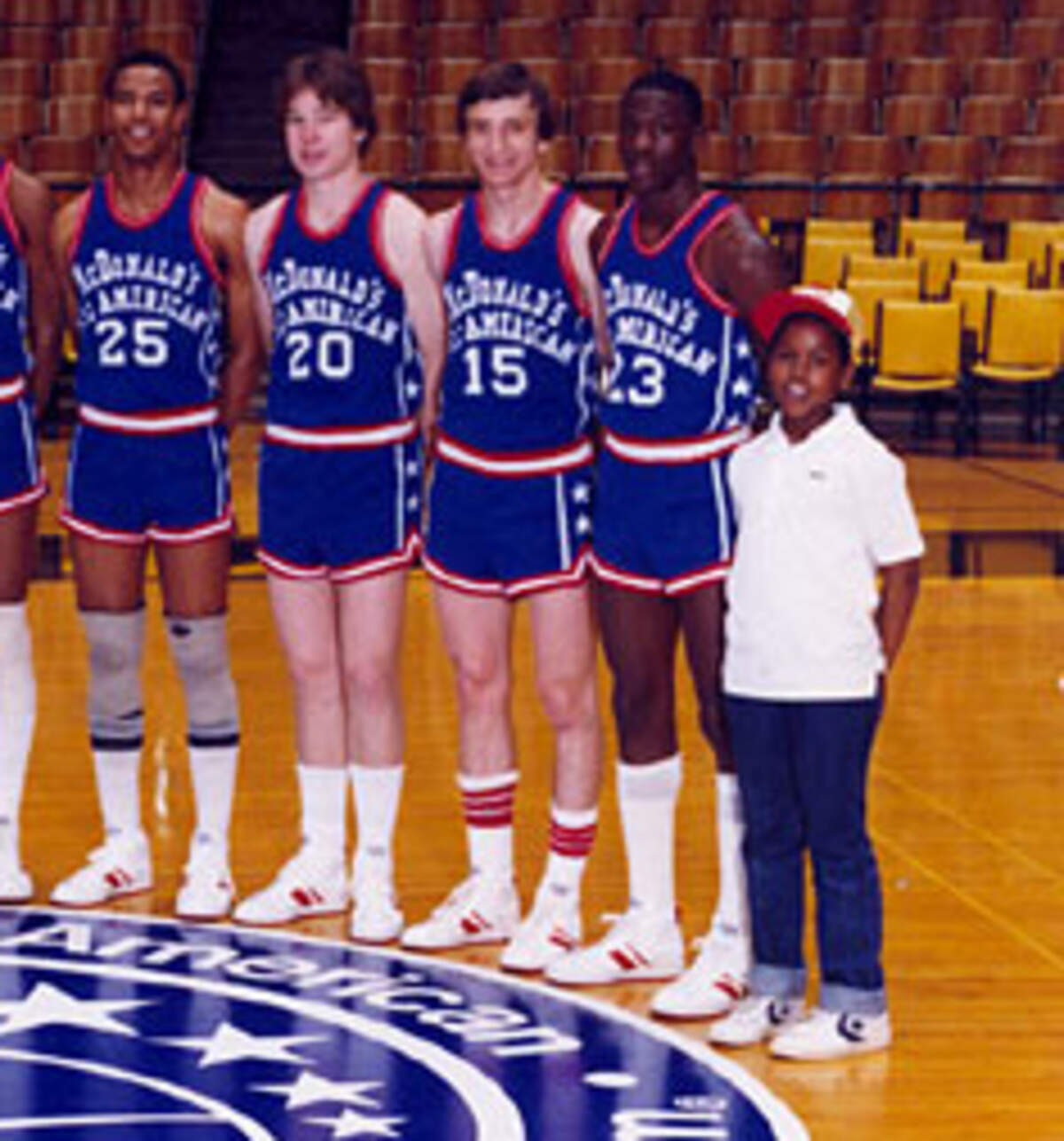
Mike Jarvis II (East team’s 12-year-old assistant coach): Michael was obviously an incredible player, but he was also super nice and really friendly. He was always with Buzz Peterson, so I was would just be sitting with those guys on the bus or hanging out with them in the hotel room or the pool. They were nice enough to let me hang out with them. I guess I didn’t bother them too much.
The day before the game, Lane, the local McDonald’s owner coordinating the week’s events, decided to host the players and families for an old-fashioned barbecue picnic outside of town. He had received major pushback about the idea from his corporate bosses, who preferred that he treat the players to a fancy meal at a top-notch restaurant in the city. Instead, Lane shuttled the players and their families 30 minutes outside of Wichita to enjoy a sunny day at an expansive country home just east of Augusta owned by the manager of one of Lane’s McDonald’s restaurants.
Lane: When I told Corporate my idea, they immediately wanted to do something different. They didn’t think the kids were going to like that. They wanted me to take them to a fancy restaurant and feed them quiche. I told them, ‘These kids don’t want quiche.’ So I put my foot down and said, ‘I’m going to have this barbecue.’ I had a friend of mine from Ark City come up and do the barbecue pork chops and chicken. The kids ended up eating every last pork chop and chicken. Every single one of them. I mean, these are 18-, 19-year-old kids. They really like to eat. After (Corporate) heard about how big of a success it was, every McDonald’s All-American game after that had a picnic.
Lane: It was out in the country with about 300 acres of land. You had Patrick Ewing wading out into the lake trying to catch fish with his bare hands. And then we brought this stagecoach and there was Michael Jordan hanging outside of it with his feet sticking off to the side. A lot of those kids hadn’t seen anything like it before. There were points where I was like, ‘Oh my gosh, we’re going to lose these kids on a picnic.’
Star is born: a glimpse of ‘MJ’ in Wichita
Wichita was playing host to just the fourth McDonald’s All-American game, but the event had already hit the big-time. As such, it drew some of the top basketball minds from around the country. Legendary UCLA coach John Wooden was in attendance for the game in Wichita, along with assistant coaches from every major program in the country. Shore, the WSU assistant, didn’t waste the opportunity to poke fun at a Michigan State assistant coach. The year before, the Spartans had reported WSU to the NCAA for what they believed to be a recruiting violation regarding Wichita native Karl Papke, who ultimately committed to the Shockers.
Shore: So I guess on his recruiting visit to Michigan State, Karl Papke told them that going to Wichita State was worth ‘x’ amount of dollars. But all he was referring to was how much he was going to save by staying at home. So fast-forward to the day of the game, and I’m walking into the arena with a Michigan State assistant coach. Karl had just wrapped up his freshman year for us and he used to drive this old, beat-up Ford. I mean, it was really beat up. So I see it parked outside when we’re walking in and I point it out to the Michigan State coach and I said, ‘See that car right there? That’s the car we bought Papke to bring him to Wichita State.’
Shore was feeling particularly confident that day. The dream scenario he imagined a year prior when he convinced WSU to waive its standard arena fee to help bring the game to Wichita was playing out to perfection. WSU already had Dreiling, the 7-1 center from Kapaun, signed, and now the Shockers were launching an all-out campaign to make sure Sherrod stayed home, too. The Heights star had remained uncommitted through his senior season, and at the time of the game (April 11) he was the only All-American who had yet to sign a letter of intent. With Sherrod still undecided, WSU leveraged its platform that week to give him a preview of what life as a Shocker could be. WSU fans knew what was at stake and delivered a special atmosphere for Sherrod that evening.
Potash (freelance journalist): It was close to a full house and the crowd was absolutely electric. But they weren’t stoked to see Michael Jordan. They were stoked to see Aubrey Sherrod.
Lutz: Aubrey was a phenomenal shooter and he was so smooth. At one point, he was regarded as a better college prospect than Michael Jordan.
Sherrod: I was the only guy who at that point had not decided on my college. I was down to Kansas State, Wichita State and Notre Dame.
Shore: You’ve got to remember, everybody thought Aubrey Sherrod was going to K-State, including us. We really thought he was going to Kansas State.
Kenton Richards (fan, Newton High junior): I remember Aubrey Sherrod had not committed yet, so a lot of people in the Wichita area wanted to make a good showing for him and impress him. Everybody was hoping he would stay home and play for the Shockers.
Van Williams (fan, Curtis Middle School): Back then, for Wichita kids, Aubrey Sherrod was the man. Even though we were going to Southeast and he was at Heights, we were big fans of him. All of the kids wanted to be like him.
David O’Brien (fan, Arkansas City High junior): I remember Aubrey Sherrod was the coolest dude on the court. He had this real distinct walk. He was just a bad-ass. He was the coolest dude ever. We were always trying to walk like Aubrey Sherrod.
Since Sherrod was the main focus for WSU that week, the host school had rolled out the red carpet for the West team and whatever was left over was given to the East team. East coach Jarvis, who later coached 18 seasons at the Division I level, remembers being perturbed by the preferential treatment. Jarvis was the coach of the No. 1 recruit in the country, Ewing, at Cambridge Ridge and Latin in Massachusetts, and Ewing, who still made the trip to Wichita, had exhausted his all-star eligibility by playing in two previous games. Without Ewing, the East had just one player taller than 6-8 ... while the West squad featured six players 6-9 or taller.
Jarvis: There was no question we were the underdog team. They were so much bigger than us. And they were getting all of the preferential treatment. I could tell even before the game. They rode in on a coach bus. We rode in on a school bus. They had the young, pretty, in-shape, in-uniform cheerleaders. Our group was quite the opposite. Everything was geared toward the West team, but the one thing they didn’t have and we did was Michael Jordan.
Jarvis: Patrick couldn’t play in Wichita because he had reached his limit of two all-star games. In hindsight, that was probably a blessing because I may not have really seen or appreciated the greatness of Michael Jordan.
After coaching against him in the D.C. game, Jarvis opted to start Jordan. That proved to be a wise decision, as Jordan started his scoring barrage early and it helped the East lead 21-12 after the first quarter and 49-43 at halftime. The Wichita crowd was rooting for the West team, with Sherrod and Dreiling, but those in attendance said there was still an appreciation for Jordan’s scoring prowess. An interesting side note: the halftime entertainment was a 10-year-old named Sean Miller, now the head coach at Arizona, who dazzled the crowd by dribbling eight basketballs at once and making 50 free throws in a row — so many that the teams actually had to wait for him to finish before they could come back onto the floor.
O’Brien: I think the diehards knew who Jordan was, but we knew he wasn’t the best player in the class. And then the game starts and he was immediately clear he was the best player on the court. We’re like, ‘Goddamn, why isn’t he the No. 1 guy?’
Sherrod: Michael stole the show. Once he got going, he was extremely difficult to stop. His mid-range game was so good. He was just elevating and shooting over people. No one could stop him.
Jim Yerkovich (West team coach): I tried to put the best athlete I could on him, but there was no question he was the best athlete. The guy who guarded him probably the best was (UNLV signee) Dwayne Polee, but there wasn’t really anyone who could guard him. Jordan just put on a show. He played an unbelievable game.
Jarvis: During the second quarter, my son came to me and said, ‘Hey dad, are you going to get him out of the game?’ I said, ‘Who are you talking about?’ He said, ‘Adrian. He’s not playing any defense.’ And I said, ‘You’re right,’ and I took him out of the game. I’m pretty sure (Maryland signee) Adrian Branch had never been subbed out of a game like that before. He was very angry and went down to the end of the bench. So my 12-year-old assistant got up out of his seat and went down and kneeled in front of him and looked him in the eyes and said, ‘If you don’t play defense, my daddy isn’t going to put you back in the game.’ That was the moment that I knew my son was a coach.
Mike Jarvis II: I couldn’t even do that now (as a coach). But I said, ‘Adrian, we’re here to win and we need you to start playing some defense.’ And after that, he started playing defense.
The second half of the game proved to be a thriller, with the final quarter becoming a battle between Sherrod and Jordan. The Wichita native stroked in a jumper with his sweet release only for Jordan to answer back with a slice to the basket and finish to extend the East’s advantage. In the final minute, Sherrod finally put the West ahead with a jumper. The West led 95-94 with just 22 seconds left, but Jordan responded by drawing a foul and sinking the game-tying and winning free throws with 11 seconds remaining. The West had one last chance, but Oral Roberts pledge Mark Acres missed a free throw. The 96-95 win by the East lived up to its billing as a spectacular game packed with spectacular talent: 14 of the 25 players in Wichita went on to play in the NBA, and three are now Hall of Famers: Jordan, Ewing and Mullin.
Jarvis: This was the first time Michael showed us what he ended up making a whole career out of: With the game on the line, he wanted the ball, to take over, and he did something with it. If I could ever get a copy of that game, boy, would I love to go back and watch him down the stretch. In a game full of legitimate, bonafide All-Americans playing their hearts out ... remember, this was an all-star game where they actually played defense and everybody wanted to win. It was a real game and Michael would not be denied. He could not be stopped.
Peterson: I knew if we wanted to win the game, I better get the ball to Michael. And he delivered.
Richards: It looked like Jordan could just turn it off and on whenever he wanted. Once the game got tight down the stretch, he took over. He probably could have scored 60 points if he would have been selfish and tried to score as many as he could. Even with all of those great players, you could tell he was head and shoulders above everybody else.
Gray: It’s cool to think about all these years later that I was there to see him first take off. I think what that game in Wichita did for him was prove that he did belong, that he was that good. I’m sure he left there thinking, ‘These guys can’t handle me.’ And from that point on, he went on a trajectory that not many players have ever been on.
Jarvis: When I got home and talked to my high school team, I told them about Michael and said, ‘I was in the presence of future greatness.’ And then the next year we went to see Michael play against Patrick in the (UNC-Georgetown) national-championship game and saw Michael hit the game-winning shot, and then my guys knew what I was talking about.
Yerkovich: It was so special because there was so much talent, so much greatness, so much potential on the court. It’s a memory that ranks up there. I was lucky enough to have a very good high school career (winning three Utah state titles at Judge Memorial in Salt Lake City) . I brought my assistant, Sonny Tangaro, and we were sitting there after the game and I turned to him and said, ‘Sonny, we’re never going to see a game like that again. We’ll never play against a guy as good as that ever again.’
Lane: We couldn’t have scripted it any better. There was so much talent out there. Afterward, I was just kind of in awe. ‘Look at what we brought to Wichita, Kansas.’ I don’t think anybody fully realized just how special that game would become.
Another person who felt the game followed a perfect script was Shore, the WSU assistant who desperately wanted to see Sherrod play well so the fans could shower him in praise. After being named MVP of the D.C. game, Sherrod scored a team-high 24 points in Wichita to win MVP honors for the West squad. And sure enough, not long after, Sherrod ended up signing with WSU, where he enjoyed a standout career for the Shockers from 1981-85. Shore and Sherrod stay in touch to this day.
Shore: It was a great day for Wichita State fans and it was a great day for just basketball fans in Wichita. Aubrey didn’t disappoint. I still remember the cheers. When Levitt Arena (now Koch Arena) was full and the players come out of that tunnel, I still get chills to this day. I haven’t been back to Wichita in 25 years, but I still get chills.
Sherrod: Absolutely, (the game) made an impact. Before, I knew I had support at the high school level playing at Heights, but I found out when you play for the university in town, it’s a different type of support. I really felt the love that night. Coach Shore and Coach Smithson were instrumental in helping me make that final decision and honestly, in the end, it was really based on my family and me wanting to play in my hometown.
Shore: I’ll never forget when we got that phone call from Aubrey. I was just ecstatic.
Shore: Aubrey Sherrod was one of the great pure shooters that ever played the game. Had there been a three-point line at that time, he probably would have scored who knows how many more points in his career. Aubrey was as good of a two-guard that ever played the college game. Even better, he’s a Wichita kid who is still in Wichita.
The best MJ grudge you’ve never heard about
After Jordan had come through in the clutch and made 13 of 19 shots to score 30 points and break the game’s scoring record, which would stand for another 18 years, it seemed like the MVP voting for the East team was a foregone conclusion. But in stunning fashion, the MVP was instead awarded to Branch, the Maryland recruit who’d scored 24 points. Nearly four decades later, some still note the fact that the three-person voting panel for the award just so happened to include Branch’s high school coach, Morgan Wootten, along with Wooden and Philadelphia hoops legend Sonny Hill.
Lane: I think the voters were a little bit political. I don’t think that was justifiable. Michael should have won it.
Jarvis: I remember Michael looking at me after they announced the MVP, and it was almost like I could see him saying in his head, ‘Oh well, I’ll show them.’ Adrian played a great game as well, but there’s no doubt Michael should have won the MVP.
Billy Packer (CBS television analyst): Of course when they announced that the most valuable player wasn’t Michael, it was astonishing. It turned out to be Adrian Branch, who had played high school for Morgan Wootten. I know Morgan’s integrity and Coach Wooden’s, as well. They obviously saw something I didn’t particularly see in the game. But I don’t think either one of them would have stooped to, ‘I’m going to pick my player no matter what.’ Adrian played fairly well, too, but not as well as Michael did. (from Michael Jordan: The Life, 2014)
Peterson: He (Jordan) was never going to let you know it, but knowing him, I’m sure that was eating him up on the inside. He kept that moment in the back of his mind, and when it came time to show who was better the next time, he was going to go all-out and show it on the floor. That was the thing about Michael: He always let his actions speak for him.
Branch: In the game in D.C., I only had (nine) points. I was frustrated with my performance. So when the McDonald’s game came around, I said, ‘I’m going to show these dudes I can play.’ I came off the bench and had 24 points, which was my (jersey) number. Michael Jordan had 30 points, but a lot of those were (from cherry-picking). We did the dirty work and threw it out to him, and he got a lot of layups and dunks. I just went to work and got that MVP. Mike was really ticked off about it, and back then I enjoyed ticking him off. (US Prep Athletes Magazine, 2015)
Jarvis: I remember we were in the elevator after the game with my son and we’re going up to our hotel room, and on the elevator was Michael Jordan’s parents and Billy Packer. I’ll never forget it. Mrs. Jordan turns to Billy and says, ‘Michael never gets any credit.’
Packer: I was kidding with her and said to her, ‘Don’t be so upset about this game. Michael’s going to be an outstanding player and he’s going to play for a great coach at North Carolina. Someday you’ll forget this night he didn’t get the MVP.’
While that memory may have faded for Mrs. Jordan, Michael never forgot the MVP snub in Wichita, and never forgot the name Adrian Branch. After the game, Jordan was quoted by The Wichita Eagle as saying, “That’s all right. I thought Branch played pretty good. I thought he deserved it.” But internally, Jordan was already preparing to wage war with Branch as the two headed off to rival ACC schools. For three years in college, Jordan’s UNC teams won five of six meetings against Branch’s Terrapins even as the Tar Heels won the conference title all three years.
Peterson: I knew from that moment on, every time we played Maryland he was going to put it on Adrian Branch. Every time we were about to play Maryland, all I had to do to get him going to was to say, ‘Wichita.’ He knew exactly what I was talking about.
Peterson: You see this dunk all the time nowadays, but it was that cradle dunk where he rocked it from the side. It wasn’t a coincidence that happened against Maryland. Michael asked (Tar Heels) Coach (Dean) Smith if he could do that dunk if he was open all by himself, and Coach told him, ‘Alright,’ but he thought it was showing off. So when Michael got that steal late in the game against Maryland, he just rocked that thing. I bet if you ask him about it today, he would tell you he couldn’t have picked a better time and opponent for that dunk to come against.
Ironically, four years after Jordan’s MVP snub in Wichita, the Chicago Bulls selected both of the 1981 McDonald’s game’s MVPs — Branch and Sherrod — in the second round of the 1985 NBA Draft. While Branch remained standoffish with Jordan, Sherrod had by then developed a friendship with Jordan.
Branch: I was a different type of dude. I was wired, even more than now. I was like, ‘Michael Jordan? Whatever, he’s a sucker.’ To me, basketball was like prize-fighting. (from the Gunnison Country Times, 2018)
Sherrod: He would come up to my hotel room and hang out. We knew each other from the all-star games and he had nicknamed me ‘Lefty.’ Back then, Michael was only in his second year in the league, so we could still go out and do normal things with him. We would go to breakfast and stuff like that. Then he got bigger and couldn’t do those things anymore. But it was cool to have that friendship with him.
Neither Sherrod nor Branch ever played in a regular-season game for the Bulls. In fact, Branch was cut before Chicago’s first preseason game because of his ongoing feud with Jordan. Meanwhile, Sherrod made it through the entire preseason before being released three days before the start of the NBA season in 1985.
Sherrod: We had just got back from our last preseason game and we were in the airport talking about practice and getting our bags. Then (Bulls coach) Stan Albeck comes over and talked to me and told me it was a numbers game and they had to let me go. It was crushing at the time because I felt like I had done enough to make the squad. But management had a different idea. I thanked them for the opportunity and went back to my hotel room and had to come up with a new plan.
But feuds with Michael Jordan don’t simply end after a couple of years. With Jordan, who’s notorious for holding grudges, they can last for life, as Branch can attest. After his playing career ended, Branch transitioned to doing color commentary for basketball games on television. In 2006, he was entering his third season as the color analyst for the Charlotte Bobcats. That same year, Jordan became a minority owner of the Bobcats. At the end of that season, Branch was informed he was being fired. Twenty-five years after the Wichita snub, Jordan still remembered.
Branch: Jordan came in and had an old ax to grind because I got the MVP trophy over him in the McDonald’s All-American game. Plus, when we were on the bus in Wichita with Chris Mullin and Patrick Ewing, I was making fun of him and my jokes were working that day. Jordan never forgot that and fired me when he became my boss. (Gunnison Country Times, 2018)
Potash (the freelance journalist): I’ve always wondered why (Jordan) never mentioned that game in his Hall of Fame speech. He basically torched every person who ever slighted him. Anybody who had ever dismissed him or disrespected him. I felt like that was one of the first times he had been disrespected. He was clearly the best player in the game, yet they gave the MVP to Adrian Branch. I still don’t understand why Jordan did not remember that in his Hall of Fame speech.
This story was originally published April 27, 2020 at 5:00 AM.
.jpg)