
Finding WSU’s doppelganger: What fans can expect for this year’s ceiling ... and floor
Gregg Marshall is attempting a reloading job this season at Wichita State that no college basketball coach has been able to pull off in the last 16 years.
By now, you’ve probably seen the number 11.2. That’s the percentage of minutes returning from the Shockers’ 25-win team last season.
It’s an important number because no team has made the NCAA Tournament with that few minutes returning since kenpom.com started in the 2002-03 season. That may be tough to comprehend for a program that has played in the last seven NCAA Tournaments and won at least 25 games for the last nine seasons.
So what are realistic expectations this season for the Shockers?
Chasing that answer inspired me to research teams from the last decade that have faced a challenge similar to WSU entering the 2018-19 season. To be considered, teams had to check the following three things off: play in a top-seven conference, be coming off at least a 20-win season, and return less than 20 percent of its minutes.
Along the way, I discovered a handful of teams that mirror WSU in some ways. I even talked to a coach (who now is Marshall’s peer in the American Athletic Conference) who has experience trying to reload the way Marshall will try this season.
What the past decade says WSU’s target should be
There have been 18 teams in the last decade to fit the three criteria: play in a top-seven conference, be coming off at least a 20-win season, and return less than 20 percent of its minutes.
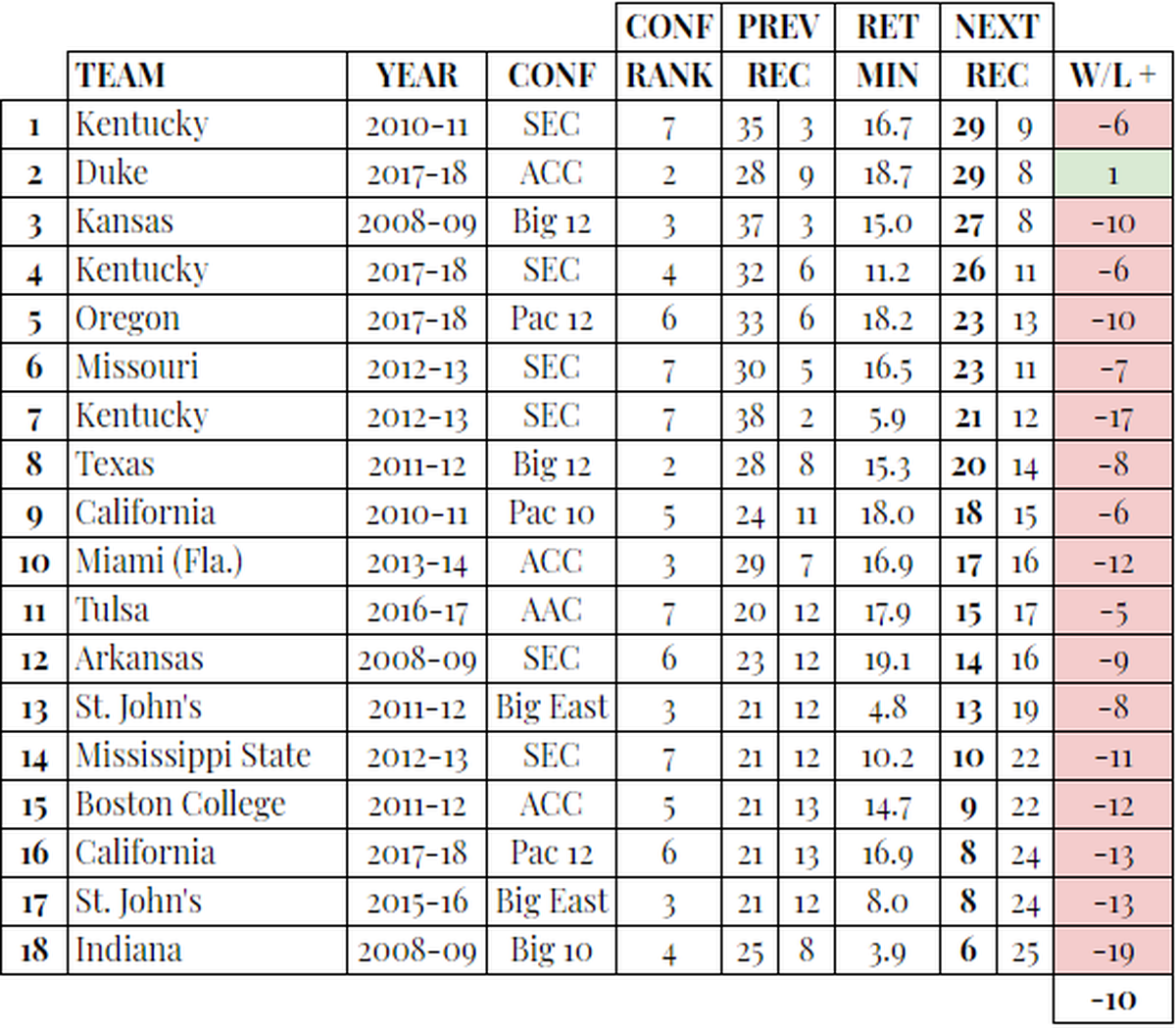
Almost every team struggled with its inexperience the next season, as 17 of those 18 teams lost at least five more games the following season and won an average of 18 games. There were eight teams that still won at least 20 games again and six returned to the NCAA Tournament.
But take a look at the six NCAA tournament teams: 2011 Kentucky, 2018 Duke, 2009 Kansas, 2018 Kentucky, 2013 Missouri and 2012 Texas. All six teams either brought in blue-chip recruits or multiple transfers to reload, while neither of those routes were an option for WSU.
And sometimes blue-chip recruits and multiple transfers still aren’t enough. Take the 2018 Oregon (23-13) and 2013 Kentucky (21-12) teams as examples. They both won 20-plus games, but missed the NCAA Tournament.
WSU doesn’t have any top-150 recruits and it might not have West Virginia transfer Teddy Allen available. That’s why the 18-win mark is a reasonable goal for the Shockers, which would look something like an 8-4 record in the non-conference and a 10-8 record in the American Athletic Conference.
Winning 18 games would likely end WSU’s NCAA Tournament streak, but it would also mean the Shockers achieved more than similar teams in their situation. If you remove the blue bloods (Kentucky, Duke and KU) from the equation, then the remaining 13 teams have won an average of 14 games.
Trying to pinpoint WSU’s exact doppelganger
There’s no team that exactly mirrors WSU, but the transition between the 2008 and 2009 seasons at Arkansas comes close.
In 2007-08, Arkansas won 23 games and made the NCAA Tournament with six seniors and a sophomore point guard about to turn pro in Patrick Beverley. Sound familiar?
The Razorbacks even played six freshmen in their rotation the next season, but five of those players were top-150 recruits. Even then, Arkansas went 14-16 and lost 14 of 16 games in SEC play.
Another similar situation came at Miami in 2013 and 2014.
The Hurricanes won 29 games in 2012-13, finished as the No. 13 team in KenPom and earned a No. 2 seed in the NCAA Tournament behind five seniors and a sophomore point guard and future pro in Shake Larkin. So far, so good.
Here’s where Miami’s situation slightly differs: After losing six of its top seven players, Miami reloaded with a redshirt senior, a grad transfer and two highly-touted recruits. Even then, Miami finished 17-16 and 7-11 in ACC play.
Oregon lost seven of its top seven of eight players from its 2017 Final Four team, but reloaded with three transfers and four top-150 recruits and still missed the NCAA Tournament with a 23-13 record. Texas played six freshmen after its 28-win 2011 season, but four of those recruits were top-100 and the Longhorns barely made the tournament as an 11 seed with 20 wins.
But all of my research actually led me to seek out a coach, not a team. And he just so happened to be a peer of Marshall’s in the American.
Establishing WSU’s ceiling and floor
Frank Haith has actually tried to reload in similar situations as WSU at two different schools in the last decade. His teams may be a good outline for what WSU’s ceiling and floor could be this season.
In his first season at Missouri (2012-13), he inherited a 30-win team that returned one player from its rotation. Though Missouri reloaded differently, the Tigers were still able to go 23-11 and get back to the NCAA Tournament playing a new cast.
WSU’s floor could be look like Haith’s 2017 season at Tulsa. The year before, he played seven seniors, won 20 games and made the NCAA Tournament. But with so many new players, the Golden Hurricane struggled in AAC play and finished 15-17.
“It was almost like we had to teach them everything all over again,” Haith said. “The biggest thing is the new guys don’t know how to win yet. It took some time to get them to completely buy into their roles and understand how we needed them to play. In college basketball, there’s no substitute for having experience.”
Tulsa lost to Jacksonville State and Little Rock in non-conference play in its rebuilding season. But when conference play began, Tulsa started 6-2.
“There’s a trust factor and that’s something that takes time to develop,” Haith said. “Fans don’t understand how hard it is. It doesn’t just happen. That happens through practices and video work and individual time. We weren’t very good early on, but once guys build that trust then things got better.
“I would tell the Wichita State fan base to be patient with the process and trust coach Marshall. It’s going to take some time to get them to play the way he wants. It took us awhile.”
Haith said it was crucial on his Missouri team that made it back to the NCAA Tournament for the team’s lone returning player, Phil Pressey, to not only be the team’s best player but it’s leader.
“One of the biggest things is finding leadership,” Haith said. “Who’s going to carry the voice of the coach in the locker room? That takes time to get that figured out. (WSU senior Markis) McDuffie has been a part of a lot of winning there, so he has a voice. He has a presence in that locker room. I don’t think we could have done what we did without Phil completely buying in and understanding his role carrying that kind of weight.”
Few coaches have been able to overcome that inexperience, at least right away, with success. But as Haith points out, not many of those coaches have the credentials of Marshall.
“Our goal never changed and I’m sure Gregg’s goal will never change,” Haith said. “He’s done this before and he’s been a consistent winner wherever he’s been. I have no doubt he will continue to get them right where they need to be by the time conference play starts.”
This story was originally published November 3, 2018 at 6:48 PM.